Data verified as at 26 Sep 2026 | Life Insurance | 8 min read
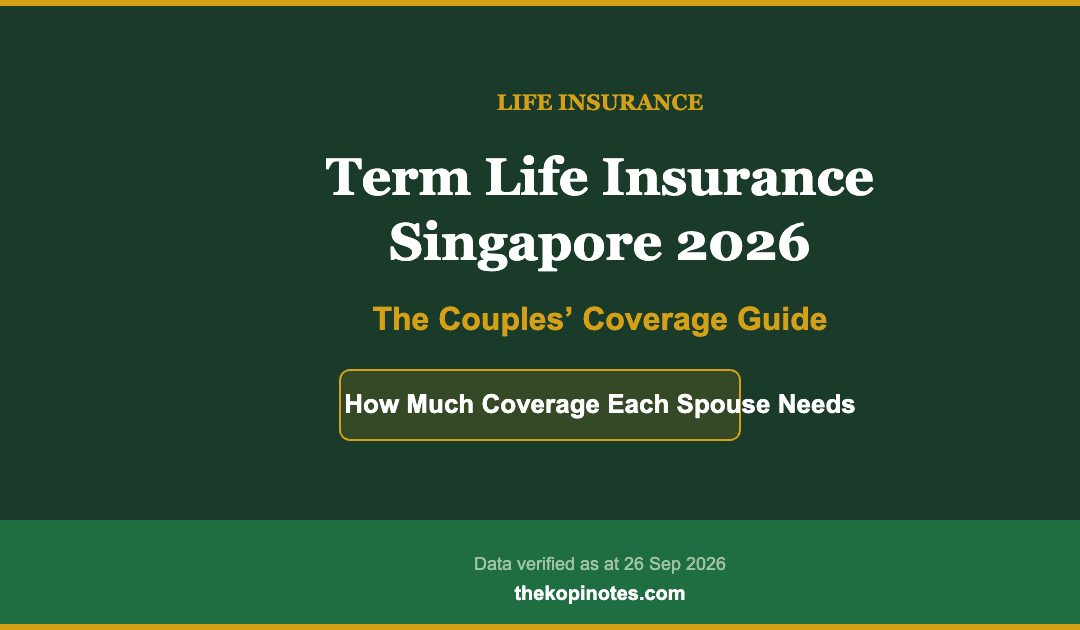
Term Life Insurance Singapore 2026: The Couples’ Coverage Guide
Most Singapore couples buy term life insurance individually — different policies, different insurers, different review dates. The problem is that a couple’s financial exposure is a single unit. When one spouse is underinsured, the household is underinsured. This guide shows how to structure coverage as a team, not as two individuals who happen to share a mortgage.
Important: This article is educational and does not constitute financial advice. Consult a licensed financial adviser before purchasing any insurance policy.
Why Couples Need a Joint Coverage Strategy
When one spouse passes away, the surviving partner faces three simultaneous financial pressures: the loss of an income stream, the continuation of fixed expenses (mortgage, utilities, children’s education), and the cost of filling service gaps (childcare, eldercare, household management). A policy sized only for the deceased’s individual needs often leaves these gaps unaddressed.
The standard mistake is for each spouse to buy coverage in isolation. Partner A gets S$500,000 of cover; Partner B gets S$300,000. But the combined household liability — mortgage, projected income loss, children’s education costs — could be S$1.4 million or more. The gap only becomes visible when it is too late to close it.
A joint strategy means calculating household exposure first, then allocating coverage to each person based on their actual income contribution, debt exposure, and dependency obligations.
The LIA Income Replacement Framework
The Life Insurance Association Singapore (LIA) Protection Gap Study uses income multiples to estimate adequate coverage. The multiplier ranges from 5× to 10× annual income depending on household obligations, with outstanding debts added on top.
For most Singapore couples in their 30s, the framework produces estimates like the following:
| Coverage Component | Basis | Example (S$80K earner, dual-income, 2 kids) |
|---|---|---|
| Income replacement | 8× annual income | S$640,000 |
| Mortgage share | 50% of outstanding balance | S$300,000 |
| Children’s education reserve | Estimated cost | S$120,000 |
| Total coverage indicated | S$1,060,000 |
Illustrative only. Consult a licensed financial adviser for a calculation specific to your household.
Coverage Needs by Household Type
Household type is the single biggest driver of how coverage should be split between spouses. The table below provides indicative ranges based on common Singapore household profiles.
| Household Type | Primary Earner | Secondary/Non-Earner | Key Consideration |
|---|---|---|---|
| Dual-income, no children | 5×–7× | 5×–6× | Mortgage share per spouse |
| Dual-income, with children | 8×–10× | 6×–8× | Add education costs and childcare |
| Single-income, stay-at-home spouse | 10×–12× | S$300K–S$500K min | Non-earner covers childcare replacement |
| Single-income, large mortgage, young kids | 12×–15× | S$400K–S$600K min | Highest gap risk; review annually |
Indicative ranges based on LIA methodology. Individual circumstances vary. Always seek personalised advice.
The most common mistake is for the non-earning or lower-earning spouse to carry insufficient coverage. A stay-at-home parent who passes away leaves behind childcare costs and household management gaps that the surviving employed spouse cannot fill through income alone. S$300,000 to S$500,000 of term cover for a non-earning spouse in a family with two young children is a reasonable starting point, not a ceiling.
The Mortgage Protection Layer
A Singapore HDB or private property mortgage is typically the largest shared liability a couple carries. When one spouse passes away, the mortgage does not pause. The surviving spouse must either continue servicing the debt on a single income or sell the property — often at the worst possible time.
The most practical approach is for each spouse to hold at least enough term cover to clear their proportional share of the outstanding mortgage balance. In a 50/50 contribution household, that means each spouse’s policy should cover at least 50% of the outstanding loan at any given point.
For a couple who took on a 25-year mortgage at S$700,000, the outstanding balance at year 10 would be approximately S$520,000 (at 3% p.a.). Each spouse’s mortgage protection layer in that scenario should be at least S$260,000 — separate from the income replacement component above.
CPF nomination plays a role here too. CPF savings, including those used for the mortgage, follow CPF nomination rules — not your insurance policy. Make sure your CPF nomination and insurance beneficiary designations are aligned and reviewed together.
Q4 2026 Premium Comparison for Couples
For a couple both aged 35 and non-smokers buying S$500,000 of 30-year level term cover each, the combined annual outlay varies substantially by insurer. Digital-first insurers offer meaningfully lower premiums than full-service traditional insurers, with female premiums typically running 30–35% lower than male equivalents at the same coverage level.
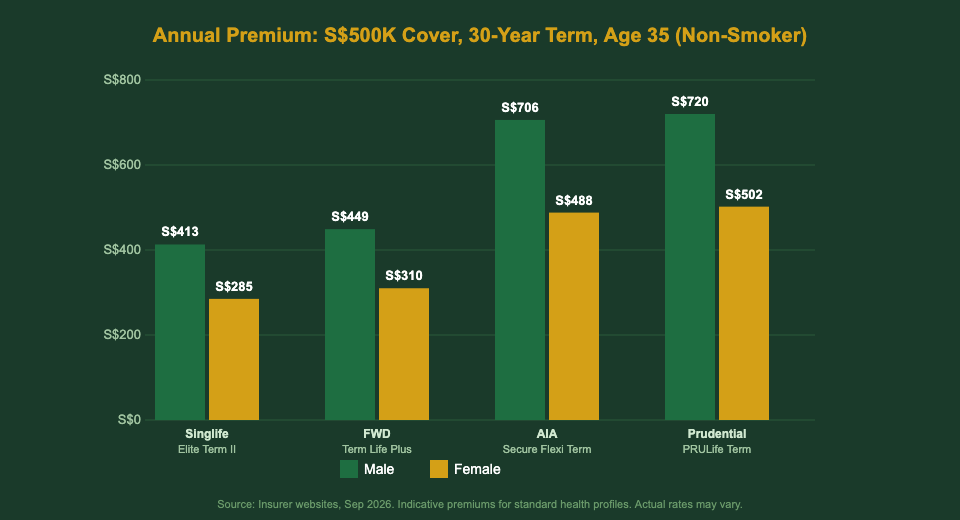
| Insurer / Plan | Male Age 35 | Female Age 35 | Combined Annual |
|---|---|---|---|
| Singlife Elite Term II | S$413 | ~S$285 | ~S$698 |
| FWD Term Life Plus | S$449 | ~S$310 | ~S$759 |
| AIA Secure Flexi Term | S$706 | ~S$488 | ~S$1,194 |
| Prudential PRULife Term | ~S$720 | ~S$502 | ~S$1,222 |
Male premiums for Singlife and FWD sourced from insurer comparison data (Sep 2026). AIA male premium from comparison sources. Female premiums and Prudential figures are indicative estimates at approximately 30–35% below male rates. All figures are for S$500,000, 30-year term, age 35, standard health profile, non-smoker. Get a direct quote as actual premiums depend on your individual health declaration and underwriting outcome.
For a couple choosing Singlife over Prudential, the annual saving is approximately S$524 — around S$15,700 over a 30-year policy term for the same S$500,000 cover per person. The case for comparing insurers before purchasing is clear.
Cross-Insurance and Beneficiary Nominations
In Singapore, a life insurance policy pays out to the nominated beneficiary. For couples, this is almost always the spouse. But two nomination structures exist under the Insurance Act, and the difference matters.
A statutory trust nomination names your spouse and/or children as beneficiaries in trust. The payout goes directly to them, bypassing your estate, which means it avoids probate delays and is protected from creditors. This is the preferred structure for most Singapore couples with dependants.
A revocable nomination is more flexible — you can change it without your beneficiary’s consent — but it does not offer the same creditor protection. For most couples who want their payout to reach their spouse and children cleanly, the statutory trust nomination is the stronger choice.
Cross-insurance does not replace proper estate planning. If you have complex assets, a professionally drafted will ensures that everything — not just the insurance payout — flows to the right people in the right proportions.
When to Review Your Coverage Together
Three triggers should prompt a joint insurance review for Singapore couples. The first is a major debt increase — a new mortgage, a refinance to a larger loan, or a significant new liability. The second is a significant income change: a promotion, a career break for a new child, or a shift from employed to self-employed. The third is any change in family structure, including the birth of a child, the passing of a parent who depended on you, or a child becoming financially independent.
The LIA Protection Gap Study (most recent edition: 2022) found that Singapore males carry an average protection gap of S$464,000. The figure for females, while historically lower, is growing as more women become primary household earners. As household costs in Singapore rise — particularly for private medical care and education — the gap tends to widen faster than existing coverage amounts catch up.
Setting a calendar review every two to three years, timed to major life milestones, is the simplest way to keep household coverage aligned with household reality. Treat it as a household financial decision, not an individual one.
Frequently Asked Questions
Can couples buy a single joint term life policy in Singapore?
Does a non-earning spouse need term life insurance?
Should couples use the same insurer for their term life policies?
How does DPS (Dependants Protection Scheme) fit into a couple's coverage plan?
What happens to term life cover when children become financially independent?
Explore More on The Kopi Notes
- Term Life Insurance Laddering: Structuring Cover Across Your Life Stages
- Best Term Life Insurance Singapore 2026: Complete Comparison Guide
- Critical Illness Insurance for Self-Employed Singaporeans 2026
- Whole Life Insurance Singapore Q4 2026: The BTIR Debate
Disclaimer: This article is for informational and educational purposes only. It does not constitute financial, legal, or investment advice. Insurance needs vary by individual circumstance. Always consult a MAS-licensed financial adviser before purchasing any insurance product. Premium figures cited are indicative and based on publicly available comparison data as at September 2026. Actual premiums depend on age, health, smoking status, and the insurer’s underwriting assessment.
Get Free Insurance Advice
Speak with a licensed insurance advisor. No obligation, no cost.
By submitting this form, you agree to our Privacy Policy.
This article was researched with the help of AI. While we strive to keep all information accurate and up to date, there may be errors. If you notice any discrepancies, please contact us.