Singapore T-Bill Rate Hits 1.92% in September 2026
What the 2026 High Means for Your Cash Strategy
The Singapore 6-month T-bill (BS26119F) cut-off yield jumped to 1.92% per annum at the September 24, 2026 auction. This is the highest level recorded in 2026 and a rise of 22 basis points from 1.70% at the previous September 10 auction. The surge is driven by a US Federal Reserve rate hike and rising global bond yields. For Singapore investors holding cash, this is the most attractive T-bill rate since early 2026.
Not financial advice. All figures are for educational reference only. Data as at September 2026 unless noted.
- Sep 24, 2026 Singapore T-bill cut-off yield: 1.92% p.a. (highest of 2026, up from 1.70%).
- Driver: US Fed rate hike (first since 2023) plus rising global bond yields.
- At 1.92%, the 6M T-bill beats SSBs (Oct 2026 Yr 1: ~1.80%) but trails best 12M FDs (~2.00-2.20%).
What Happened at the September 24, 2026 T-Bill Auction
The Monetary Authority of Singapore announced the results of the September 24, 2026 6-month T-bill auction on the same day. The cut-off yield came in at 1.92% per annum.
This is the highest cut-off yield for Singapore T-bills in all of 2026. The previous auction on September 10 came in at 1.70% — a jump of 22 basis points in just two weeks.
| Metric | Sep 24, 2026 | Sep 10, 2026 |
|---|---|---|
| Cut-off yield | 1.92% | 1.70% |
| Total applications | S$15.8 billion | S$16.6 billion |
| Competitive bids | S$14.3 billion | S$15.2 billion |
| Average bid yield | 1.69% | 1.56% |
| T-bill code | BS26119F | — |
Source: MAS, Growbeansprout.com, September 2026.
Total applications actually fell from S$16.6 billion to S$15.8 billion. Yet the yield still rose sharply. This reflects market-rate conditions rather than a demand surge — yields moved up because the underlying SGS market shifted.
If you placed a competitive bid below 1.92%, you received 100% of your T-bill allocation. If you bid at exactly 1.92%, you received a partial allotment of around 49%.
Why Did the Singapore T-Bill Rate Jump to 1.92%?
The Singapore T-bill yield does not move in isolation. It tracks global interest rate conditions, especially the US Federal Reserve.
Driver 1: The US Federal Reserve raised rates.
The US Fed hiked its benchmark rate for the first time since 2023. This was unexpected by many market participants. When the Fed hikes, US Treasury yields rise. Singapore Government Securities tend to follow the same direction.
Driver 2: Rising global bond yields.
US Treasury yields climbed, and global bond markets followed. Higher bond yields mean investors demand higher returns for short-term instruments like T-bills. This pushed the Singapore T-bill rate up by 22 basis points in a single two-week cycle.
The Singapore T-bill yield had been declining steadily through most of 2026. It started the year around 3.51% and fell as low as 1.30% in August. The recent reversal confirms a shift in direction driven by global macro forces.
You can read TKN’s earlier analysis of this trend in the 6-month T-bill Singapore rate Q4 2026 guide.
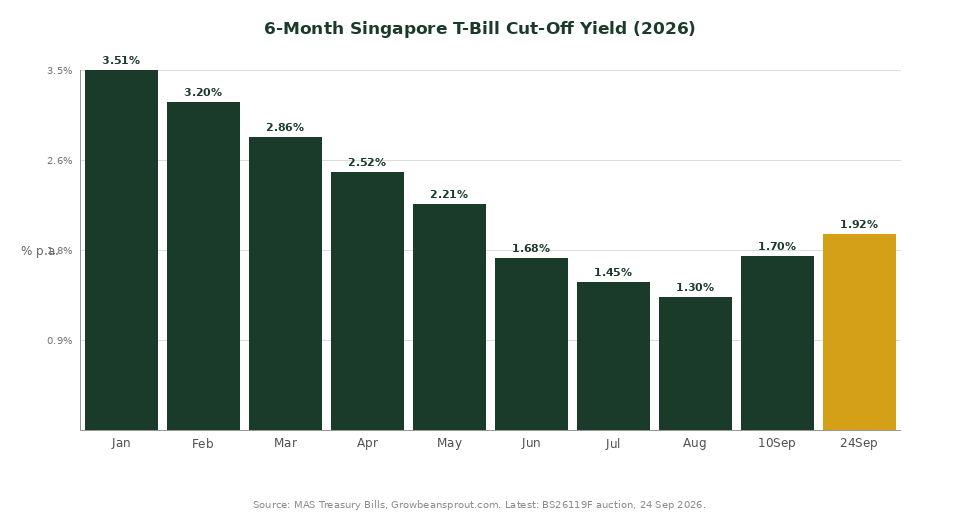
Singapore T-Bill Rate History in 2026
Here is how the 6-month T-bill cut-off yield moved through 2026. The data shows a sharp decline through mid-year, then a reversal in September.
| Period | Cut-Off Yield (p.a.) | Change vs Prior |
|---|---|---|
| January 2026 | ~3.51% | — |
| March 2026 | ~2.86% | -65bps |
| June 2026 | ~1.68% | -118bps |
| August 2026 | ~1.30% | -38bps |
| September 10, 2026 | 1.70% | +40bps |
| September 24, 2026 | 1.92% | +22bps (2026 high) |
Source: MAS Treasury Bills auction results, Growbeansprout.com. Monthly figures are approximate mid-month cuts. September figures are exact auction results.
The decline from 3.51% to 1.30% represented a near-halving of the T-bill rate through mid-2026. The recent bounce from 1.30% in August to 1.92% today is a sharp reversal. Whether it continues depends on US Fed policy over the next quarter.
For background on how Singapore T-bills work and a step-by-step application guide, see TKN's Singapore T-Bills 2026 complete guide.
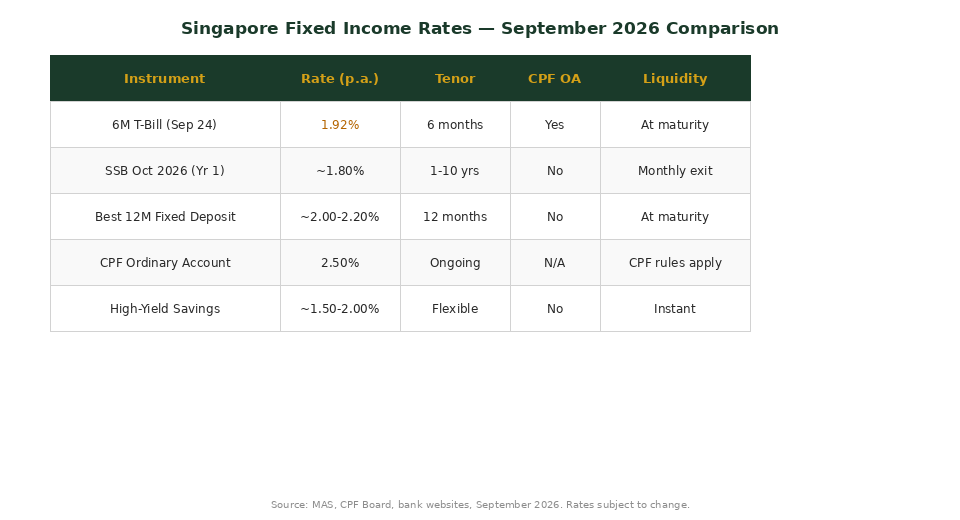
How Does 1.92% Compare to Other Singapore Fixed Income Options?
At 1.92%, the T-bill is now more competitive than it has been for months. Here is how it stacks up against alternatives available to Singapore investors in September 2026.
vs Singapore Savings Bonds (SSBs): The October 2026 SSB offers approximately 1.80% in Year 1. The T-bill beats SSBs on rate for the 6-month horizon. However, SSBs allow monthly exit with no penalty, which is useful if you need liquidity. For a detailed comparison, see TKN's Singapore Savings Bonds 2026 guide.
vs 12-Month Fixed Deposits: Some banks are offering around 2.00-2.20% p.a. for 12-month fixed deposits following the Fed hike. If you can lock in for 12 months, fixed deposits offer a slight rate advantage. The T-bill wins on shorter commitment (6 months).
vs CPF Ordinary Account: CPF OA pays 2.50% p.a., still above the current T-bill rate. If you have unused CPF OA funds, leaving them there currently earns more on a pure-rate basis. T-bills are most relevant for cash savings outside CPF.
vs High-Yield Savings Accounts: Most accounts offer 1.50-2.00% p.a. with conditions (salary credit, spend requirements). The T-bill at 1.92% is competitive and condition-free.
If you invest via Syfe for cash management or ETF portfolios, check the current promotions and use a Syfe referral code to unlock your first-deposit bonus.
For investors looking beyond short-term cash, the best S-REITs in Singapore 2026 guide covers higher-yield dividend investments for longer time horizons.
What Should You Do With the 1.92% T-Bill Rate?
Your action depends on your cash goals. Here is a simple framework:
If you want a safe, condition-free short-term return: Apply for the next T-bill auction. At 1.92%, you earn more than most savings accounts with zero bank requirements and full government backing.
If you already hold T-bills maturing soon: Rolling over is more attractive than it was in August. The rate climbed from 1.30% to 1.92% in less than six weeks. TKN covered the roll-over framework in the article T-Bill Singapore September 2026: Roll Over or Switch to SSBs.
If you are weighing T-bills against fixed deposits: Banks typically reprice FD promotions within a week or two of a major rate move. Watch for new 12-month FD offers in early October 2026 that may push above 2.20%.
If you are planning for retirement: Short-term T-bills should be part of a broader strategy, not your only vehicle. Use TKN's Singapore retirement planning calculator to model how consistent short-term investing contributes to your long-term savings goal.
Check the MAS bonds and bills page for the exact auction calendar and to apply.
How to Apply for Singapore T-Bills
Applying for Singapore T-bills is straightforward. Here are the three main routes:
Via DBS, OCBC, or UOB internet banking: Log in, go to Investments, then find Singapore Government Securities or Treasury Bills. You can apply using cash or CPF OA funds through CPFIS.
Via CDP (Central Depository): Apply through ATM or online if you have a CDP account. Applications are linked to your designated bank account.
Via brokerage platforms: FSMOne offers T-bill access. If you are opening a new FSMOne account, use the FSMOne referral code to get a sign-up bonus. For S-REIT ETF investing via FSMOne, see TKN's Singapore REIT ETF guide.
The minimum application amount is S$1,000. Non-competitive bids are fully allotted at the cut-off rate and are the default choice for most retail investors — you do not need to guess where the yield lands.
Frequently Asked Questions
What is the Singapore T-bill rate for September 2026?
Why did the Singapore T-bill yield jump to 1.92% in September 2026?
How does the 1.92% T-bill rate compare to SSBs and fixed deposits?
Is the Singapore T-bill rate likely to go higher?
Can I use CPF OA savings to invest in T-bills?
How do I apply for the next Singapore T-bill auction?
What was the lowest Singapore T-bill rate in 2026?
This article was researched with the help of AI. While we strive to keep all information accurate and up to date, there may be errors. If you notice any discrepancies, please contact us.