Mapletree Logistics Trust (M44U) Gearing & Debt Maturity 2026: Is MLT Built for Higher-for-Longer Rates?
A deep dive into MLT’s balance sheet — gearing ratio, debt maturity profile, interest rate sensitivity, and what it all means for your DPU in 2026.
Mapletree Logistics Trust (SGX: M44U) carries an aggregate leverage of approximately 39.1% as at 1H FY2026 — well below the MAS cap of 50%, but rising steadily since 2023. With the Fed’s September 2026 rate hike pushing borrowing costs higher, the question every unitholder is asking is the same: does MLT’s debt maturity profile give you enough cushion to sleep at night? This article breaks down the numbers.
Not financial advice. All figures are for educational reference only. Data as at September 2026 unless noted.
- MLT gearing sits at ~39%, below the 50% MAS cap but trending higher
- About 74% of MLT debt is fixed-rate, limiting immediate DPU damage from rate hikes
- 11% of debt matures in 2026 — near-term refinancing at elevated rates is the main risk
MLT at a Glance
Mapletree Logistics Trust is one of Asia-Pacific’s largest pure-play logistics REITs. It owns and manages a portfolio of modern warehouses and distribution facilities across 9 countries, including Singapore, Australia, China, Japan, Hong Kong, South Korea, Malaysia, Vietnam, and India. The REIT is sponsored by Mapletree Investments Pte Ltd, a wholly-owned subsidiary of Temasek Holdings.
For investors focused on passive income in Singapore, MLT has historically delivered a quarterly DPU alongside a diversified geographic footprint. But after the Fed’s September 2026 rate hike, the balance sheet has come under increased scrutiny.
| Metric | Value (Q2 FY2026/27) |
|---|---|
| SGX Ticker | M44U |
| Total Portfolio Countries | 9 |
| Total Assets (est.) | SGD 14.3 billion |
| Aggregate Leverage | ~39.1% (1H FY2026) |
| Avg Cost of Debt | ~3.8% p.a. |
| Interest Coverage Ratio | ~3.2x |
| Fixed Rate Debt Proportion | ~74% |
| Annualised DPU (FY2026 est.) | SGD 0.0880 per unit |
Source: Mapletree Logistics Trust Q2 FY2026/27 Investor Presentation and Company Filings, September 2026.
What Is Gearing and Why It Matters for S-REIT Investors
Gearing — formally called aggregate leverage — measures total debt as a percentage of total assets. For S-REITs, MAS sets the regulatory cap at 50%. This cap exists to prevent excessive risk-taking that could leave unitholders exposed during a downturn.
Here is why gearing matters to you directly. A higher gearing ratio means more interest expense, which eats into distributable income and, ultimately, your DPU. When interest rates rise, highly geared REITs take a harder hit because more of their income is consumed by debt servicing. On the flip side, when rates fall, high gearing amplifies DPU upside as interest costs drop faster.
The rule of thumb most experienced S-REIT investors use: below 35% is comfortable; 35-42% is manageable but worth watching; above 42% starts raising flags, especially in a high-rate environment. MLT currently sits in the middle zone — manageable, but not without risk. If you want to compare how MLT stacks up against the broader S-REIT universe, our guide to the best S-REITs in Singapore 2026 covers the sector’s full gearing landscape.
MLT Gearing History: FY2023 to Q2 FY2027
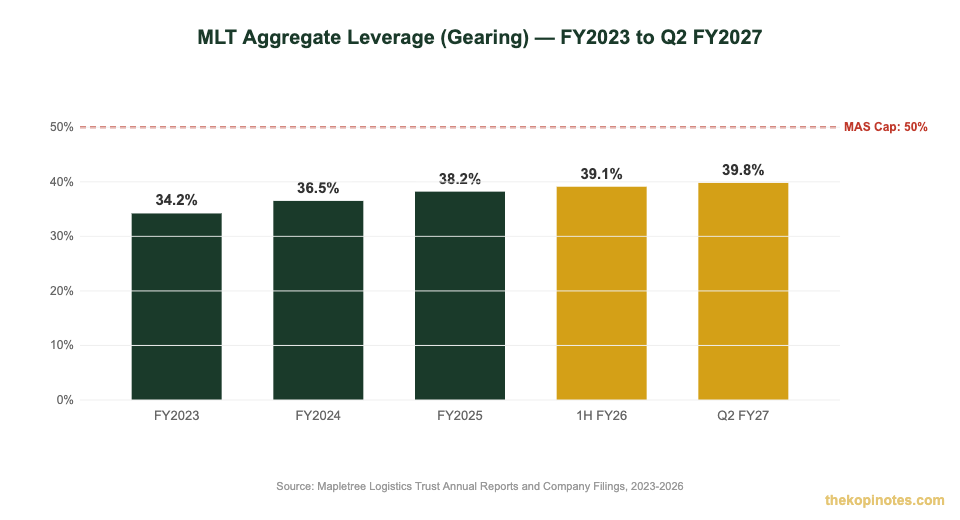
MLT’s gearing has been on a slow but consistent upward trajectory since FY2023. Three years ago, MLT was running at a comfortable 34.2%. By FY2024 that had risen to 36.5%, driven partly by acquisitions in Australia and India. FY2025 saw gearing reach 38.2% as the higher interest rate environment started feeding through into valuations — lower property values (the denominator in the gearing formula) push the ratio up even without new borrowings.
The latest figure of 39.1% as at 1H FY2026 reflects both the continued valuation headwinds and the impact of higher borrowing costs on the portfolio. Our earlier analysis of MLT’s share price after the Fed rate hike covered the immediate market reaction in detail. This article focuses on the structural balance sheet picture.
Debt Maturity Profile: How Much Matures and When
The debt maturity profile is arguably more important than the gearing headline number. Even a modestly geared REIT can face stress if a large chunk of its debt matures all at once during a period of high rates. Let us look at how MLT’s debt is spread.
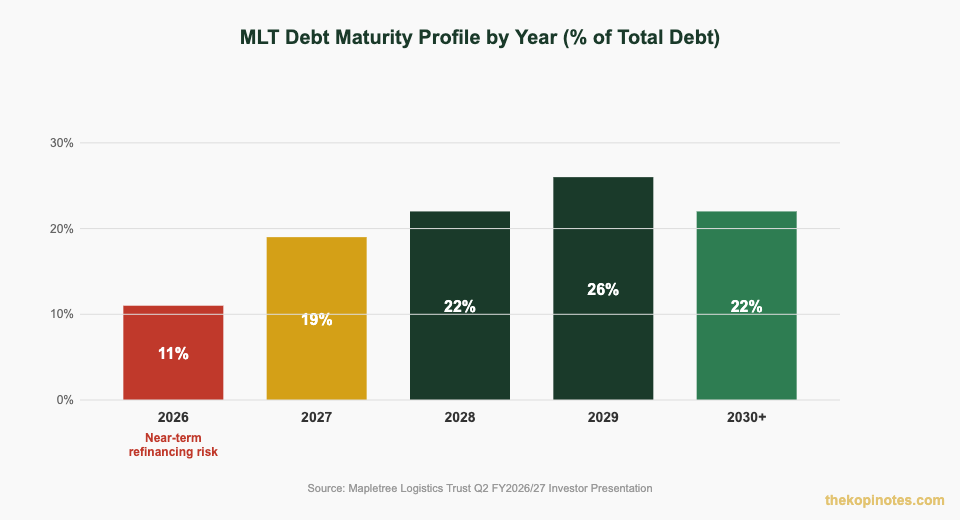
Based on MLT’s most recent company presentation, the debt maturity schedule looks like this: approximately 11% of total debt matures in 2026, 19% in 2027, 22% in 2028, 26% in 2029, and the remaining 22% in 2030 and beyond. This is a broadly well-laddered profile, which is exactly what you want to see.
| Year | % of Total Debt Maturing | Risk Level |
|---|---|---|
| 2026 | ~11% | Near-term pressure |
| 2027 | ~19% | Watch closely |
| 2028 | ~22% | Manageable |
| 2029 | ~26% | Manageable |
| 2030+ | ~22% | Long-dated comfort |
Source: Mapletree Logistics Trust Q2 FY2026/27 Investor Presentation. Figures are approximate and may differ from filed accounts.
The good news: MLT typically begins refinancing debt 12 to 18 months ahead of maturity. Much of the 2026 tranche has likely already been rolled over. The 2027 tranche (19%) is the one to watch — that refinancing will happen through 2026 into 2027, and if the Fed holds rates elevated, that tranche will lock in at higher cost than what it replaced. To understand how the Japan portfolio — a key revenue contributor — is positioned amid currency fluctuations, see our MLT Japan portfolio deep dive.
Interest Rate Sensitivity: What Every 1% Rate Rise Costs You
With roughly 26% of MLT’s debt on floating rates, a 100 basis point (1%) rise in benchmark rates adds directly to interest expense. Here is how to calculate the impact on your DPU.
MLT’s total gross debt is approximately SGD 5.6 billion. The floating rate portion is roughly SGD 1.46 billion (26%). A 1% rate rise on that floating exposure adds approximately SGD 14.6 million to annual interest costs. Spread across MLT’s approximate unit base of 6.0 billion units, that translates to a DPU reduction of about SGD 0.0024 per unit per year — or roughly 2.7% of annualised DPU.
That said, the 74% fixed-rate hedge means most of MLT’s interest cost is locked in through the relevant debt maturities. The floating rate exposure mainly comes into play during refinancing. When a fixed-rate tranche expires and is rolled over at a higher rate, the new coupon becomes effectively fixed again — just at a higher level. This is the medium-term DPU risk, not an immediate quarterly hit. For long-term retirement planning with S-REITs, run your own numbers in our Singapore retirement calculator.
Is MLT’s Balance Sheet Safe After the Rate Hike?
Four factors support MLT’s balance sheet resilience in the current environment. First, gearing at 39.1% leaves a meaningful 10.9 percentage point buffer before the MAS cap. Second, the 74% fixed-rate debt provides near-term insulation against further rate moves. Third, the interest coverage ratio of approximately 3.2x sits above the 2.5x threshold most analysts consider comfortable for investment-grade REITs. Fourth, MLT’s sponsor (Mapletree Investments, backed by Temasek) retains the ability to support the REIT via equity injections or asset sales in a stress scenario.
However, the risks deserve equal weight. The 11% of debt maturing in 2026 will refinance into a higher-rate environment. The 2027 tranche (19%) brings another refinancing round that — if rates stay elevated — will lock in higher interest costs for years. Property valuations in China and Australia have faced headwinds, which reduces the asset base in the gearing denominator and pushes the ratio higher without any new borrowings. A combination of rate hikes, valuation declines, and weaker DPU could put the 40-42% range in view within 18 months.
The bottom line: MLT’s balance sheet is structurally safe. The REIT is not at risk of breaching its MAS limit, and the laddered maturity profile prevents any single refinancing cliff. But unitholders holding for DPU income should factor in a gradual erosion of distributions — perhaps 3 to 5% over the next 12 to 18 months — as fixed-rate debt rolls over at higher cost. For context on how the broader S-REIT market is navigating this environment, the Singapore REIT ETF guide covers a diversified approach to S-REIT exposure.
Frequently Asked Questions
What is MLT's current gearing ratio?
As at 1H FY2026 (to March 2026), Mapletree Logistics Trust’s aggregate leverage stood at approximately 39.1%. This is based on total gross borrowings divided by total assets, which is the MAS-mandated calculation method for Singapore REITs. The figure is comfortably below the regulatory cap of 50%, but has been rising gradually since 2023.
What is the MAS gearing cap for S-REITs?
The Monetary Authority of Singapore (MAS) sets the aggregate leverage limit for Singapore REITs at 50% of total assets. This cap can be extended to 60% only if the REIT maintains an interest coverage ratio of at least 2.5x. Most well-managed S-REITs target a gearing range of 35-42% to leave headroom for acquisitions and to absorb property valuation declines.
How much of MLT's debt is at fixed interest rates?
Approximately 74% of MLT’s total debt is hedged at fixed rates as at Q2 FY2026/27. The remaining 26% is on floating rates, primarily linked to SORA and benchmark rates in the various countries where MLT operates. The high proportion of fixed-rate debt insulates most of MLT’s interest expense from near-term rate hikes, with the main risk coming at debt maturity and refinancing.
What happens to MLT's DPU if interest rates rise further?
A 100 basis point (1%) increase in floating rates reduces MLT’s distributable income by approximately SGD 14.6 million annually, based on the 26% floating rate exposure and estimated total debt of SGD 5.6 billion. This translates to a DPU reduction of roughly SGD 0.0024 per unit per year, or about 2.7% of the current annualised DPU. The larger medium-term risk is fixed-rate debt rolling over into higher-cost refinancings through 2027 and 2028.
How does MLT's gearing compare to other S-REITs?
At 39.1%, MLT’s gearing is broadly in line with other large diversified S-REITs. For comparison, CapitaLand Ascendas REIT and Mapletree Industrial Trust typically run in the 36-40% range, while smaller or more acquisitive REITs can push into the low-40s. MLT’s combination of 39% gearing and 74% fixed-rate debt puts it in a defensible position relative to peers, though not dramatically better than the sector average.
Should I sell MLT if interest rates stay high?
That decision depends entirely on your own financial situation, investment horizon, and income needs — this article does not constitute financial advice. From a structural standpoint, MLT’s balance sheet is not distressed. The gearing headroom, fixed-rate hedge, and sponsor support all suggest MLT can manage through a higher-for-longer environment without a rights issue or distress sale. However, unitholders should expect gradual DPU erosion of 3-5% over 12 to 18 months as debt matures and refinances at higher rates.
Build Your S-REIT Income Portfolio
Compare the top S-REITs and start investing with our referral bonuses. Use the retirement calculator to see how MLT fits your income target.
This article was researched with the help of AI. While we strive to keep all information accurate and up to date, there may be errors. If you notice any discrepancies, please contact us.