6-Month T-Bill Singapore Rate (September 2026): Why the 6M Currently Beats the 1-Year
By The Kopi Notes | Updated: September 2026
The 6-month Singapore T-bill (BS26118E) cut off at 1.70% per year in the auction on 10 September 2026 — the highest rate this year, and unusually, above the 1-year T-bill rate of 1.68%. This short-term yield inversion reflects rising domestic liquidity demand after the US Fed hiked rates by 25 basis points on 16 September. The next auction (BS26119F) is on 24 September, with applications closing 23 September at 9pm.
Not financial advice. All figures are for educational reference only. Data as at September 2026 unless noted.
- The 6-month T-bill is currently at 1.70% — slightly above the 1-year T-bill at 1.68%, which is unusual (yield inversion).
- CPF-OA at 2.50% still beats both T-bill tenors, so weigh carefully if using CPF funds.
- The Sep 24 auction is upcoming — apply via DBS/POSB, OCBC or UOB by 23 Sep, 9pm (cash); earlier for CPF/SRS.
What Is the Current 6-Month T-Bill Rate?
The most recent 6-month Singapore T-bill (BS26118E) was auctioned on 10 September 2026 and cleared at a cut-off yield of 1.70% per year. That is the highest cut-off rate for the 6-month T-bill in all of 2026.
The jump from 1.60% in the 27 August auction to 1.70% on 10 September was the biggest single-auction move this year. Two factors drove it: rising global bond yields ahead of the Fed meeting, and investors submitting bids at higher yields (the median submitted yield rose to 1.63%).
The issuance size was $8.4 billion, with total applications of $16.6 billion — giving a bid-to-cover ratio of 1.97x. Demand remains healthy but slightly softer than recent auctions.
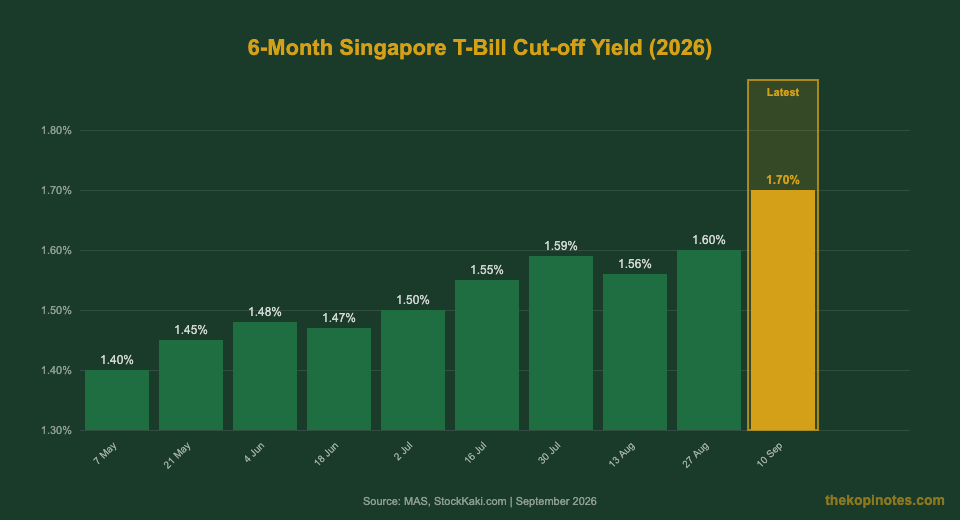
Source: MAS, StockKaki.com | September 2026. Cut-off yields for each 6-month T-bill auction, May to September 2026.
Recent 6-Month T-Bill Auction History
| Auction Date | Issue Code | Cut-off Yield | Change | Bid-to-Cover |
|---|---|---|---|---|
| 10 Sep 2026 | BS26118E | 1.70% | +0.10 | 1.97x |
| 27 Aug 2026 | BS26117D | 1.60% | +0.04 | 1.93x |
| 13 Aug 2026 | BS26116C | 1.56% | -0.03 | 2.13x |
| 30 Jul 2026 | BS26115B | 1.59% | +0.04 | 2.11x |
| 16 Jul 2026 | BS26114A | 1.55% | +0.05 | 1.82x |
Source: MAS. Cut-off yields are annualised. Bid-to-cover = total bids divided by amount offered; higher indicates stronger demand.
6M vs 1-Year T-Bill: The Unusual Yield Inversion
Something uncommon is happening in Singapore right now. The 6-month T-bill (1.70%) is yielding more than the 1-year T-bill (1.68%). Normally, you would expect a longer duration to offer a higher rate — you are locking your money away for more time, so you should be compensated more.
This short-end inversion suggests the market expects rates to plateau or edge lower over the next 12 months. The Fed just hiked once (to 3.75%-4.00%) on 16 September — but that does not automatically mean Singapore rates move in lockstep.
Singapore manages monetary policy through the Singapore dollar exchange rate, not interest rates directly. So MAS does not set the T-bill rate. It is determined by supply and demand at each auction. Right now, short-term demand for liquidity is high — investors want the safety of a 6-month T-bill without committing to a full year.
What the Inversion Means for You
If you are choosing between 6-month and 1-year T-bills right now, the math favours the 6-month by a tiny margin. But more importantly, the 6-month gives you flexibility: your money matures in March 2027, at which point you can reassess the rate environment.
A 1-year T-bill matures in late September 2027. If rates continue to rise (possible but not guaranteed), you miss out on rolling into higher rates. The Singapore T-bill laddering strategy for Q4 2026 explores this dynamic in detail — essentially, you stagger your T-bill applications across multiple auctions so you are never fully locked in.
How to Apply for the September 24 T-Bill Auction
The next 6-month T-bill auction (BS26119F) is on 24 September 2026. The T-bill issues (settles) on 29 September. Here is how to apply:
- Cash applications: Apply via DBS/POSB, OCBC or UOB internet banking or ATM. Deadline is 23 September (Wednesday) at 9pm.
- CPF-OA or CPF-SA applications: Apply through your CPF investment account, linked to one of the three banks. The CPF deadline is typically earlier — check your bank as it is usually the morning of auction day.
- SRS applications: Apply through your SRS operator bank. Deadline aligns roughly with the cash deadline.
The minimum application is S$1,000, in multiples of S$1,000. Most retail investors submit a non-competitive bid — you accept the cut-off yield as determined at auction, rather than specifying a price. This is the simplest approach and guarantees full allotment (subject to issuance limits).
You can buy T-bills with cash you have sitting in a savings account, or with CPF-OA/CPF-SA funds. For the CPF angle, read our CPF investment strategy guide — it covers when T-bills beat leaving funds in CPF-OA (hint: at 1.70%, T-bills fall short of the 2.50% CPF-OA floor).
6-Month T-Bill vs Cash Alternatives (September 2026)
The 6-month T-bill does not exist in isolation. Before applying, it is worth comparing it against the other places you could park your cash over the next 6 months.
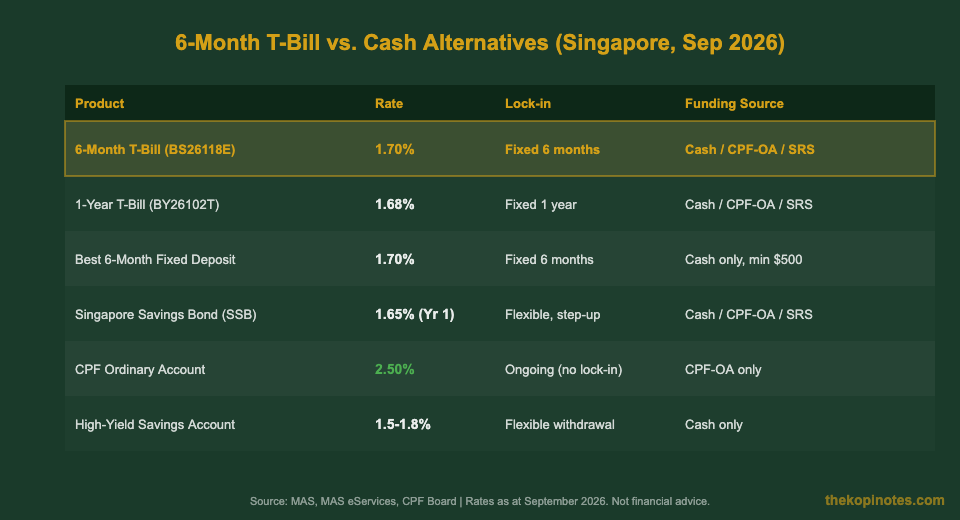
Source: MAS, CPF Board, MAS eServices | Rates as at September 2026. Not financial advice.
| Product | Rate (p.a.) | Lock-in Period | Key Consideration |
|---|---|---|---|
| 6-Month T-Bill (BS26118E) | 1.70% | 6 months | Tax-free, govt-backed, cash/CPF/SRS |
| 1-Year T-Bill (BY26102T) | 1.68% | 1 year | Slightly lower, less flexibility |
| Best 6-Month Fixed Deposit | 1.70% | 6 months | Min deposit $500, cash only |
| Singapore Savings Bond (SSB) | 1.65% (Yr 1), 2.32% avg (10Y) | Flexible redemption | Best long-term flexibility; no CPF allowed |
| CPF Ordinary Account | 2.50% | No lock-in | Beats T-bills if using CPF funds |
| High-Yield Savings Account | 1.5-1.8% | Flexible | Conditional on salary credit / spend |
Source: MAS, CPF Board, bank websites | Rates as at September 2026. CPF-OA rate is the guaranteed minimum floor.
The key insight from this table: if you are considering using CPF-OA funds to buy T-bills, you need to think carefully. The CPF-OA pays a guaranteed 2.50% per year. The 6-month T-bill pays 1.70%. That means buying T-bills with CPF-OA actually costs you money relative to leaving the funds in CPF — you are earning 80 basis points less.
T-bills with CPF-OA only made sense when rates were above 2.5% (as they were in 2023 and 2024). At current levels, CPF-OA investors should pause before applying.
For cash investors, the 6-month T-bill at 1.70% is competitive with the best fixed deposit rates and beats the SSB first-year rate of 1.65%. The advantage of T-bills over fixed deposits: they are government-backed without the SDIC $75,000 per-institution cap (though both are highly safe). The advantage of SSBs over T-bills: you can exit any month without penalty. For your longer-term savings ladder, see our Singapore Savings Bonds guide.
When the 6-Month T-Bill Makes Sense for You
Not every investor should be buying T-bills right now. Here is a quick framework to decide:
6M T-Bill is a Good Fit If…
- You have idle cash sitting in a savings account earning under 1.70%.
- You will not need that money for at least 6 months (T-bills cannot be redeemed early).
- You want a safe, government-backed return with zero credit risk.
- You are applying with SRS funds (which would otherwise earn very little in the SRS account).
6M T-Bill May NOT Be Ideal If…
- You are using CPF-OA funds — you lose 80bps vs leaving money in CPF-OA at 2.50%.
- You might need the money before March 2027 — T-bills are illiquid once issued.
- You want long-term compounding — consider the best S-REITs in Singapore 2026 for higher income potential.
- Your savings account already pays above 1.70% with conditions you can meet.
For retirement planning purposes, T-bills alone are not a complete strategy. They are a short-term parking tool. To map out your full retirement income picture, use our Singapore retirement calculator — it lets you model different return assumptions and see if your savings are on track.
If you want to grow your T-bill income over time, consider allocating part of your cash to a robo-advisor with a fixed income sleeve. Both Syfe (referral code SRPRFFFCD) and Endowus (referral code 2V343) offer bond and cash management products that complement a T-bill strategy.
For brokerage access to the broader bond market, FSMOne (referral code P0544985) gives you access to SGD bonds and SGS securities directly.
Frequently Asked Questions
What is the current 6-month T-bill interest rate in Singapore?
Is the 6-month T-bill rate higher than the 1-year T-bill rate right now?
How do I apply for the Singapore 6-month T-bill auction on 24 September?
Should I use CPF-OA funds to buy the 6-month T-bill?
Can I sell my T-bill before maturity?
How does the US Fed rate hike affect Singapore T-bill rates?
Disclaimer: This article is for educational reference only and does not constitute financial advice. T-bill rates change with every auction. Always verify the latest rates on the MAS website before making any investment decisions. Past auction yields do not guarantee future cut-off rates.
This article was researched with the help of AI. While we strive to keep all information accurate and up to date, there may be errors. If you notice any discrepancies, please contact us.