Mapletree Pan Asia Commercial Trust Share Price (SGX: N2IU): Rate Hike Impact, DPU Outlook and 2026 Deep-Dive
Post-September 2026 FOMC Rate Hike Analysis | Pan-Asia Office & Retail REIT
Table of Contents
Jump to Section
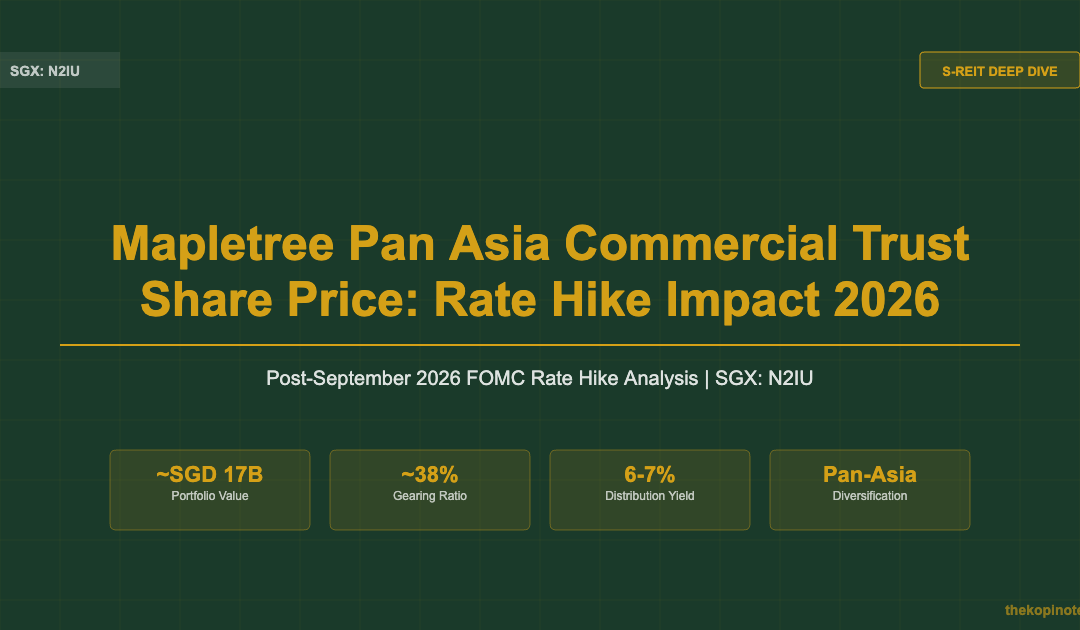
Mapletree Pan Asia Commercial Trust (SGX: N2IU) is one of Singapore’s largest diversified commercial REITs, with a portfolio spanning Singapore, Japan, South Korea, China, India, Australia, and Germany. After the US Federal Reserve raised rates by 25 basis points in September 2026, income-seeking investors are asking whether MPACT’s pan-Asia portfolio — weighted heavily toward Singapore office and retail — can sustain its distribution per unit (DPU) through a higher-for-longer rate environment. Here is what the data shows.
Not financial advice. All figures are for educational reference only and based on publicly available announcements as at September 2026 unless noted.
- MPACT holds ~SGD 17 billion in pan-Asia commercial properties, with Singapore making up about 65% of portfolio value.
- The September 2026 rate hike puts modest upward pressure on MPACT’s floating-rate debt, but the REIT’s hedging programme covers most near-term exposure.
- Distribution yield sits at roughly 6-7%, and gearing of ~38% leaves meaningful headroom below the MAS 50% limit.
What Is Mapletree Pan Asia Commercial Trust (MPACT)?
MPACT was formed in November 2022 when Mapletree Commercial Trust and Mapletree North Asia Commercial Trust merged. It is one of the largest commercial REITs listed on the Singapore Exchange (SGX). The trust invests primarily in office and retail properties across the Asia-Pacific and Europe.
The trust is managed by Mapletree Commercial Trust Management Ltd, a wholly owned subsidiary of Mapletree Investments Pte Ltd. Mapletree Investments itself is a subsidiary of Temasek Holdings, which gives MPACT a strong sponsor backing.
You can think of MPACT as owning some of Singapore’s most recognisable commercial properties — Mapletree Business City (MBC), mTower, Bank of America HarbourFront — alongside a broad international portfolio across Japan, South Korea, China, India, Australia, and Germany.
MPACT Portfolio Overview Across Asia
MPACT’s portfolio is spread across two key segments: Singapore and overseas. Singapore properties generate the bulk of net property income (NPI), while the international portfolio adds geographic diversification.
| Country | Key Properties | Portfolio Share | Asset Type |
|---|---|---|---|
| Singapore | Mapletree Business City, mTower, MLHF, Bank of America HarbourFront, The Inflexion @ MBC | ~65% | Office + Retail |
| Japan | Osaka offices, Festival City (retail) | ~15% | Office + Retail |
| South Korea | Seoul office properties | ~8% | Office |
| China | Retail properties in Beijing and Shanghai | ~5% | Retail |
| Others (India, Australia, Germany) | Scattered office and commercial assets | ~7% | Mixed |
Source: MPACT investor presentations, SGX announcements. Portfolio allocation approximate as at mid-2026.
Singapore is the cornerstone. Mapletree Business City alone — a massive integrated office campus in the Alexandra-Harbourfront precinct — contributes meaningfully to NPI. Its high-tech, creative-industry tenants give MBC relatively sticky occupancy even in a rate-hike cycle.
How the September 2026 Rate Hike Affects MPACT
When the US Federal Reserve raised interest rates by 25 basis points in September 2026, Singapore money market rates moved in tandem — the 3-month SORA (Singapore Overnight Rate Average) edged higher. This matters for MPACT because some of its debt is floating-rate.
However, MPACT actively manages interest rate risk. The trust maintains interest rate hedges that convert a portion of its floating-rate borrowings to fixed-rate exposure. In practice, this means that not all of MPACT’s debt repayments rise immediately when SORA moves.
Here is how a 25-basis-point rate move translates to MPACT’s bottom line, based on a simplified sensitivity analysis:
| Scenario | Unhedged Floating Debt (est.) | +25bps Rate Impact on NPI | Approx. DPU Impact |
|---|---|---|---|
| Base (fully hedged) | 0% | Nil | Nil |
| Partial hedge (30% unhedged) | ~SGD 1.7B | -SGD 4.3M | ~-0.1c/unit |
| Partial hedge (50% unhedged) | ~SGD 2.9B | -SGD 7.2M | ~-0.2c/unit |
Source: Illustrative sensitivity based on ~SGD 5.8B total debt estimate and 3.2 billion units outstanding. Actual hedge ratios disclosed in MPACT quarterly reports. Not financial advice.
The key takeaway: a 25-basis-point hike is not a catastrophe for MPACT. The larger risk is a sustained higher-for-longer rate environment if the Fed follows up with additional hikes. That would compound the pressure on any unhedged debt coming up for refinancing.
The international portfolio adds currency risk on top of interest rate risk. For example, Japan properties generate yen-denominated income. A weaker yen — which often accompanies US rate hikes — reduces the SGD value of Japanese NPI. MPACT uses forward contracts to mitigate some of this, but the hedge is imperfect.
For more context on how Singapore REITs navigate rate cycles, see our overview of the best S-REITs in Singapore 2026.
DPU History and Distribution Outlook
Distribution per unit (DPU) is the most watched metric for income investors. MPACT’s DPU history reflects the post-merger dilution from the 2022 combination — the enlarged unit count spread the same income over more units, so per-unit distributions look smaller than either predecessor REIT had delivered.
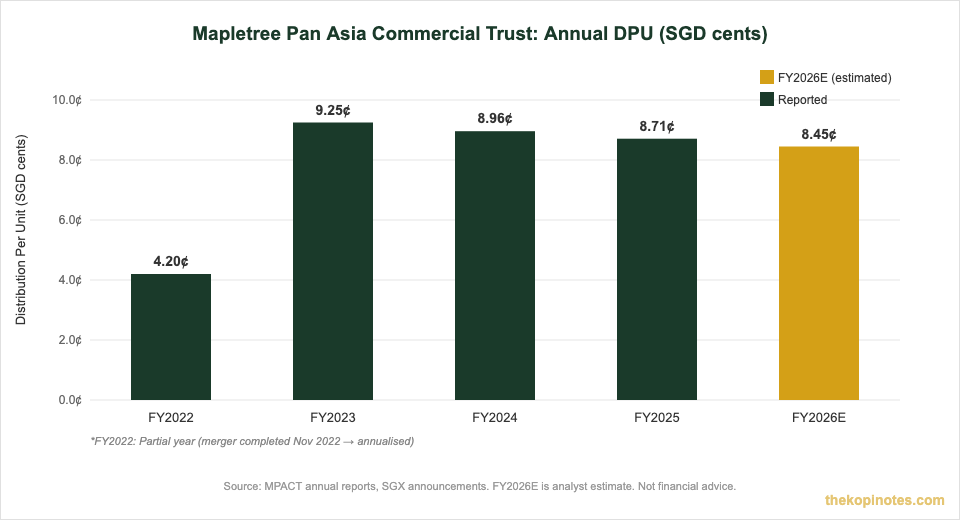
The chart above shows MPACT’s annual DPU trajectory since the merger. FY2022 is shown as a partial-year figure (the merger completed in November 2022). From FY2023 onward, DPU has gradually declined as interest costs rose with higher global rates.
The FY2026E figure is an analyst estimate based on the REIT’s NPI trajectory and current debt costs. A 25-basis-point rate hike in September 2026 could shave roughly 0.1 to 0.2 cents off the annualised DPU, depending on MPACT’s hedging position at the time of its next refinancing.
For investors focused on passive income in Singapore, the key question is whether the 6-7% yield adequately compensates for the rate risk. At current share prices, it arguably does — especially given the sponsor quality and portfolio diversification.
What to Watch in the Next Distribution Announcement
When MPACT announces its next half-year results, look for three things: the actual DPU paid, the percentage of income available for distribution, and the hedged ratio on debt. If the hedged ratio has fallen below 70%, rising SORA will have a larger bite going forward.
Balance Sheet Health and Gearing
Gearing — also called aggregate leverage — is the ratio of total debt to total assets. MAS caps Singapore REITs at 50%. Higher gearing means a REIT is more sensitive to rising interest costs and has less room to borrow for acquisitions.
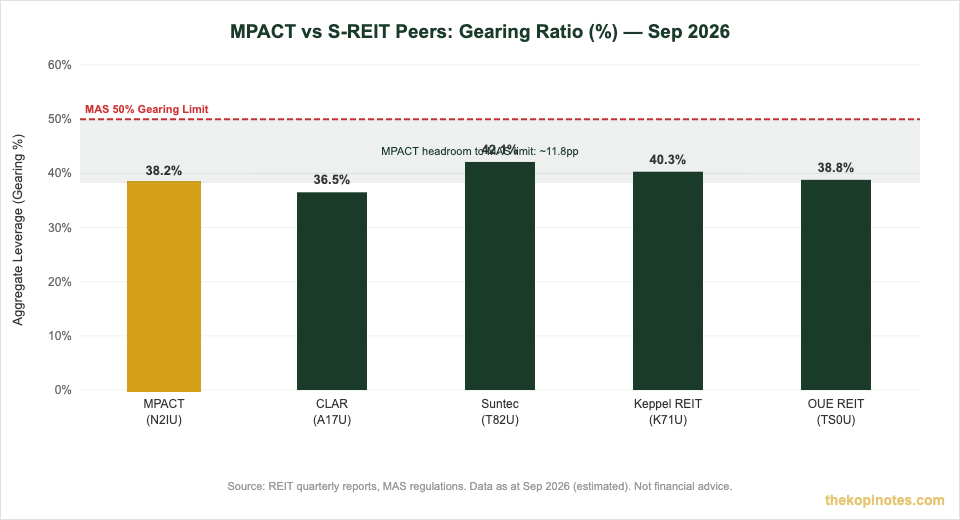
MPACT’s gearing of approximately 38% places it in a comfortable mid-range among Singapore commercial REITs. It has about 11 to 12 percentage points of headroom before hitting the MAS limit — meaning the REIT can absorb moderate property value declines or debt drawdowns without breaching the regulatory ceiling.
Suntec REIT carries higher gearing at around 42%, which makes it more vulnerable to property valuation write-downs in a higher-rate environment. MPACT’s more conservative balance sheet is a relative strength in 2026.
That said, MPACT’s debt maturity profile matters too. If large chunks of debt mature in 2027 or 2028 — when global rates may still be elevated — refinancing costs will weigh on DPU. Check MPACT’s debt maturity schedule in its latest investor presentation for the exact split.
Interest Coverage Ratio
The interest coverage ratio (ICR) measures how many times a REIT can pay its interest from NPI. MAS requires REITs to maintain an ICR above 1.5x if their gearing exceeds 45%. MPACT is well below that trigger level, and its ICR has historically sat in the 3-4x range. At that level, even a significant interest cost increase would not threaten distribution payments.
Is MPACT Fairly Valued Now?
Two metrics matter most for REIT valuation: price-to-net asset value (P/NAV) and distribution yield.
P/NAV compares the market price per unit to the book value of assets minus liabilities per unit. A P/NAV below 1.0 means the market is pricing the REIT at a discount to the value of its properties. Post-September 2026 rate hike, most Singapore commercial REITs — including MPACT — trade at or slightly below 1.0x NAV. This is typical in a rising-rate environment because higher borrowing costs compress property valuations.
| Valuation Metric | MPACT (est. Sep 2026) | S-REIT Sector Avg | Interpretation |
|---|---|---|---|
| P/NAV | ~0.80-0.90x | ~0.75-0.95x | At or modest discount to book |
| Distribution Yield | ~6.0-7.0% | ~5.5-7.0% | Competitive vs peers |
| Yield Spread over 10Y SGS | ~2.0-3.0% | ~1.5-2.5% | Narrowed but still positive |
| Gearing | ~38% | ~35-42% | Mid-range, comfortable |
Source: Illustrative estimates based on SGX announcements and analyst commentary as at Sep 2026. Not financial advice. Actual figures may differ.
The yield spread over the 10-year Singapore Government Securities (SGS) bond yield is one of the cleanest ways to assess REIT value. A wider spread suggests REITs are relatively cheap; a narrow or negative spread suggests they are expensive compared to risk-free alternatives. After the rate hike, SGS yields have risen, compressing this spread. However, MPACT’s ~6-7% yield still offers a meaningful premium to Singapore T-bills at around 3-4%.
To see how MPACT stacks up against the full range of S-REITs, and to use a retirement income calculator to model how a REIT portfolio might generate income for you, visit our Singapore retirement calculator.
Verdict: Buy, Hold or Wait?
MPACT is not a simple buy after a rate hike. The case for it rests on three factors: sponsor quality (Temasek-backed Mapletree), portfolio quality (prime Singapore commercial assets with sticky occupancy), and income sustainability (strong ICR, manageable gearing).
The case against it is the macro backdrop. If the Fed hikes again in November 2026 or early 2027, SORA will move higher again. MPACT’s refinancing costs will eventually reflect this, and DPU will likely trend down modestly. For investors who bought at lower prices, the yield-on-cost remains attractive. For new investors, the question is whether 6-7% adequately compensates for the duration and currency risks embedded in a pan-Asia portfolio.
Here is how different investor types might think about MPACT:
- Long-term income investors: The yield is competitive and the sponsor is rock-solid. Dollar-cost averaging into MPACT during rate-hike weakness is a reasonable strategy if you have a 5-year-plus horizon.
- Traders and shorter-term investors: Wait for clarity on whether the September 2026 hike is the last in this cycle. If the Fed pauses, MPACT’s share price will likely recover as rate-sensitive assets reprice upward.
- CPF or SRS investors: MPACT may be eligible for SRS investments. Check with your broker. Using Syfe referral code and sign-up bonus can reduce transaction costs if you invest via Syfe’s REIT+ portfolio that includes MPACT-type exposure.
If you want to invest in Singapore REITs via a low-cost platform, consider using the FSMOne referral code (P0544985) — FSMOne offers SGX-listed REIT purchases with competitive brokerage fees and a robust research portal.
This article is for informational and educational purposes only. Nothing here constitutes financial advice. Consult a licensed financial adviser before making any investment decisions.
Frequently Asked Questions About MPACT (N2IU)
”What
”Is
”What
This article was researched with the help of AI. While we strive to keep all information accurate and up to date, there may be errors. If you notice any discrepancies, please contact us.