Buffer ETFs in Singapore: Are They Worth the US Tax Risk After the Fed Hike?
Defined outcome ETFs cap your gains but limit your losses — here’s what Singapore investors need to know before buying one, including a tax trap most brokers won’t mention.
A buffer ETF (also called a defined outcome ETF) caps your upside in exchange for protecting a set percentage of your downside over a fixed period, usually three months. Funds like Innovator’s Buffer ETF suite are US-listed on Cboe BZX and NYSE Arca. For Singapore investors, that means 30% US dividend withholding tax and US estate tax exposure — costs that plain UCITS ETFs like CSPX and VWRA avoid entirely.
Not financial advice. All figures are for educational reference only. Data verified as at 20 September 2026.
- Buffer ETFs protect against a set amount of loss (say, the first 10% or 15%) but cap your gains too — you give up upside for downside protection.
- Almost all buffer ETFs are US-listed, so you pay 30% withholding tax on distributions and face US estate tax risk. There’s no LSE-listed UCITS equivalent yet.
- For most Singapore investors, a core CSPX or VWRA holding plus cash is simpler and cheaper. Buffer ETFs only make sense as a small, deliberate hedge — and only through a broker like IBKR that can access US exchanges.
What Is a Buffer ETF?
A buffer ETF, also known as a defined outcome ETF, is built to deliver a specific result over a fixed “outcome period” — usually three months, sometimes 12 months. It tracks an index like the S&P 500, but uses options contracts to cap your upside at a set percentage while cushioning your downside by a set percentage.
Here’s the trade-off in plain English. You might get exposure to the S&P 500 with a 6% upside cap and a 10% downside buffer for the quarter. If the market rises 15%, you only get 6%. If the market falls 10% or less, you lose nothing. If it falls 20%, you only feel the last 10% of that loss.
The largest issuers are Innovator ETFs and FT Vest. As at 2026, the buffer ETF category holds roughly USD 83.13 billion in assets across 467 funds from 20 issuers, with Innovator and FT Vest jointly controlling over 85% of that market (source: ETF Action, 2026). That is a meaningful slice of the US ETF industry, and it has grown fast — this is not a niche product anymore.
You’ll also see this called a “structured outcome” or “options-based defined outcome” strategy. Whatever the label, the mechanics are the same: cap, buffer, and a reset date.
Why Buffer ETFs Are Trending After the September 2026 Fed Hike
On 16 September 2026, the US Federal Reserve raised its benchmark rate by 25 basis points to 3.75%–4.00% — the first hike since 2023. The move was aimed at containing inflation driven partly by rising oil prices, and the Fed’s updated projections point to at least one more hike before year-end.
Rate hikes tend to spook equity markets. Higher borrowing costs squeeze company earnings and make bonds more attractive relative to stocks, which increases volatility. That’s exactly the environment where buffer ETFs get attention: investors who are nervous about a pullback but don’t want to sell out of equities entirely start looking for a middle ground.
You should know that higher volatility actually improves the terms buffer ETFs can offer. Caps are set using options pricing, and options get more expensive (and offer wider payoffs) when volatility rises. So the outcome ranges you’ll see quoted right now may look more generous than they did in a calmer market — that’s not a coincidence.
Popular Buffer ETFs and What They Cost
Innovator runs a laddered suite of buffer ETFs so there’s always a fresh outcome period starting somewhere. Here’s a sample of what’s on offer, based on Innovator’s SEC filings (2026):
| Fund | Ticker | Exchange | Buffer | Outcome Period |
|---|---|---|---|---|
| US Equity 5 to 15 Buffer ETF | EALT | Cboe BZX | 5%–15% | Quarterly |
| US Equity 10 Buffer ETF | ZALT | Cboe BZX | 10% | Quarterly |
| US Small Cap 10 Buffer ETF | RBUF | Cboe BZX | 10% | Quarterly |
| International Developed 10 Buffer ETF | IBUF | NYSE Arca | 10% | Quarterly |
Source: Innovator ETFs Trust Form 497K SEC filings, 2026. Buffer and cap levels reset at the start of each outcome period and vary with market volatility.
As a live example, the EALT fund’s current outcome period runs 1 July 2026 to 30 September 2026. For that quarter, it offers an upside cap of 6.63% (before fees) on the S&P 500-tracking underlying, with a buffer against the first 5% to 15% of losses (source: Innovator ETFs Trust SEC filing, 2026). Once the quarter ends, the fund resets with a new cap based on where options are pricing volatility at that time.
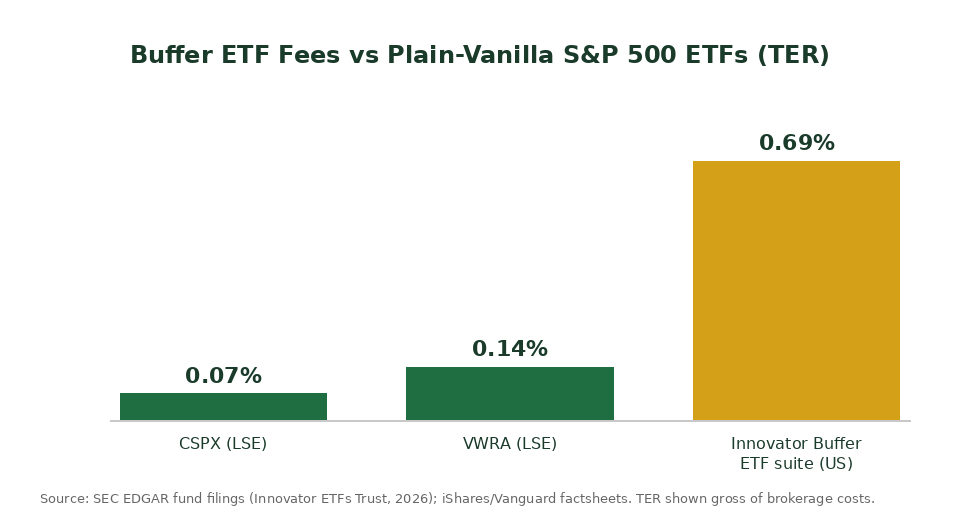
Management fees across Innovator’s buffer suite run around 0.69% per year based on SEC filings — nearly 10 times the 0.07% TER on a plain S&P 500 tracker like CSPX. You’re paying for the options overlay that builds the cap and buffer, not for stock-picking or active management.
The Singapore Investor’s Catch: US Tax Risk
Here’s what most articles about buffer ETFs skip over, and it matters a lot if you live in Singapore. Every buffer ETF on the market today is US-domiciled and listed on a US exchange (Cboe BZX or NYSE Arca). There is currently no Ireland-domiciled, LSE-listed UCITS version — unlike CSPX or VWRA, which exist specifically to sidestep US tax rules for non-US investors.
That difference costs you in two ways. First, distributions from a US-domiciled fund are subject to a 30% US withholding tax for non-resident foreigners, versus 15% under the US-Ireland tax treaty that UCITS ETFs benefit from. Second, US-situs assets — including shares in US-domiciled ETFs — are exposed to US estate tax for non-resident aliens above a USD 60,000 threshold, with rates that can run up to 40%. Ireland-domiciled UCITS ETFs are not classified as US-situs assets, so they escape this exposure entirely.
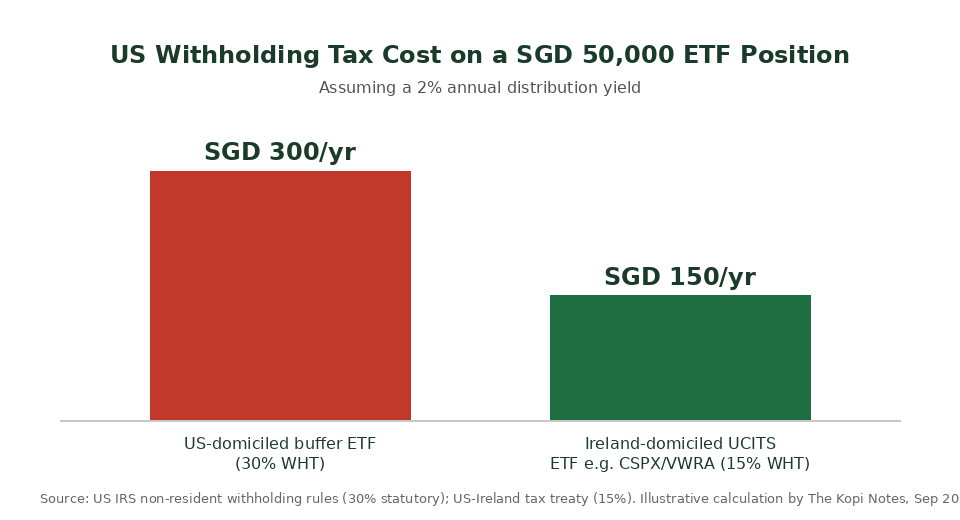
Say you hold SGD 50,000 in a buffer ETF paying a 2% annual distribution. At the 30% US withholding rate, you’d lose about SGD 300 a year to tax on that income. The same position in an Ireland-domiciled UCITS ETF at the 15% treaty rate would cost you SGD 150 — half as much, every single year, for as long as you hold it. Over a 10-year horizon, that gap alone adds up to real money, before you even factor in estate tax exposure.
However, most buffer ETFs are built to minimise distributions in the first place — the options overlay tends to generate limited income — so the practical WHT drag may be smaller than a high-yield fund. Still, the estate tax exposure is real and doesn’t depend on how much the fund distributes. If you’re investing meaningfully in US-domiciled ETFs, it’s worth reading our Singapore REIT ETF guide and the LSE-listed alternatives before committing.
How to Buy Buffer ETFs From Singapore
Because buffer ETFs trade only on US exchanges, you’ll need a broker with direct access to Cboe BZX or NYSE Arca. Here’s how the main options in Singapore stack up:
Interactive Brokers (IBKR) gives you direct access to US-listed ETFs at low commissions, and is the most commonly used platform among Singapore investors buying US-domiciled products. Search the ticker, confirm the exchange is Cboe BZX or NYSE Arca, and place your order in USD.
Syfe Brokerage and moomoo also offer US market access, though you should always confirm the specific ticker is supported before assuming coverage — buffer ETF tickers are less commonly listed than mainstream names.
Before funding a US brokerage position, it’s worth comparing platforms properly. Our Syfe referral code and sign-up bonus page and moomoo Singapore review break down fees and account setup if you’re deciding where to hold a small tactical position like this.
One practical note: buying mid-outcome-period means you don’t get the full stated buffer or cap. If a fund is three weeks into a three-month period and the underlying has already risen 3%, your entry point only has the remaining upside and downside range left — not the range advertised at the start of the period. Always check where the fund is in its current cycle before buying.
Risks to Consider
Buffer ETFs are not a free lunch. You’re giving up something real — uncapped upside — in exchange for downside protection that only applies for a fixed window and only up to a fixed amount.
The buffer only protects losses up to the stated range. A 10% buffer on a fund that falls 25% still leaves you down 15%. If you buy partway through the outcome period, both your cap and your buffer shift, and you may end up with less protection than the fund’s headline numbers suggest. Smaller, newer buffer ETFs can also have wider bid-ask spreads than a heavily traded fund like CSPX, which adds a hidden cost every time you trade.
There’s also concentration risk: most buffer ETFs track a single index like the S&P 500, so you’re not getting the global diversification you’d get from VWRA or similar. And because the options overlay resets every outcome period, buffer ETFs are not designed to be a permanent core holding — they work best as a deliberate, time-limited hedge, not a “set and forget” position.
For most Singapore investors building a long-term retirement portfolio, a simple CSPX or VWRA core, sized appropriately with our Singapore retirement calculator, will do more for you at a fraction of the cost. Buffer ETFs make more sense as a small, specific allocation — for example, if you’re worried about a near-term pullback but don’t want to sell a position you’d otherwise hold long-term.
Frequently Asked Questions
What is a buffer ETF in simple terms?
A buffer ETF is a fund that caps how much you can gain over a set period, usually three months, in exchange for protecting you from a set percentage of losses over that same period. It uses options contracts to build this structure around an index like the S&P 500.
Can Singapore investors buy buffer ETFs with CPF or SRS funds?
No. Buffer ETFs are listed on US exchanges and are not on the CPFIS list of approved investments. Some brokers may allow SRS funds to be used for US-listed ETF purchases, but you should confirm this directly with your broker and read the SRS scheme rules before assuming it applies.
Are buffer ETFs safer than regular index ETFs?
Not exactly — they trade one type of risk for another. You get protection against a defined range of losses, but you also give up any gains above the cap. If the market rallies strongly, a buffer ETF holder earns far less than someone holding an uncapped S&P 500 ETF like CSPX.
Why do buffer ETFs cost more than CSPX or VWRA?
The higher management fee, typically around 0.69% per year versus 0.07% for CSPX, pays for the options contracts that create the cap and buffer structure. Plain index ETFs like CSPX simply hold the underlying stocks, which is far cheaper to run.
What happens if I buy a buffer ETF partway through its outcome period?
You won’t get the full advertised cap or buffer. If the underlying index has already moved since the period started, your effective cap and buffer shift to reflect the remaining range for that period. Always check how far into the current outcome period a fund is before buying.
Do buffer ETFs face the same US estate tax issue as other US ETFs?
Yes. Because buffer ETFs are US-domiciled, they count as US-situs assets for non-resident aliens, exposing holdings above USD 60,000 to US estate tax. Ireland-domiciled UCITS ETFs like CSPX and VWRA avoid this exposure, which is why most Singapore investors use them for core holdings instead.
Building a Core ETF Portfolio First?
Start with a low-cost, tax-efficient UCITS ETF before considering tactical hedges like buffer ETFs. Open a brokerage account using our referral links for exclusive sign-up bonuses.
This article was researched with the help of AI. While we strive to keep all information accurate and up to date, there may be errors. If you notice any discrepancies, please contact us.