TribeCar + MariBank + Trust Bank + Endowus + Syfe: The Real-Return-After-Inflation Routing Order (2026)
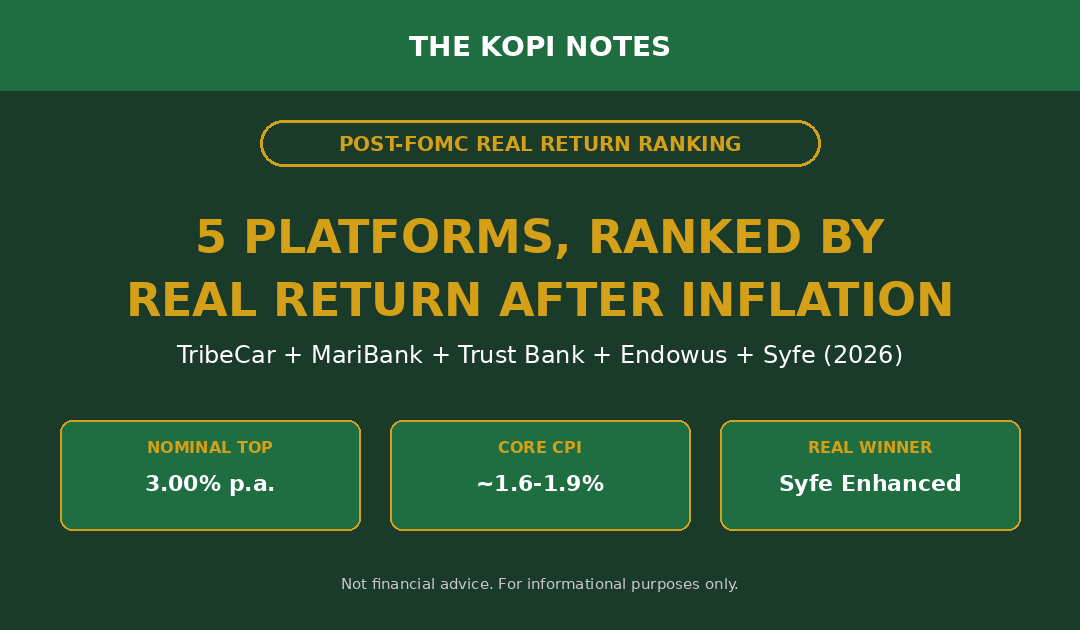
Skipping car ownership frees up cash every month. Most guides rank where it goes by headline interest rate. This one ranks it by what survives Singapore’s ~1.6–1.9% core inflation — the real return — after the Fed’s 17 September 2026 hike to 3.75–4.00%.
TribeCar’s pay-per-use model (from S$0.70/hr, referral code zZDeg) means no down payment, no COE, no insurance premium, no depreciation. For someone who’d otherwise be paying S$500–S$1,200 a month in car ownership costs, that’s real freed-up cash every single month.
The question most quick-win-referral articles skip: once that cash is free, where does it actually gain the most after inflation eats into it? A platform paying 0.88% nominal when core inflation is running near 1.9% is losing purchasing power — not growing your money. This article ranks five platforms by real return, not headline rate, and gives a routing order that still respects liquidity and insurance needs.
This is not financial advice. Rates, promotions and CPI forecasts change; always verify current figures on each platform’s own site before acting.
Table of Contents
Why Real Return, Not Headline Rate
MAS’s September 2026 survey of market watchers put the median forecast for 2026 core inflation at 1.9%, with core CPI running 1.6% year-on-year as of June 2026. That’s the erosion rate every Singapore dollar sitting in cash is fighting against.
A savings account paying 0.85% nominal isn’t “safe growth” — against 1.9% inflation, it’s a -1.05% real return. The money is losing purchasing power even while the account balance goes up. The Fed’s 25bp hike to 3.75–4.00% on 17 September 2026 pushed some platform rates up slightly, but the ranking that matters is nominal rate minus inflation, not nominal rate alone.
That doesn’t mean skip the low-rate accounts entirely — liquidity and deposit insurance still matter for money you might need next week. It means being honest about which stops are for safety and which are for growth.
The Five Platforms and Their Current Rates
| Platform | Nominal Rate | Access / Lock-in | Protection |
|---|---|---|---|
| Trust Bank Flex | 0.85% p.a. (union) / 0.75% (non-union) achievable — not the 2.40% headline, which needs S$20k invested or S$100k ADB | Instant | SDIC S$100k |
| MariBank | 0.88% p.a. flat base rate | Instant | SDIC S$100k |
| Syfe Cash+ Guaranteed | ~1.30% p.a. SGD, contractual | Short fixed term | Not SDIC-insured |
| Endowus Cash Smart Ultra | ~2.50% p.a. net (Secure ~1.3%, Core ~2.1% for shorter horizons) | No lock-in, fund-based | Not SDIC-insured (underlying MMFs) |
| Syfe Cash+ Enhanced | ~3.00% p.a. projected | No lock-in, bond fund | Not SDIC-insured, market risk |
Rates as at September 2026, cross-checked against each platform’s own site. Rates change without notice — verify current figures before acting.
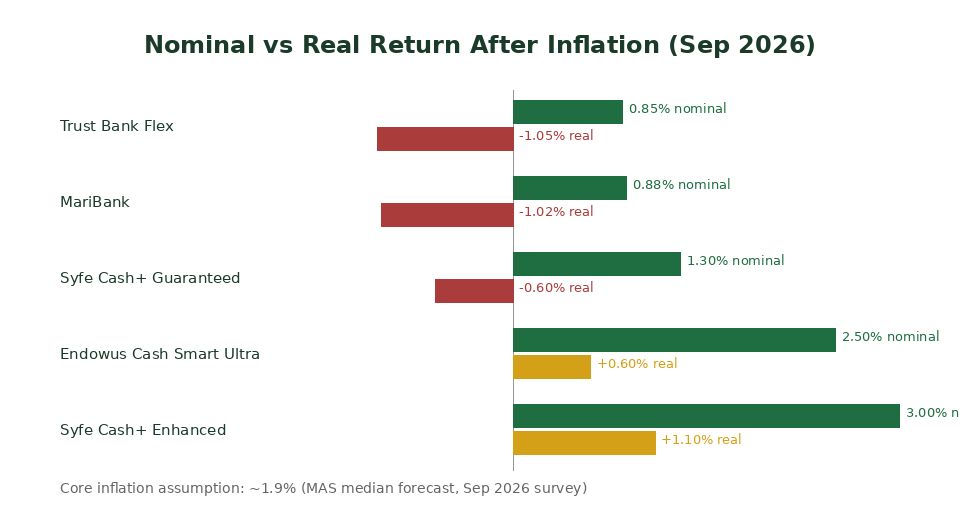
Real-Return Ranking Table
| Rank | Platform | Nominal | Real Return (vs 1.9% CPI) |
|---|---|---|---|
| 1 (best) | Syfe Cash+ Enhanced | 3.00% | +1.10% |
| 2 | Endowus Cash Smart Ultra | 2.50% | +0.60% |
| 3 | Syfe Cash+ Guaranteed | 1.30% | -0.60% |
| 4 | MariBank | 0.88% | -1.02% |
| 5 (worst) | Trust Bank Flex | 0.85% | -1.05% |
Only two of the five stops beat inflation on a pure real-return basis. That doesn’t make the other three “bad” — it makes them the wrong tool for anything beyond a 3–6 month emergency buffer.
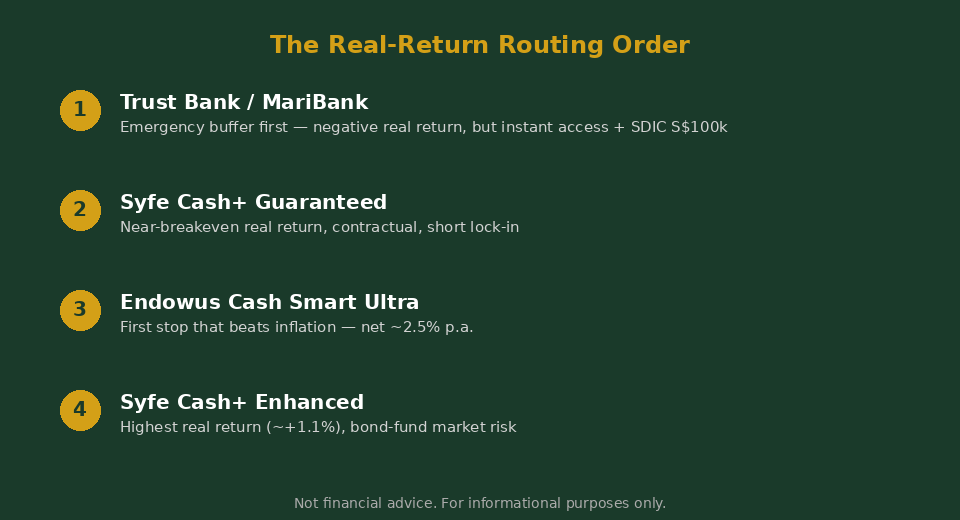
The Routing Order, Step by Step
Step 1 — Trust Bank / MariBank (emergency buffer). Build 1–3 months of expenses here first, split across both for SDIC headroom. Negative real return, but instant access and SDIC S$100k coverage each are worth more than the yield for money you might need next week.
Step 2 — Syfe Cash+ Guaranteed. Once the buffer is set, near-breakeven real return with a contractual (not projected) rate and a short fixed term. A stepping stone, not a destination.
Step 3 — Endowus Cash Smart Ultra. The first stop that actually beats inflation. No lock-in, fund-based, net yield around 2.5% p.a. This is where “spare cash beyond the emergency buffer” should land by default.
Step 4 — Syfe Cash+ Enhanced. The highest real return of the five, but it’s a bond fund carrying market risk and isn’t SDIC-insured. Reserve this tier for money with a genuinely longer horizon — 12 months or more — where short-term price swings won’t force a bad-timing sale.
TribeCar’s freed-up S$500–S$1,200/month is what funds this whole sequence — each month’s savings moves down the ladder as the tier above it is already topped up.
Worked Example: S$500/Month
Say skipping car ownership frees up S$500 a month. A real-return-aware routing order might look like this once the emergency buffer (Step 1) is already full:
- Month 1–6: full S$500/month into Endowus Cash Smart Ultra — building toward a 6-month runway at a real yield that actually grows purchasing power.
- Once the Ultra tier holds 3–6 months of expenses: new monthly savings start splitting — part continues into Cash Smart Ultra, part starts building a Syfe Cash+ Enhanced position for money with a 12-month-plus horizon.
Over a year, routing by real return instead of habit (just leaving it in whichever bank app is already open) is the difference between purchasing power growing and purchasing power quietly shrinking while the balance ticks up.
Risks and Caveats
Inflation forecasts move. MAS’s 1.5–2.5% 2026 core inflation range (April 2026 forecast) and the September survey’s 1.9% median are both estimates, not guarantees — the real-return ranking above will shift if actual CPI prints differently.
Syfe Cash+ Enhanced is a bond fund, not a deposit — it carries market risk and is not SDIC-insured, unlike Trust Bank and MariBank. Endowus Cash Smart funds are money-market funds, also not SDIC-insured, though generally low-volatility.
Platform rates and promotions change without notice. Always check each platform’s own site for the current published rate before moving money, and never park an emergency buffer somewhere you can’t access instantly.
FAQ
Why rank by real return instead of nominal rate?
Should I skip Trust Bank and MariBank entirely since their real return is negative?
Is Syfe Cash+ Enhanced safe?
What's the difference between Endowus Cash Smart Secure, Core and Ultra?
How is the ~1.9% inflation figure sourced?
Does the Fed's September 2026 rate hike change this ranking?
Can I use all five platforms at once?
This article is for informational purposes only and does not constitute financial advice. Rates, promotions and inflation forecasts are accurate as at the publish date and subject to change — always verify current figures directly with each platform.
This article was researched with the help of AI. While we strive to keep all information accurate and up to date, there may be errors. If you notice any discrepancies, please contact us.