Term Life Insurance Singapore 2026: How the Fed Rate Hike Affects Your Premiums
Coverage from S$413/yr · Fed at 3.75–4.00% · Compare AIA, Prudential, Singlife, FWD
Term life insurance in Singapore pays a lump sum to your family if you die or are diagnosed with a terminal illness during the policy period. A 35-year-old non-smoker buying S$500,000 of cover over 30 years pays as little as S$413 per year with Singlife — and with the Fed raising rates to 3.75–4.00% in September 2026, insurers’ investment returns have improved, which may support more competitive pricing going forward.
Not financial advice. All figures are for educational reference only. Data verified as at 18 September 2026 unless noted.
- Term life insurance is your most affordable way to protect your family — from S$413/yr for S$500k cover.
- The Fed’s September 2026 rate hike to 3.75–4.00% may support slightly more competitive premiums as insurers earn more on their bond portfolios.
- Buy 9–10x your annual income in coverage and compare at least three insurers before signing.
What Is Term Life Insurance?
Term life insurance is the simplest form of life coverage. You pay a fixed premium every year. If you die — or are diagnosed with a terminal illness — during the policy term, your insurer pays your chosen sum assured to your family. If you outlive the policy, you receive nothing back.
That last part is what makes it affordable. You are paying purely for protection, not for an investment component. That is why a 35-year-old can get S$500,000 of coverage for as little as S$413 per year with a digital-first insurer like Singlife.
In Singapore, MAS regulates all term life policies. Common coverage periods run from 10 to 40 years, or to a specified age such as 65, 70, or 100.
Term Life vs Whole Life vs Integrated Shield Plans
| Product | Covers | Returns Cash? | Annual Premium |
|---|---|---|---|
| Term Life | Death, terminal illness | No | Lowest — from S$400+/yr |
| Whole Life | Death + savings | Yes (cash value) | 5–15x higher |
| Integrated Shield | Hospitalisation | No | Separate product |
Source: MAS product definitions; insurer product sheets, September 2026.
For most working Singaporeans with dependants, term life is the first protection priority. Get the coverage your family needs at the lowest cost, then invest the savings into ETFs or plan your retirement with the remainder.
How Interest Rates Affect Term Life Premiums
The Federal Reserve raised rates by 25 basis points to 3.75–4.00% on 17 September 2026. It was the first rate hike in over three years — a significant shift for global financial markets, including insurance companies.
Here is the connection you need to understand: life insurers invest your premiums into bonds and fixed-income assets. These investments must cover future claims over 20 to 40 years. When interest rates are low, insurers earn less on those investments — which means they need more in premiums today to fund the same future payout. When rates rise, the opposite happens.
In practice, the impact on premiums is gradual. Insurers do not reprice overnight. But sustained higher rates over 12 to 24 months tend to show up as more competitive premium bands. Singapore insurers also have their own actuarial models and reinsurance arrangements, so local premium movements may lag the Fed by one or two repricing cycles.
The takeaway for you: the rate environment in late 2026 is favourable for locking in term life coverage. If the Fed eventually cuts rates, insurers may nudge premiums upward in the next round of repricing.
2026 Premium Comparison — Singapore Insurers
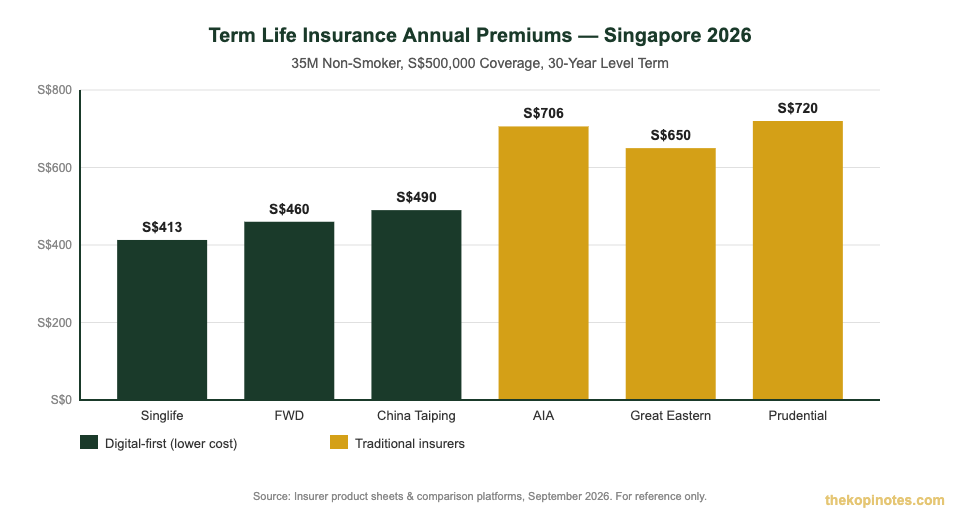
Below are indicative annual premiums for a 35-year-old male non-smoker seeking S$500,000 of coverage over a 30-year level term. Figures are from insurer product sheets and comparison platforms as at September 2026.
| Insurer | Product | Annual Premium | Notes |
|---|---|---|---|
| Singlife | Elite Term II | S$413 | Most competitive for standard profiles |
| FWD | FWD Term Life | S$460 | Strong digital experience |
| China Taiping | i-Term Plus | S$490 | Competitive mid-tier |
| Great Eastern | GREAT Term 2 | S$650 | Strong brand, wider distribution |
| AIA | Secure Flexi Term | S$706 | Optional CI rider add-ons |
| Prudential | PRUActive Term | S$720 | Comprehensive but pricier |
Source: Insurer product sheets and comparison platforms, September 2026. Premiums are indicative for a 35M non-smoker, S$500,000, 30-year level term. Actual premiums depend on health and underwriting outcome.
The gap between cheapest and most expensive is striking: Singlife at S$413 versus Prudential at S$720 is a 74% difference for the same coverage. Over 30 years, that gap compounds to over S$9,000 in premium savings.
For detailed reviews, see our best term life insurance Singapore guide, our AIA term life review, and our Prudential PRUActive Term review.
How Much Coverage Do You Need?
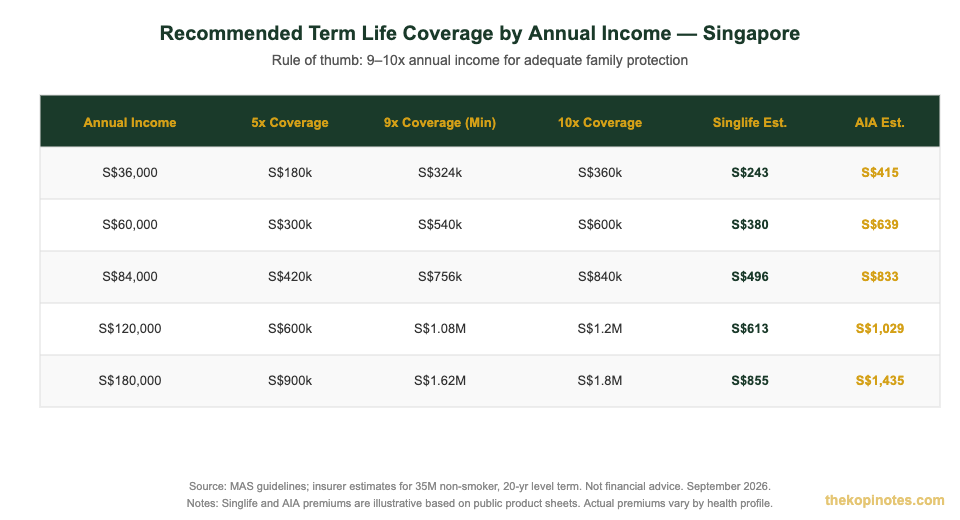
The Singapore benchmark is 9–10 times your annual income. If you earn S$60,000 per year, you need S$540,000 to S$600,000 in sum assured. If you earn S$120,000, that rises to S$1.08 million to S$1.2 million. Many Singaporeans are significantly underinsured relative to this.
Beyond the income multiple, also consider:
- Outstanding mortgage: add the remaining loan balance to your sum assured target
- Children’s education: budget S$80,000–S$150,000 per child for local university
- Spouse’s income: if your spouse earns well, you may need less; if they do not work, you need more
- CPF Life: CPF Life provides some retirement income but does not replace death coverage
If you also want income replacement in case of disability, look at disability income insurance, which pays up to 75% of your gross income if you cannot work.
Key Features to Compare Before You Buy
Definition of Terminal Illness
Most Singapore term life policies pay out on terminal illness, defined as a condition with a life expectancy of 12 months or less. Check if your policy uses 12 months or 24 months — the broader definition offers earlier access to funds.
Guaranteed Renewability and Convertibility
Some term plans let you renew or convert to whole life without further medical underwriting. This is valuable if your health deteriorates during the policy term. Not all digital-first policies offer this.
Premium Waiver on Total Permanent Disability
A premium waiver rider means your premiums are waived if you become totally and permanently disabled. This is a relatively cheap add-on that provides meaningful protection.
Critical Illness Riders
You can add critical illness (CI) coverage as a rider on a term life base plan. This pays out on diagnosis of a major condition even if you survive. For many Singaporeans, a standalone CI plan is more cost-effective. See our Great Eastern term life review for a full breakdown of bundled rider options.
Once your protection is in place, grow your savings with platforms like Endowus — use the Endowus referral code for a fee rebate, or the Syfe referral code for managed portfolio access.
When to Buy — The Rate Hike Window
The best time to buy term life insurance is as soon as you have dependants who rely on your income. Every year you delay costs you more. Premiums increase with age — a 30-year-old buying S$500,000 of cover pays roughly 15–25% less than a 35-year-old for the same policy.
The September 2026 rate environment adds a secondary consideration. The Fed at 3.75–4.00% marks the highest rate in Singapore’s recent economic cycle. Insurers with large bond portfolios benefit from higher yields. If rates reverse in 2027 or 2028, some insurers may reprice term premiums upward.
Three groups who should act now: first, anyone aged 28–40 with a spouse, children, or a mortgage. Second, anyone with a pre-existing condition that is currently well-managed — act sooner because underwriting gets harder if conditions progress. Third, self-employed professionals with no employer group coverage. You are unprotected by default.
Frequently Asked Questions
How much does term life insurance cost in Singapore in 2026?
Does the Fed rate hike in September 2026 affect term life insurance premiums?
How much term life coverage do I need in Singapore?
What is the difference between term life and critical illness insurance?
Can I use CPF to pay for term life insurance premiums?
Which term life insurer is cheapest in Singapore?
Get Free Insurance Advice
Speak with a licensed insurance advisor. No obligation, no cost.
By submitting this form, you agree to our Privacy Policy.
This article was researched with the help of AI. While we strive to keep all information accurate and up to date, there may be errors. If you notice any discrepancies, please contact us.