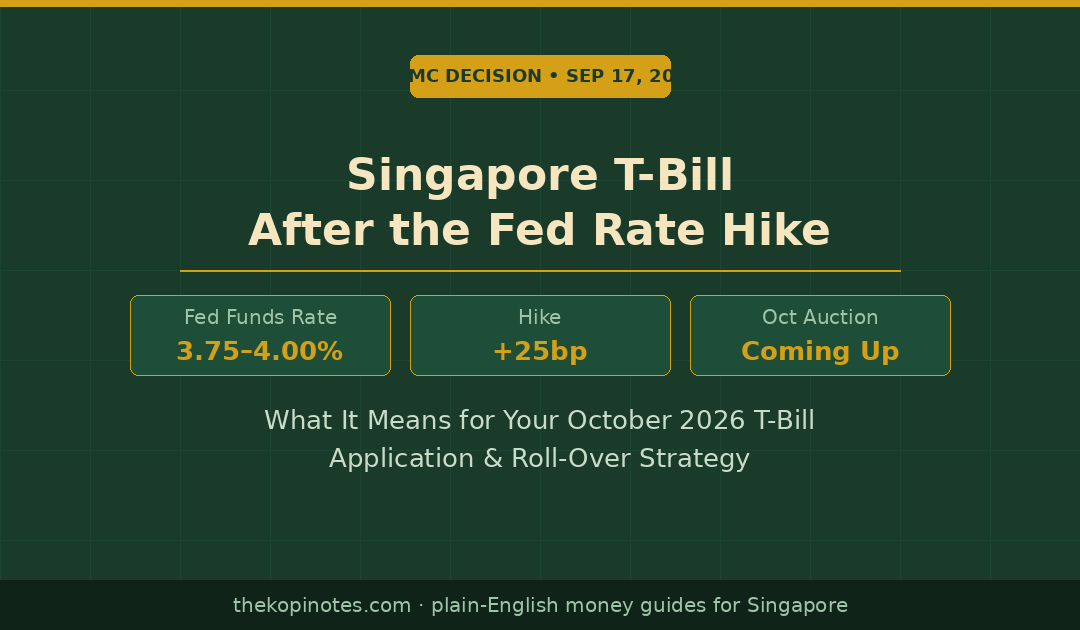
FOMC DECISION · 17 SEPTEMBER 2026
Singapore T-Bill After the September 2026 FOMC Rate Hike: October Auction Guide
The Fed raised rates 25 basis points to 3.75–4.00%. Here is what that means for Singapore T-bill cut-off yields and your October 2026 auction strategy.
25 basis points. That is the size of the hike the Federal Reserve announced on 17 September 2026, lifting the target range for the federal funds rate to 3.75–4.00%. For Singapore T-bill investors, the question is immediate: does this move the cut-off yield for the October 2026 auction, and what should you do now?
This article covers how a Fed hike transmits into Singapore T-bill yields, what the October auction is likely to look like, and the three scenarios most retail investors face.
Disclosure: This article is for informational purposes only and does not constitute financial advice. T-bill cut-off yields depend on competitive bids at each auction and cannot be guaranteed. Consult a licensed financial adviser before making investment decisions.
What the FOMC Decision Means for Singapore
Singapore manages its monetary policy through the exchange rate, not an interest rate. MAS adjusts the Singapore dollar nominal effective exchange rate (S$NEER) policy band rather than setting an overnight borrowing rate. So a Fed hike does not directly translate into a higher Singapore T-bill yield by the same amount.
But the transmission is real. Singapore government securities (SGS) trade in a global capital market. When US short-term risk-free rates rise, investors globally demand higher yields elsewhere to remain competitive. Our pre-FOMC T-bill guide covered the decision framework investors faced when the hike was priced at 65% probability. Now the outcome is confirmed. Three channels carry the Fed signal into Singapore T-bill auctions.
- US dollar short-term benchmarks. SOFR and US T-bill yields are the global reference for short-duration government paper. When they rise, SGD equivalents tend to follow with a lag and at a smaller magnitude.
- SGD swap and SORA rates. The 6-month SORA swap rate shifts as global interbank expectations change. Banks that submit competitive bids at MAS T-bill auctions anchor their bids to this curve.
- Investor demand at auction. Higher global yields can soften demand slightly, giving competitive bidders room to price a higher cut-off and still clear the auction.
How T-Bill Cut-Off Yields Are Affected
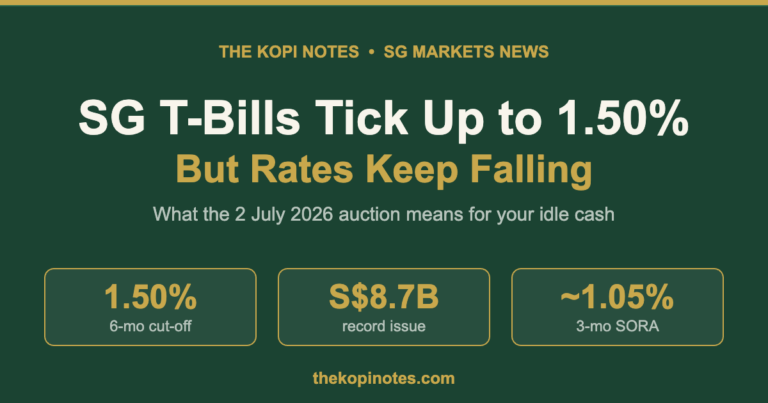
The Singapore 6-month T-bill cut-off yield stood at approximately 1.70% in the September 2026 auction cycle before today’s decision. The full picture of 2026 auction results is in the Singapore T-bill interest rate guide.
After a 25bp Fed hike, the most likely outcome for the October 2026 auction is a modest upward drift rather than a direct 25bp step. Historical data shows SGD short-term government yields absorb 30–60% of equivalent US rate moves in the near term, with the remainder absorbed by exchange-rate adjustments and MAS policy offsets.
| Scenario | 6M Cut-Off Yield | Key Driver |
|---|---|---|
| Pre-FOMC baseline | ~1.70% | Market had priced 65% hike probability |
| Post-hike conservative | 1.75–1.85% | 30–40% pass-through |
| Post-hike moderate | 1.85–2.00% | 50–60% pass-through, strong bidding |
| Hawkish forward guidance | Above 2.00% | Fed signals further hikes ahead |
These are indicative ranges based on historical pass-through patterns, not forecasts. The actual cut-off yield is determined entirely by competitive bids submitted at the October auction.
October 2026 T-Bill Auction: Key Dates and Process
MAS issues 6-month SGS T-bills on a two-week cycle. Following the September 2026 cycle, the next auction falls in early October 2026. Check the MAS SGS calendar for confirmed auction and application closing dates before submitting.
Four practical points for the October application:
- Application window. Apply via your bank’s internet banking platform or ATM, linked to your SGX CDP account. The closing date is typically the business day before the auction date.
- Non-competitive bids receive the cut-off yield. Most retail investors apply non-competitively and receive whatever the auction clears at. You do not need to submit a specific yield.
- Minimum S$1,000, maximum S$1 million per non-competitive application, in S$1,000 multiples.
- CPF-OA eligible. You can use CPF Ordinary Account funds to apply. Weigh the 2.5% guaranteed CPF-OA rate against the expected T-bill cut-off before committing.
Three Investor Scenarios
Where you sit depends on one question: when does your existing T-bill mature relative to the October auction date?
Scenario 1: T-bill matures before the October auction
Your funds sit in cash for one to three weeks between maturity and the auction. Park the proceeds in a high-yield savings account or money market fund to avoid dead cash drag. Apply non-competitively on the first day the October auction opens and take the cut-off yield.
Scenario 2: T-bill matures after the October auction
You are locked in at your existing cut-off yield until maturity. If October yields rise as expected, you roll over at a higher rate once your bill matures. No action is required. The strategy here is patience.
Scenario 3: Fresh cash, no current T-bill
Wait for the October auction rather than locking into any current instrument at a lower yield. Submit a non-competitive bid on opening day. If October yields disappoint, you still have the option to explore SSBs or fixed deposits for the next cycle.
The SSB Interest Calculator models the exact return on any SSB tranche over your chosen holding period. For building a fixed-income ladder across T-bills, SSBs and bonds, the Bond Ladder Calculator handles the sequencing.
Singapore Savings Bonds vs T-Bills After the Hike
The current SSB (SBAUG26, GX26080T) offers a 10-year average return of ~2.06% and a first-year rate of ~1.46%. Before the September FOMC hike, T-bills at ~1.70% already outperformed the SSB first-year rate. After the hike, the T-bill edge may widen further for the first six months.
| Factor | 6M T-Bill | SSB |
|---|---|---|
| Holding period | 6 months (fixed) | 1–10 years (flexible) |
| Early exit | Secondary market only; limited liquidity | Any month, no penalty |
| Reinvestment risk | High: must rebid every 6 months | None: step-up is locked at issue |
| CPF-OA eligible | Yes | Yes |
| Best for | Highest short-term yield, active management | Certainty over 3–10 years, minimal admin |
T-bills win on short-horizon yield after this hike. SSBs win if you value certainty over several years and dislike the quarterly application cycle.
If you are also reviewing your SRS account in the current rate environment, the SRS post-FOMC guide published 16 September 2026 covers how fixed-income options inside SRS compare after the rate hike.
For automated fixed-income access without managing individual auction applications, Endowus (referral code: 2V343) and FSMOne (referral code: P0544985) both offer Singapore government bond fund exposure. These are referral links — we earn a commission if you sign up.
Frequently Asked Questions
Did the Fed raise rates on 17 September 2026?
Will Singapore T-bill yields rise by the same 25bp?
When is the next Singapore T-bill auction?
Should I use CPF-OA funds for the October T-bill auction?
Can I sell my T-bill early if I need the cash?
Is there a maximum T-bill application size?
How do T-bills compare with SSBs after the rate hike?
Do I need a brokerage account to buy Singapore T-bills?
Is this article financial advice?
This article was researched with the help of AI. While we strive to keep all information accurate and up to date, there may be errors. If you notice any discrepancies, please contact us.