Factor Investing ETFs Singapore: Quality, Value, Momentum & Low Volatility Explained (2026 Guide)
Table of Contents
Quick Navigation
- What Is Factor Investing, and Why Bother?
- The Four Main Factors, Explained
- The Four Factor ETFs on the LSE
- Why Singapore Investors Buy These on the LSE
- Factor ETFs vs a Plain World Index Fund
- How to Buy Factor ETFs in Singapore
- Who Should Use Factor ETFs?
- Risks to Understand First
- Frequently Asked Questions
Factor ETFs like IWQU, IWVL, IWMO and MVOL let Singapore investors tilt a portfolio toward specific drivers of long-term return — quality, value, momentum or low volatility — instead of simply buying the market as-is. All four are Ireland-domiciled UCITS funds listed on the London Stock Exchange, so they carry the same 15% US dividend withholding tax and no US estate tax exposure as CSPX or VWRA.
Not financial advice. All figures are for educational reference only. Data verified as at September 2026 against iShares and Vanguard fund factsheets unless otherwise noted.
- Factor investing means picking stocks by a specific measurable characteristic — quality, value, momentum or low volatility — instead of simply weighting by company size like VWRA or CSPX do
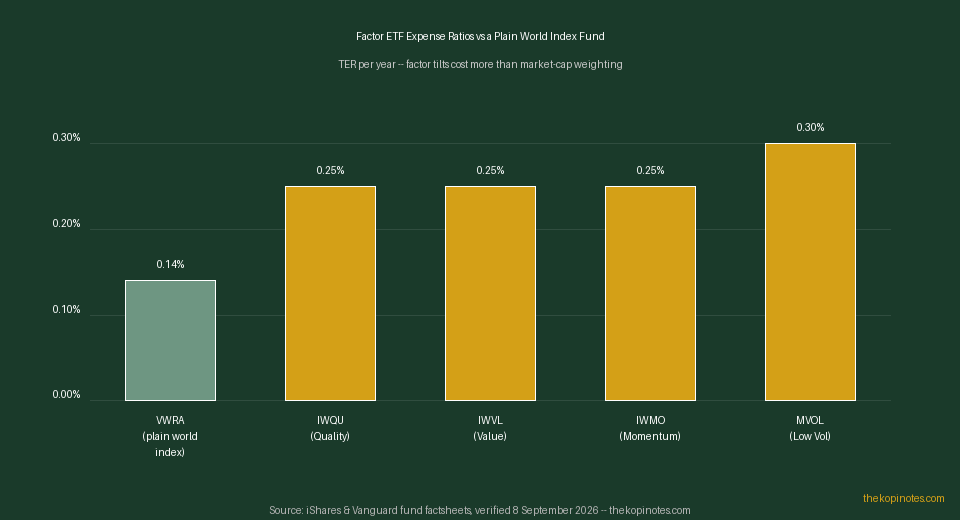
- The four main LSE-listed factor ETFs (IWQU, IWVL, IWMO, MVOL) charge 0.25%-0.30% a year, noticeably more than a plain world index fund like VWRA at 0.14%
- Factors move in long cycles of years-long under- and out-performance, so most Singapore investors should treat them as a small tilt alongside a core index holding, not a replacement for one
What Is Factor Investing, and Why Bother?
When you buy a plain world index fund like VWRA, you’re buying every eligible company weighted by size. The bigger the company, the bigger its slice of your money. That’s simple and cheap, but it also means your portfolio is quietly concentrated in whichever handful of mega-cap stocks happen to be the most expensive right now.
Factor investing takes a different approach. Instead of weighting by size, a factor ETF screens the same broad universe of stocks for one specific, measurable characteristic — how profitable a company is, how cheap its shares are relative to earnings, how strongly its share price has been trending, or how much it swings around. It’s still rules-based and still holds hundreds of stocks. It’s not stock-picking. It’s re-weighting.
This isn’t a new idea. Academics have documented factor premiums for decades — the value and size factors go back to Fama and French’s research in the 1990s, momentum to Jegadeesh and Titman’s work around the same time, and low volatility to what’s often called the “low-vol anomaly”: less volatile stocks have historically delivered returns similar to or better than the wider market, with a smoother ride getting there. Fund managers like BlackRock (iShares) turned these ideas into low-cost, rules-based ETFs that any investor can buy on the LSE.
The Four Main Factors, Explained in Plain English
Each factor ETF screens for a different characteristic. Here’s what each one is actually looking for, in everyday language.
- Quality. Companies with high profitability (return on equity), low debt, and stable earnings growth — think reliable, well-run businesses rather than exciting ones. The iShares MSCI World Quality Factor ETF (IWQU) screens for exactly these three traits, equally weighted.
- Value. Stocks trading cheaply relative to their earnings, book value, sales and cash flow — the classic “buy low” approach. The iShares MSCI World Value Factor ETF (IWVL) tracks the MSCI World Enhanced Value Index, which tilts toward statistically cheap companies across developed markets.
- Momentum. Stocks that have been rising over the past 6-12 months tend to keep rising for a while longer, and vice versa for fallers. The iShares MSCI World Momentum Factor ETF (IWMO) rebalances regularly to keep riding whatever is currently trending, which also means higher turnover than the other three factors.
- Low volatility. Stocks that historically swing less than the broader market — utilities, consumer staples, healthcare — tend to deliver similar long-run returns with noticeably smaller drawdowns. The iShares MSCI World Minimum Volatility ETF (MVOL) builds a portfolio specifically to minimise overall swings, not just to hold “defensive” sectors.
Here’s the part that trips up new investors: these four factors don’t move together. Value tends to do well when interest rates rise and the economy is recovering. Momentum can do very well in a strong bull market, then fall sharply when a trend reverses. Quality and low volatility both tend to hold up better in downturns, but for different reasons. That’s exactly why they’re sold as four separate ETFs rather than one blended fund.
The Four Factor ETFs Available on the LSE
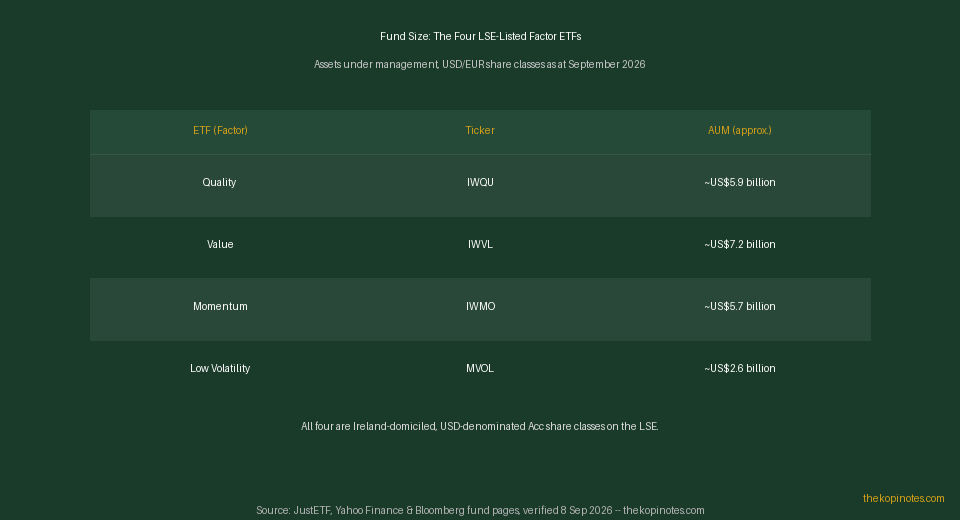
All four are managed by iShares (BlackRock), domiciled in Ireland, and listed in USD on the London Stock Exchange as accumulating share classes — meaning dividends are reinvested automatically rather than paid out in cash. Distributing share classes exist for some of these funds under different tickers if you’d rather receive cash dividends; check the accumulating vs distributing ETFs guide before choosing.
| ETF (Factor) | Ticker | TER | AUM (approx.) | Index Tracked |
|---|---|---|---|---|
| Quality | IWQU | 0.25% p.a. | ~US$5.9bn | MSCI World Sector Neutral Quality |
| Value | IWVL | 0.25% p.a. | ~US$7.2bn | MSCI World Enhanced Value |
| Momentum | IWMO | 0.25% p.a. | ~US$5.7bn | MSCI World Momentum |
| Low Volatility | MVOL | 0.30% p.a. | ~US$2.6bn | MSCI World Minimum Volatility |
Source: iShares/BlackRock fund factsheets, JustETF and Bloomberg fund pages, verified 8 September 2026. AUM figures combine major share classes and are approximate.
Notice that low volatility costs slightly more than the other three. That’s because minimising volatility requires a more complex optimisation across correlations between stocks, not just a simple ranking and screen — a small extra cost for the smoother ride it aims to deliver.
Why Singapore Investors Buy These on the LSE, Not the US
You could buy the same four factors in a US-listed ETF instead — iShares runs USA-only equivalents on the NYSE. But for a Singapore investor, that comes with two real costs: a higher US dividend withholding tax, and exposure to US estate tax on holdings above USD 60,000 if something happens to you.
| ETF Type | Domicile | US Dividend WHT | US Estate Tax Risk |
|---|---|---|---|
| IWQU / IWVL / IWMO / MVOL (LSE) | Ireland | 15% | None |
| US-domiciled factor equivalents (NYSE) | USA | 30% | Yes (above USD 60k) |
Ireland’s tax treaty with the US means Ireland-domiciled UCITS funds only suffer a 15% withholding tax on US-sourced dividends, versus 30% for a US-domiciled fund held by a non-US person. Since all four factor ETFs invest heavily in US large caps — often 60%+ of the MSCI World universe — this difference matters more than it might for a purely Asian or emerging-market fund. There’s also no capital gains tax and no dividend tax in Singapore on either version, so the LSE route is close to a straightforward, no-downside choice for most Singapore-based investors, exactly as with CSPX.
Factor ETFs vs a Plain World Index Fund: Cost and Behaviour
The most obvious difference is cost. VWRA charges 0.14% a year (after Vanguard’s July 2026 fee cut). All four factor ETFs charge more — 0.25% for quality, value and momentum, and 0.30% for low volatility.
| Feature | VWRA (Plain World) | Factor ETFs (IWQU/IWVL/IWMO/MVOL) |
|---|---|---|
| TER | 0.14% p.a. | 0.25%-0.30% p.a. |
| Weighting method | Market capitalisation | Screened/tilted by factor score |
| Number of holdings | ~3,600+ | ~300-500 (fewer, more concentrated) |
| Tracking behaviour | Matches the broad market closely | Can diverge meaningfully from the market for years at a time |
| Best used as | Core, whole-portfolio holding | Satellite tilt alongside a core holding |
Fewer holdings means more concentration risk, and a bumpier ride relative to the broad market — sometimes helpful, sometimes not, depending on which years you’re invested through. That’s the trade-off you’re paying the extra 0.11-0.16% a year for.
How to Buy Factor ETFs in Singapore
Since IWQU, IWVL, IWMO and MVOL are all listed on the LSE in USD, you buy them the same way you’d buy CSPX or VWRA — through a broker with LSE market access.
Interactive Brokers (IBKR)
Fund your account, search the ticker (e.g. “IWQU”), select the LSE listing, and place your order in USD. IBKR’s low commissions and tight FX spreads make it the most cost-effective option for larger, one-off purchases, though the platform has a steeper learning curve for first-time investors.
Saxo Markets
Saxo offers a more polished interface with LSE access built in. Commissions run slightly higher than IBKR’s tiered plan but the platform is easier for beginners to navigate, and Saxo’s research tools cover factor ETFs alongside standard equities.
Syfe Brokerage
Syfe offers commission-free UK-listed ETF trading through a weekly LSE trading window with automatic FX conversion, making it the simplest option if you’re comfortable trading on a set day each week rather than in real time.
Note: moomoo Singapore does not currently offer London Stock Exchange market access, so it isn’t an option for these four ETFs — stick to IBKR, Saxo or Syfe Brokerage instead.
Whichever broker you use, search for the exact ticker (IWQU, IWVL, IWMO or MVOL) and double-check you’re buying the LSE-listed, USD-denominated Acc share class rather than a similarly-named fund on a different exchange or in a different currency.
Who Should Use Factor ETFs? Should You Replace VWRA With One?
Factor ETFs make sense if:
- You already hold a core index fund like VWRA or CSPX and want to add a small, deliberate tilt on top — not replace your core holding
- You understand and can tolerate a factor underperforming the broad market for several years in a row without panic-selling
- You want exposure to a specific, research-backed characteristic (e.g. quality companies, or lower-volatility stocks for a more conservative tilt closer to retirement)
Consider skipping factor ETFs if:
- You want the simplest possible portfolio — one core world index fund is a completely reasonable, evidence-backed choice on its own
- You’re likely to chase whichever factor has performed best recently and sell after a bad stretch, which tends to erode any factor premium in practice
- The extra 0.11%-0.16% a year in fees isn’t justified by a clear reason for choosing one factor over another
If you’re building toward a long-term goal like retirement, keep the bigger picture in mind: a factor tilt is a refinement, not a foundation. Model how your total portfolio and contributions add up over time with our Singapore retirement planning calculator, and see how ETF income fits into a broader passive income plan in our passive income Singapore guide.
Risks to Understand Before You Buy
Factor investing is well-researched, but it isn’t a free lunch. A few risks are worth understanding upfront.
- Long cycles of underperformance. Value, in particular, underperformed the broad market for most of the 2010s before recovering. A factor can lag for five to ten years — long enough to test anyone’s conviction.
- Higher cost than a plain index fund. You’re paying 0.25%-0.30% versus 0.14% for VWRA. That gap compounds over decades if the factor doesn’t earn its keep.
- Concentration. With roughly 300-500 holdings screened for one characteristic, factor ETFs are less diversified across sectors and styles than a full-market fund with 3,600+ constituents.
- Factor crowding. As more money flows into well-known factors, some research suggests the premium available to investors can shrink over time compared to when the factor was first discovered academically.
- Same currency and market risk as any LSE ETF. These are still USD-denominated equity funds exposed to global equity market swings and SGD/USD movements, just like CSPX or VWRA.
None of this means factor ETFs are a bad idea — it means they’re a deliberate, informed choice rather than a default one.
Frequently Asked Questions — Factor Investing ETFs
What is factor investing?
Is IWQU the same as VWRA or CSPX?
Can I buy factor ETFs using my CPF or SRS funds?
Which factor ETF has the lowest fees?
Should I replace my VWRA holding with a factor ETF?
What happens if a factor underperforms for years?
Keep Building Your ETF Knowledge
If factor ETFs are a satellite tilt, your core holding still matters most. Revisit our guides on how to buy CSPX in Singapore and the VWRA ETF Singapore guide to make sure your core portfolio is set up efficiently before layering on any tilts.
Not sure whether accumulating or distributing share classes suit your goals better? Our accumulating vs distributing ETFs guide breaks down which one to pick and why.
Ready to Start Investing in ETFs?
Open a brokerage account and buy your first ETF today. Use our referral links for exclusive sign-up bonuses.
This article was researched with the help of AI. While we strive to keep all information accurate and up to date, there may be errors. If you notice any discrepancies, please contact us.