Korea ETF Singapore: How to Buy XKSD, HKOD & IKOR (2026 Guide)
A Singapore investor’s guide to Korea’s AI chip rally — UCITS ETFs, tax rules, and 2026 data.
XKSD, HKOD and IKOR are Ireland- and Luxembourg-domiciled UCITS ETFs listed on the London Stock Exchange that track the MSCI Korea Index, giving Singapore investors direct access to Samsung Electronics and SK Hynix — the two chipmakers driving 2026’s KOSPI rally. You can buy them through Interactive Brokers, Saxo, moomoo or Syfe Brokerage. Unlike the US-listed EWY, these UCITS ETFs carry no US estate tax exposure.
Not financial advice. All figures are for educational reference only. Data verified as at September 2026 unless otherwise noted.
- Korea’s KOSPI index has swung wildly in 2026 — up roughly 90% at its peak, then down 25%, then up 18% in a single day — all driven by AI chip demand for Samsung and SK Hynix.
- XKSD (Xtrackers, 0.45% TER), HKOD (HSBC, 0.50% TER) and IKOR (iShares, 0.65% TER) are the three LSE-listed UCITS options — all avoid US estate tax, unlike the US-listed EWY.
- A Korea ETF is really a two-stock AI chip bet dressed up as a country fund — know that concentration risk before you buy.
Table of Contents
What Is a Korea ETF?
A Korea ETF is a fund that holds a basket of South Korean stocks in a single trade. Most track the MSCI Korea Index or its capped version, the MSCI Korea 25/50 Index.
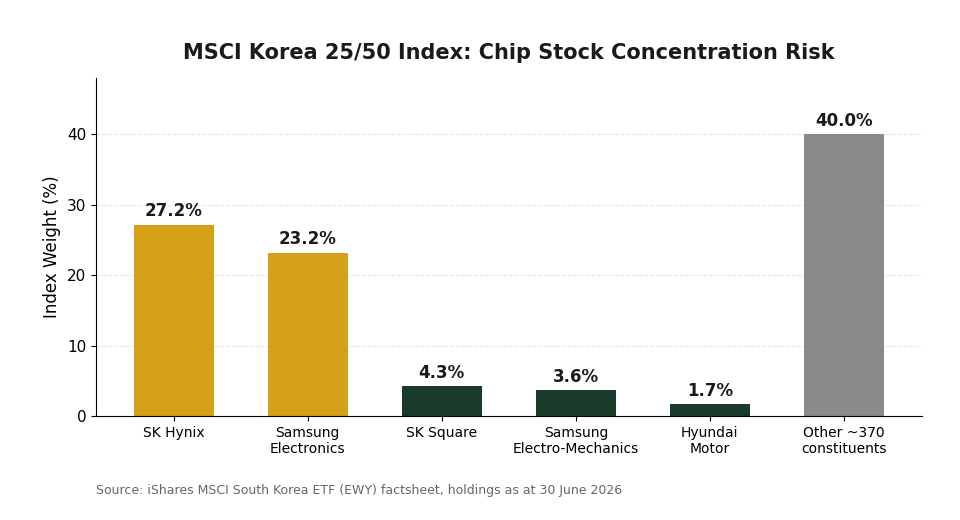
The “25/50” in the name is a rule, not a typo. It caps any single stock at 25% of the index and caps combined mega-cap weights at 50%. That rule exists precisely because Korea’s market is so top-heavy. Even with the cap, Samsung Electronics and SK Hynix together make up close to half the index today.
For you as a Singapore investor, the real decision isn’t which index to track — all three UCITS options below track a near-identical basket. UCITS just means the fund is registered under Europe’s retail fund rules, which is what lets it trade on the London Stock Exchange (LSE) and be sold to investors outside the EU, including Singapore. The real decision is where the ETF itself is domiciled. Ireland- and Luxembourg-domiciled UCITS ETFs trade on the LSE in USD or GBP. The alternative is a US-listed fund like the iShares MSCI South Korea ETF (EWY), which trades on NYSE Arca in the US.
Both routes buy the same underlying Korean shares. The difference isn’t what you own — it’s the tax treatment of the wrapper. We’ll get to the numbers in the tax table further down.
Why Korea ETFs Are Trending in 2026
Korea’s stock market has had a wild 2026. The KOSPI rallied roughly 90% from its January lows, hitting an intraday high of 8,933.62 on 2 June — driven almost entirely by AI chip demand for SK Hynix’s high-bandwidth memory (HBM) chips.
HBM is the memory that feeds Nvidia’s AI processors. SK Hynix controls an estimated 57–62% of the global HBM market. That single fact explains most of what happened to Korean stocks this year.
The rally wasn’t smooth. From that June peak, the KOSPI fell 25% and wiped out roughly USD 1 trillion in market value within weeks. Then, on 31 July, it staged the largest single-day gain in its history — up 18% in one session — as the global AI trade came roaring back. By mid-August, the index had climbed back into a technical bull market, up about 23% from its 30 July low.
Here’s what that means for you: a Korea ETF isn’t a diversified emerging-market fund. It’s closer to a leveraged bet on two chip companies riding the AI supercycle. That’s the opportunity — and it’s also the risk, covered in more detail below.
There’s a second story running alongside the AI rally. In June 2026, MSCI reviewed Korea for developed-market status again — and kept it in the emerging-market bucket. Limited won convertibility in offshore markets, a rigid investor identification system, and restrictions on off-exchange transactions were the main reasons cited. A near-term upgrade is now off the table until at least 2028.
That matters for fund flows, not just headlines. Staying in the emerging-market bucket keeps Korea inside broad EM index funds — and out of developed-market ones — for years to come. If you’re holding a global EM ETF already, you likely have Korea exposure without realising it.
Best Korea ETFs for Singapore Investors
Three UCITS ETFs give you LSE access to Korean equities. All three sidestep the US estate tax exposure that comes with US-listed funds like EWY. The table below includes each fund’s TER — the Total Expense Ratio, or what you pay each year to hold it, expressed as a percentage of your investment.
| ETF | Ticker (LSE) | ISIN | TER | Domicile | Structure |
|---|---|---|---|---|---|
| Xtrackers MSCI Korea UCITS ETF 1C | XKSD | LU0292100046 | 0.45% | Luxembourg | Accumulating |
| HSBC MSCI Korea Capped UCITS ETF USD | HKOD | IE00B3Z0X395 | 0.50% | Ireland | Distributing (semi-annual) |
| iShares MSCI Korea UCITS ETF USD (Dist) | IKOR | IE00B0M63391 | 0.65% | Ireland | Distributing |
| iShares MSCI South Korea ETF (US-listed) | EWY (NYSE Arca) | US4642868511 | 0.59% | United States | Distributing |
Source: justETF, DWS Xtrackers, HSBC Asset Management, iShares fund factsheets, September 2026
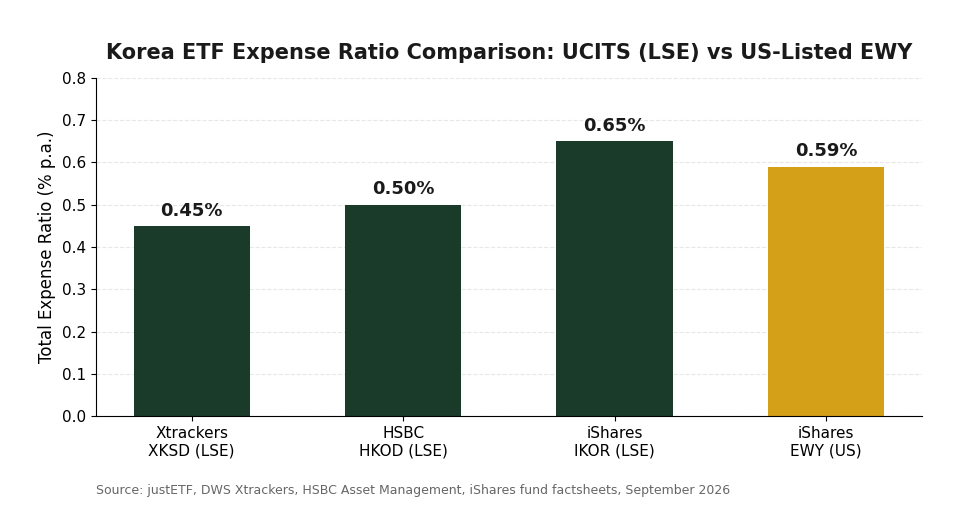
XKSD is the cheapest of the three. It tracks the broader MSCI Korea index at a 0.45% TER and reinvests dividends automatically (accumulating). HKOD uses the capped MSCI Korea 20/35 methodology and pays a semi-annual cash distribution — useful if you want dividend income rather than automatic reinvestment. IKOR is the priciest at 0.65%, though iShares also runs an accumulating share class (ticker CSKR, ISIN IE00B5W4TY14) if you’d rather compound returns inside the fund.
For a SGD 20,000 position, that TER gap is small in dollar terms — SGD 90 a year for XKSD versus SGD 130 for IKOR — but it compounds over decades, so the cheaper option wins by default unless the distribution schedule matters more to you.
Now for the part that actually matters more than the TER gap: where the fund itself is domiciled. US-domiciled funds — including EWY — are treated by the IRS as “US situs” property for estate tax purposes. Situs just means legal location: the IRS looks at where the fund is domiciled, not what it invests in, so a US-listed fund counts as US property even though it only holds Korean stocks. Ireland- and Luxembourg-domiciled UCITS ETFs are not US situs assets. Here’s the difference in plain numbers.
| ETF Type | Domicile | Traded On | US Estate Tax Risk |
|---|---|---|---|
| XKSD / HKOD / IKOR | Ireland / Luxembourg | London Stock Exchange | None |
| EWY | United States | NYSE Arca | Yes — above USD 60,000, up to 40% tax |
Source: IRS — Nonresidents with US Assets, June 2026. See our full US estate tax guide for Singapore investors for the mechanics.
One nuance worth flagging: Korean dividend withholding tax applies before any of these funds distribute income to you, at a rate set by the tax treaty between Korea and each fund’s own home country — not by where you, the Singapore investor, live. That withholding cost is largely baked into all four funds’ returns already, so it isn’t a meaningful reason to pick one LSE option over another. The one number genuinely in your control is US estate tax exposure — and that’s a straightforward domicile choice.
How to Buy Korea ETFs in Singapore
All three LSE-listed options are available through brokers that offer London Stock Exchange access. Here’s how it works on the four platforms Singapore investors use most.
Interactive Brokers (IBKR): Fund your account, search “XKSD”, “HKOD” or “IKOR” in the order entry screen, and select the LSE listing (denominated in USD or GBX depending on the share class). IBKR charges a small LSE commission but gives you the widest choice of Korea ETFs, including CSKR if you want the accumulating iShares version.
Saxo Markets: Similar process — search by ticker or ISIN, confirm the LSE exchange, and place your order in USD. Saxo’s platform clearly labels UCITS ETFs, which helps if you’re comparing accumulating versus distributing share classes.
moomoo Singapore: moomoo has added LSE access for many popular UCITS ETFs. Check the specific ticker is listed before funding, since not every LSE-listed fund is available on every platform.
Syfe Brokerage: Syfe added LSE stocks and UCITS ETFs to its brokerage in 2026, with unlimited free trades on scheduled UCITS orders. Orders for LSE-listed ETFs are typically batched and executed weekly, which suits investors who are dollar-cost averaging rather than timing entries. If you’re new to LSE investing, this is the simplest starting point — you can open a Syfe account with our referral code for a sign-up bonus.
Whichever broker you use, place your order during LSE trading hours (3:00pm–11:30pm Singapore time) to get a live quote instead of a stale one.
Risks to Consider
A Korea ETF is not a “safe” diversifier — it’s a concentrated, cyclical bet. Here’s what to weigh before you buy.
Concentration risk. Samsung Electronics and SK Hynix together make up close to half of the index. If AI chip demand cools, or if either company stumbles on execution, the whole fund feels it — there’s no diversification cushion from the other ~370 constituents, which barely move the needle.
Volatility. 2026 alone saw a 90% rally, a 25% correction, and an 18% single-day surge — sometimes within the same quarter. If you can’t stomach that swing in your portfolio, size your position accordingly, or treat this as a satellite holding rather than a core one.
Currency risk. The underlying stocks trade in Korean won. Even though the ETF is priced in USD or GBP on the LSE, won weakness against those currencies (or against SGD) can offset gains in the underlying shares.
Geopolitical and governance risk. North Korea tensions periodically spook Korean equities, and Korea’s “chaebol discount” — where family-controlled conglomerates trade cheaper than peers due to governance concerns — has been a long-running feature, not a bug, of this market.
Liquidity risk. These UCITS ETFs are smaller than CSPX or VWRA. Spreads can be wider, especially outside LSE trading hours, so use limit orders rather than market orders when you buy or sell.
None of this means avoid Korea entirely — it means size the position like the concentrated, thematic bet it actually is. If you already hold a broad emerging-market or Asia ex-Japan fund, check your existing Korea weight before adding a dedicated Korea ETF on top. For a broader single-country comparison, see our Nasdaq 100 ETF Singapore guide on the US alternative to concentrated tech exposure, and our note on accumulating vs distributing ETFs if you’re deciding between XKSD and HKOD/IKOR on structure alone. If you’re weighing how a volatile satellite position like this fits your bigger picture, run the numbers through our free Singapore retirement calculator before you size the trade.
Prefer a steadier, income-focused single-theme ETF instead of a chip-cycle bet? Our Dividend Aristocrats ETF Singapore guide covers GBDV and USDV — two LSE-listed UCITS options built for consistency rather than momentum.
Frequently Asked Questions
What is the best Korea ETF for Singapore investors?
For most Singapore investors, XKSD (Xtrackers MSCI Korea UCITS ETF) is the most cost-efficient LSE option at a 0.45% TER, and it accumulates dividends automatically. If you want cash distributions instead, HKOD or IKOR are the alternatives, at a slightly higher cost. All three avoid the US estate tax exposure that comes with the US-listed EWY.
Is South Korea a developed or emerging market?
As at the June 2026 MSCI market classification review, Korea remains an emerging market. MSCI cited limited won convertibility in offshore markets, a rigid investor identification system, and restrictions on off-exchange transactions as the main barriers. A near-term upgrade to developed-market status is now unlikely before 2028.
Can I buy Korea ETFs using my CPF or SRS funds?
No — LSE-listed UCITS ETFs like XKSD, HKOD and IKOR are not on the CPF Investment Scheme’s approved list. If you invest via SRS, check with your specific broker first, since SRS-funded trades are usually restricted to SGX-listed instruments or specific broker-approved products, not general LSE access.
Which broker is best for buying Korea ETFs in Singapore?
Interactive Brokers offers the widest selection, including the accumulating iShares share class (CSKR). Saxo Markets is a close second with clear UCITS labelling. Syfe Brokerage is the simplest option for beginners, with unlimited free trades on scheduled UCITS orders, though orders are typically batched weekly rather than executed instantly.
Is XKSD the same as EWY?
They track very similar Korean equity baskets, but they are not the same fund. XKSD is Luxembourg-domiciled, trades on the LSE, and carries no US estate tax exposure. EWY is US-domiciled, trades on NYSE Arca, and is treated as a US situs asset — meaning holdings above USD 60,000 can be subject to US estate tax at rates up to 40% for non-US persons.
What are the risks of investing in a Korea ETF?
The biggest risk is concentration — Samsung Electronics and SK Hynix together make up close to half the index, so the fund behaves more like a two-stock semiconductor bet than a diversified country fund. Add in won currency risk, periodic geopolitical tension with North Korea, and Korea’s long-standing “chaebol discount” on governance, and this is best treated as a satellite position, not a core holding.
Ready to Add Korea Exposure to Your Portfolio?
Open a brokerage account with LSE access and size your Korea ETF position like the concentrated bet it is.
This article was researched with the help of AI. While we strive to keep all information accurate and up to date, there may be errors. If you notice any discrepancies, please contact us.