CPF Contribution Rate 2026: Complete Guide for Singapore Employees
Employee and employer rates by age group, OA/SA/MA split, and everything that changed in 2026.
In 2026, Singapore employees below 55 contribute 20% of their salary to CPF, while employers add 17% — a combined 37%. Rates taper by age, falling to 12.5% total for workers above 70. The Ordinary Wage ceiling is $7,400 per month. Here is the full breakdown of CPF contribution rates 2026, including what changed and how your money splits across OA, SA, and MediSave.
Not financial advice. All figures are for educational reference only. Verify current rates at the CPF Board website. Data as at 2026 unless noted.
- Under-55 workers: 20% (you) + 17% (employer) = 37% total CPF
- Rates taper with age — 55-60 workers get 32% total; above 70 gets 12.5%
- Ordinary Wage ceiling is $7,400/month — contributions only apply up to this amount
Free download: The Singapore Money Playbook — 7 money mindset shifts written for Singapore, with the CPF-adjusted retirement number most guides get wrong (PDF + Notion).
Table of Contents
Contents — Click to expand
- What Is the CPF Contribution Rate?
- CPF Contribution Rates by Age Group (2026)
- What Changed in 2026?
- How CPF Splits Across OA, SA, and MediSave
- Worked Example: Your Take-Home Pay
- Ordinary Wage and Additional Wage Ceilings
- Voluntary CPF Top-Ups
- CPF for Self-Employed Singaporeans
- Frequently Asked Questions
What Is the CPF Contribution Rate?
The CPF contribution rate is the percentage of your salary that flows into your Central Provident Fund each month. Both you and your employer contribute. The split depends on your age and how much you earn.
For most Singaporeans below 55, the combined rate is 37% of your Ordinary Wages — 20% from you and 17% from your employer. Your portion is deducted from your gross pay. Your employer’s portion is paid on top of your salary, so it does not reduce your take-home.
CPF contributions go into three sub-accounts: the Ordinary Account (OA) for housing and investments, the Special Account (SA) for retirement, and the MediSave Account (MA) for healthcare. Note: from 2025, the SA was closed for those aged 55 and above — amounts shifted to the Retirement Account (RA) and OA.
CPF Contribution Rates by Age Group (2026)
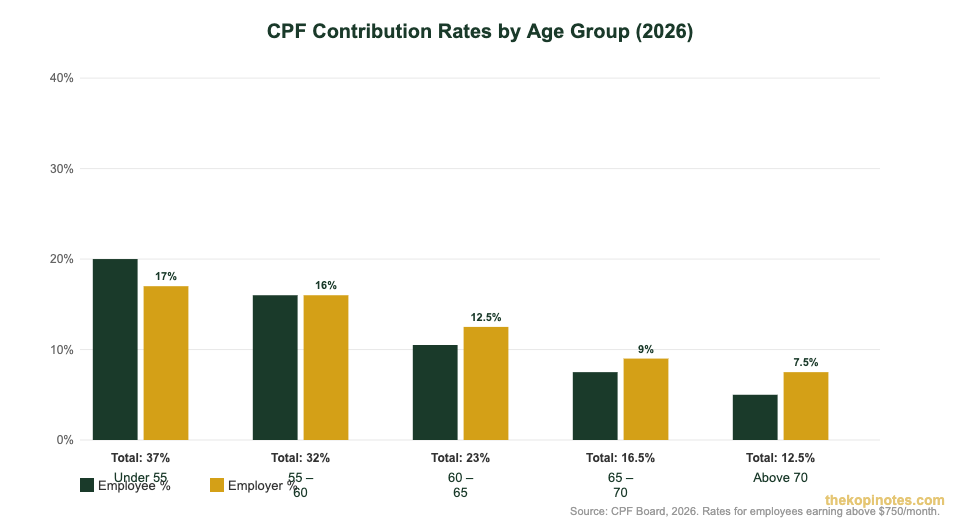
These are the mandatory CPF contribution rates for Singaporeans and Permanent Residents earning more than $750 per month. Rates apply to Ordinary Wages up to the $7,400 monthly ceiling.
| Age Group | Employee % | Employer % | Total % |
|---|---|---|---|
| Below 55 | 20% | 17% | 37% |
| 55 to 60 | 16% | 16% | 32% |
| 60 to 65 | 10.5% | 12.5% | 23% |
| 65 to 70 | 7.5% | 9% | 16.5% |
| Above 70 | 5% | 7.5% | 12.5% |
Source: CPF Board, 2026. Applicable to Singaporeans and PRs earning above $750/month. Lower graduated rates apply for wages $50–$750/month and for first- and second-year PRs.
What Changed in 2026?
The most significant ongoing shift has been the progressive increase in contribution rates for older workers — particularly the 55-60 and 60-65 age groups. The government started raising these rates in 2022 to help Singaporeans aged 55 and above build more retirement savings.
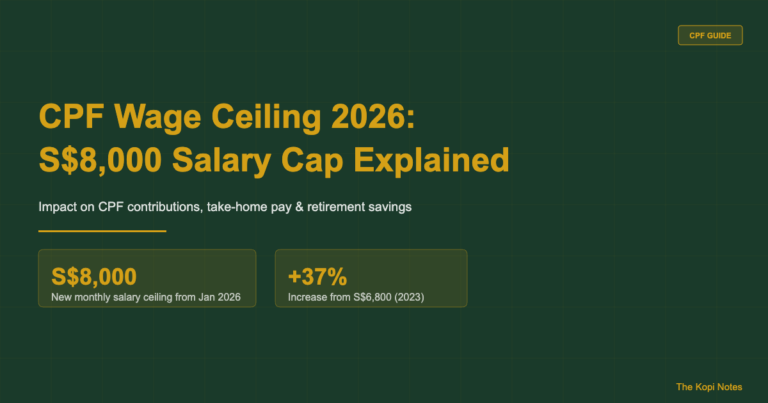
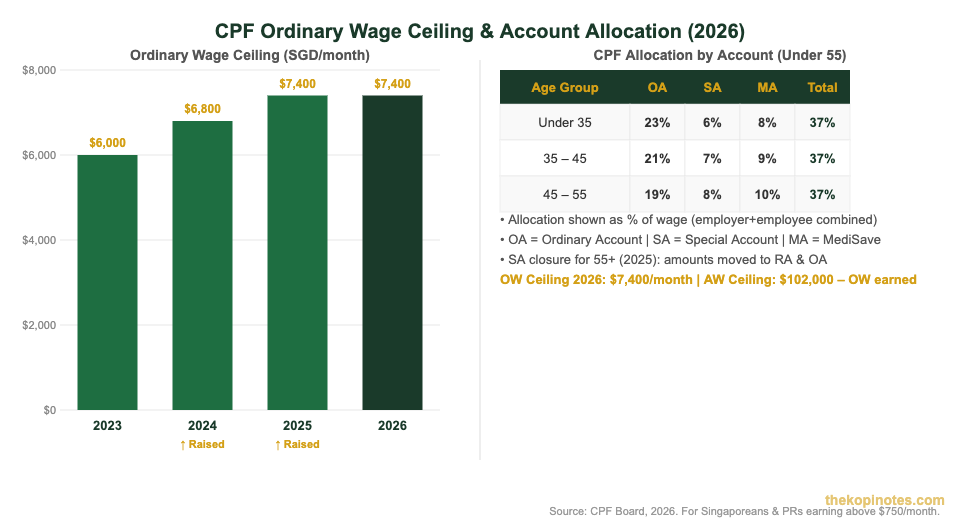
The Ordinary Wage ceiling has also risen steadily. It was $6,000 in 2023, moved to $6,800 in 2024, and reached $7,400 in 2025. It remains at $7,400 in 2026. This matters because more of your salary is now subject to CPF contributions — meaning more forced savings, but slightly lower take-home pay on higher salaries.
The closure of the Special Account (SA) for members aged 55 and above, implemented in 2025, continues to apply. From age 55, a Retirement Account (RA) is created and your SA balance is transferred to it (up to the Full Retirement Sum). Any remaining SA balance moves to OA.
How CPF Contributions Split Across OA, SA, and MediSave
Your total CPF contribution is not deposited as a single lump sum. It is divided among three accounts based on your age. Younger workers get a larger share in OA (useful for housing loans), while older workers get more in MA (for rising healthcare needs).
| Age Group | OA | SA | MediSave | Total |
|---|---|---|---|---|
| Under 35 | 23% | 6% | 8% | 37% |
| 35 to 45 | 21% | 7% | 9% | 37% |
| 45 to 55 | 19% | 8% | 10% | 37% |
Source: CPF Board, 2026. Allocation shown as percentage of Ordinary Wages (combined employee + employer contribution). Rates for 55+ differ as contributions flow to OA and MA (RA topped up via RSTU).
Worked Example: Your Take-Home Pay
Say you are 35 years old and earn $5,000 a month. Here is exactly what happens to that $5,000:
- Employee CPF contribution: 20% × $5,000 = $1,000 (deducted from your pay)
- Employer CPF contribution: 17% × $5,000 = $850 (paid by employer on top, does not reduce your salary)
- Your take-home pay: $5,000 − $1,000 = $4,000
- Total CPF credited to your accounts: $1,850 per month
Of that $1,850, the allocation for a 35-year-old is: OA gets $1,050 (21%), SA gets $350 (7%), MA gets $450 (9%). The SA and OA earn interest of 4% and 2.5% per annum respectively — making CPF one of the most reliable ways to grow passive income in Singapore risk-free.
If you want to model how your CPF savings grow over time, try the Singapore retirement calculator — it accounts for interest compounding across all three accounts.
Ordinary Wage and Additional Wage Ceilings
Two CPF ceilings determine how much of your pay is subject to contributions:
Ordinary Wage (OW) ceiling — $7,400/month: If you earn $10,000 per month, CPF contributions only apply to $7,400. The extra $2,600 is not subject to CPF.
Additional Wage (AW) ceiling — $102,000 minus total OW: This applies to variable pay like annual bonuses. If you earned $7,400 × 12 = $88,800 in OW for the year, your AW ceiling is $102,000 − $88,800 = $13,200. Bonuses above $13,200 are not subject to CPF.
The OW ceiling increase from $6,000 (2023) to $7,400 (2025-2026) means higher earners now contribute more to CPF — adding to their housing and retirement savings, but reducing monthly take-home slightly. For those planning to use CPF for investing, a higher OA balance offers more capital to deploy through CPFIS.
Voluntary CPF Top-Ups
Beyond the mandatory contributions, you can add more to your CPF via two routes:
Retirement Sum Topping-Up Scheme (RSTU): Top up your own or a family member’s Special Account (under 55) or Retirement Account (55+). You get a tax relief of up to $8,000 per year for self top-ups, plus another $8,000 for topping up family members. This is one of the most tax-efficient moves available to Singaporeans.
Voluntary Contributions (VC): Contribute extra to all three CPF accounts, up to the CPF Annual Limit of $37,740 (mandatory + voluntary combined). VC does not attract tax relief but builds your retirement balance faster.
If you are already maximising CPF, the next step is usually a Singapore Savings Bond or a diversified ETF portfolio. For investors who want more control, platforms like FSMOne allow you to invest your SRS and cash savings in low-cost funds alongside your CPF.
CPF for Self-Employed Singaporeans
If you are self-employed — a freelancer, sole proprietor, or partner in a firm — your CPF obligations are different. You must contribute to MediSave only. The rate is between 6% and 10.5% of your net trade income, depending on your age and income level.
However, contributing voluntarily to OA and SA is one of the smartest things a self-employed person can do. You get the same interest rates (2.5% OA, 4% SA), the same tax relief on RSTU top-ups, and the same access to CPF-approved investments. You just have to be more intentional about it, since no employer is doing it for you.
If you are planning your retirement as a self-employed person, consider pairing voluntary CPF top-ups with dividend-paying assets. Our guide on passive income in Singapore covers how to build a sustainable income stream outside CPF.
The Bottom Line
CPF contribution rates in 2026 remain one of the most generous forced-savings systems in the world. At 37% combined for workers below 55, it means nearly two-fifths of your salary is being set aside for housing, retirement, and healthcare — automatically.
Understanding your exact rate and how your contributions split is the first step to making CPF work harder for you. Use the Singapore retirement calculator to see how your CPF balance compounds over time, and check the CPF Board’s official CPF contribution rate tables for the most up-to-date figures.
Frequently Asked Questions
What is the CPF contribution rate for employees below 55 in 2026?
What is the Ordinary Wage ceiling for CPF contributions in 2026?
Did CPF contribution rates change in 2026?
How is my CPF contribution split across OA, SA, and MediSave?
Does my employer's CPF contribution reduce my take-home pay?
Can self-employed Singaporeans contribute to CPF?
What is the CPF Annual Limit for 2026?
This article was researched with the help of AI. While we strive to keep all information accurate and up to date, there may be errors. If you notice any discrepancies, please contact us.