Mapletree Logistics Trust (M44U) 2026: Complete Investor Guide — DPU, Portfolio & Investment Thesis
Mapletree Logistics Trust (SGX: M44U), or MLT, is one of Singapore’s most widely held S-REITs — a pan-Asia logistics REIT spanning warehouses and distribution centres across 9 countries. With approximately 186 properties and AUM of roughly S$13–14 billion, MLT offers retail investors diversified exposure to Asia’s booming e-commerce and supply chain infrastructure. Yet its DPU has fallen from a peak of 9.014 cents in FY2021/22 to approximately 7.26 cents in FY2025/26 as China headwinds and rising interest costs took hold. With Fed rate cuts on the horizon and China divestment strategy under way, this 2026 guide breaks down everything Singapore investors need to know about MLT.
Not financial advice. All data is for educational and informational purposes only. Data as at September 2026 unless stated.
- Pan-Asia logistics REIT: 186 properties across Singapore, Japan, South Korea, Australia, China, Hong Kong, Vietnam, Malaysia, India
- DPU has declined from a peak 9.014c (FY2021/22) to ~7.26c (FY2025/26) — China writedowns and higher borrowing costs the main culprits
- At unit prices around S$1.20–1.40, MLT offers a dividend yield of approximately 5.5–6.5% — competitive for a blue-chip logistics REIT
- China divestment strategy in progress (S$154.5M Guangzhou sale completed) — simplifying the portfolio and reducing concentration risk
- Fed rate cuts + Asia e-commerce growth = potential DPU recovery in FY2026/27 — the bull case for MLT investors in 2H2026
Table of Contents — Click to expand
- What Is Mapletree Logistics Trust?
- MLT Portfolio: 9 Countries, 186 Properties
- DPU History & Dividend Yield
- Key Financial Metrics & Gearing
- China Exposure: Headwind or Opportunity?
- Rate Cut Tailwinds: Why 2H2026 Matters
- MLT vs Peer S-REITs: Yield Comparison
- How to Invest in MLT in Singapore
- Frequently Asked Questions
What Is Mapletree Logistics Trust?
Mapletree Logistics Trust (SGX: M44U) is Singapore’s first and one of Asia’s largest pan-Asia logistics real estate investment trusts. Listed on the Singapore Exchange in July 2005, MLT is managed by Mapletree Logistics Trust Management Ltd — a wholly owned subsidiary of Mapletree Investments Pte Ltd, the real estate arm of Temasek Holdings.
MLT focuses exclusively on logistics real estate: warehouses, distribution centres, cold storage facilities, and integrated logistics hubs. Unlike diversified industrial REITs such as CapitaLand Ascendas REIT (which includes business parks and data centres), MLT is a pure-play logistics REIT — which means its performance is closely tied to trade volumes, e-commerce growth, and supply chain demand across Asia.
MLT at a Glance (September 2026)
| Metric | Value |
|---|---|
| SGX Ticker | M44U |
| REIT Type | Pan-Asia Logistics / Warehouse |
| Number of Properties | ~186 |
| Total AUM | ~S$13–14 billion |
| Countries | 9 (SG, JP, KR, AU, CN, HK, VN, MY, IN) |
| FY2025/26 DPU | ~7.26 Singapore cents |
| Dividend Yield (est.) | ~5.5–6.5% |
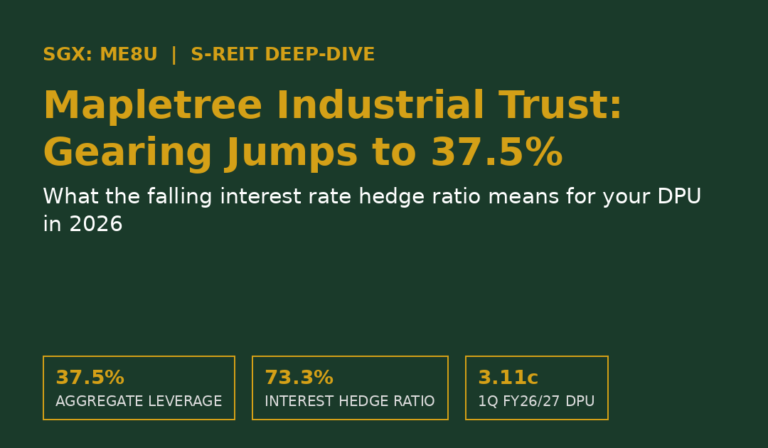
| Aggregate Gearing | ~38–40% |
| Sponsor | Mapletree Investments Pte Ltd (Temasek-linked) |
| Distribution Frequency | Quarterly |
Source: MLT SGX filings and investor presentations, 2026. Yield is estimated based on prevailing unit price range. Not financial advice.
The sponsor relationship with Mapletree Investments — which manages over S$77 billion in assets globally — gives MLT a strong pipeline of potential property acquisitions. This “right of first refusal” arrangement means MLT can grow its portfolio when accretive opportunities arise without competing in the open market.
MLT pays distributions quarterly, which is a feature Singapore income investors appreciate. For more on how S-REIT distributions work and how to compare yields, see our Best S-REITs Singapore 2026 guide.
MLT Portfolio: 9 Countries, 186 Properties
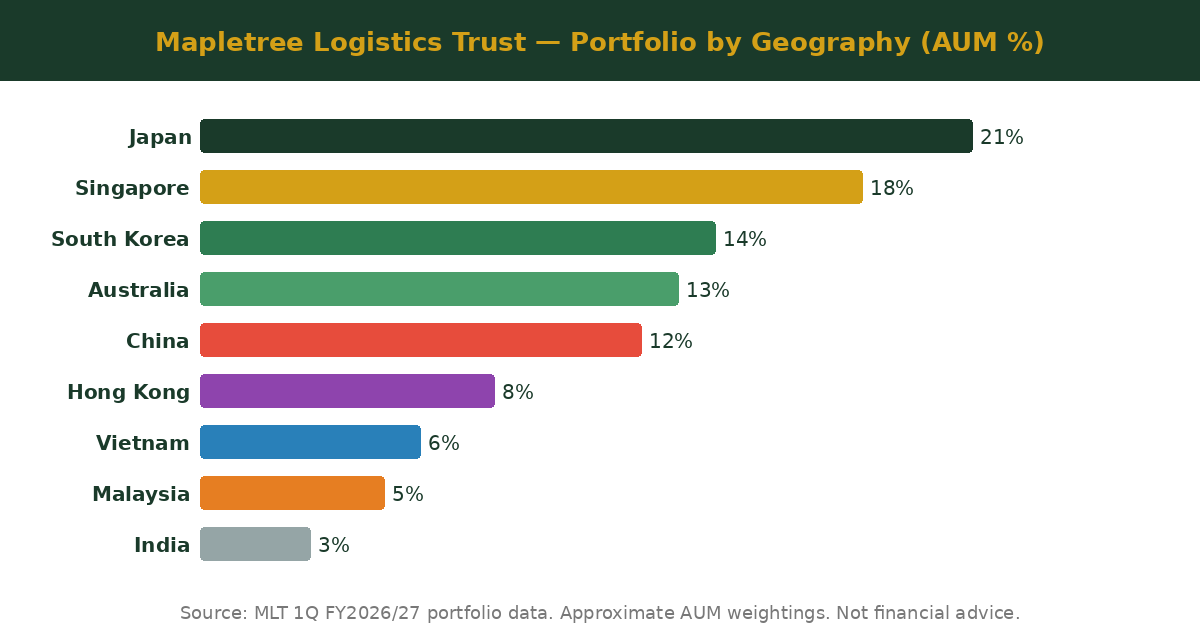
One of MLT’s defining features is its geographic breadth. No other SGX-listed REIT combines logistics real estate across as many Asian markets. Here’s how the portfolio breaks down by country:
| Country | Approx. AUM % | Key Assets / Notes |
|---|---|---|
| Japan | ~21% | Largest single market; modern Grade-A facilities, e-commerce tailwinds |
| Singapore | ~18% | Home market; high-quality, freehold-equivalent leasehold assets |
| South Korea | ~14% | Growing cold-chain and e-commerce fulfilment exposure |
| Australia | ~13% | AUD-denominated; logistics scarcity in Sydney, Melbourne |
| China | ~12% | Being strategically reduced via divestments; RMB weakness a headwind |
| Hong Kong | ~8% | High-value urban logistics; limited new supply |
| Vietnam | ~6% | High-growth manufacturing hub; supply-chain China+1 diversification |
| Malaysia | ~5% | Shah Alam and Johor logistics clusters |
| India | ~3% | Bangalore and Pune; early-stage but high long-term potential |
Source: MLT investor presentation, 1Q FY2026/27 (July 2026). Approximate AUM weightings. Not financial advice.
The geographic diversification is a double-edged sword. On the upside, MLT benefits from Asia’s structural e-commerce and supply chain growth story. On the downside, currency exposure across 9 currencies (SGD, JPY, KRW, AUD, RMB, HKD, VND, MYR, INR) creates foreign exchange risk that can erode SGD-denominated DPU even when local-currency returns are healthy.
DPU History & Dividend Yield
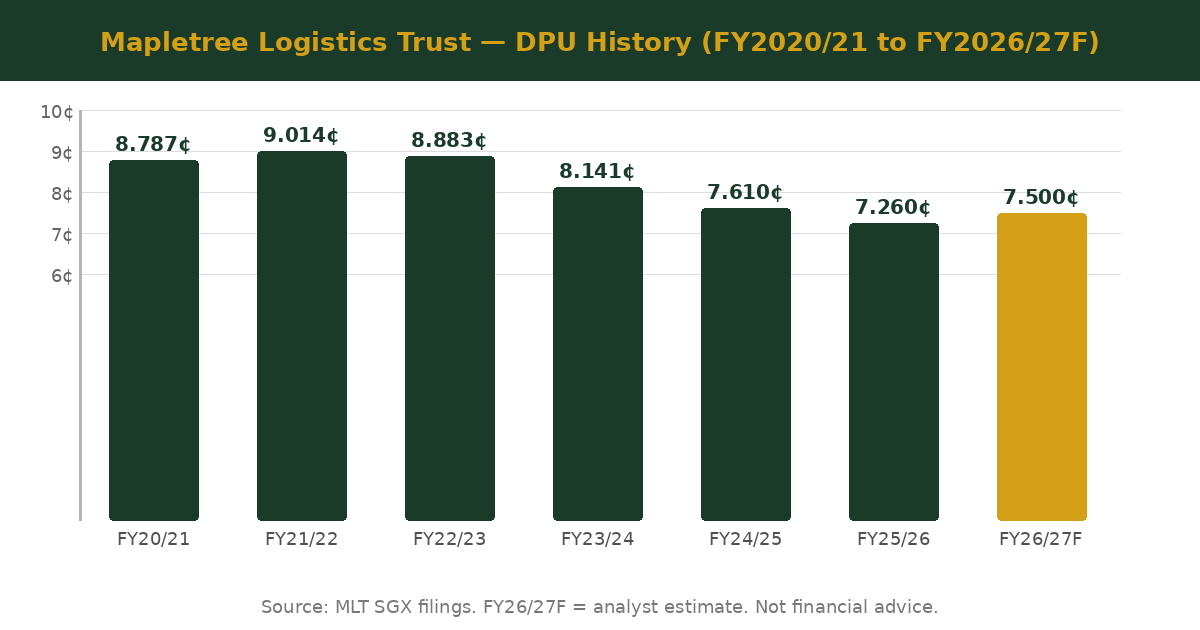
MLT’s distribution per unit (DPU) peaked at 9.014 cents in FY2021/22 — a high watermark driven by near-zero interest rates, strong pandemic e-commerce tailwinds, and aggressive portfolio expansion. Since then, DPU has declined for three consecutive years as borrowing costs rose sharply with global rate hikes, and China property market weakness eroded valuations.
| Financial Year | DPU (Singapore cents) | YoY Change |
|---|---|---|
| FY2020/21 | 8.787¢ | — |
| FY2021/22 (Peak) | 9.014¢ | +2.6% |
| FY2022/23 | 8.883¢ | –1.5% |
| FY2023/24 | 8.141¢ | –8.4% |
| FY2024/25 | 7.610¢ | –6.5% |
| FY2025/26 | ~7.26¢ | ~–4.6% |
| FY2026/27 (Analyst estimate) | ~7.50¢ | ~+3.3% (recovery) |
Source: MLT SGX annual reports. FY2025/26 figure is based on reported results and analyst estimates. FY2026/27F is a consensus analyst forecast and not guaranteed. Not financial advice.
At a unit price of approximately S$1.30, MLT’s estimated FY2026/27 forward yield is around 5.8% — above the Singapore 10-year bond yield and competitive with peer logistics REITs globally. The quarterly distribution schedule provides regular income cash flow for investors.
For comparison across all major S-REITs, see our Best S-REITs Singapore 2026 guide or use our retirement income calculator to model how MLT distributions fit your passive income plan.
Key Financial Metrics & Gearing
Understanding MLT’s balance sheet is essential before investing. Three metrics matter most for S-REIT investors: aggregate leverage (gearing), cost of debt, and interest coverage ratio (ICR).
| Financial Metric | MLT (FY2025/26) | What It Means |
|---|---|---|
| Aggregate Gearing | ~38–40% | Below MAS’s 50% regulatory limit — headroom for acquisitions |
| Cost of Debt | ~3.2–3.5% | Manageable; will fall as rates cut and hedges roll off |
| Interest Coverage Ratio | ~3.0–3.5x | Above MAS’s 1.5x minimum; comfortable cushion |
| Fixed-Rate Debt % | ~75–80% | Shields most debt from rate volatility in the near term |
| Debt Maturity Profile | Well-staggered | No single-year cliff; maturities spread over 5+ years |
| Portfolio Occupancy | ~96–97% | High occupancy across the portfolio; strong tenant demand |
Source: MLT SGX filings and investor presentations. Figures approximate. Not financial advice.
One important note: MLT completed a S$400 million perpetual bond refinancing in 2026 — replacing older, higher-cost perpetual securities with newer instruments at a lower coupon. This reduces the drag on distributable income and is a positive signal for FY2026/27 DPU recovery. For the full breakdown, see our earlier MLT share price and DPU outlook article.
China Exposure: Headwind or Opportunity?
China has been the single biggest drag on MLT’s performance since FY2022/23. Three headwinds combined:
- Property valuation writedowns: China’s real estate market slump extended to logistics assets, cutting the book value of MLT’s China portfolio.
- RMB weakening: A weaker Chinese yuan translates directly to lower SGD-equivalent distributions from China assets.
- Slower domestic demand: China’s post-pandemic recovery in consumer spending and e-commerce was below expectations, softening logistics asset income.
MLT’s management has responded with a deliberate China divestment strategy. The sale of a Guangzhou property for S$154.5 million in 2026 was the most significant step — reducing China’s share of AUM and redeploying capital into higher-quality markets like Japan, South Korea, and Australia.
The key question for investors: is China’s drag now “priced in” at current MLT unit prices? Analysts are divided — but the direction of travel (reducing China, growing Japan and Korea) is structurally positive for DPU quality.
MLT’s management has guided toward reducing China exposure below 10% of AUM through ongoing divestments. This de-risking move should improve the quality of the remaining portfolio and reduce FX drag on future DPU.
Rate Cut Tailwinds: Why 2H2026 Matters
MLT, like all S-REITs, benefits from falling interest rates through two channels: lower borrowing costs and yield compression (which drives unit price appreciation).
With the US Federal Reserve cutting rates in 2026, the impact on MLT is playing out as follows:
- Cost of debt improvement: As higher-rate hedges roll off and get replaced at lower rates, MLT’s all-in borrowing cost should decline from ~3.4% toward 3.0% or below over FY2026/27–27/28. Each 0.1 percentage point reduction in borrowing cost adds roughly 0.05–0.10 cents to annual DPU.
- Unit price re-rating: When risk-free rates fall, REIT yield spreads compress — meaning REIT unit prices typically rise to maintain competitive yields. At an 80 bps rate cut, MLT’s fair value could re-rate by 10–20% based on DCF models.
- Asia currency recovery: Rate cuts in the US tend to weaken the USD and strengthen Asian currencies — including the JPY, KRW, and AUD. A stronger JPY translates directly to higher SGD-equivalent income from MLT’s Japan portfolio (its largest segment).
This makes MLT an interesting rate-cut play alongside more direct beneficiaries like CapitaLand Ascendas REIT. The difference: MLT’s rate cut case is amplified by the Japan exposure angle (JPY recovery) and the China overhang clearing gradually.
MLT vs Peer S-REITs: Yield Comparison
How does MLT stack up against comparable S-REITs in September 2026?
| REIT | Type | Est. Yield | Gearing |
|---|---|---|---|
| MLT (M44U) | Pan-Asia Logistics | ~5.5–6.5% | ~38–40% |
| CLAR (A17U) | Industrial + DC | ~5.0–5.5% | ~37% |
| AIMS APAC REIT (O5RU) | Industrial | ~7.0–8.0% | ~32–35% |
| Keppel DC REIT (AJBU) | Data Centres | ~4.5–5.5% | ~36–38% |
| Suntec REIT (T82U) | Office + Retail | ~6.5–7.5% | ~42–44% |
Source: Estimated yields based on prevailing unit prices and analyst DPU forecasts, September 2026. Not financial advice. Yields change daily based on price movements.
MLT sits in the “blue-chip quality at fair yield” band — not the cheapest yield available among S-REITs, but backed by a global sponsor and a professionally managed, broadly diversified portfolio. Investors who want pure logistics exposure without the higher gearing or smaller-market concentration risk of some peers tend to find MLT’s risk-reward attractive.
How to Invest in MLT in Singapore
Singaporeans can buy MLT units through any SGX-connected brokerage account. MLT is eligible for CPF Investment Scheme (CPFIS) investing under the Ordinary Account — a feature that makes it popular for CPF investors looking for S-REIT exposure. It is also eligible for the Supplementary Retirement Scheme (SRS).
Recommended brokerages for MLT investors:
- Endowus (referral code: 2V343) — for CPF and SRS-eligible REIT fund investing
- FSMOne (referral code: P0544985) — low commission, good for SGX-listed REITs
- Syfe (referral code: SRPRFFFCD) — for REITs portfolios via the Syfe REIT+ portfolio
MLT is also held within the Singapore REIT ETF (NikkoAM-StraitsTrading Asia ex Japan REIT ETF, ticker: CFA), so investors who prefer not to pick individual S-REITs can get MLT exposure through a diversified REIT fund.
Before investing, always calculate how MLT distributions fit your overall passive income target using our retirement planning calculator.
Frequently Asked Questions
What is Mapletree Logistics Trust and how does it work?
Is Mapletree Logistics Trust a good investment in 2026?
What is MLT's current dividend yield?
Can CPF or SRS funds be used to invest in MLT?
What is MLT's China exposure and why does it matter?
How does MLT compare to Keppel DC REIT and CapitaLand Ascendas REIT?
What are the main risks of investing in MLT?
What is the MLT unit price outlook for 2H2026?
How do I buy MLT units in Singapore?
This article was researched with the help of AI. While we strive to keep all information accurate and up to date, there may be errors. If you notice any discrepancies, please contact us.