Keppel DC REIT Interest Rate Sensitivity 2026: How Rate Cuts Boost DPU and NAV
Last updated: October 2026 | Category: S-REITs | Keppel DC REIT (SGX: AJBU)
Keppel DC REIT (SGX: AJBU) is Singapore’s largest listed data centre REIT, with an asset under management (AUM) of approximately SGD 11 billion across 23 data centres in 9 countries as at Q3 2026. As interest rates fall in 2026, KDC benefits through two distinct channels: lower floating-rate borrowing costs that flow directly into higher DPU, and cap rate compression that boosts asset values and lifts NAV per unit for Singapore investors.
Not financial advice. All figures are for educational reference only. Data as at October 2026 unless noted.
What Makes Keppel DC REIT Rate-Sensitive?
Like all leveraged S-REITs, Keppel DC REIT funds its portfolio acquisitions with a combination of equity and debt. That debt creates a direct link between interest rate movements and the trust’s financial performance. For Singapore investors tracking the best S-REITs in Singapore 2026, understanding this sensitivity is essential before sizing a position.
There are two main transmission channels through which rate changes affect KDC:
Channel 1 — Borrowing Costs (DPU Channel)
KDC’s total borrowings are split between fixed-rate and floating-rate debt. The floating-rate portion reprices as benchmark rates move — primarily the Singapore Overnight Rate Average (SORA) for SGD debt and SOFR for USD debt. When rates fall, the interest expense on floating-rate debt falls with it, and the saving flows through directly to distributable income and ultimately DPU.
Channel 2 — Cap Rate Compression (NAV Channel)
Data centre assets are valued using capitalisation rates (cap rates), which are heavily influenced by prevailing interest rates. When risk-free rates fall, investors accept lower yields on real estate — cap rates compress, pushing asset values higher. A higher portfolio value translates to a higher NAV per unit, which in turn tends to support a higher share price. This is the “multiple expansion” effect that makes REITs attractive in falling-rate environments.
Importantly, Channel 2 tends to have a much larger impact on total return than Channel 1. A 100bps cut in SORA might add ~0.22 cents to annual DPU (around 2.4%), but the same move could add S$0.30–0.50 to NAV per unit — a 15–25% boost that re-rates the share price. This is why data centre REITs often outperform significantly in rate-cutting cycles.
KDC’s Debt Profile 2026
As at Q3 2026, KDC’s debt structure provides meaningful but managed exposure to floating rates. The trust has actively hedged the majority of its borrowings at fixed rates — a prudent approach that protected DPU during the 2022–2023 rate hike cycle, and which now limits (but does not eliminate) the upside from falling rates.
| Metric | Value |
|---|---|
| Total borrowings | ~SGD 3.1 billion |
| Gearing ratio | ~35.5% |
| MAS leverage limit | 50% |
| Headroom to limit | ~SGD 1.4 billion |
| Weighted avg. all-in cost of debt (WACID) | ~2.6% p.a. |
| Fixed rate debt | ~72% (~SGD 2.23B) |
| Floating rate debt | ~28% (~SGD 868M) |
| Avg. debt maturity | ~3.8 years |
| Interest coverage ratio (ICR) | ~3.8x |
Source: Keppel DC REIT Q3 2026 results (TKN estimates). Figures are approximate.
The WACID of ~2.6% is comfortably below the portfolio’s net property income yield of around 5.5–6.0%, meaning KDC’s leverage is positively accretive — each dollar of debt earns more than it costs. As fixed-rate hedges mature and are refinanced at lower rates over 2026–2027, the average borrowing cost should continue to decline, providing a structural multi-year DPU tailwind.
How Rate Cuts Flow Through to DPU
To quantify the DPU impact of falling rates, we can model the effect on KDC’s floating-rate debt book. Here is the step-by-step calculation for a 25 basis point (0.25%) rate cut:
- Floating-rate debt exposed to rate movements: ~SGD 868 million
- Annual interest saving from 25bps cut: SGD 868M × 0.25% = SGD 2.17 million
- Units outstanding: ~3.87 billion
- DPU uplift per unit: SGD 2.17M ÷ 3.87B = ~0.056 Singapore cents
- Annualised DPU base (H1 2026 annualised): ~9.2 cents
- DPU uplift as percentage: ~0.6% per 25bps cut
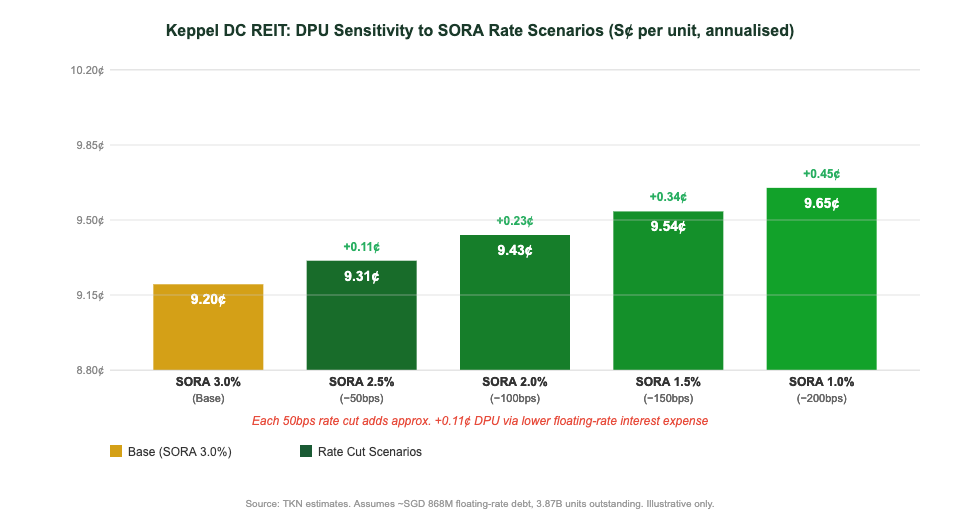
If SORA falls by a cumulative 100 basis points from current levels (approximately 2.2% to 1.2%), the total DPU benefit is approximately +0.22 cents per unit per annum — a ~2.4% uplift to the distribution. Combined with rental reversion from lease renewals (data centre rents in key markets have been rising 3–8% per annum), KDC’s DPU trajectory looks supportive heading into 2027.
Investors building a passive income Singapore portfolio can use platforms like Endowus (referral code 2V343) or Syfe (referral code SRPRFFFCD) to access KDC through SGX-listed REIT portfolios or managed funds.
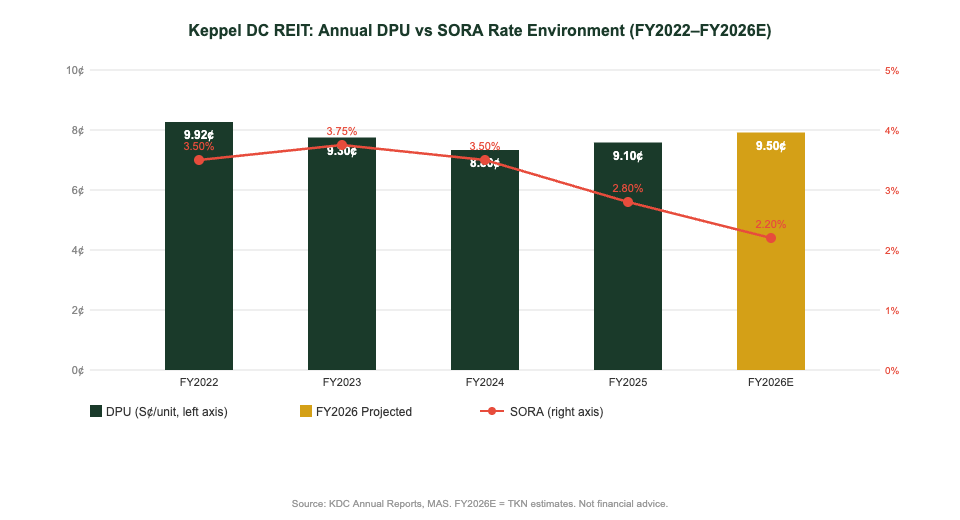
Chart 1: KDC Annual DPU vs SORA Rate Environment (FY2022–FY2026E)
Cap Rate Compression: The NAV Multiplier Effect
Data centre assets in Singapore and Asia command some of the tightest cap rates globally — typically in the 3.5–4.5% range for prime, long-leased facilities with hyperscaler tenants. This low-yield asset class is especially sensitive to interest rate movements, as even small changes in the discount rate can meaningfully shift valuations.
The table below illustrates how KDC’s NAV per unit could change under different cap rate scenarios, using an estimated portfolio value of SGD 8.8 billion and 3.87 billion units outstanding:
| Scenario | Est. Cap Rate | Portfolio Value | NAV/Unit | P/NAV (at S$2.25) |
|---|---|---|---|---|
| SORA 3.0% (Base) | 3.75% | SGD 8.8B | S$1.85 | 1.22x |
| SORA 2.5% (-50bps) | 3.50% | SGD 9.4B | S$2.00 | 1.13x |
| SORA 2.0% (-100bps) | 3.25% | SGD 10.1B | S$2.16 | 1.04x |
| SORA 1.5% (-150bps) | 3.00% | SGD 10.8B | S$2.31 | 0.97x |
Source: TKN estimates. Cap rate assumptions are illustrative. Actual valuations depend on individual lease structures, tenant quality, and market conditions.
The table highlights an important insight: if rates continue falling towards the 1.5% level, KDC would trade at a discount to NAV at the current share price of ~S$2.25. Historically, high-quality data centre REITs in Asia have commanded significant premiums to NAV in low-rate environments, suggesting meaningful re-rating potential if SORA continues to decline.
KDC in Past Rate Cycles: What History Tells Us
Keppel DC REIT has now lived through one full interest rate cycle since its IPO in 2014 — from the near-zero rate environment of 2019–2021, through the aggressive hike cycle of 2022–2023, and now into the current cutting cycle. The data is instructive.
2019–2021 (Ultra-low rates): With SORA near zero, KDC attracted enormous investor interest as a high-quality yield vehicle with structural growth from data centre demand. The REIT traded at P/NAV premiums of 1.8–2.5x — far above its IPO valuations. DPU was strong, buoyed by acquisitions funded at historically cheap borrowing costs.
2022–2023 (Rate hike cycle): As the Fed and MAS moved aggressively to tighten monetary policy, KDC’s share price fell from a peak of around S$3.00 to lows near S$1.70 — a ~43% decline. P/NAV compression was the dominant driver, as investors required higher dividend yields to compensate for rising risk-free rates. The DPU impact was more modest (the high fixed-rate hedge ratio protected earnings), but the valuation de-rating was severe.
2024–2026 (Cutting cycle): With rates now declining, KDC has partially recovered. The share price has rebounded to around S$2.20–2.30, but remains well below the 2021 peak. The key question for investors: how much of the rate-cut benefit is already priced in at the current P/NAV of ~1.22x?
For context on how to build a resilient Singapore portfolio that weathers rate cycles, our Singapore retirement calculator can help model different income scenarios over time.
Chart 2: KDC DPU Sensitivity to SORA Rate Scenarios
Current Valuation: Is Rate-Cut Optimism Already Priced In?
As at October 2026, KDC’s valuation metrics suggest the market has partially — but not fully — priced in the rate-cutting tailwind.
| Metric | Value |
|---|---|
| Share price (SGX: AJBU) | ~S$2.25 |
| NAV per unit | ~S$1.85 |
| P/NAV | ~1.22x |
| Annualised DPU (H1 2026 × 2) | ~S$0.092 |
| Distribution yield (on price) | ~4.1% |
| Distribution yield (on NAV) | ~5.0% |
| Market capitalisation | ~SGD 8.7 billion |
Source: SGX, Keppel DC REIT H1 2026 results (TKN estimates). Approximate figures only.
A P/NAV of 1.22x is above the long-run average for Singapore REITs (~1.0x) but well below KDC’s own historical peak (2.0–2.5x in 2020–2021). The 4.1% distribution yield is lower than most Singapore retail or office REITs, reflecting KDC’s premium positioning as a defensive, growth-oriented data centre vehicle. Investors using FSMOne (referral code P0544985) can access KDC with competitive brokerage rates for regular investment plans.
Investment Verdict for Singapore Investors
Keppel DC REIT remains one of the highest-quality data centre REITs in Asia, supported by a blue-chip tenant roster of hyperscalers, financial institutions, and government agencies, and a resilient occupancy profile underpinned by AI-driven structural demand for computing infrastructure.
The interest rate cutting cycle is a genuine tailwind for KDC, operating through both the DPU channel (lower floating-rate borrowing costs) and the NAV channel (cap rate compression lifting asset values). However, the tailwind is partially priced in at the current 1.22x P/NAV premium.
For Singapore investors considering KDC in 2026:
- Bull case: Rates fall faster and further than expected (SORA below 1.5%); AI demand drives occupancy upside and positive rental reversion; KDC re-rates towards 1.5–1.8x P/NAV → potential total return of 25–40% over 2–3 years
- Base case: Gradual rate normalisation continues; DPU grows 2–4% annually; share price tracks NAV growth → total return of 8–12% p.a. including distributions
- Bear case: Rate cuts stall or reverse (e.g. inflation spike); AI buildout plateaus; P/NAV re-rates towards 1.0x → downside risk of 15–20% from current levels
KDC is best suited for growth-oriented dividend investors with a 3–5 year horizon who want exposure to AI infrastructure themes alongside steady income. For pure yield seekers, the 4.1% distribution yield may disappoint relative to Singapore T-bills or fixed deposits — compare these using TKN’s free tools before committing capital.
Frequently Asked Questions
What is Keppel DC REIT's interest rate sensitivity in 2026?
Keppel DC REIT is sensitive to interest rates through two channels: (1) its ~28% floating-rate debt (~SGD 868M) reprices when SORA/SOFR moves, affecting interest expense and DPU directly; and (2) data centre cap rates are influenced by prevailing interest rates, so falling rates compress cap rates, boosting asset values and NAV per unit. The NAV impact is typically larger than the DPU impact in percentage terms.
How much does KDC's DPU change per 25bps rate cut?
Based on KDC’s estimated ~SGD 868 million of floating-rate debt and ~3.87 billion units outstanding, each 25 basis point rate cut saves approximately SGD 2.17 million in annual interest expense, translating to a DPU uplift of about 0.056 Singapore cents per unit per annum — roughly a 0.6% increase on the current annualised DPU of ~9.2 cents. A cumulative 100bps cut adds approximately +0.22 cents per unit.
What is Keppel DC REIT's current gearing ratio?
As at Q3 2026, Keppel DC REIT’s gearing ratio is approximately 35.5% — comfortably below the MAS leverage limit of 50% for Singapore REITs. This leaves approximately SGD 1.4 billion of debt headroom before the regulatory limit is reached, providing KDC with significant capacity for accretive acquisitions if market conditions are favourable.
Can I use SRS or CPF to invest in Keppel DC REIT?
Yes. Keppel DC REIT (SGX: AJBU) is listed on the Singapore Exchange and is eligible for investment using your Supplementary Retirement Scheme (SRS) account. SRS investments in S-REITs like KDC can be made through most Singapore brokerage platforms. Note that CPF Ordinary Account funds cannot be used to purchase individual REIT stocks — only selected CPF-included unit trusts and ETFs are eligible for CPF investment.
Is Keppel DC REIT a good buy if interest rates continue falling in 2026?
Falling interest rates are generally positive for KDC, but investors should consider the current valuation. At ~1.22x P/NAV and a ~4.1% distribution yield, some rate-cut optimism is already priced in. KDC suits investors with a 3–5 year horizon who want AI infrastructure exposure with dividend income. For pure yield seekers, the 4.1% yield may be less attractive than alternatives. Always consult a licensed financial adviser for personalised advice.
How does KDC's NAV change when interest rates fall?
When interest rates fall, data centre cap rates tend to compress — investors accept lower yields from real assets as the opportunity cost of capital declines. This compression increases the capitalised value of KDC’s rental income streams. Our modelling suggests that a 25bps compression in cap rates (e.g. from 3.75% to 3.50%) could add approximately S$0.10–0.16 per unit to KDC’s NAV. Over a full 150bps rate cutting cycle, the cumulative NAV uplift could be in the range of S$0.40–0.50 per unit.
Start Building Your S-REIT Portfolio Today
Access Keppel DC REIT and other top Singapore REITs through these platforms — with exclusive referral bonuses for TKN readers.
Not financial advice. TKN may receive referral compensation from the platforms above. Always conduct your own due diligence before investing.
This article was researched with the help of AI. While we strive to keep all information accurate and up to date, there may be errors. If you notice any discrepancies, please contact us.