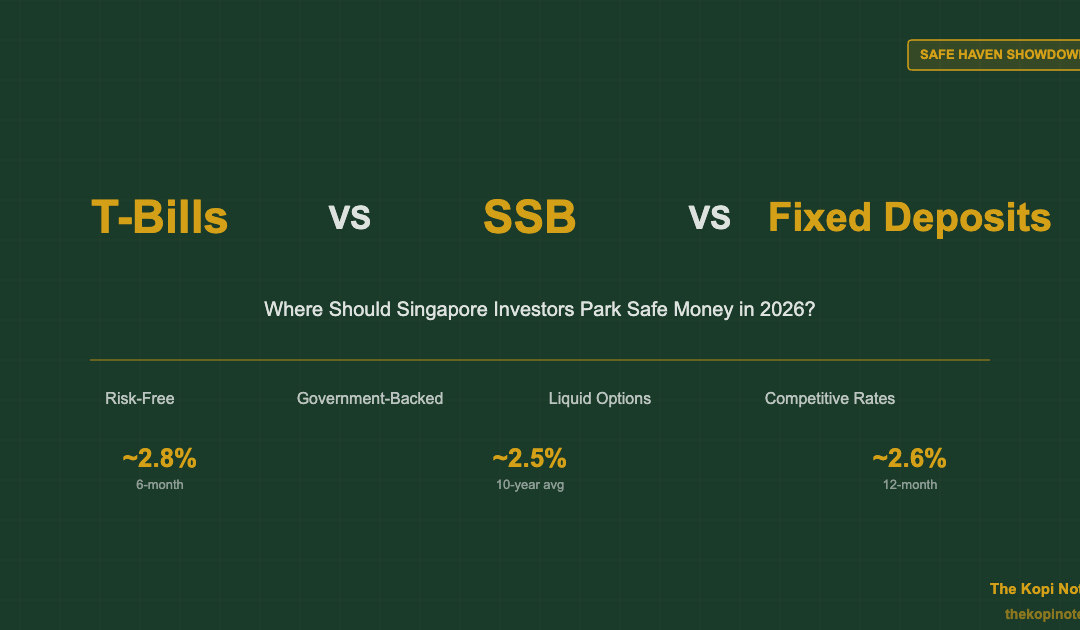
Singapore T-Bills, Singapore Savings Bonds (SSB), and fixed deposits are the three safest places to park money in 2026 — all effectively risk-free for Singapore residents. T-Bills currently offer the highest yield at approximately 2.80% for 6-month tenors. SSBs provide step-up rates averaging about 2.50% with the unique advantage of penalty-free early redemption. Fixed deposits from top banks pay around 2.50–2.70% for 12-month tenors with the simplest application process.
This is an editorial comparison. Not financial advice. All figures are for educational reference only. Data as at July 2026 unless noted.
- T-Bills offer the highest yield (~2.80%) but lock your money for 6 months with no early exit. Best for investors who won’t need the cash
- SSBs are the most flexible — redeem any month with zero penalty. Best for emergency funds and uncertain timelines
- Fixed deposits are the simplest — walk into a bank and you’re done. Best for first-timers and small amounts
Quick Verdict
“Should I buy T-Bills, SSB, or just put it in an FD?” is one of the most common questions on r/singaporefi. The answer depends on one thing: how soon might you need the money?
Definitely won’t need it for 6 months? Buy T-Bills. Highest yield, zero credit risk, tax-free.
Might need it anytime? Buy SSBs. You can redeem any month after the first, with no penalty. You get your full principal back plus accrued interest. This makes SSBs perfect for emergency funds.
Want zero hassle? Open a fixed deposit. Walk into DBS, OCBC, or UOB, choose your tenor, and you’re done in 10 minutes. No auction, no application window.
Current Yields Compared
| Product | Current Yield | Tenor | Min Investment | Risk |
|---|---|---|---|---|
| T-Bills (6-month) | ~2.80% p.a. | 6 months | S$1,000 | Risk-free (govt) |
| T-Bills (1-year) | ~2.70% p.a. | 12 months | S$1,000 | Risk-free (govt) |
| SSB (latest issue) | ~2.50% (10yr avg) | Up to 10 years | S$500 | Risk-free (govt) |
| FD — DBS (12-month) | ~2.50% p.a. | 12 months | S$1,000 | SDIC insured |
| FD — OCBC (12-month) | ~2.60% p.a. | 12 months | S$20,000 | SDIC insured |
| FD — UOB (12-month) | ~2.55% p.a. | 12 months | S$10,000 | SDIC insured |
| FD — GXS Bank (12-month) | ~3.10% p.a. | 12 months | S$500 | SDIC insured |
Source: MAS.gov.sg (T-Bill auctions), SGS.gov.sg (SSB), bank websites — as at July 2026. T-Bill yields are cut-off yields from recent auctions. FD rates vary by promotion and deposit size.
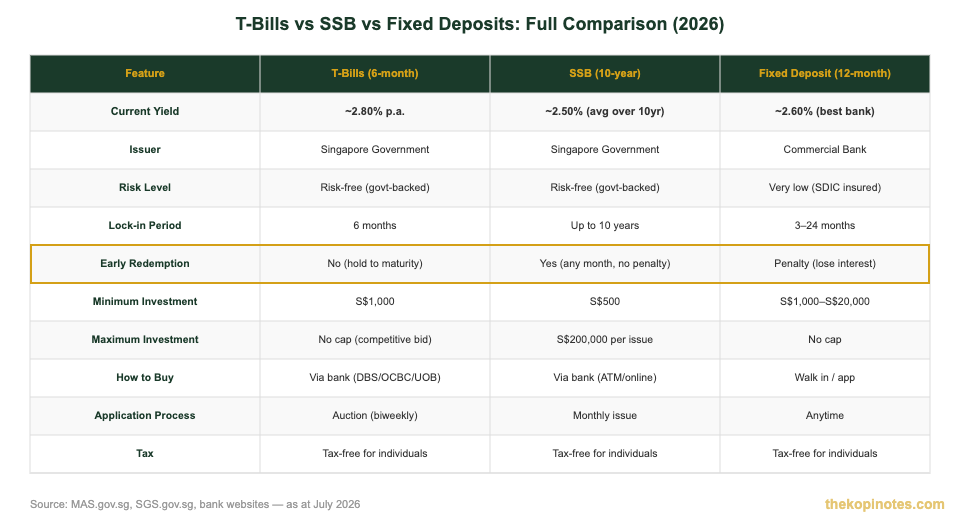
Yields have come down from their 2023–2024 peaks (when T-Bills hit 4%+). In mid-2026, the gap between the three options is much narrower — roughly 0.30% separates the best T-Bill from the average FD. This means the choice should be driven by liquidity needs, not yield chasing.
What Each Product Actually Is
Singapore Treasury Bills (T-Bills)
T-Bills are short-term government securities issued by MAS on behalf of the Singapore Government. They come in 6-month and 1-year tenors. You buy them at a discount to face value and receive the full face value at maturity — the difference is your interest. For example, if you buy S$10,000 worth of 6-month T-Bills at 2.80%, you pay about S$9,860 upfront and receive S$10,000 at maturity.
T-Bills are auctioned biweekly via DBS, OCBC, UOB, and other banks. You can apply for a “non-competitive” bid (most people do this), which means you accept whatever the auction yield turns out to be. For more details, read our Singapore T-Bills guide.
Singapore Savings Bonds (SSB)
SSBs are 10-year government bonds with a step-up interest structure — the longer you hold, the higher your average return. The key feature is that you can redeem any month after the first with zero penalty. Your principal and accrued interest are guaranteed by the Singapore Government.
SSBs are issued monthly. Each issue has a cap of S$200,000 per individual. You can hold multiple issues simultaneously. Applications open on the 1st to the 28th of each month via DBS, OCBC, UOB, and other banks. See our Singapore Savings Bonds guide for the full walkthrough.
Fixed Deposits (FD)
Fixed deposits are the simplest option. You deposit a lump sum with a bank for a fixed period (typically 1–24 months) at a guaranteed interest rate. At maturity, you get your principal plus interest. Most banks offer FDs through their app or in-branch.
The downside: if you break an FD early, you lose some or all of the interest earned. Unlike SSBs, there’s no penalty-free exit. FD rates also vary significantly between banks — digital banks like GXS often offer higher rates than DBS, OCBC, or UOB.
Liquidity & Early Redemption
This is the most important practical difference — and the one that should drive your decision.
| Product | Early Redemption? | Penalty | Time to Get Cash Back |
|---|---|---|---|
| T-Bills | No (hold to maturity only*) | N/A | On maturity date |
| SSBs | Yes, any month after first | None — full principal + accrued interest | Within 2–3 business days |
| Fixed Deposits | Yes, but with penalty | Partial or full interest forfeiture | Same day to 1 business day |
*T-Bills can technically be sold on the secondary market before maturity, but this requires a brokerage account and may incur transaction costs.
SSBs are the clear winner for liquidity. You can redeem any month, get your full principal back plus interest earned to date, and receive the cash within 2–3 business days. No penalty, no questions asked. This makes SSBs the ideal vehicle for emergency funds — they earn more than a savings account while remaining almost as liquid.
T-Bills are the least liquid. Once you buy, you’re locked in until maturity (6 or 12 months). If you need the money before then, you’d have to sell on the secondary bond market — which most retail investors don’t do.
How to Buy Each One
T-Bills
Apply through your bank’s online platform (DBS, OCBC, or UOB) during the auction window. Auctions happen every two weeks. Choose “non-competitive” bid for simplicity — you’ll get the average yield. Minimum S$1,000, in multiples of S$1,000. Application fee: S$2 (DBS/POSB) or free (varies by bank).
SSBs
Apply from the 1st to 28th of each month via your bank’s ATM, online banking, or mobile app. Results announced on the last business day. Minimum S$500, in multiples of S$500. Maximum S$200,000 per issue. Application fee: S$2 (refunded if unsuccessful).
Fixed Deposits
Open anytime — no auction or application window. Most banks let you open FDs through their app or in-branch. Minimum varies: S$500 (GXS), S$1,000 (DBS), S$10,000 (UOB), S$20,000 (OCBC). No application fee.
Decision Guide: Which Suits You?
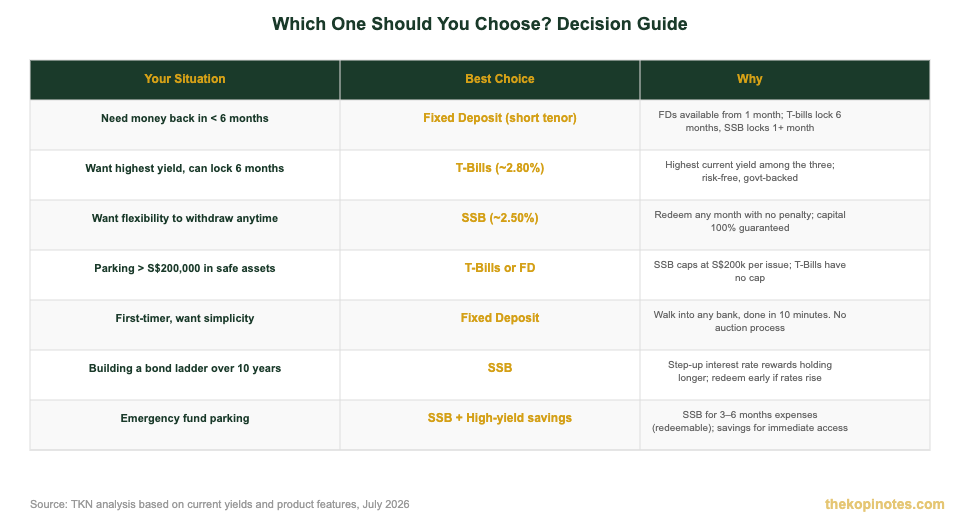
Emergency fund (3–6 months expenses): SSBs are ideal. You earn ~2.50% with the ability to redeem any month if you need the cash. Park your emergency fund across 2–3 SSB issues for monthly maturity coverage.
Wedding fund / BTO savings (2+ years away): T-Bills on a rolling 6-month ladder. Every 6 months, your T-Bill matures and you can either withdraw or roll into a new one. You’ll earn the highest yield while maintaining semi-annual access.
Short-term parking (1–3 months): Fixed deposits with short tenors, or a high-yield savings account. T-Bills and SSBs aren’t ideal for very short periods.
Large lump sum (> S$200,000): Split between T-Bills (no cap per auction) and FDs. SSBs cap at S$200,000 per issue, so they can’t absorb very large sums in one go.
For long-term wealth building beyond safe assets, consider allocating part of your portfolio to investments — our retirement calculator can help you model different allocation strategies.
TKN’s Take
Use all three. They serve different purposes, and a smart Singapore investor should have money in at least two of these vehicles.
Our recommended allocation for a typical saver with S$50,000 in safe assets:
Put S$15,000–S$20,000 in SSBs as your emergency fund (redeemable anytime). Put S$20,000–S$30,000 in rolling T-Bills for the highest yield. Keep S$5,000–S$10,000 in a high-yield savings account like GXS Bank (3.48%) for immediate-access cash.
Fixed deposits are best for specific situations: promotional rates that beat T-Bills, foreign currency FDs (like USD FDs during rate cycles), or when you want absolute simplicity. Check if your bank is running any promotional FD rates before defaulting to T-Bills.
Frequently Asked Questions
Are T-Bills and SSBs completely risk-free?
Can I lose money on T-Bills or SSBs?
What is a T-Bill ladder?
Are Singapore Savings Bonds better than fixed deposits?
How do I apply for T-Bills?
Should I use T-Bills or a high-yield savings account?
Are fixed deposit rates going up or down in 2026?
Do I need to pay tax on T-Bills, SSBs, or fixed deposits?
This article was researched with the help of AI. While we strive to keep all information accurate and up to date, there may be errors. If you notice any discrepancies, please contact us.