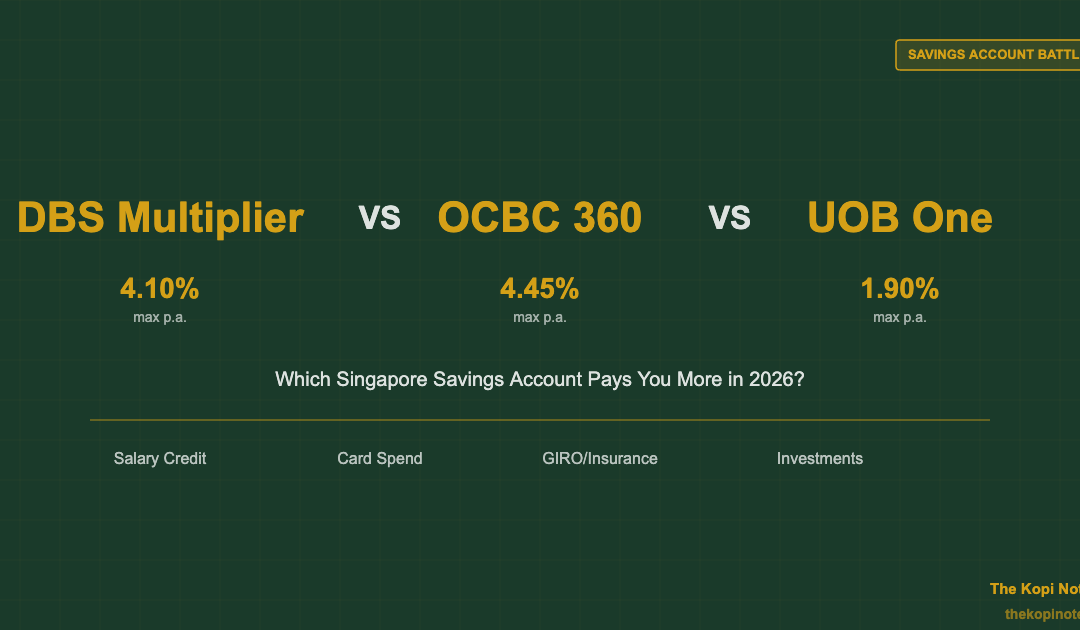
DBS Multiplier, OCBC 360, and UOB One are Singapore’s three most popular high-yield savings accounts — and every month, Redditors on r/singaporefi ask which one is best. In mid-2026, DBS Multiplier offers the best realistic returns for most working adults at around 2.50% p.a., while OCBC 360 has the highest ceiling at 4.45% but is hardest to max out. UOB One trails at 1.90% but suits investors with large balances above S$100,000.
This is an editorial comparison. Not financial advice. All figures are for educational reference only. Data as at July 2026 unless noted.
- DBS Multiplier is the easiest to hit a solid rate (~2.50%) — just credit your salary and use a DBS card. Best for most people
- OCBC 360 has the highest maximum (4.45%) but requires you to grow your balance by S$500/month, spend S$500 on cards, AND hit other categories. Realistic rate: ~1.95%
- UOB One pays best above S$100,000 but the effective rate at lower balances is disappointing (1.00% for S$20,000)
Quick Verdict
The “best” savings account depends on your spending habits, salary, and how much effort you’re willing to put into meeting bonus requirements. Here’s the honest answer.
DBS Multiplier wins for simplicity. Credit your salary (any amount) and spend on a DBS credit card. That’s it. Two categories give you roughly 2.50% on your first S$50,000. No need to grow your balance monthly, no GIRO requirements, no insurance purchases.
OCBC 360 has the highest ceiling at 4.45% p.a. — but reaching it requires you to credit S$1,800+ salary, spend S$500+ on OCBC cards, grow your balance by S$500 every month, AND tick additional bonus categories. Most people realistically earn about 1.95%.
UOB One is the outlier. After rate cuts in late 2025, the maximum dropped to 1.90%. The effective rate for typical balances under S$50,000 is around 1.00%. UOB One only shines if you have exactly S$100,000–S$150,000 in liquid savings.
Interest Rate Comparison
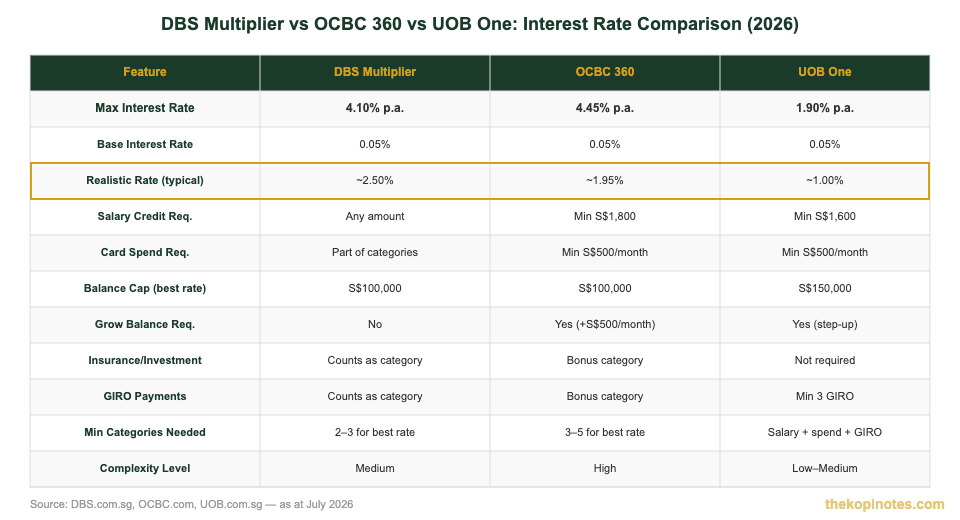
All three accounts share the same base interest rate of 0.05% p.a. — essentially nothing. The real returns come from meeting bonus interest requirements.
But maximum rates are misleading. Nobody should choose their savings account based on the “up to” rate. What matters is the realistic rate you’ll actually achieve — and that’s where the comparison gets interesting.
Realistic Rates (What You’ll Actually Earn)
Let’s model a typical Singaporean worker: earns S$4,000/month, spends S$500 on credit cards, has no insurance or investment products with the bank.
| Profile | DBS Multiplier | OCBC 360 | UOB One |
|---|---|---|---|
| Salary credit only | ~1.80% | ~0.55% | ~0.50% |
| Salary + card spend | ~2.50% | ~1.25% | ~1.00% |
| Salary + card + grow balance | ~2.50% | ~1.95% | ~1.00% |
| All categories maxed | ~4.10% | ~4.45% | ~1.90% |
Source: Calculated from published tier structures — DBS.com.sg, OCBC.com, UOB.com.sg, July 2026. Rates assume first S$50,000 balance.
The key insight: DBS Multiplier gives you the highest rate for the least effort. With just salary crediting and card spending — things most people do anyway — you get about 2.50%. OCBC 360 only catches up if you also grow your balance by S$500 every month, which means you need to save S$500 more each month than you spend.
OCBC 360’s “grow your balance” requirement is its biggest weakness. If you withdraw money one month — even for a legitimate expense — your bonus interest drops. It punishes normal spending patterns.
Requirements Breakdown
DBS Multiplier
DBS Multiplier uses a “category” system. You earn higher interest by banking across more DBS product categories: salary credit, credit card spend, home loan, insurance, and investments. The more categories you use, the higher your rate. Two categories (typically salary + card spend) unlock a competitive rate with minimal effort.
There’s no minimum salary amount — even S$1 credited counts. No minimum spend threshold either. And there’s no requirement to grow your balance monthly.
OCBC 360
OCBC 360 stacks multiple bonus categories: salary credit (min S$1,800), card spend (min S$500/month), balance growth (increase average daily balance by S$500 each month), insurance purchase, and investment. Each category adds bonus interest.
The S$1,800 salary minimum is a problem for part-time workers or freelancers. The S$500 monthly balance growth requirement means you must continuously increase your savings — if you plateau or withdraw, you lose that bonus.
UOB One
UOB One requires salary credit (min S$1,600), card spend (min S$500/month), and 3 GIRO payments. The interest is heavily back-loaded — if your balance is only S$20,000, you’re stuck in the lowest tier earning about 1.00%. The higher tiers only kick in above S$50,000 and S$100,000.
The advantage? UOB One’s balance cap is S$150,000, higher than DBS and OCBC’s S$100,000 cap. If you have S$150,000 in liquid savings, UOB One earns bonus interest on the full amount.
Earnings by Balance Size
Here’s how much you’d actually earn in a year at realistic rates (salary + card spend met).
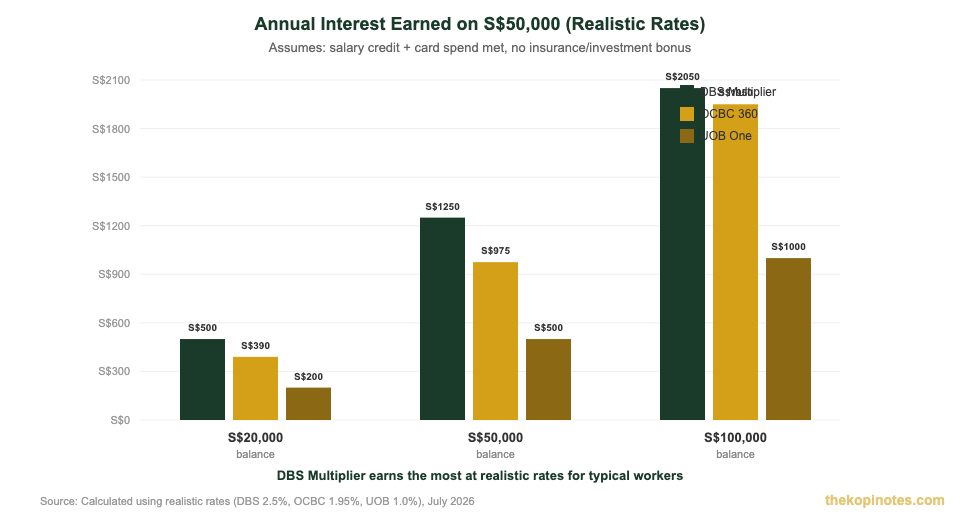
| Balance | DBS Multiplier (~2.5%) | OCBC 360 (~1.95%) | UOB One (~1.0%) |
|---|---|---|---|
| S$20,000 | S$500/year | S$390/year | S$200/year |
| S$50,000 | S$1,250/year | S$975/year | S$500/year |
| S$100,000 | S$2,050/year | S$1,950/year | S$1,000/year |
| S$150,000 | S$2,050/year* | S$1,950/year* | S$1,500/year |
*DBS and OCBC cap bonus interest at S$100,000. Amounts above S$100,000 earn base rate only (0.05%). UOB One caps at S$150,000. Source: Calculated from published rates, July 2026.
At every balance level under S$100,000, DBS Multiplier earns you the most for typical effort. The only scenario where UOB One wins is if you have exactly S$100,000–S$150,000 — because DBS and OCBC cap their bonus rates at S$100,000.
For the excess above S$100,000, consider parking it in a digital bank like Trust Bank or MariBank for a better base rate.
What About Digital Banks?
A question that always comes up in these Reddit threads: “Should I just use GXS / Trust Bank / MariBank instead?”
Digital banks offer simpler, no-conditions interest — but at lower rates for larger balances. GXS Bank pays up to 3.48% with no conditions, but caps at S$75,000. MariBank pays 2.68% with no conditions. Trust Bank pays up to 2.40%.
The smart play is to combine both. Use DBS Multiplier for your main salary account (earning 2.50%+ on S$50,000–S$100,000) and park excess cash in a digital bank. This beats putting everything in one place. For a deep dive, check our comparison of savings and investment options.
TKN’s Take
DBS Multiplier is the best savings account for most Singaporeans in 2026. It offers the highest realistic return (2.50%) for the least effort. You don’t need to grow your balance monthly, you don’t need a minimum salary of S$1,800, and you don’t need to juggle five bonus categories.
OCBC 360 rewards extreme discipline — if you can grow your balance by S$500 every single month without fail, and spend S$500 on the right cards, it edges ahead. But most people slip up occasionally, losing their bonus.
UOB One is hard to recommend in 2026 after its rate cuts. The only exception is if you have S$150,000 in cash savings and want everything under one roof — UOB One’s higher balance cap means you earn bonus interest on the full S$150,000.
Whatever you choose, don’t leave money in a basic POSB/DBS savings account earning 0.05%. That’s losing money to inflation. Use our retirement calculator to see how much more you could build with a higher savings rate.
Frequently Asked Questions
Which savings account has the highest interest rate in Singapore 2026?
Can I have more than one high-yield savings account?
What's the minimum salary for DBS Multiplier?
Is the OCBC 360 grow balance requirement hard to meet?
Should I use a digital bank instead of DBS Multiplier?
Why did UOB One cut rates in 2025?
What happens if I exceed the S$100,000 balance cap?
Which bank credit card should I use?
This article was researched with the help of AI. While we strive to keep all information accurate and up to date, there may be errors. If you notice any discrepancies, please contact us.