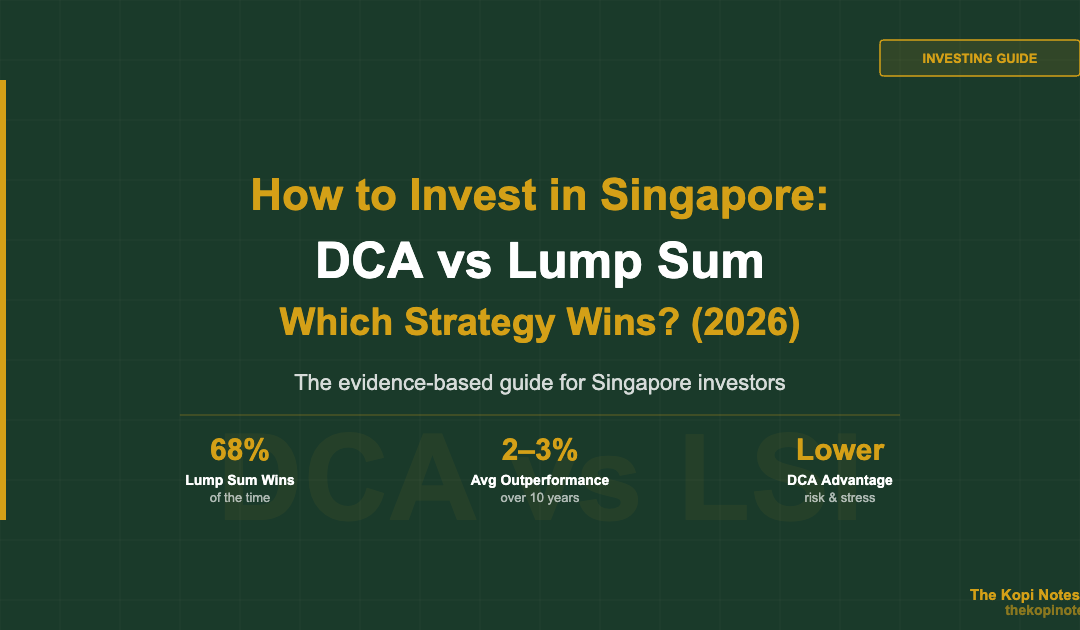
How to Invest in Singapore: Dollar Cost Averaging vs Lump Sum — Which Strategy Wins? (2026)
The evidence-based guide every Singapore investor needs to read before choosing their approach
When it comes to how to invest in Singapore, one question divides almost every investor: should you invest a fixed amount every month (dollar cost averaging), or put in everything you have right now (lump sum)? Vanguard’s research across 46 years of market data found that lump sum investing outperforms DCA 68% of the time — but DCA still wins in certain situations. This guide breaks down exactly when to use each strategy, with real SGD numbers.
Not financial advice. All figures are for educational reference only. Data as at August 2026 unless noted. Data verified as at 31 August 2026.
- Lump sum investing mathematically beats DCA in ~68% of market scenarios, according to Vanguard research
- DCA is still the better choice if you don’t have a lump sum, are psychologically risk-averse, or have irregular income
- For most Singaporeans, the right answer is: start DCA now rather than wait to accumulate a lump sum
Table of Contents
- What Is Dollar Cost Averaging (DCA)?
- What Is Lump Sum Investing?
- What the Research Actually Shows
- The SGD Numbers: How Much Does It Matter?
- When DCA Is the Better Choice
- When Lump Sum Investing Is the Better Choice
- The Singapore Reality: Which Should You Choose?
- Best Platforms for DCA and Lump Sum in Singapore
- Frequently Asked Questions
What Is Dollar Cost Averaging (DCA)?
Dollar cost averaging (DCA) means investing a fixed amount of money at regular intervals — regardless of what the market is doing. You put in $500 every month whether the STI is up, down, or sideways.
The logic is simple. When prices are low, your $500 buys more units. When prices are high, it buys fewer. Over time, your average cost per unit tends to be lower than the average market price during that period. This mechanical consistency removes emotion from the equation.
In Singapore, DCA is extremely common. Many investors set up a Regular Savings Plan (RSP) through platforms like Endowus, Syfe, or POEMS — and the money goes in automatically every month. You don’t need to think about it. You don’t need to wait for the “right” time.
The beauty of DCA is that it works even when you’re not watching. A working adult who commits $500 a month from age 25 to 55 accumulates 30 years of systematic investing — no market timing required.
What Is Lump Sum Investing?
Lump sum investing (also called lump sum investing, or LSI) means putting a large amount of money into the market all at once. You get a $50,000 bonus and invest it all today — rather than spreading it over 12 or 24 months.
The mathematical case for lump sum is simple: markets go up more often than they go down. Roughly 65–70% of monthly stock market returns are positive. So the longer your money is in the market, the more time it has to compound. Every day you wait to invest is a day your money isn’t working.
In Singapore, natural lump sum moments include: year-end bonuses, CPF Ordinary Account top-up proceeds, property sale proceeds, inheritance, or insurance payouts. These are one-time injections — and the question is always whether to invest immediately or spread it out.
What the Research Actually Shows
The most cited study is from Vanguard (2012, updated 2022). They analysed over 46 years of market data across the US, UK, and Australia, and found one clear winner in most scenarios.
The result: lump sum investing outperformed DCA in 68% of rolling 12-month periods, assuming a 60/40 stock-bond portfolio. When you extend to 36-month periods, lump sum wins even more often.
Here’s the key chart showing how lump sum outperformance climbs as the time horizon extends:
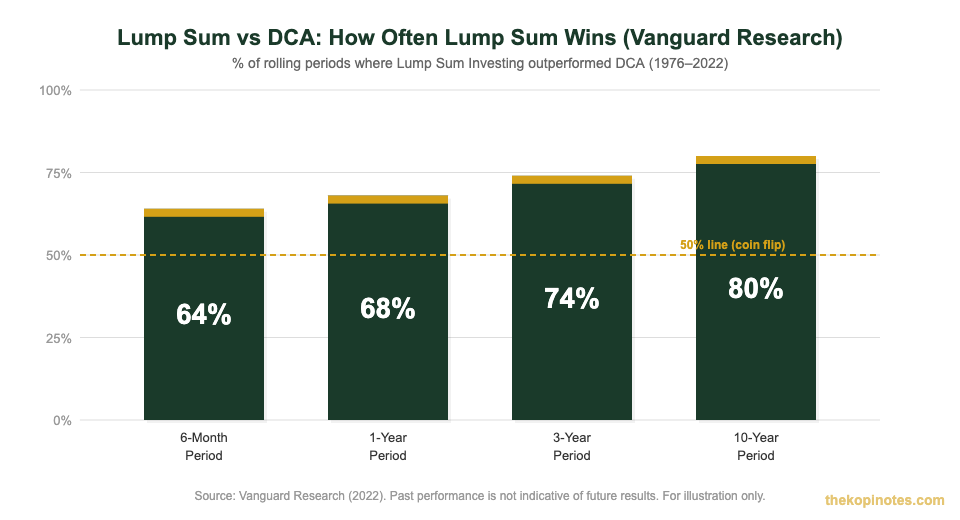
Source: Vanguard Research (2022). Data based on rolling periods 1976–2022. Past performance is not indicative of future results.
Why does lump sum win so often? Markets spend more time going up than going down. The S&P 500 has delivered about 10% average annual returns since the 1960s. When you delay investing — even by spreading over 12 months — you’re statistically more likely to miss upside than to avoid a crash.
However — and this is critical — the Vanguard research also found that when lump sum underperforms DCA, it tends to underperform significantly. The 32% of scenarios where DCA wins are often major downturns. If you happened to invest your lump sum right before the 2008 GFC or the 2020 COVID crash, DCA would have clearly won.
The Psychological Reality
There’s a reason many investors still prefer DCA even knowing the math. Investing a $100,000 windfall and watching it drop 20% in the first month is gut-wrenching. Many investors panic and sell. That mistake is far more costly than the 2-3% average underperformance of DCA.
Vanguard’s own conclusion was nuanced: “If the investor is primarily concerned with minimising the impact of short-term volatility and the regret that often accompanies poorly timed investments, DCA may be preferable — even if it is expected to underperform a lump sum approach.”
In short: the mathematically optimal strategy and the psychologically sustainable strategy are not always the same thing.
The SGD Numbers: How Much Does It Matter?
Enough theory. Let’s look at what this actually means in Singapore dollar terms.
Scenario: You have $60,000 available to invest. You’re deciding between:
- Option A (DCA): Invest $500 per month for 10 years ($60,000 total)
- Option B (Lump Sum): Invest the full $60,000 today
Assuming average annual returns across different asset classes:
| Asset Class | Avg Annual Return | DCA End Value $500/mth × 10 yrs |
Lump Sum End Value $60k on Day 1 |
LSI Advantage |
|---|---|---|---|---|
| S&P 500 ETF (e.g. CSPX) | ~10%/yr | $102,420 | $155,625 | +$53,205 |
| Global ETF (e.g. VWRA) | ~9%/yr | $96,750 | $142,044 | +$45,294 |
| STI / Singapore Stocks | ~6%/yr | $81,960 | $107,450 | +$25,490 |
| Bonds / Fixed Deposits | ~4%/yr | $73,620 | $88,810 | +$15,190 |
Source: Compound interest projections based on Vanguard historical averages. DCA assumes $500/month for 120 months with monthly compounding. Lump Sum assumes $60,000 invested on Day 1 with annual compounding. Projections are illustrative and do not account for taxes, fees, or currency movements. As at Aug 2026.
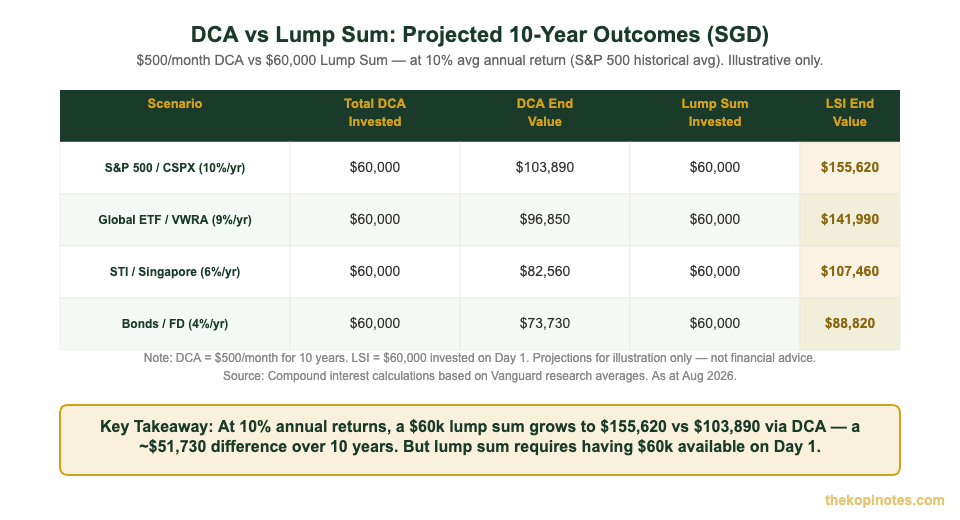
Projections for illustration only. Not a guarantee of future returns. As at Aug 2026.
The difference at 10% annual returns is striking: lump sum beats DCA by over $53,000 over 10 years on a $60,000 investment. That’s more than 50% of the original capital in “lost” compounding time.
However, note that this comparison requires you to have $60,000 available on Day 1. Most Singaporeans don’t. That’s where DCA becomes not just acceptable — but the only realistic option.
When DCA Is the Better Choice
DCA wins — not just psychologically, but practically — in several specific scenarios. If any of these apply to you, DCA is almost certainly the right strategy.
1. You Don’t Have a Lump Sum
This is the most common situation. You earn a monthly salary and can invest $300–$800 per month. You don’t have $50,000 sitting in a bank account doing nothing. In this case, the DCA vs lump sum debate is academic — DCA is your only option, and that’s completely fine.
2. You’re Investing in a Highly Volatile Asset
The Vanguard research was based on diversified stock-bond portfolios. For concentrated, single-stock or high-volatility assets, DCA’s risk-reduction benefit is more meaningful. If you’re investing in a single sector ETF or a thematic fund with wide price swings, spreading your entry point reduces the chance of buying at a peak.
3. You’re Prone to Panic-Selling
Be honest with yourself. If investing $50,000 and seeing it drop to $38,000 in one month would cause you to sell everything, DCA is better for you. The best investment strategy is the one you can stick with. A 2–3% theoretical underperformance is nothing compared to the losses from panic-selling at the bottom.
4. You’re a New Investor Building Habits
For those just starting out, DCA builds the discipline of consistent investing. Using the DCA calculator at TKN or setting up an auto-deduction via Endowus or Syfe creates a routine. Habits compound too — not just returns.
5. You’re Uncertain About Market Conditions
Market valuations in 2026 remain elevated by historical standards. If you’re investing a windfall in a period when price-to-earnings ratios look stretched, spreading your entry over 3–6 months isn’t irrational — it’s risk management.
When Lump Sum Investing Is the Better Choice
If you have a lump sum available and the following conditions apply, the research says: invest it now.
1. You Have a Long Time Horizon (10+ Years)
The longer your investment horizon, the stronger the case for lump sum. Over a 10-year or 20-year horizon, short-term volatility becomes noise. Time in the market consistently beats timing the market. If you’re 30 years old investing for retirement at 65, investing a lump sum today and ignoring the noise is the mathematically optimal choice.
2. You Received a Windfall
Bonus, inheritance, property proceeds, CPF refund — these are classic lump sum moments. The key insight: this money is not already invested. Every day it sits in a savings account earning 1–2% is a day it’s not compounding at 8–10%. Research supports moving it into the market promptly.
3. The Market Just Had a Significant Correction
After a 20–30% market drawdown, lump sum investing becomes even more attractive than usual. You’re buying units at a discount. Historic lump sum performance after major corrections is particularly strong. Dollar cost averaging into a recovering market still works — but a lump sum at the bottom compounds powerfully.
4. You’ve Already Stress-Tested Your Risk Tolerance
You’ve been through a significant correction before and didn’t panic. You understand volatility intellectually and emotionally. In that case, the 68% statistical edge of lump sum is yours to capture.
The Singapore Reality: Which Should You Choose?
For most Singaporeans reading this, the practical answer is clear. If you’re investing a monthly salary, you’re already DCA investing — and that’s the correct approach for your situation.
If you’ve received a windfall (bonus, sale proceeds, inheritance), the research says deploy it in one shot — or at most, spread it over 3–6 months if the psychological risk of seeing a big drop is real for you.
The real mistake to avoid: Waiting to accumulate enough for a lump sum before starting to invest. This “paralysis by analysis” is what actually costs most investors — years of compounding time lost while waiting for the “perfect” moment. Start with whatever you can now, and invest windfalls promptly when they arrive.
If you want to understand whether to use CPF, SRS or cash first before applying DCA or lump sum strategy, read our guide on how to invest in Singapore using CPF, SRS and cash in the right order — which account you invest through affects your returns just as much as DCA vs lump sum.
Use our Singapore retirement calculator to model how much you need to invest — monthly or as lump sum — to reach your retirement target.
Best Platforms for DCA and Lump Sum in Singapore
Your choice of strategy matters less than choosing the right platform and actually starting. Here are the best options for each approach in 2026.
| Platform | Best For | DCA Support | Fees (approx) | Min. Investment |
|---|---|---|---|---|
| Endowus | CPF / SRS / Cash | ✅ Auto-invest | 0.25–0.60% p.a. | $1,000 |
| Syfe | Goal-based DCA | ✅ Auto-invest | 0.25–0.65% p.a. | No minimum |
| IBKR (Interactive Brokers) | Lump Sum ETF buys | Manual only | USD 0–1 per trade | No minimum |
| FSMOne | RSP (DCA) + Lump Sum | ✅ RSP from $50 | 0.08% + $8.80 min | $50 RSP |
Source: Platform pricing pages as at Aug 2026. Fees may change — always verify on the platform’s official website before investing.
For DCA investors, Endowus and Syfe are the easiest — set up an automatic monthly transfer and forget about it. Endowus is particularly strong for CPF and SRS investing, where the fee structure is flat and transparent. Use our Endowus referral code (code: 2V343) for fee rebates on your first investment.
For lump sum investors, Interactive Brokers (IBKR) is the preferred platform for buying LSE-listed ETFs like CSPX and VWRA at the lowest cost. Commission as low as USD 0 per trade for US-listed ETFs, with competitive FX rates. Use our referral link for IBKR (code: jianxiong368) to get started. Alternatively, Syfe’s Syfe referral code and sign-up bonus (code: SRPRFFFCD) gives you a cash bonus on your first deposit — ideal if you prefer a managed lump sum deployment.
If you prefer FSMOne’s RSP for automatic DCA into unit trusts and ETFs, use our FSMOne referral code (P0544985) for a reduced transaction fee period.
A Practical Hybrid Approach
Here’s what many TKN readers do — and it makes practical sense for most Singaporeans:
- Set up $300–$500/month DCA into a global ETF via Endowus or Syfe (automated, consistent)
- When you receive a bonus or windfall, deploy 80% as lump sum immediately into IBKR-bought CSPX or VWRA
- Keep 20% as emergency fund / liquidity cushion
This approach gets you the best of both worlds: the discipline and consistency of DCA for your salary income, and the mathematical edge of lump sum for one-time inflows.
For a deeper dive on whether to invest via your CPF OA before moving to cash investing, read our article on Singapore REIT ETF guide for income-focused investors looking to complement their growth portfolio.
Frequently Asked Questions
Is DCA or lump sum better for Singapore investors in 2026?
How much should I invest via DCA each month in Singapore?
What happens to DCA if the market crashes right after I start?
Can I use CPF OA money for DCA or lump sum investing?
Is lump sum investing risky in Singapore?
How do I start DCA investing in Singapore as a beginner?
What's the best ETF to DCA into in Singapore?
Bottom Line: Start Investing Now, Refine Later
The DCA vs lump sum debate has a clear mathematical winner: lump sum, about two-thirds of the time. But the practical winner for most Singaporeans is: whatever strategy you can actually start and sustain.
If you have $500/month available right now, start DCA today. Don’t wait until you’ve accumulated a “proper” lump sum.
If you receive a bonus or windfall, deploy it promptly — the evidence strongly supports not letting it sit in cash while you agonise over timing.
And if you haven’t decided which account to invest from (CPF OA, SRS, or cash savings), that decision matters just as much as DCA vs lump sum. Our guide on how to invest in Singapore using the right account order will help you prioritise.
The best investment decision you can make today is simply to start. Compound interest rewards the patient and the consistent.
Disclaimer: This article is for informational and educational purposes only. It does not constitute financial advice. All investment decisions should be made based on your personal financial circumstances and risk tolerance. TKN may receive referral fees from platforms mentioned. Data verified as at 31 August 2026. Returns are not guaranteed.
This article was researched with the help of AI. While we strive to keep all information accurate and up to date, there may be errors. If you notice any discrepancies, please contact us.