Medisave Hospitalisation 2026: Claim Limits, April Rider Changes & What You’ll Actually Pay
Updated August 2026 | Category: Integrated Shield Plans
Table of Contents
- What Medisave Covers During a Hospital Stay
- Medisave Withdrawal Limits for Hospitalisation (2026)
- How MediShield Life Protects You
- ISP Rider Changes from 1 April 2026
- What You’ll Actually Pay: Before vs After
- Should You Switch to the New ISP Rider?
- 5 Smart Ways to Maximise Your Medisave
- Frequently Asked Questions
Data verified as at 31 August 2026. Not financial advice. All figures are for educational reference only.
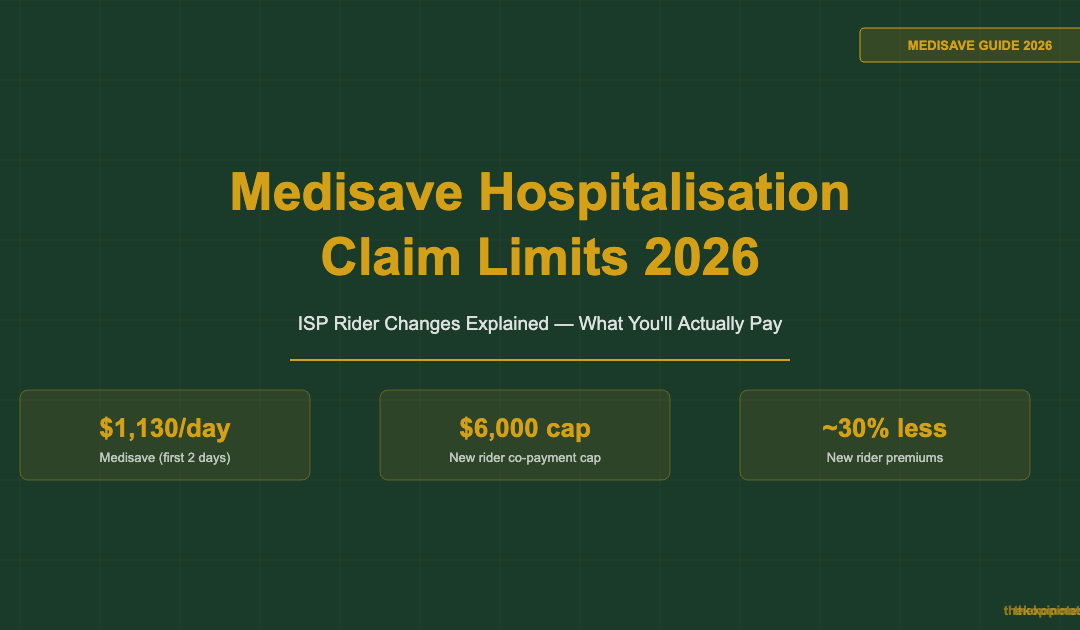
If you’re admitted to a Singapore hospital in 2026, your Medisave can cover up to $1,130 per day for the first two days, then $400 per day from day three. But from 1 April 2026, MOH changed the Integrated Shield Plan (ISP) rider rules — new riders no longer cover your deductible. This guide breaks down exactly how much you can claim, what’s changed, and how to work out your actual out-of-pocket cost.
- Medisave pays $1,130/day for the first 2 days and $400/day from day 3 for general hospital stays
- From April 2026, new ISP riders no longer cover the deductible ($1,500–$3,500) — you pay this yourself
- New riders cost ~30% less in premiums — but you take on more out-of-pocket risk per admission
What Medisave Covers During a Hospital Stay
Medisave is Singapore’s mandatory medical savings scheme. Every working Singaporean contributes a portion of their CPF to their Medisave Account (MA) — and you can use it to pay hospital bills when you’re admitted.
During a hospital stay, Medisave covers:
- Daily ward charges — the base cost of your bed for the night
- Daily treatment fees — doctor’s rounds, nursing care, and ward-based procedures
- Investigations and medicines — blood tests, X-rays, and medications ordered during your stay
- Surgery — via the Table of Surgical Procedures (TOSP), from $240 to $5,290 depending on complexity
You can use your own Medisave or that of an immediate family member (spouse, parent, grandparent, sibling, or child). This makes Medisave a flexible resource across your whole household.
What Medisave does not cover: outpatient bills beyond approved chronic disease programmes, dental work (with very limited exceptions), cosmetic procedures, and the portion of your bill above Medisave limits — that’s where MediShield Life and your ISP come in.
Medisave Withdrawal Limits for Hospitalisation (2026)
The CPF Board sets firm limits on how much Medisave you can use per day. These limits apply regardless of how much is in your Medisave Account. Here are the 2026 figures:
| Hospitalisation Type | Days 1–2 (per day) | Day 3+ (per day) |
|---|---|---|
| General Hospitalisation | $1,130 | $400 |
| Day Surgery (ward charges) | $830 | N/A |
| Psychiatric Treatment | $1,130 | $230 |
| Surgery (TOSP, by complexity) | $240–$5,290 | |
Source: CPF Board, cpf.gov.sg — MediSave Withdrawal Limits, effective 2025/2026
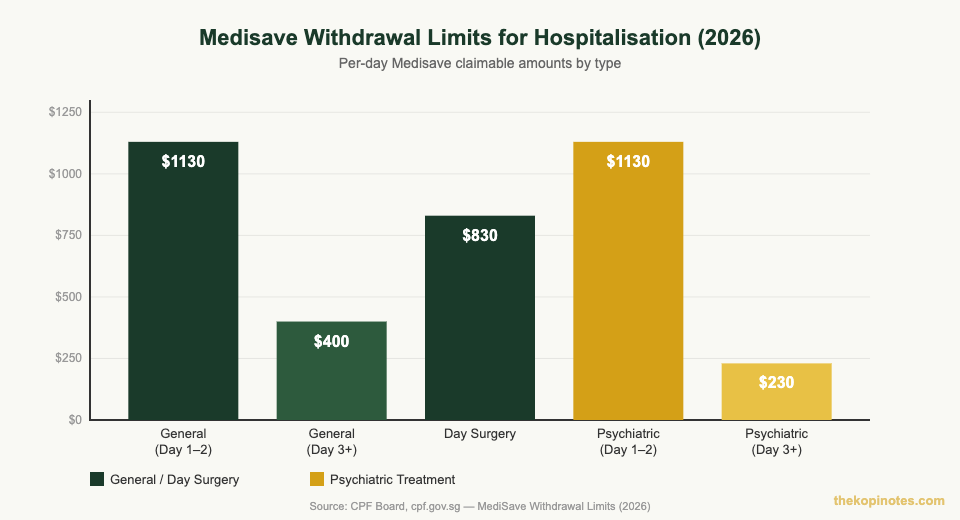
For a typical 5-night stay in a Class A ward (private room), your Medisave would cover:
- Day 1: $1,130
- Day 2: $1,130
- Days 3–5: $400 × 3 = $1,200
- Total Medisave for ward charges: $3,460
Any surgery would add to this. A mid-complexity surgery (Table 5A) adds another $2,610 from Medisave. So your Medisave could cover $6,070 of a 5-night admission with surgery — before MediShield Life and your ISP kick in for the balance.
How MediShield Life Protects You (The Base Layer)
Every Singapore Citizen and PR is automatically enrolled in MediShield Life. It’s the foundation of your healthcare protection — and it covers large hospital bills after your Medisave and deductible are applied.
MediShield Life has two key cost-sharing components:
Deductible: A fixed amount you pay first before MediShield Life pays anything. It ranges from $500 to $3,000 per year depending on your age and ward class. Once you’ve paid the deductible once in a policy year, you don’t pay it again for subsequent admissions that year.
Co-insurance: After the deductible, MediShield Life pays most of your bill — but you still bear a percentage. The co-insurance rate is tiered: 10% on the first claimable amount, then 5%, then 3% as your bill grows. This can also be paid from Medisave.
MediShield Life is benchmarked to Class B2/C ward rates. If you choose Class A or B1, the payout is pro-rated — meaning a larger gap between what MediShield Life pays and your actual bill. That gap is why many Singaporeans buy an Integrated Shield Plan (ISP).
ISP Rider Changes from 1 April 2026
An ISP is a private insurance plan that sits on top of MediShield Life and extends your coverage — often to Class A or private hospital wards. You pay ISP premiums from your Medisave (for the base plan) and cash (for the rider).
Before April 2026, most ISP riders offered “full coverage” — they covered the deductible, co-insurance, and essentially your entire bill up to the plan limit. You could leave hospital with near-zero out-of-pocket expense.
From 1 April 2026, MOH changed the rules for new ISP riders. Here’s what changed:
| Feature | Legacy Rider (before Apr 2026) | New Rider (from Apr 2026) |
|---|---|---|
| Deductible covered? | Yes — fully covered | No — you pay it |
| Minimum co-payment | 5% | 5% (unchanged) |
| Co-payment cap | $3,000 or lower | $6,000 minimum |
| Available for purchase? | No — legacy riders no longer sold from 1 Apr 2026 | Yes |
| Estimated premium | Base | ~30% lower on average |
Source: Ministry of Health, moh.gov.sg/newipriders — New ISP Rider Framework (April 2026)
The minimum IP deductible under the new rules depends on your ISP’s coverage class:
- B1-targeted ISP: Deductible of $2,500 for Class A/B1 stays; $2,000 for B2; $1,500 for C
- A-ward / private hospital ISP: Deductible of $3,500 for private/A stays; $2,500 for B1; $2,000 for B2; $1,500 for C
If you’re on a legacy rider you bought before April 2026, good news — you can keep it. Nothing changes unless you voluntarily switch to a new rider.
If you’re buying an ISP or rider for the first time (or upgrading) after April 2026, only the new-framework riders are available.
What You’ll Actually Pay: Before vs After
Let’s put numbers to it. Take a $30,000 private hospital bill — say, a 5-night admission with surgery:
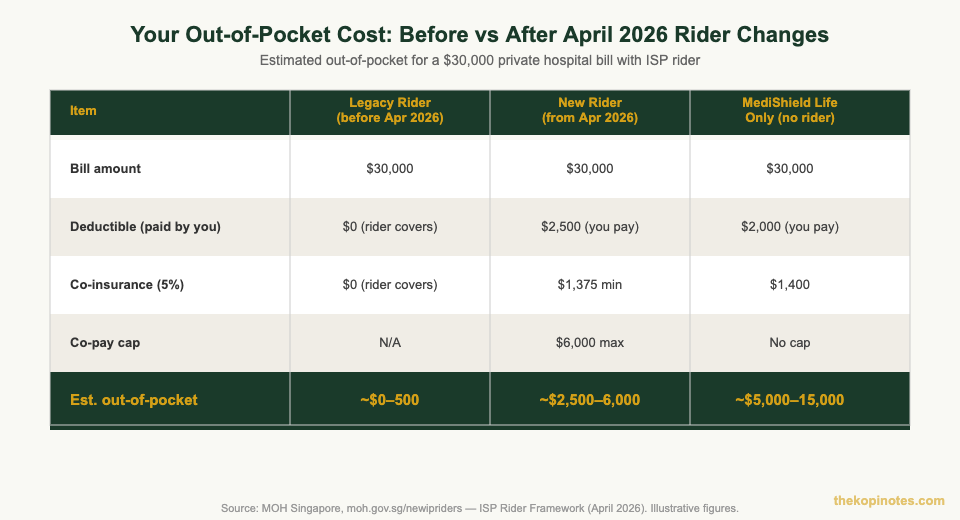
The chart above shows the striking difference. With a legacy rider, most Singaporeans paid close to nothing out of pocket. With the new rider, you’ll pay your deductible ($2,500–$3,500) plus 5% co-insurance — capped at $6,000 in total.
For a $30,000 bill with a private-hospital ISP (new rider), your math might look like:
- Deductible (you pay): $3,500
- Balance after deductible: $26,500
- 5% co-insurance on $26,500: $1,325
- Your total out-of-pocket: $4,825 — within the $6,000 cap
- Rider covers the remaining ~$25,175
That $4,825 can be paid from Medisave, so you may not need to dip into cash at all — as long as you have enough in your Medisave Account.
Compare this to having no ISP at all. MediShield Life’s payout is benchmarked to subsidised ward rates. On a $30,000 private hospital bill, you could face $10,000–$15,000+ out of pocket. That’s where a good CPF investment strategy and ISP plan become non-negotiable for most Singaporeans.
Should You Switch to the New ISP Rider?
This depends on two things: your financial cushion and your risk tolerance.
Switch if:
- You have $10,000+ in your Medisave Account and can absorb the deductible from there
- You’re young and healthy — lower probability of multiple admissions per year
- You want to save 30% on annual rider premiums
- You’re buying a new plan after April 2026 — legacy riders are no longer available anyway
Keep your legacy rider if:
- You or a family member has a chronic condition that results in frequent hospitalisations
- Your Medisave balance is low and you’d struggle to cover a $3,500 deductible in cash
- The premium savings don’t outweigh your peace of mind
Use the Singapore retirement calculator to estimate how your Medisave balance will grow over time and whether it gives you enough buffer to absorb the new deductible structure.
5 Smart Ways to Maximise Your Medisave for Hospitalisation
Whether you’re on a legacy or new rider, these steps help you get the most out of your Medisave during a hospital stay:
1. Authorise family members’ Medisave upfront. You can use a spouse’s or parent’s Medisave in addition to your own. Authorise this before admission — doing it during a hospital stay adds friction.
2. Ask for an itemised bill. Some charges (e.g. certain implants or consumables) have separate Medisave sub-limits. An itemised bill helps you maximise claims on each component separately.
3. Know your Medisave balance. Check your Medisave balance via the CPF website or app. If your balance is below $5,000, consider topping up — Medisave top-ups also give you potential tax relief. For investing the excess, platforms like Endowus referral code let you invest your Medisave in lower-risk funds.
4. Check your ISP’s panel hospitals. ISP insurers reimburse at different rates for panel vs non-panel hospitals. Choosing a panel hospital can reduce your out-of-pocket even further.
5. Keep your ISP premiums up to date. A lapsed ISP means you fall back on MediShield Life only — and that can leave you with a very large gap on a private hospital bill. Set up GIRO from your Medisave to avoid accidental lapses.
Frequently Asked Questions
How much Medisave can I use per day for a hospital stay in 2026?
You can use up to $1,130 per day for the first two days of a general hospital admission, and $400 per day from the third day onwards. For day surgery, the limit is $830 per day for hospital charges. These limits are set by the CPF Board and apply to ward charges, treatment fees, investigations, and medicines.
What changed with ISP riders from 1 April 2026?
From 1 April 2026, new ISP riders can no longer cover the minimum deductible set by MOH. This means you now pay your deductible out of pocket (from Medisave or cash) before your rider kicks in. The minimum deductible ranges from $1,500 to $3,500 depending on your ISP’s ward class. The co-payment cap was also raised to a minimum of $6,000 (from as low as $3,000 previously). However, new riders are expected to be about 30% cheaper on average.
Can I still keep my old ISP rider after April 2026?
Yes. If you bought a legacy ISP rider before 1 April 2026, you can keep it. Your existing coverage is not affected. You will only move to the new framework if you voluntarily switch to a new rider — for example, to benefit from the lower premiums. Legacy riders are no longer available for new purchases as of 1 April 2026.
Can I use Medisave to pay the new deductible?
Yes, the deductible under your ISP can be paid using Medisave, subject to Medisave withdrawal limits. For most admissions, your Medisave covers the first few days of ward charges plus the deductible, so you may not need to use cash at all — provided your Medisave Account has a sufficient balance.
What is the minimum IP deductible under the new rider rules?
It depends on your ISP’s coverage class and the ward you use. For a B1-targeted ISP, the minimum deductible is $2,500 for Class B1/A stays, $2,000 for Class B2, and $1,500 for Class C. For a private hospital ISP, the deductible is $3,500 for private or Class A wards, stepping down to $2,500 for B1 and $2,000 for B2. These figures are set by MOH as of April 2026.
Does MediShield Life cover private hospital stays?
Yes, but only at pro-rated rates benchmarked to Class B2/C wards. For a private hospital bill, MediShield Life will pay based on what that treatment would cost in a Class B2 ward — leaving a potentially large gap. Your ISP covers the gap between MediShield Life’s payout and your actual private hospital bill, up to your plan limit.
How do I check how much Medisave I have?
Log in to the CPF Member Portal at cpf.gov.sg or use the CPF mobile app. Your Medisave Account balance is shown under Healthcare Financing. You can also use the portal to authorise family members’ Medisave for an upcoming hospitalisation.
Get Free Insurance Advice
Speak with a licensed insurance advisor. No obligation, no cost.
By submitting this form, you agree to our Privacy Policy.
This article was researched with the help of AI. While we strive to keep all information accurate and up to date, there may be errors. If you notice any discrepancies, please contact us.