CapitaLand Integrated Commercial Trust (CICT): Rate Cuts & DPU Recovery Guide 2026
Singapore’s largest diversified commercial REIT — what lower rates mean for your DPU in 2H2026.
Table of Contents
- What Is CapitaLand Integrated Commercial Trust?
- CICT Portfolio Overview 2026
- How Rate Cuts Benefit CICT in 2H2026
- DPU History & Distribution Outlook
- CICT vs S-REIT Peers: Yield & Gearing
- Is CICT Fairly Valued in 2026?
- Key Risks to Watch
- How to Buy CICT in Singapore
- Our 2026 Verdict
- Frequently Asked Questions
CapitaLand Integrated Commercial Trust (CICT) is Singapore’s largest diversified commercial REIT by market capitalisation, owning an approximately S$24 billion portfolio of retail malls, Grade A offices, and integrated developments across Singapore, Germany and Australia. Listed on SGX under the ticker CICT and sponsored by CapitaLand Investment Limited (CLI), it pays distributions twice yearly. With the US Federal Reserve cutting interest rates in 2H2026, CICT’s cost of debt is easing — setting up a meaningful DPU recovery that income investors should watch closely.
Not financial advice. All figures are for educational reference only. Data as at August 2026 unless noted.
- CICT is SGX’s largest commercial REIT — strong CapitaLand sponsor, 26-property portfolio, semi-annual DPU.
- Rate cuts directly ease CICT’s refinancing costs. Every 25bps cut could add approximately 0.05–0.10 cents to annual DPU.
- At an indicative yield of ~5.1% and gearing of ~38.5%, CICT offers defensive income with rate-normalisation upside — but FX risk and office headwinds deserve attention.
What Is CapitaLand Integrated Commercial Trust?
CapitaLand Integrated Commercial Trust — commonly known as CICT — is a real estate investment trust listed on the Singapore Exchange (SGX) Main Board. It was formed in November 2020 through the merger of two established S-REITs: CapitaLand Mall Trust (CMT) and CapitaLand Commercial Trust (CCT).
That merger created something special. You get retail exposure — from heartland malls to Orchard Road icons — combined with a Grade A office portfolio, all under one REIT. This diversification is a key reason CICT has become many Singapore investors’ core REIT holding.
Here are the fast facts:
- SGX Ticker: CICT
- Sponsor: CapitaLand Investment Limited (CLI)
- REIT Manager: CapitaLand Integrated Commercial Trust Management Limited
- Distribution: Semi-annual (June and December)
- Portfolio Value: ~S$24 billion (as at mid-2026)
- Properties: 21 in Singapore + 5 overseas (Germany & Australia)
- Structure: Stapled security (units + subordinated perpetual securities)
CICT’s sponsor, CapitaLand Investment, is one of Asia’s largest diversified real estate managers. The sponsor provides CICT with a strong pipeline of assets and has a track record of injecting quality properties into the REIT over time.
If you want to understand how CICT’s share price responds to macro shifts, our CICT share price analysis covers the technical and fundamental picture in detail.
CICT Portfolio Overview 2026
CICT’s portfolio spans retail, office, and integrated mixed-use developments. In Singapore, the properties range from prime Orchard Road to suburban heartland — giving you broad coverage of Singapore’s commercial real estate cycle.
| Property | Type | Location | CICT Stake |
|---|---|---|---|
| Raffles City Singapore | Integrated | City Hall | ~60% |
| CapitaSpring | Grade A Office | Robinson Rd | 45% |
| ION Orchard | Prime Retail | Orchard Road | 50% |
| Plaza Singapura | Suburban Mall | Dhoby Ghaut | 100% |
| Bugis Junction & Bugis+ | Mall + Office | Bugis | 100% |
| Tampines Mall | Suburban Mall | Tampines | 100% |
| Funan | Integrated | City Hall | 100% |
| IMM Building | Outlet Mall | Jurong | 100% |
| Frankfurt Main Tower | Grade A Office | Frankfurt, Germany | ~94% |
| 101 Miller Street | Grade A Office | Sydney, Australia | 100% |
Source: CICT Investor Relations (selected key properties). Full portfolio at cict.com.sg. Stake percentages approximate as at mid-2026.
The portfolio is heavily weighted to Singapore (~85% of assets), which reduces CICT’s exposure to the eurozone growth slowdown and Australian property cycle. The overseas assets, however, add useful diversification and some Euro/AUD currency exposure.
How Rate Cuts Benefit CICT in 2H2026
This is the core of the 2026 investment case for CICT. As the Federal Reserve eases rates — with markets pricing in further cuts after the September 2026 FOMC — CICT stands to benefit through three channels.
1. Lower Refinancing Costs
CICT carries approximately S$8–9 billion in total borrowings to fund its S$24 billion portfolio. With gearing at ~38.5%, the REIT relies heavily on debt markets. A lower rate environment reduces the cost when existing debt matures and is refinanced.
As at 1H2026, CICT’s weighted average cost of debt is approximately 3.2% per annum. With ~70% of its debt on fixed rates or hedged via interest rate swaps, the benefit from rate cuts flows through gradually — as fixed-rate tranches mature and are replaced at lower market rates.
2. Narrowing Yield Spread Attracts Investors
When risk-free rates (like the Singapore 10-year government bond yield) fall, the gap between CICT’s distribution yield and the risk-free rate widens. This makes CICT more attractive relative to bonds — bringing in fresh capital that can push the unit price higher.
3. Asset Valuation Upside
Commercial property valuations are inversely linked to capitalisation rates. When interest rates fall, cap rates typically compress — increasing the appraised value of CICT’s properties. This could boost CICT’s Net Asset Value (NAV) per unit and reduce its P/NAV discount.
Combined, these three forces create a genuine tailwind for CICT in 2H2026 — one that the market has only partially priced in, based on where CICT’s unit price traded through mid-2026. If you are building passive income in Singapore via S-REITs, CICT’s rate sensitivity makes it worth watching closely.
CICT DPU History & Distribution Outlook
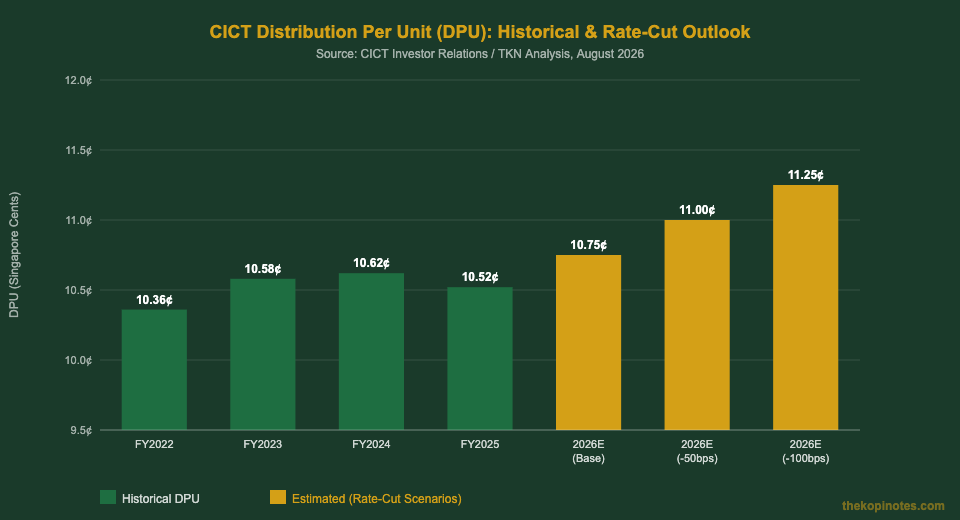
CICT distributes at least 90% of its distributable income — this is a regulatory requirement for Singapore REITs under IRAS rules. Distributions are paid semi-annually, typically in June and December each year.
Here is CICT’s recent DPU track record:
| Period | DPU (S¢) | Annualised DPU | Indicative Yield* |
|---|---|---|---|
| 1H2023 | 5.24¢ | ~10.48¢ | ~5.1% |
| 2H2023 | 5.34¢ | ~10.58¢ | ~5.2% |
| 1H2024 | 5.28¢ | ~10.56¢ | ~5.1% |
| 2H2024 | 5.34¢ | ~10.68¢ | ~5.2% |
| FY2025 (full year) | ~10.52¢ | 10.52¢ | ~5.1% |
| 1H2026 (estimated) | ~5.35¢ | ~10.70¢ | ~5.2% |
Source: CICT investor presentations & SGX filings. *Indicative yield based on approximate unit price of S$2.05. 1H2026 figures are estimates for illustrative purposes only. Past distributions are not a guarantee of future payouts.
What you notice immediately is that CICT’s DPU has been remarkably stable — hovering around 10.5–10.7 cents per year through the high-rate environment of 2022–2025. The resilience reflects strong occupancy (typically above 96%) and a diversified tenant base across essential retail and Grade A office.
The recovery story for 2026 is simple: as higher-cost fixed-rate debt matures and is refinanced at current (lower) market rates, distributable income grows. Combine that with Singapore’s healthy office demand and stable retail footfall, and CICT’s DPU has a credible recovery path ahead.
You can compare CICT’s distribution performance against the best S-REITs in Singapore 2026 to see where it ranks on yield and total return potential.
CICT vs S-REIT Peers: Yield & Gearing
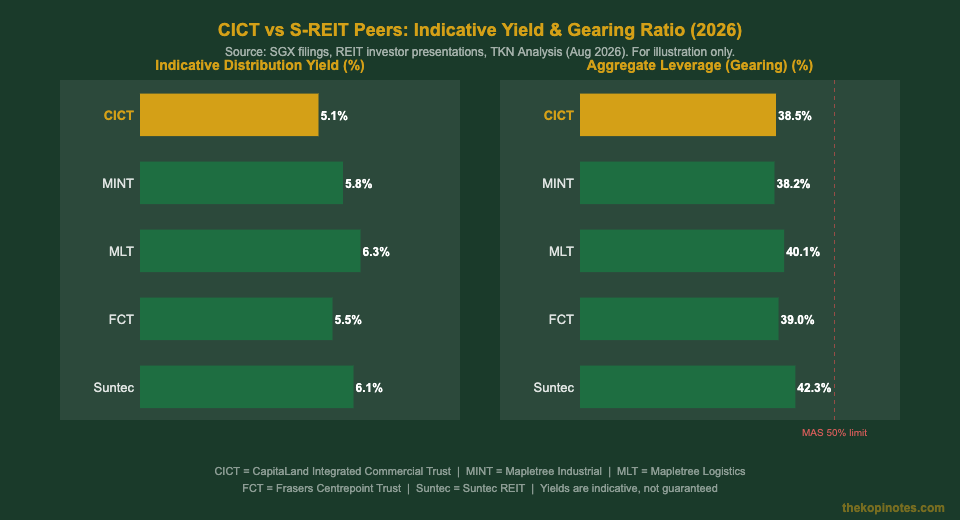
How does CICT stack up against other major S-REITs? The chart above shows indicative yield versus gearing. Here is the quick read:
- Yield: At ~5.1%, CICT offers a lower yield than industrial and logistics peers (MINT ~5.8%, MLT ~6.3%). This is the “quality premium” you pay for CICT’s brand, sponsor strength, and portfolio liquidity.
- Gearing: CICT’s ~38.5% gearing is below the MAS 50% regulatory limit and is well within the REIT’s internal target range. Peers like Suntec REIT carry higher gearing (~42%), which adds more refinancing risk.
- Liquidity: CICT’s large market cap (~S$13–14 billion) makes it the most liquid S-REIT — easy to buy and sell without moving the market.
If you prioritise income over capital gains, a higher-yielding REIT like MLT might appeal. But if you want a defensive anchor in your S-REIT portfolio — one with strong sponsor backing, stable occupancy and a clear rate-cut tailwind — CICT is hard to beat.
Is CICT Fairly Valued in 2026?
The key valuation metric for any S-REIT is its Price-to-NAV (P/NAV) ratio — essentially whether you are buying a dollar of real estate assets for more or less than a dollar.
| Metric | CICT (Approx, Aug 2026) | Comment |
|---|---|---|
| Unit Price (Indicative) | ~S$2.05 | Mid-2026 trading range |
| NAV Per Unit | ~S$2.20 | Approximate 2H2025 book value |
| P/NAV Ratio | ~0.93x | Slight discount to NAV |
| Gearing Ratio | ~38.5% | Well below 50% MAS limit |
| Interest Coverage Ratio | ~3.1x | Healthy buffer above 1.5x threshold |
| Cost of Debt | ~3.2% | Declining as debt is refinanced |
Source: CICT investor presentations, SGX filings. Figures are approximate and for educational illustration only. Always verify current data at cict.com.sg.
Trading at a modest discount to NAV (~0.93x), CICT is not the deep-value bargain that smaller S-REITs sometimes offer. But for a REIT of this quality and size, a sub-1x P/NAV is reasonably attractive — especially if rate cuts push NAV higher and compress the discount further.
Key Risks to Watch
No REIT is risk-free. Here is what to keep an eye on with CICT in 2026:
- Office Market Softening: CICT’s Grade A office assets (CapitaSpring, Asia Square Tower 2, Frankfurt Main Tower) face headwinds from hybrid work patterns and new supply entering Singapore’s CBD. Watch occupancy and rental reversion rates in quarterly results.
- Retail Structural Shift: E-commerce continues to pressure certain retail categories. CICT’s pivot toward food & beverage, experiential retail and services helps, but flagship mall performance needs monitoring.
- FX Risk: The Germany and Australia portfolios generate income in EUR and AUD. Unfavourable currency moves reduce SGD-equivalent DPU. CICT partially hedges this exposure but cannot eliminate it.
- Refinancing Risk: If rate cuts stall or reverse, CICT’s ~30% floating-rate debt will cost more. Also watch the debt maturity profile — a large tranche maturing in a higher-rate environment would pressure DPU.
- Geopolitical Risk: CICT’s overseas assets (Germany, Australia) add exposure to geopolitical events and local regulatory changes beyond Singapore’s control.
How to Buy CICT in Singapore
Buying CICT is straightforward — it is listed on SGX, so you purchase it like any regular stock. Here are the most popular platforms Singaporean investors use.
Option 1: IBKR (Interactive Brokers)
IBKR offers the lowest brokerage fees for S-REIT purchases — typically 0.08% per trade (min USD 1.50) for SGX-listed stocks. If you are investing a larger amount (S$10,000+), IBKR’s fee structure is very competitive. Use referral code jianxiong368 when signing up.
Option 2: FSMOne
FSMOne is a popular Singapore platform for REITs and ETFs. You can buy CICT directly and also access their Regular Savings Plan to automate monthly purchases. Use the FSMOne referral code P0544985 to get started with a bonus.
Option 3: Syfe
Syfe’s REIT+ portfolio includes CICT as a core holding, weighted by market cap. If you prefer a managed S-REIT portfolio rather than picking individual REITs, Syfe REIT+ is worth considering. Visit the Syfe referral code page (SRPRFFFCD) for the latest sign-up bonus.
Option 4: Local Bank Platforms (DBS, OCBC, UOB)
DBS Vickers, OCBC Securities and UOB Kay Hian all let you buy CICT through their respective trading platforms. These are convenient if you already bank with them, though brokerage fees are typically higher than IBKR or FSMOne.
Once you own CICT units, distributions are paid directly to your bank account or brokerage cash account twice a year. You can also use the Singapore retirement calculator to model how CICT distributions fit into your long-term passive income plan.
Our 2026 Verdict: CICT as a Core S-REIT Holding
CICT is not the highest-yielding S-REIT on SGX. You pay a quality premium for its sponsor backing, portfolio scale, and remarkable distribution stability. But in a rate-cutting environment, that premium narrows — and CICT’s DPU recovery story becomes increasingly compelling.
If you are building a Singapore dividend portfolio for long-term passive income, CICT earns its place as a core holding. Its ~5.1% indicative yield, sub-1x P/NAV, S$13B+ market cap liquidity, and clear rate-cut tailwind make it one of the more balanced risk/reward options in the S-REIT space heading into 2H2026.
That said, do your own due diligence. Check CICT’s latest quarterly results, watch the office occupancy trend, and verify current DPU and gearing figures at cict.com.sg. This article is for educational purposes only and is not financial advice.
Explore other top S-REIT opportunities in our guide to the best S-REITs in Singapore 2026. Use the Endowus referral code 2V343 to invest in a managed REIT portfolio via your CPF or SRS account.
Frequently Asked Questions
What does CICT stand for?
How often does CICT pay distributions?
Is CICT’s gearing ratio safe?
How do Fed rate cuts affect CICT’s DPU?
Can I buy CICT using my CPF or SRS funds?
What is CICT’s NAV per unit in 2026?
This article was researched with the help of AI. While we strive to keep all information accurate and up to date, there may be errors. If you notice any discrepancies, please contact us.