Best Japan ETFs for Singapore Investors (2026): Nikkei 60,000 and the Hedging Decision
The Nikkei just crossed a historic milestone. Here is how to get Japan exposure on the LSE — and whether you should hedge the yen.
Japan’s Nikkei 225 broke above 60,000 for the first time in April 2026, powered by Bank of Japan rate hikes to 1% and a weaker yen boosting exporter earnings. Singapore investors get exposure through Ireland- or Luxembourg-domiciled UCITS ETFs like CSJP and XDJP on the London Stock Exchange. A key 2025 precedent makes this decision worth thinking through: in a year of dramatic yen swings, currency-hedged Japan funds outperformed unhedged ones by more than 400 basis points.
Not financial advice. All figures are for educational reference only. Data verified as at August 2026 unless noted.
- The Nikkei 225 crossed 60,000 in April 2026, driven by BOJ rate hikes (now 1%), a weaker yen, and PM Sanae Takaichi’s pro-growth policy push.
- XDJP and CSJP give unhedged Japan exposure at 0.09–0.12% TER. Currency-hedged options like DXJ cost more (0.48%), and in 2025 outperformed unhedged Japan equity by 400+ basis points during a volatile year for the yen.
- Buy on the LSE via IBKR, Saxo, or Syfe. None of these are CPF-investable, but most brokers support SRS purchases.
Table of Contents
What Is Japan Equity Investing?
Japan runs one of the largest, most liquid developed stock markets outside the US. You can track it in two very different ways. The Nikkei 225 is a price-weighted index of 225 large, liquid companies — a bit like the Dow Jones Industrial Average. Higher share-price stocks move the index more, regardless of company size.
The MSCI Japan Index works differently. It is float-adjusted and market-cap-weighted, covering a broader slice of the market. Neither index is “better” — they just answer different questions. The Nikkei tells you how Japan’s best-known blue chips are doing. MSCI Japan tells you how the broader market is doing.
You do not need a Japanese brokerage account for either. Ireland- and Luxembourg-domiciled UCITS ETFs listed on the London Stock Exchange (LSE) give you the same exposure, with far less tax friction than buying individual Japanese stocks directly through a local broker.
Why Japan Is Trending in 2026
Three forces are driving the loudest Japan rally in a generation.
First, the index milestone. The Nikkei 225 broke above 60,000 for the first time in April 2026, having already cleared 50,000 the year before.
Second, politics turned unusually market-friendly. Prime Minister Sanae Takaichi called a snap election early in the year and won a landslide, strengthening her mandate for pro-growth fiscal policy. Political stability plus fiscal support is a rare combination for Japan, and investors have rewarded it.
Third, the Bank of Japan (BOJ) is finally normalising policy after decades near zero. The BOJ hiked its policy rate to 1% in June 2026 — the highest level since 1995 — and held it there at its July meeting. That is not automatically bad for stocks. A summary of the BOJ’s July meeting flagged rising risk that core inflation accelerates “clearly above” its 2% target, with one board member suggesting future hikes could come faster than markets expect. For now, investors are reading steady hikes as a sign the BOJ trusts the recovery, not a threat to it.
Here is the part that trips up first-time Japan ETF buyers: a weaker yen has been a tailwind for exporter earnings all year, even as the BOJ hikes rates. The yen has fallen roughly 8.6% against the US dollar over the past 12 months (as at 28 August 2026), even though it firmed about 2.4% over just the past month. That tension is exactly why the hedging decision below matters this year more than most.
Underneath the macro headlines sits a slower-moving structural story. Years of Tokyo Stock Exchange-driven governance reform have pushed Japanese companies to unwind cross-shareholdings, buy back stock, and target higher return on equity. That has arguably done more for long-term earnings quality than any single rate decision — and it is not going away when the current rally cools.
However, sell-side outlooks for the second half of 2026 point to a broadening rally: rising real wages, stronger domestic demand, and gains spreading beyond AI-linked exporters into more of the market. That is a genuinely different setup from the “Japan never re-rates” story of the last decade.
Best Japan ETFs for Singapore Investors
Four LSE-listed, UCITS-compliant funds cover almost everything a Singapore investor needs for Japan exposure. You are really making two separate choices: which index (Nikkei 225 versus MSCI Japan), and whether to hedge the yen.
| Fund | Ticker | Index | TER | Currency | Fund Size | Best For |
|---|---|---|---|---|---|---|
| Xtrackers Nikkei 225 UCITS ETF (Dist) | XDJP | Nikkei 225 | 0.09% | Unhedged (JPY) | ~EUR 2.0bn | Cheapest, most liquid Nikkei tracker |
| iShares MSCI Japan UCITS ETF (Acc) | CSJP | MSCI Japan | 0.12% | Unhedged (JPY) | ~USD 1.65bn | Broad market, accumulating (compounding) |
| iShares MSCI Japan UCITS ETF (Dist) | IJPN | MSCI Japan | 0.12% | Unhedged (JPY) | Same family as CSJP | Investors who want cash distributions |
| WisdomTree Japan Equity UCITS ETF (USD Hedged) | DXJ | WisdomTree Japan Hedged Equity Index | 0.48% | Hedged to USD | Smaller, niche | Equity exposure without yen risk |
Source: iShares CSJP factsheet (30 Jul 2026); justETF XDJP profile (Aug 2026); WisdomTree DXJ product page (Aug 2026).
On a SGD 50,000 position, XDJP’s 0.09% TER costs about SGD 45 a year. CSJP or IJPN at 0.12% costs about SGD 60 a year. DXJ’s 0.48% TER costs about SGD 240 a year — roughly SGD 195 more than the cheapest unhedged option, before any difference in returns.
That extra cost is not wasted money — it is the price of currency insurance, and in 2025 it paid off, which is why Singapore investors are weighing the same trade-off again in 2026. According to WisdomTree’s own research, its Japan Hedged Dividend Index outperformed its unhedged counterpart by more than 400 basis points in 2025, a year in which the yen swung sharply before ending roughly flat. That is the precedent behind the hedging decision Singapore investors face again in 2026. Strip out the currency swings, and you keep more of the pure equity story: rate hikes, governance reform, and earnings growth.
However, hedging is a bet, not a free lunch. If the yen resumes its longer 12-month slide against the US dollar, an unhedged fund like XDJP or CSJP captures that additional currency tailwind on top of the equity return — while DXJ, having paid to strip the currency out, would not. There is also a structural difference worth knowing: because the Nikkei 225 is price-weighted, a handful of high-share-price names (think Fast Retailing) can swing the whole index disproportionately, versus the more evenly distributed weighting of MSCI Japan.
How to Buy Japan ETFs in Singapore
All four funds above trade on the LSE, so the buying process is the same one you would use for any other UCITS ETF.
Interactive Brokers (IBKR) is typically the most cost-effective choice for larger, buy-and-hold positions, thanks to low commissions on LSE trades and tight FX conversion spreads.
Saxo Markets offers a similarly wide range of LSE tickers with a more beginner-friendly interface, though its commission structure suits less frequent traders better than active accumulators.
Syfe Brokerage and MooMoo Singapore both list these tickers and work well for smaller, regular purchases. Compare FX conversion fees carefully — on a USD-denominated fund, currency conversion often costs more than the trading commission itself.
To place an order: fund your account, search for the ticker (XDJP, CSJP, IJPN, or DXJ), select the London Stock Exchange listing, and buy in USD or GBP depending on the share class. Settlement is typically T+2.
None of these funds are CPFIS-approved, so you cannot use CPF Ordinary Account savings to buy them. Most are SRS-compatible if your broker supports overseas ETF purchases through your SRS account — check with your provider first, and see our CPF investment strategy guide for what CPF money can and cannot buy.
If you are building a full portfolio rather than a single-country tilt, Japan works best as a satellite position alongside a global core like our VWRA ETF Singapore guide or CSPX ETF Singapore guide, both of which already include Japan as part of a broader world index.
Risks to Consider
After a rally from 50,000 to 60,000 in roughly a year, valuation risk is real. If earnings growth does not keep pace with the price move, the market is vulnerable to multiple compression on any bad news.
BOJ policy risk cuts both ways. Faster-than-expected rate hikes could strengthen the yen sharply. That would help hedged holders relative to unhedged ones, but it could also squeeze exporter earnings across the board — the same companies that have benefited most from yen weakness so far.
If you go unhedged, you carry currency risk on top of the equity risk. A stronger SGD against the yen erodes your returns when converted home, and a weaker SGD amplifies them — independent of how Japanese stocks actually perform.
Hedging has its own cost drag. You are paying roughly four times the TER for currency protection. If the yen resumes weakening against major currencies, that hedge becomes a net negative versus simply holding the unhedged fund.
Finally, remember that Japan is a single-country allocation. The Nikkei 225’s price-weighting concentrates returns in a handful of high-share-price names, which is a different risk profile from a broadly diversified global fund. Most Singapore investors are better served treating Japan as a smaller tilt on top of a core global holding, not a replacement for one — see our diversified commodity ETF guide for another example of how single-theme exposure fits into a wider portfolio.
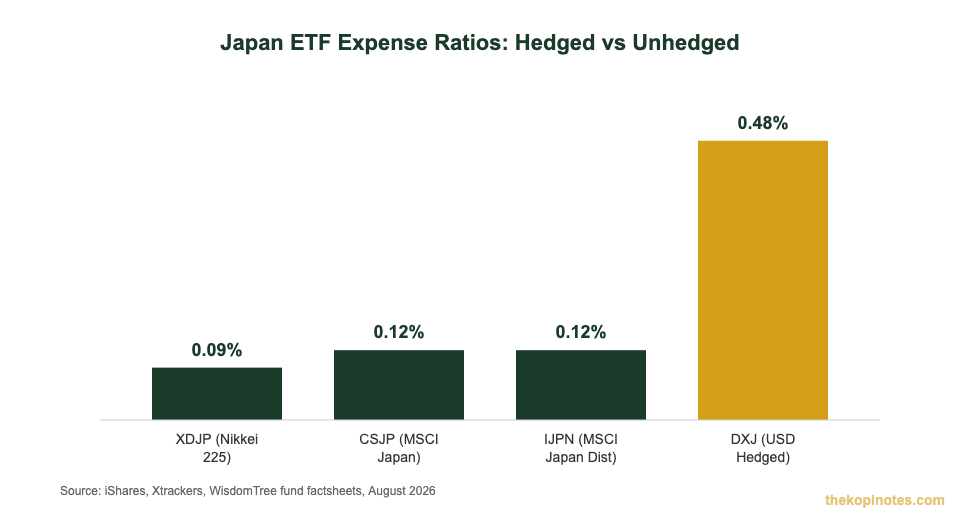
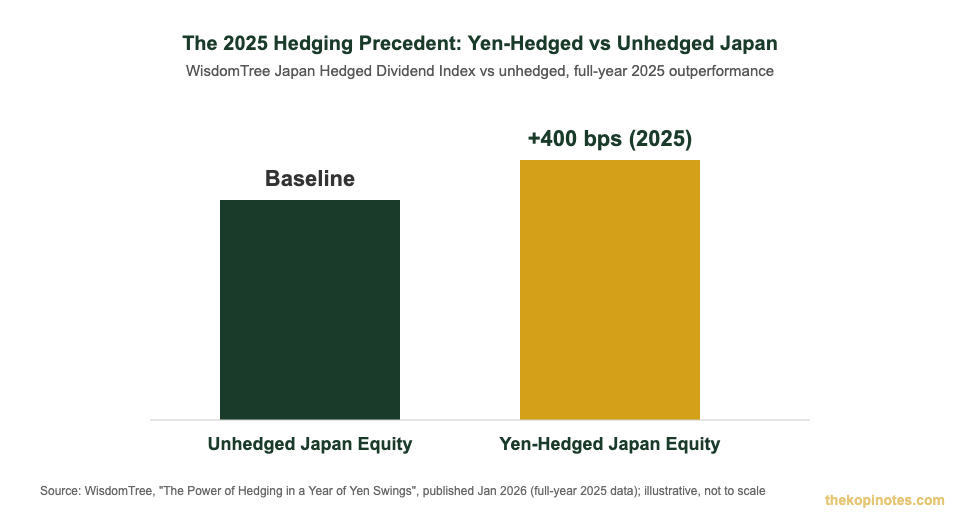
Further reading: Bank of Japan policy statements for the latest rate decisions, and WisdomTree’s research on yen hedging in 2026 for the full hedged-vs-unhedged data behind the chart above.
Frequently Asked Questions
What is the best Japan ETF for Singapore investors in 2026?
There is no single best fund — it depends on what you want. XDJP (Xtrackers Nikkei 225 UCITS ETF) is the cheapest at 0.09% TER and tracks Japan’s best-known blue chips. CSJP (iShares MSCI Japan UCITS ETF) at 0.12% TER gives broader market exposure and accumulates dividends automatically. Both are LSE-listed and Ireland- or Luxembourg-domiciled, which keeps withholding tax and estate tax exposure low for Singapore investors.
Should I buy a currency-hedged or unhedged Japan ETF?
In 2025, WisdomTree’s currency-hedged Japan dividend index outperformed its unhedged counterpart by more than 400 basis points, in a year when the yen swung sharply before ending roughly flat. Heading into 2026, with the yen down about 8.6% over the past 12 months but firmer over the past month, that same hedging trade-off is back in play. Hedging costs more (0.48% TER versus 0.09–0.12%), and it only pays off if the yen strengthens or stays flat. If you expect further yen weakness, an unhedged fund lets you capture that as extra return.
Can I buy Japan ETFs like CSJP or XDJP using my CPF or SRS funds?
No CPF Ordinary Account funds — none of these LSE-listed Japan ETFs are CPFIS-approved. Most are SRS-compatible if your broker supports overseas ETF purchases through an SRS account, but confirm this with your broker before assuming eligibility, since not all platforms extend SRS access to every LSE ticker.
What is the difference between the Nikkei 225 and the MSCI Japan index?
The Nikkei 225 is a price-weighted index of 225 large companies, so higher share-price stocks move it more regardless of company size. The MSCI Japan Index is float-adjusted and market-cap-weighted, covering a broader, more evenly distributed slice of the market. Neither is objectively better — the Nikkei is more concentrated in a handful of high-priced names, while MSCI Japan spreads risk more widely.
Is it too late to invest in Japan after the Nikkei hit 60,000?
Nobody can time this precisely, but sell-side outlooks for the second half of 2026 point to a broadening rally — rising real wages, stronger domestic demand, and gains spreading beyond AI-linked exporters. That said, after a rally from 50,000 to 60,000 in roughly a year, valuation risk is real, so consider dollar-cost averaging into a position rather than committing a lump sum at current levels.
Which broker is best for buying Japan ETFs in Singapore?
Interactive Brokers (IBKR) is typically the most cost-effective for larger, buy-and-hold positions thanks to low LSE commissions and tight FX spreads. Saxo Markets suits investors who want a more beginner-friendly interface. Syfe Brokerage and MooMoo Singapore both work well for smaller, regular purchases — just compare their FX conversion fees, which often cost more than the trading commission itself.
Ready to Add Japan Exposure to Your Portfolio?
Open a brokerage account and buy your first Japan ETF today. Use our referral links for exclusive sign-up bonuses.
This article was researched with the help of AI. While we strive to keep all information accurate and up to date, there may be errors. If you notice any discrepancies, please contact us.