Mapletree Pan Asia Commercial Trust Share Price 2026: Rate Cuts vs Japan Risk — MPACT Investor Guide (SGX: N2IU)
Published August 2026 · 9 min read · SGX: N2IU

Mapletree Pan Asia Commercial Trust (MPACT, SGX: N2IU) owns VivoCity and Mapletree Business City II in Singapore, Festival Walk in Hong Kong, and a Japan office portfolio. At approximately S$1.32, the REIT yields around 6.2%. The Jackson Hole summit in August 2026 signalled Fed rate cuts ahead — but Japan’s 56% occupancy remains a significant drag on DPU recovery. Here is what you need to know before investing.
Not financial advice. All data is for educational reference only. Figures are approximate as at August 2026 unless otherwise stated.
- MPACT yields ~6.2% at ~S$1.32, trading at ~13% discount to NAV — attractive for long-term income investors
- Fed rate cuts (signalled at Jackson Hole Aug 2026) reduce MPACT’s refinancing costs and make its 6.2% yield more competitive vs bonds
- Japan’s 56% occupancy is the key risk — if occupancy recovers to 75%+ by FY2028, DPU upside is meaningful
Table of Contents
1. What is MPACT?
2. Share Price & Valuation 2026
3. Portfolio Breakdown
4. 1Q FY2027 Results
5. Rate Cut Impact — Jackson Hole
6. DPU History & Yield
7. MPACT vs Commercial REIT Peers
8. Bull vs Bear Case
9. How to Buy MPACT in Singapore
10. FAQ
What is Mapletree Pan Asia Commercial Trust (MPACT)?
Mapletree Pan Asia Commercial Trust (MPACT) is one of Singapore’s largest diversified commercial REITs, formed in 2022 through the merger of Mapletree Commercial Trust and Mapletree North Asia Commercial Trust. It trades on the SGX under ticker N2IU.
The REIT holds retail and office properties across four countries. Its Singapore anchor — VivoCity — is the city’s largest suburban mall and delivers reliable, near-full occupancy income. The North Asia properties add diversification but introduced DPU volatility as Japan office demand softened in 2025–2026.
Mapletree Investments Pte Ltd manages MPACT. It is 100% owned by Temasek Holdings — Singapore’s state investment company. This means MPACT has strong institutional backing, access to capital, and a pipeline of potential asset injections over time. That sponsor quality is a key reason income investors consider MPACT despite near-term headwinds.
If you want a diversified Singapore commercial REIT with Temasek sponsorship and VivoCity’s consumer traffic tailwind, MPACT is worth serious analysis. If you want pure Singapore exposure without North Asia risk, explore the best S-REITs in Singapore 2026 for alternatives.
MPACT Share Price 2026: Current Level and Valuation
As at August 2026, MPACT trades at approximately S$1.32. This is a discount of roughly 13% to the estimated NAV of ~S$1.52 per unit. Buying MPACT below NAV means you are acquiring the underlying real estate portfolio at a markdown — historically a signal of long-term value if the business fundamentals remain sound.
The discount has widened in 2025–2026 due to rate-hike headwinds and Japan occupancy concerns. However, with the Fed now signalling cuts (see Section 5), REIT valuations typically re-rate upward as the risk-free rate falls and dividend yields become more attractive relative to bonds.
| Metric | Value (Aug 2026, Indicative) |
|---|---|
| Share Price | ~S$1.32 |
| Estimated NAV per Unit | ~S$1.52 |
| P/NAV | ~0.87x (13% discount to NAV) |
| Indicative Distribution Yield | ~6.2% |
| Aggregate Leverage (Gearing) | ~38.5% |
| Market Capitalisation | ~S$7.8 billion |
Source: SGX, Mapletree Investments, analyst estimates Aug 2026. All figures are approximate. Not financial advice. Always verify via SGX or your broker before making investment decisions.
MPACT Portfolio: Singapore Strength vs Japan Headwinds
MPACT owns five core properties across four markets. Singapore delivers strong, stable income. Japan is the problem child. Here is how each asset is performing as at August 2026:
| Property | Country | Type | Committed Occupancy |
|---|---|---|---|
| VivoCity | Singapore | Retail | ~99% |
| Mapletree Business City II | Singapore | Office / Business Park | ~97% |
| Mapletree Anson | Singapore | Grade A Office | ~96% |
| Festival Walk | Hong Kong | Retail & Office | ~97% |
| Japan Gateway Properties | Japan | Office | ~56% ⚠ |
Source: Mapletree Investments quarterly filings, SGX, August 2026. Figures are approximate estimates.
The Japan office weakness is structural. Remote work adoption in Japanese tier-2 cities has outpaced pre-pandemic projections. Management has flagged leasing initiatives and potential asset recycling options. Recovery to 75%+ occupancy by FY2028 would provide meaningful DPU uplift — but there is no guarantee of the timeline.
1Q FY2027 Results: DPU Fell 2.5% as Japan Drags
MPACT’s 1Q FY2027 results (reported August 2026) showed Distribution Per Unit (DPU) fell 2.5% year-on-year. The culprit was Japan. Singapore performed well across VivoCity and the two office properties. Here is a breakdown of the key drivers:
What pulled DPU down: Japan occupancy fell to 56%, the lowest level since the MNACT assets were acquired. With empty space generating no rental income but still incurring fixed costs, the income shortfall flowed directly through to distributions. FX headwinds from a weaker JPY against the SGD further compressed Japan’s income contribution.
What held up well: VivoCity delivered positive rental reversions — meaning new leases signed at higher rents than the expiring ones. MBC II retained strong tenant demand from technology and financial services firms. Singapore contributed around 60% of net property income, providing a stable income floor.
Gearing improved to ~38.5%. This is well below the MAS 50% regulatory ceiling and gives MPACT flexibility. Lower gearing also reduces the refinancing risk that was a concern when rates were rising. As rates fall, MPACT refinances existing debt at lower cost — a direct DPU tailwind.
For passive income investors in Singapore, the key question is: is 2.5% annual DPU decline a temporary cyclical dip or a structural decline? Management’s actions on Japan over the next 2–3 quarters will answer this question decisively.
Rate Cut Impact: What Jackson Hole Means for MPACT Investors
The Jackson Hole Economic Policy Symposium (August 21–23, 2026) was a turning point for global interest rate expectations. Fed Chair Powell’s remarks signalled a clear shift toward rate cuts, with markets now pricing in a 25bps reduction at the September 17–18, 2026 FOMC meeting.
For MPACT, rate cuts have three distinct positive effects:
1. Lower refinancing costs. MPACT’s ~38.5% gearing means it carries a significant debt load. As that debt matures and is refinanced at lower rates, the interest expense falls. Each 25bps cut in borrowing costs on S$3 billion of debt saves approximately S$7.5 million annually — directly boosting distributable income and DPU.
2. Yield spread widens. When the Singapore 10-year government bond yield falls, MPACT’s 6.2% distribution yield looks more attractive by comparison. Historically, REIT prices rise as investors switch from low-yield bonds back into higher-yielding REITs. This compresses the P/NAV discount.
3. Property valuations may recover. Lower cap rates (driven by lower risk-free rates) can push up property valuations — expanding NAV and further reducing the P/NAV discount.
That said, rate cuts alone will not fix Japan. The structural occupancy problem requires on-the-ground leasing improvements, not just lower global rates. Rate cuts are a necessary tailwind — not a sufficient one. Combining rate cut momentum with Japan occupancy recovery by FY2028 would create a compelling re-rating case. For broader context on Singapore REIT investing via ETFs, our ETF guide covers the Lion-Phillip S-REIT ETF and similar products that give diversified exposure without single-REIT risk.
MPACT DPU History: The Declining Trend Explained
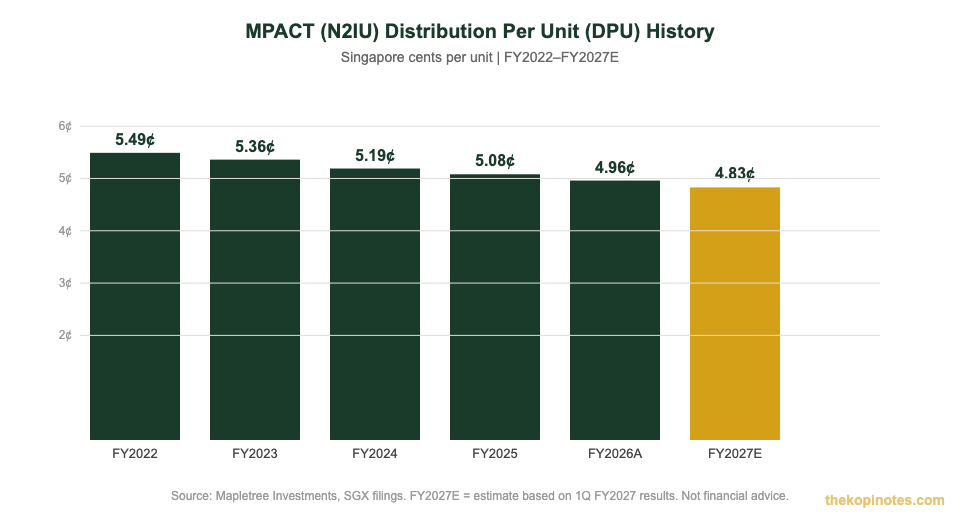
MPACT’s Distribution Per Unit (DPU) — the amount of cash paid to unit holders each year — has been gradually declining since FY2022. This reflects the post-merger integration drag, Japan occupancy weakness, and FX headwinds from a stronger SGD against the JPY and HKD.
| Financial Year | Annual DPU (Approx.) | Year-on-Year Change |
|---|---|---|
| FY2022 | 5.49¢ | — |
| FY2023 | 5.36¢ | -2.4% |
| FY2024 | 5.19¢ | -3.2% |
| FY2025 | 5.08¢ | -2.1% |
| FY2026A | 4.96¢ | -2.4% |
| FY2027E | ~4.83¢ | ~-2.6% (est.) |
Source: Mapletree Investments annual reports, SGX filings. FY2027E is an estimate based on 1Q FY2027 results. All figures approximate. Not financial advice.
At ~4.83¢ DPU and ~S$1.32 share price, the indicative yield is ~6.2%. For context, a Singapore investor holding 50,000 units would receive approximately S$2,415 in annual distributions. Use our Singapore retirement planning calculator to see how MPACT fits into a broader income strategy.
MPACT vs Singapore Commercial REIT Peers
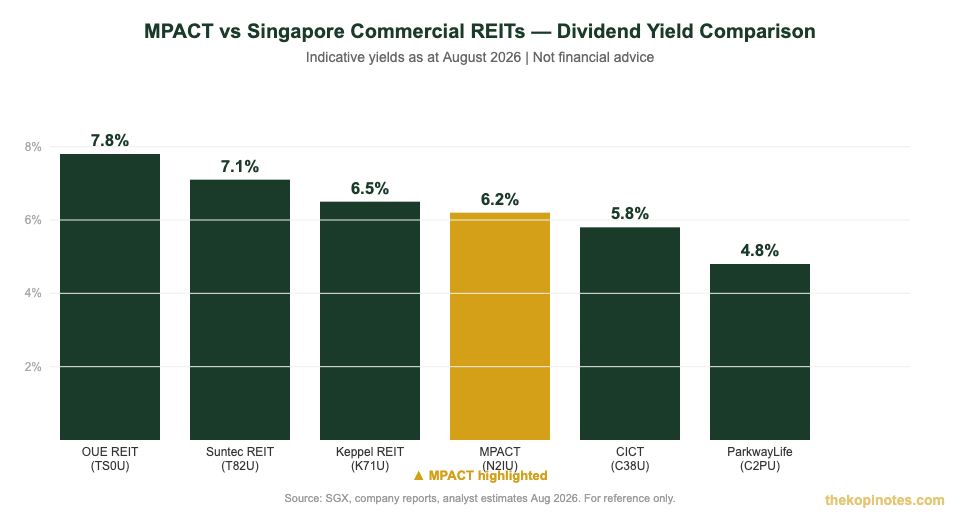
How does MPACT stack up against other Singapore commercial and mixed-use REITs? The table below compares indicative yield, gearing, and P/NAV for the main peers as at August 2026. All data is approximate and should be verified via SGX before any investment decision.
| REIT | Ticker | Ind. Yield | Gearing | P/NAV |
|---|---|---|---|---|
| MPACT | N2IU | ~6.2% | ~38.5% | ~0.87x |
| CapitaLand Integrated Commercial Trust | C38U | ~5.8% | ~37.4% | ~0.93x |
| Suntec REIT | T82U | ~7.1% | ~42% | ~0.75x |
| Keppel REIT | K71U | ~6.5% | ~39% | ~0.82x |
| OUE REIT | TS0U | ~7.8% | ~41% | ~0.70x |
Source: SGX, company results, analyst estimates August 2026. All figures are approximate. Not financial advice. Verify via SGX before investing.
MPACT sits in the middle of the yield range — offering more than CICT but less than Suntec or OUE. Its stronger gearing position (38.5% vs Suntec’s 42%) gives it more refinancing flexibility in a rate-cut environment. The Temasek-backed sponsor also provides asset injection optionality that smaller peers like OUE lack.
MPACT Bull vs Bear Case (August 2026)
Here is a structured look at the investment thesis on both sides. MPACT is not a simple buy or sell — your conviction level should depend on your view of Japan’s office market recovery timeline.
Bull Case — Reasons to Buy
- Rate cuts unlock re-rating: Fed cuts starting September 2026 reduce interest costs and compress the P/NAV discount from 13% toward historical average of ~5–8%
- VivoCity is resilient: 99% occupancy and positive rental reversions mean Singapore income growth is organic and self-sustaining
- Temasek sponsor quality: Access to pipeline assets and strong capital management track record provides optionality
- Japan turnaround upside: If occupancy recovers from 56% to 75%+, DPU could recover by 0.15–0.20¢ per unit — a 3–4% DPU uplift
- Attractive P/NAV entry: Buying real estate at 87 cents on the dollar provides a margin of safety
Bear Case — Key Risks
- Japan occupancy stays low: If Japan office demand does not recover, DPU continues declining 2–3% annually
- FX headwinds persist: JPY weakness vs SGD reduces Japan income after conversion — hedging costs also erode income
- Hong Kong uncertainty: Festival Walk faces China macro and retail sentiment headwinds that are hard to predict
- Rate cuts are priced in: If markets have already rallied in anticipation, the actual cut may not move MPACT’s price further
How to Buy MPACT (N2IU) in Singapore
Buying MPACT is straightforward if you have a brokerage account. Here is a step-by-step guide for Singapore investors:
Step 1: Open a brokerage account. You need a CDP (Central Depository) linked brokerage account to hold Singapore-listed REITs. Popular options for Singapore investors include Syfe Trade, FSMOne, Interactive Brokers, and local banks. Each has different fee structures.
Step 2: Search for the ticker N2IU. On any SGX-connected brokerage platform, search “N2IU” or “Mapletree Pan Asia Commercial Trust” to find MPACT.
Step 3: Check the current price and place an order. Verify the current bid/ask spread. MPACT typically trades in board lots of 100 units, so at S$1.32 per unit, one lot costs approximately S$132. Most investors accumulate over time via regular purchases.
Step 4: Monitor distributions. MPACT distributes quarterly. Set a reminder to check quarterly DPU announcements via the SGX website or your broker’s corporate actions feed.
If you prefer not to pick individual REITs, a diversified approach via REIT ETFs may suit you better. See our Singapore REIT ETF guide for options like the Lion-Phillip S-REIT ETF.
For cost-efficient brokerage access, consider using a Syfe referral code (SRPRFFFCD) or an Endowus referral code (2V343) for managed portfolio options that include S-REIT exposure. FSMOne (P0544985) also offers competitive brokerage rates for SGX trades.
Frequently Asked Questions: MPACT (N2IU)
What is the MPACT share price today?
What is MPACT's dividend yield in 2026?
Is MPACT (N2IU) a good buy in 2026?
How does MPACT compare to CICT?
What will Fed rate cuts do for MPACT?
What is MPACT's gearing ratio and is it safe?
This article was researched with the help of AI. While we strive to keep all information accurate and up to date, there may be errors. If you notice any discrepancies, please contact us.