TribeCar + GXS + Syfe: The 3-Step Pipeline From Car Payment to Passive Income (2026)
How giving up car ownership for TribeCar can free up roughly S$1,250 a month — and turn that gap into a real emergency buffer, then a growing dividend income stream.
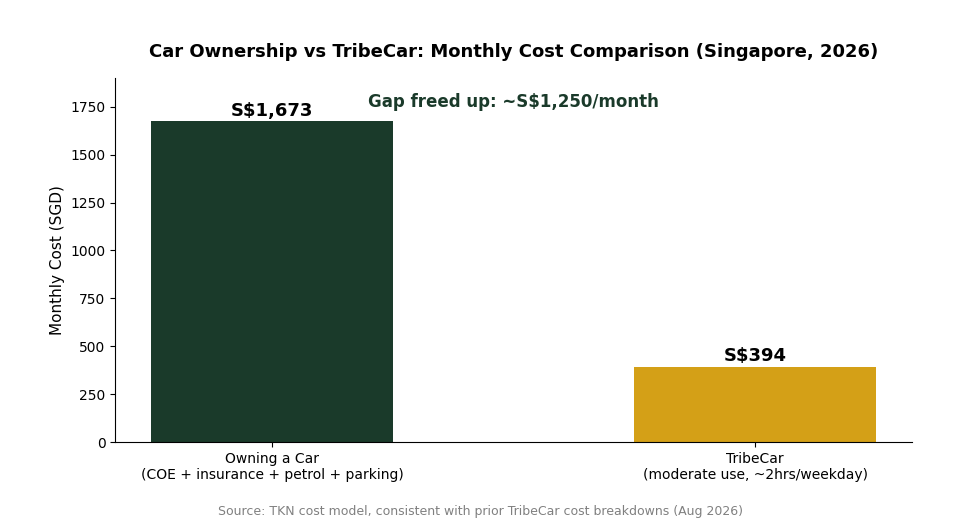
Owning a car in Singapore costs about S$1,673 a month once you add COE, insurance, petrol, parking and maintenance. Switching to TribeCar for moderate weekday use costs roughly S$394 a month — freeing up about S$1,250. Park that in a GXS Bank Saving Pocket first to build a 6-month buffer, then route ongoing surplus into Syfe Income+ for a targeted 4–6% p.a. dividend income.
Not financial advice. All figures are for educational reference only. Data as at August 2026 unless noted.
- Skipping car ownership for TribeCar frees up about S$1,250/month — the same gap TKN has used across prior TribeCar comparisons
- Step 1: park that S$1,250/month in GXS Bank’s Saving Pocket (1.08% p.a., no lock-in) until you hit a 6-month buffer of about S$7,500
- Step 2: once the buffer is built, redirect new monthly surplus into Syfe Income+, which targets 4–6% p.a. in dividend income from REITs, global dividend stocks and bonds — over 36 months this pipeline could be worth around S$2,700 more than leaving everything in GXS
Table of Contents
Why Skip Car Ownership for TribeCar?
Step 1: Build Your Buffer in GXS Bank
Step 2: Route Surplus Into Syfe Income+
The Numbers: 12/24/36-Month Comparison
Risks and What to Watch Out For
How to Start This Pipeline
FAQ
Why Skip Car Ownership for TribeCar?
Cars in Singapore are expensive because of the Certificate of Entitlement (COE) — basically a 10-year licence to own a vehicle, sold at auction. In the second August 2026 COE bidding exercise, Category A (cars up to 1,600cc) closed at S$128,501.
That COE cost gets spread over the car’s lifespan, but it still pushes total ownership cost to roughly S$1,673 a month once you add insurance, road tax, petrol, parking and servicing. Most of that cost sits idle — the average private car in Singapore is parked more than 90% of the time.
TribeCar, a peer-to-peer car-sharing platform, lets you drive when you actually need to. A moderate-use subscription plan — about 2 hours of driving on weekdays — runs around S$394 a month including the subscription fee and typical top-up usage.
That’s the number this whole pipeline is built around. The question isn’t whether you can find S$1,250 a month — it’s what you do with it once you have it. Most people let it sit in a regular bank account earning 0.05% p.a., which is basically nothing. This guide gives you two-stop plan instead.
| Cost Item | Owning a Car | TribeCar (moderate use) |
|---|---|---|
| COE (amortised) + depreciation | ~S$900 | S$0 |
| Insurance + road tax | ~S$280 | Included |
| Petrol + parking + servicing | ~S$493 | Included in usage |
| Subscription / usage fee | — | ~S$394 |
| Total monthly cost | ~S$1,673 | ~S$394 |
Source: TKN cost model, consistent with prior TribeCar cost breakdowns published August 2026.
Step 1: Build Your Buffer in GXS Bank
Before you invest a single dollar, you need an emergency buffer. A 6-month buffer means you can cover half a year of expenses if you lose your job or face a medical bill — without touching investments or taking on debt.
GXS Bank’s Saving Pocket is a good home for this. It pays 1.08% p.a. with daily interest, no salary crediting, no minimum balance and no lock-in — you can withdraw any time. Deposits are covered by SDIC up to S$100,000 per depositor. If you don’t mind locking funds for a fixed term, GXS’s Boost Pocket pays a base 0.88% p.a. plus a tenure bonus, reaching up to 1.60% p.a. if held to maturity — useful once your buffer is built and you want a slightly better rate on a portion of it.
If you route the freed-up S$1,250/month into a GXS Saving Pocket, here’s roughly how fast you’d hit a S$7,500 buffer (6 months of TribeCar-level expenses):
That’s your buffer target hit in about half a year — roughly S$17 more than if you’d just stuffed the cash under a mattress, thanks to daily interest. Once you’re past that point, every additional dollar of TribeCar savings doesn’t need to sit in cash anymore. That’s where Step 2 comes in.
Signing up with GXS Bank’s referral code gets you a welcome bonus on your first deposit — see the button below for the current code and offer.
Ready to open a GXS Bank account?
Use referral code YONG477 when signing up.
Step 2: Route Surplus Into Syfe Income+
Once your 6-month buffer sits safely in GXS, don’t let the next S$1,250/month pile up in the same low-yield account. GXS’s 1.08% p.a. is fine for cash you might need tomorrow — it’s not designed to grow money you won’t touch for years.
Syfe Income+ is a managed portfolio that targets 4–6% p.a. in regular payouts by holding a mix of Singapore REITs, global dividend stocks and investment-grade bonds. Management fees run from 0.65% p.a. on the first S$20,000 down to 0.35% p.a. above S$100,000, and the portfolio pays out monthly distributions — useful if you want your TribeCar savings to eventually generate a bit of passive income, not just sit as a number in an app.
This isn’t a cash account — the value can go down as well as up, since REITs and dividend stocks move with the market. That’s exactly why it belongs in Step 2, after your buffer is already secure, not before.
Ready to start investing your surplus with Syfe?
Sign up with Syfe’s referral code SRPRFFFCD for a welcome bonus.
The Numbers: 12/24/36-Month Comparison
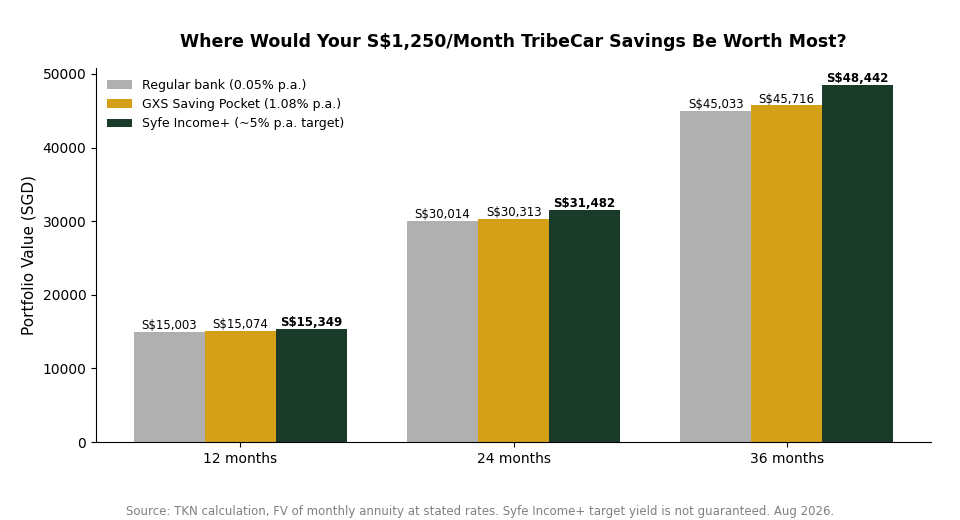
Here’s what happens if you kept routing S$1,250/month into each option instead of stopping at the GXS buffer. This assumes you’re investing the ongoing surplus, not the emergency fund itself:
| Timeframe | Regular Bank (0.05%) | GXS Saving Pocket (1.08%) | Syfe Income+ (~5% target) |
|---|---|---|---|
| 12 months | S$15,003 | S$15,074 | S$15,349 |
| 24 months | S$30,014 | S$30,313 | S$31,482 |
| 36 months | S$45,033 | S$45,716 | S$48,442 |
Source: TKN calculation, future value of a monthly annuity at the stated rates. Syfe Income+’s target yield is not guaranteed and actual returns will vary with markets. Aug 2026.
Over three years, sticking with Syfe Income+ instead of parking everything in GXS could mean roughly S$2,700 more — and unlike GXS’s fixed-rate deposit, that difference comes from real dividend income and market growth, which means it can also underperform in a bad year. That trade-off is the whole point of building the GXS buffer first: it gives you a cash cushion so a rough patch in the markets doesn’t force you to sell Syfe holdings at the wrong time.
Risks and What to Watch Out For
This pipeline isn’t risk-free, and it’s worth being honest about the trade-offs before you start.
TribeCar isn’t free of hassle. You need to book in advance, return the car on time, and occasionally deal with availability during peak periods (weekends, public holidays). If you drive daily or need a car at short notice constantly, TribeCar’s cost advantage shrinks fast — this pipeline works best for moderate, planned car use.
GXS interest rates can change. Digital bank rates in Singapore move with the interest rate environment. The 1.08% p.a. Saving Pocket rate quoted here is accurate as at August 2026, but always check the current rate before committing your buffer.
Syfe Income+ is not a savings account. Its value can fall, especially during REIT or bond market downturns. The 4–6% p.a. target yield is not guaranteed, and short-term returns can be negative. Only invest money you won’t need in the next 3–5 years, and never skip Step 1 (the buffer) to jump straight into Step 2.
Referral bonuses are a nice-to-have, not the reason to do this. The core value of this pipeline is the S$1,250/month freed up by dropping car ownership — referral welcome bonuses are a small extra on top, not the main event.
How to Start This Pipeline
Here’s the practical order of steps:
1. Sign up for TribeCar and cancel or sell your car (or simply decide not to buy one). Estimate your realistic usage pattern first so your S$394/month figure is accurate for your situation.
2. Open a GXS Bank account and set up a standing instruction to move your freed-up S$1,250/month into a Saving Pocket automatically, right after your salary is credited.
3. Track your buffer. Once it hits roughly 6 months of expenses (S$7,500 in this example, but use your own number), stop adding to GXS and start routing new surplus to Syfe Income+ instead.
4. Review annually. Interest rates, TribeCar pricing and Syfe’s portfolio composition can all change — check in once a year to make sure the numbers still make sense for you.
If you’d rather explore other REIT and dividend-focused options for Step 2, TKN’s passive income Singapore guide walks through several alternatives beyond Syfe, and the Singapore retirement calculator can help you see how this pipeline fits into your longer-term retirement numbers.
See This Pipeline in Context
This 3-step approach builds on two earlier TKN comparisons: TribeCar + GXS Bank’s Boost Pocket laddering strategy (cash-only, no growth leg) and TribeCar + Syfe’s direct investing approach (skips the buffer step entirely). This guide sits between the two — buffer first, then invest — which is generally the safer sequencing for most households.
FAQ
How much can I really save by switching from car ownership to TribeCar?
Based on a moderate-use pattern (roughly 2 hours of weekday driving), you could free up about S$1,250 a month. If you drive less, the gap could be even bigger; if you drive daily or need last-minute access often, the savings shrink and a car might still make sense for you.
Why build a GXS buffer before investing with Syfe?
An emergency buffer in a liquid, low-risk account like GXS means you won’t need to sell your Syfe Income+ holdings at a bad time if you face an unexpected expense. Investing before you have a buffer is one of the most common mistakes new investors make.
Is GXS Bank safe for my emergency fund?
GXS Bank is a full digital bank licensed by the Monetary Authority of Singapore (MAS), and deposits are covered by SDIC insurance up to S$100,000 per depositor — the same protection as traditional banks.
Is Syfe Income+'s 4-6% p.a. yield guaranteed?
No. It’s a target yield based on the underlying REITs, dividend stocks and bonds in the portfolio, not a fixed rate. Actual distributions and total returns can be higher or lower depending on market conditions, and the portfolio’s value can fall.
How long does it take to build a 6-month buffer this way?
At S$1,250 a month, a S$7,500 buffer (roughly 6 months of TribeCar-level expenses) takes about 6 months to build, growing slightly faster than a flat savings rate thanks to GXS’s daily interest.
Can I use this pipeline if I already own a car?
Yes — you’d simply calculate the difference between your current car costs and TribeCar’s moderate-use pricing for your situation, then apply the same buffer-then-invest sequence to whatever gap you find.
What if I want a bigger emergency buffer than 6 months?
That’s reasonable, especially if your income is variable or you’re the sole earner in your household. Simply extend Step 1 until GXS holds however many months of expenses you’re comfortable with before moving to Step 2.
The biggest lever here isn’t the interest rate or the target yield — it’s deciding to redirect the S$1,250/month in the first place. Everything after that is just picking the right home for it at each stage.
Not financial advice. TKN may earn a referral fee if you sign up through the links on this page, at no extra cost to you.
This article was researched with the help of AI. While we strive to keep all information accurate and up to date, there may be errors. If you notice any discrepancies, please contact us.