Elite UK REIT 1H2026 Results: 3-Year High DPU Explained (SGX: MXNU)
1.55p DPU, 9.8% Yield, and a £31.9 Million UK Government Portfolio Expansion
Elite UK REIT (SGX: MXNU) posted a three-year high distribution per unit (DPU) of 1.55 pence for 1H2026, up 0.6% year-on-year, alongside a proposed £31.9 million acquisition of five UK government-leased properties. The REIT stays over 99% leased to the UK Government, with net gearing down to 34.6%. Here’s what the fresh results and expansion mean if you hold or are considering MXNU units.
Not financial advice. All figures are for educational reference only. Data as at August 2026 unless noted.
- Elite UK REIT (formerly Elite Commercial REIT) posted a 3-year high 1H2026 DPU of 1.55 pence, a 9.8% yield at the 31.5 pence unit price
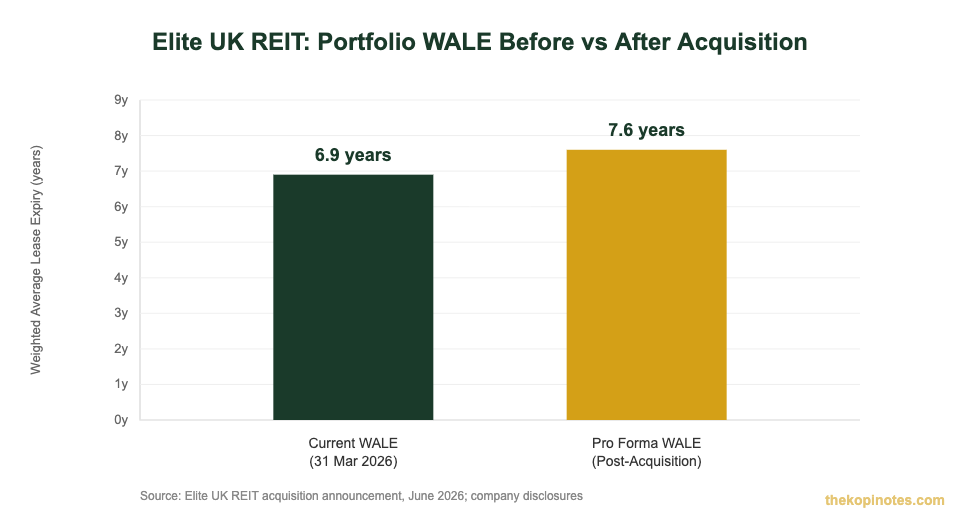
- The REIT proposed a £31.9 million acquisition of five UK government-leased properties, lifting portfolio WALE (weighted average lease expiry) from 6.9 to 7.6 years pro forma
- Net gearing fell to 34.6%, giving room for more deals — but 92% of income still comes from one UK government department
Table of Contents
Contents — Click to expand
- What Happened at Elite UK REIT
- From Elite Commercial REIT to Elite UK REIT
- 1H2026 Results: Revenue, NPI and the 3-Year High DPU
- The £31.9 Million UK Government Property Acquisition
- Why Lower Gearing and Longer WALE Matter to You
- Risks: DWP Concentration and the 2028 Lease Wall
- How Elite UK REIT Compares to Other S-REITs
- Should You Buy Elite UK REIT Now?
- How to Buy Elite UK REIT in Singapore
- Frequently Asked Questions
What Happened at Elite UK REIT
Elite UK REIT released two pieces of news this quarter. On 7 August 2026, it reported 1H2026 results showing a three-year high DPU. On 16 June 2026, it proposed buying five more UK government-leased buildings.
Both announcements point the same way. Management is deploying capital into more government-backed income, while gradually bringing down the REIT’s debt load.
If you already hold MXNU units, this is a steady update rather than a dramatic pivot. If you’re weighing whether to buy in, the fresh numbers give you a clearer read on where the REIT stands today.
From Elite Commercial REIT to Elite UK REIT
You may still know this counter as Elite Commercial REIT. The manager renamed it Elite UK REIT in May 2024 to better reflect its focus. The SGX ticker, MXNU, never changed.
The REIT invests in UK properties leased almost entirely to the UK Government, mainly through the Department for Work and Pensions (DWP). DWP runs jobcentres, benefits offices and related services across Britain.
That single-tenant concentration is unusual for an S-REIT. It’s also the point of the strategy: government tenants rarely default, and leases tend to run for years at a stretch. Read our full Elite UK REIT investor guide for more on the REIT’s structure and history.
1H2026 Results: Revenue, NPI and the 3-Year High DPU
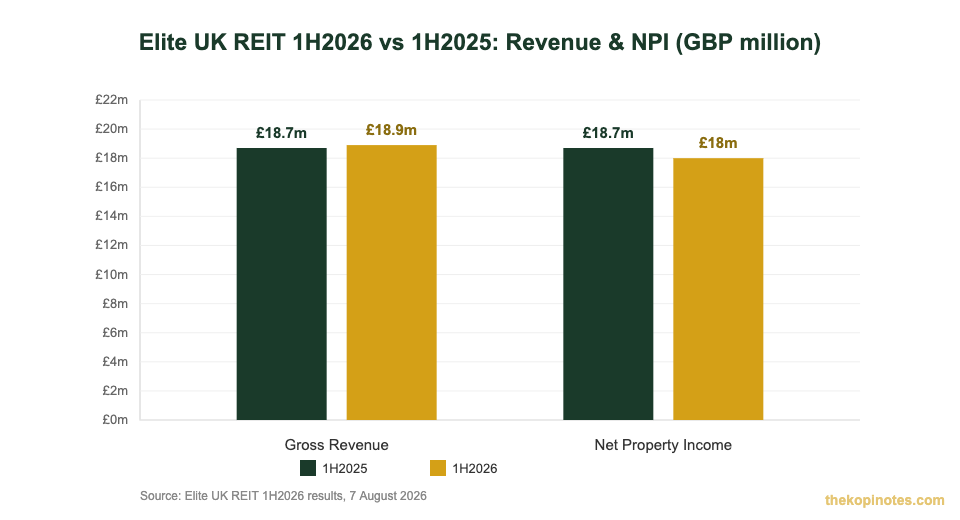
Elite UK REIT posted gross revenue of £18.9 million for the six months to 30 June 2026, up 0.8% from £18.7 million a year earlier. Three new properties bought in June 2025 drove the increase.
Net property income (NPI) — revenue left after paying property expenses — slipped 3.3% year-on-year to £18.0 million. That’s not a red flag. The REIT booked a one-off dilapidation settlement (a payout from an outgoing tenant to cover repair costs) in 1H2025 that inflated the prior-year base.
Despite the NPI dip, DPU still climbed to 1.55 pence, a three-year high, thanks to lower financing costs and a smaller unit base. At the 31.5 pence unit price, that works out to a 9.8% distribution yield.
Distribution yield is simply your annual DPU divided by the unit price — it tells you the cash return you’d earn buying at today’s price, before accounting for any capital gain or loss.
| Metric | 1H2025 | 1H2026 |
|---|---|---|
| Gross revenue | £18.7 million | £18.9 million (+0.8%) |
| Net property income | £18.7 million | £18.0 million (-3.3%) |
| DPU | ~1.54 pence (implied) | 1.55 pence (+0.6% YoY) |
| Distribution yield | — | 9.8% (at 31.5p unit price) |
| Net gearing | — | 34.6% (down from 47.5% end-2023) |
Source: Elite UK REIT 1H2026 results announcement, 7 August 2026; REITSWEEK.
The £31.9 Million UK Government Property Acquisition
On 16 June 2026, Elite UK REIT proposed buying five freehold or virtual freehold UK properties, all fully leased to the British government. The combined price is about £31.9 million.
The five buildings sit across England, Scotland and Wales. Together they’re expected to generate roughly £2.6 million in annual gross rental income, at a weighted average lease expiry (WALE) of 13.3 years as at 31 December 2025 — far longer than the REIT’s existing portfolio.
WALE tells you the average number of years left on a REIT’s leases, weighted by rental income. A longer WALE means more visibility over future cash flow, since fewer leases need renewing soon.
| Property | Location |
|---|---|
| Queensway House | East Kilbride, Scotland |
| Griffin House | Wigan, England |
| Penhaligon House | St Austell, England |
| Challand House | Pontefract, England |
| Bridgend Jobcentre | Bridgend, Wales |
Source: Elite UK REIT acquisition announcement, 16 June 2026; Reuters.
The REIT is separately spending £19.0 million converting a Dundee office building, Lindsay House, into purpose-built student accommodation (PBSA). HMRC has also signed on as a new tenant elsewhere in the portfolio — a sign the REIT is slowly diversifying beyond DWP alone.
Both deals need unitholder approval at an extraordinary general meeting (EGM) — a shareholder vote called for a specific decision outside the REIT’s regular annual meeting. That EGM had not been scheduled as at the time of writing.
Why Lower Gearing and Longer WALE Matter to You
Gearing is the ratio of a REIT’s debt to its total assets. Elite UK REIT’s net gearing has fallen from 47.5% at end-2023 to 34.6% as of June 2026 — well inside the Monetary Authority of Singapore’s (MAS) 50% regulatory ceiling for S-REITs.
Lower gearing means two things for you as a unitholder. First, less rental income goes toward interest payments, leaving more for distributions. Second, the REIT has more room to borrow for future deals without breaching MAS limits.
The pro forma WALE of 7.6 years, up from 6.9 years, also cuts near-term refinancing and re-leasing risk. Fewer leases expire in any single year, so DPU is less exposed to a bad renewal cycle.
Together, these two metrics explain why the market read the acquisition announcement as DPU-accretive news rather than a dilutive capital raise.
Risks: DWP Concentration and the 2028 Lease Wall
Elite UK REIT’s biggest risk is concentration. DWP alone contributes about 92% of gross rental income. If DWP consolidates offices or negotiates hard on renewals, your distributions feel it directly.
That said, DWP has been a reliable tenant historically, and UK government departments rarely walk away from long-standing office leases without extended notice periods. The risk is more about renewal terms than an outright tenant loss.
A cluster of DWP leases is due for renewal around 2028. That’s still a few years out, but it’s the single event most likely to move MXNU’s unit price between now and then. Watch for renewal updates in future results.
The NPI dip this half, while explained by a one-off dilapidation settlement, is a reminder that a government-backed portfolio isn’t expense-free. Vacant units still cost money to refurbish before a new tenant moves in.
Currency is another factor. Elite UK REIT earns rental income in British pounds. A weaker pound against the Singapore dollar can shrink the SGD value of your distributions even if underlying UK rental income holds steady.
Finally, the £31.9 million acquisition still needs unitholder sign-off at the EGM. If the REIT funds it partly through a private placement or rights issue, existing unitholders could see some near-term dilution before the new properties start contributing to DPU.
How Elite UK REIT Compares to Other S-REITs
Elite UK REIT isn’t the only overseas-focused, niche S-REIT on the exchange. Here’s how it stacks up against two comparable names and the broader sector.
| Metric | Elite UK REIT | United Hampshire US REIT | Prime US REIT |
|---|---|---|---|
| Distribution yield | 9.8% | ~9.4% | ~3.7% |
| Gearing | 34.6% | 38.6% | 45.2% |
| Tenant focus | UK Government (DWP) | US essential retail | US office |
Source: Company disclosures and market data, as at August 2026. S-REIT sector average yield (iEdge S-REIT Index): approximately 6.2%-6.3%.
On yield, Elite UK REIT sits well above the broader iEdge S-REIT sector average of roughly 6.2%-6.3%. That premium partly compensates you for the single-tenant concentration risk and pound-sterling currency exposure discussed above.
Compared to United Hampshire US REIT, the two REITs offer similar yields, but Elite UK REIT’s sovereign tenant base carries less credit risk than commercial retail tenants, even essential ones. Compared to Prime US REIT, which is still working through a soft US office market, Elite UK REIT’s government-anchored income looks steadier. For a broader view of how S-REITs stack up today, see our best S-REITs in Singapore 2026 guide.
Should You Buy Elite UK REIT Now?
If you want steady, government-backed income and can stomach pound-sterling currency swings, Elite UK REIT’s 9.8% yield and improving balance sheet make a reasonable case. See our Elite UK REIT price target 2026 analysis for a deeper valuation view.
If you’re uncomfortable with a single tenant making up 92% of income, or you’d rather wait for clarity on the 2028 DWP lease renewals, it’s fair to sit on the sidelines until the EGM and renewal terms are confirmed.
Either way, don’t size a single REIT position — however defensive — as more than a modest slice of your portfolio. Diversifying across a few REITs, or supplementing with a broad REIT ETF, spreads out tenant and country risk. Our Singapore retirement calculator can help you work out how much passive income you actually need REITs like this to generate.
Think of Elite UK REIT as a satellite holding rather than a core one. A 5-10% portfolio allocation lets you capture the yield premium without overexposing your income to a single government department in a country you don’t live in.
How to Buy Elite UK REIT in Singapore
Elite UK REIT trades on the SGX mainboard under the ticker MXNU, in Singapore dollars, so you don’t need a UK brokerage account to invest.
You can buy MXNU units through most Singapore brokerages with SGX access. If you’re starting out or want CPF/SRS-eligible options, sign up through the Endowus referral code for a low-cost, all-in-one platform.
Here’s the process in practice:
- Open a brokerage account with SGX market access, or use your existing one
- Fund the account in SGD — no currency conversion needed since MXNU trades in SGD despite earning GBP rental income
- Search for “MXNU” or “Elite UK REIT” on your broker’s platform
- Place a buy order at the board lot size (typically 100 units)
- Set a calendar reminder for the next results announcement and the acquisition EGM date
Before you commit funds, read the REIT’s SGX announcements and the Elite UK REIT investor relations page yourself. Company filings are the primary source — always more current than any third-party summary, including this one.
Frequently Asked Questions
Is Elite Commercial REIT the same as Elite UK REIT?
What was Elite UK REIT's 1H2026 DPU?
What is Elite UK REIT's current distribution yield?
Why did net property income fall if revenue rose?
What properties is Elite UK REIT proposing to buy?
What is the biggest risk with Elite UK REIT?
Ready to Start Investing in S-REITs?
Compare brokers and check today’s sign-up bonuses before you buy your first REIT.
This article was researched with the help of AI. While we strive to keep all information accurate and up to date, there may be errors. If you notice any discrepancies, please contact us.