Does the Fed Rate Affect Your Endowment Plan? Singapore 2026 Guide
No, the Fed does not directly set your endowment plan’s return. Your guaranteed rate is locked the day you buy and never moves again. But the non-guaranteed bonus – the part insurers add on top – is funded by a participating fund that holds bonds and equities, and those assets do react to interest rates. So Fed policy affects your bonus indirectly, through Singapore bond yields, not directly through your policy.
Not financial advice. All figures are for educational reference only. Data verified as at 17 August 2026 unless otherwise stated.
- Your endowment plan has two parts: a guaranteed rate (fixed forever) and a non-guaranteed bonus (moves with the insurer’s participating fund performance).
- Fed rate decisions move US and Singapore bond yields, which flow into the participating fund’s returns – and eventually into future bonus declarations. It’s a slow, indirect link, not a lever the Fed pulls directly.
- Singapore’s 10-year bond yield rose to about 2.4% in August 2026, its highest since mid-2025 – a mild tailwind for insurers’ bond-heavy portfolios even as the Fed holds rates steady.
Table of Contents
Jump to a section
- The two parts of your endowment plan’s return
- What actually drives the non-guaranteed bonus
- Where Singapore bond yields stand in 2026
- What the Fed’s September 2026 decision means for you
- IIRR caps: the illustration ceiling that barely moves
- Worked example: S$50,000 over 10 years
- What this means for plans we’ve already reviewed
- Should this change your endowment plan decision?
- FAQ
The Two Parts of Your Endowment Plan’s Return
Every traditional endowment plan sold in Singapore has two return components, and they behave completely differently.
The guaranteed portion is written into your contract. It’s typically low – often 1.0% to 2.0% p.a. for a single-premium plan – and the insurer must pay it no matter what happens to interest rates, markets, or the economy. Once you sign, this number is frozen for the life of the policy – see our deeper breakdown of what “guaranteed” actually means in your endowment plan for the full picture.
The non-guaranteed bonus is different. This is your share of profits from the insurer’s Participating Fund (Par Fund) – a pool that invests premiums from thousands of policyholders into a mix of bonds, equities, and property. The bonus is declared each year based on how that fund actually performs. It’s not promised, and it can go up or down.
Here’s why this matters for the Fed question. You’ll sometimes see headlines like “Fed holds rates – what it means for your savings plan.” For the guaranteed part of an existing policy, the honest answer is: nothing. It doesn’t matter what the Fed does. That number was locked the day you signed. The Fed can only ever influence the non-guaranteed bonus – and only indirectly, through the assets your Par Fund holds.
What Actually Drives the Non-Guaranteed Bonus
Par Funds are large, diversified pools. According to Great Eastern’s own explanation of how participating funds work, policyholders share in the fund’s profits through both guaranteed and non-guaranteed benefits, with bonuses reflecting the fund’s long-term investment performance.
Two features matter for our Fed question:
1. Bond-heavy allocation. Most Singapore insurers’ Par Funds hold a large share of high-grade bonds – Singapore Government Securities (SGS), corporate bonds, and some overseas fixed income. When bond yields rise, new money the fund invests earns more. When yields fall, new money earns less. Existing bonds in the fund also gain or lose value as yields move.
2. Smoothing. Insurers don’t pass through a single year’s return directly. Singlife’s own FAQ on its participating fund bonus announcement explains that bonuses are designed to stay as stable as possible across the policy term – smoothed over multiple years rather than swinging with each year’s market performance. That means even a big, sudden Fed move takes years to fully show up in your bonus, if it shows up at all.
So the chain runs like this: Fed policy → US and global bond yields → Singapore bond yields (SGS) → Par Fund investment income → smoothed bonus declaration, several years later. Each link weakens the signal. By the time it reaches your policy statement, a single Fed decision barely registers.
Where Singapore Bond Yields Stand in 2026
This is the number that actually matters more than the Fed funds rate itself, because it’s what Singapore insurers’ Par Funds are directly exposed to.
The Singapore 10-year government bond yield climbed to around 2.4% in August 2026, its highest level since June 2025, up roughly 34 basis points over the trailing month. That’s a meaningful move for a bond-heavy portfolio. It happened while the Fed itself sat still – a reminder that Singapore yields don’t move in lockstep with US policy. They react to local inflation, MAS monetary settings, and global bond market sentiment too.
| Period | US Fed Funds Rate (midpoint) | Singapore 10Y Bond Yield |
|---|---|---|
| Dec 2024 | ~4.63% | ~2.85% |
| Jun 2025 | ~4.38% | ~2.55% |
| Dec 2025 | ~3.63% | ~2.10% |
| Aug 2026 | ~3.63% | ~2.38%–2.43% |
Source: US Federal Reserve target range (FRED DFEDTARU/DFEDTARL), TradingEconomics Singapore 10Y government bond yield series. Figures approximate, as at August 2026.
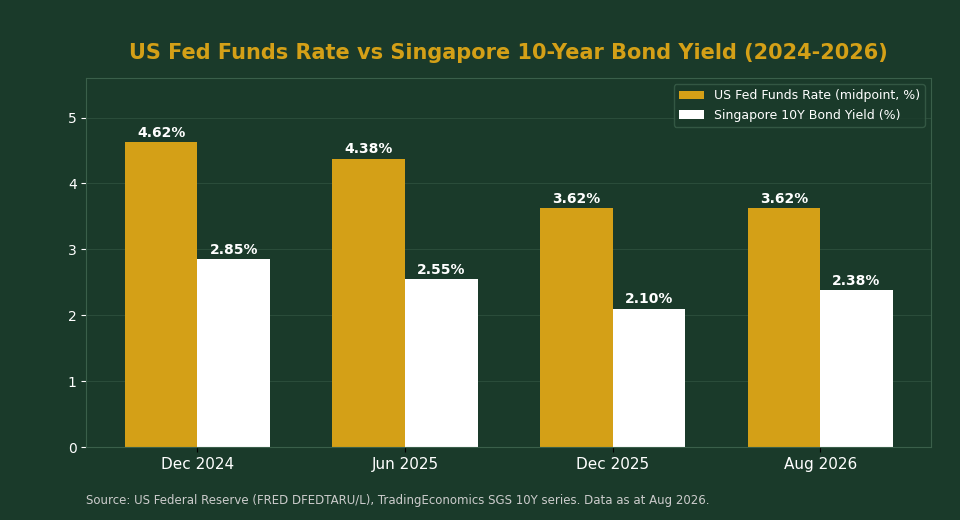
You can see the gap: US rates fell through 2025 as the Fed cut three times, while Singapore’s 10-year yield fell too but by less, then actually rebounded in 2026 even as the Fed stayed on hold. That rebound is the part that matters for your Par Fund – rising SGS yields are a mild tailwind for future bond income, independent of what the Fed does next.
What the Fed’s September 2026 Decision Means for You
The next FOMC meeting lands on 15–16 September 2026. As at mid-August, prediction markets put the odds at roughly 73–74% for a hold, around 25–26% for a 25 basis-point hike, and under 2% for a cut, according to Polymarket’s Fed decision market and Kalshi’s September FOMC contract. That’s a shift from a more hawkish lean earlier in the summer, driven by softer July inflation and a weaker jobs report.
Here’s the part most headlines skip: even if the Fed does hike in September, it wouldn’t be bad news for your endowment plan’s bonus outlook. A hike (or just “higher for longer”) tends to keep global bond yields elevated, which is a small positive for insurers’ bond-heavy portfolios – more income on new bond purchases. A cut would do the opposite, pulling yields down and reducing income on new money.
That said, don’t overweight any single meeting. One 25bp move changes very little for a fund that reinvests gradually over years and smooths its bonus declarations. The trend across several quarters matters far more than any one decision.
IIRR Caps: The Illustration Ceiling That Barely Moves
When an insurer shows you a projected return on a participating plan, they can’t just make up a number. The Life Insurance Association (LIA) Singapore sets a hard ceiling called the Illustrated Investment Rate of Return (IIRR) – basically the maximum annual growth rate an insurer is allowed to illustrate for a participating policy.
As confirmed on LIA Singapore’s own page on the IIRR for par policies, the current caps are 4.25% p.a. (upper illustration) and 3.00% p.a. (lower illustration), with the lower rate required to sit at least 1.25 percentage points below the upper one. These caps are reviewed annually based on the long-term expected returns of the asset classes Par Funds typically hold – equities, bonds, and property.
Read that again: these are illustration caps, reviewed once a year by an industry body, not a number that jumps around with each Fed statement. They’ve stayed at 4.25%/3.00% since a July 2021 revision. This is why you’ll see almost every insurer’s brochure – including NTUC Income’s endowment plans – illustrate at the same 4.25% upper rate. It’s not a coincidence or a market signal. It’s a regulatory ceiling everyone uses.
What actually varies by insurer is how much of that ceiling gets translated into real, declared bonuses over time – which depends on each insurer’s own fund performance and smoothing policy, not the IIRR cap itself.
Worked Example: S$50,000 Over 10 Years
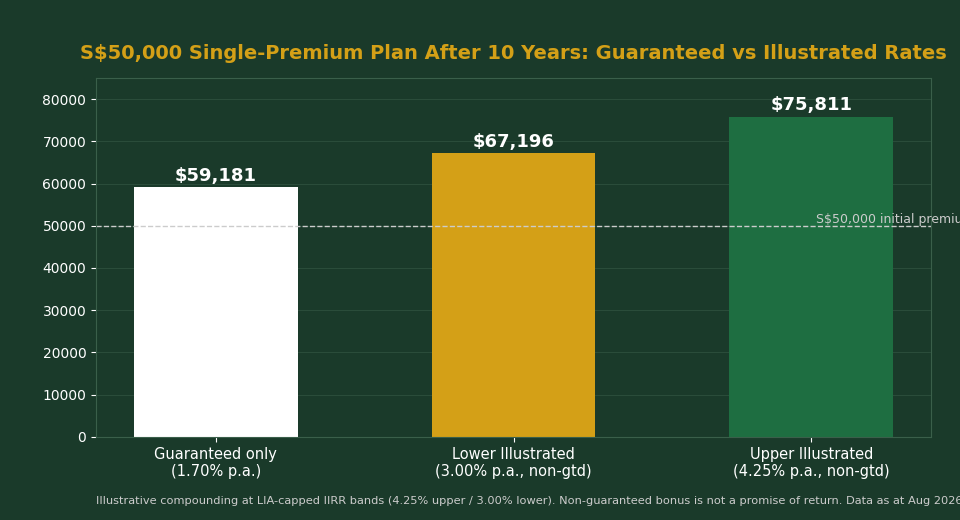
Let’s make this concrete. Say you put S$50,000 into a single-premium participating endowment plan for 10 years. Some plans in this space, like Prudential’s PRUAssure Growth, guarantee around 1.70% p.a. Here’s what S$50,000 becomes at three different compounding rates: the guaranteed floor, and the two LIA illustration bands.
| Scenario | Rate (p.a., compounded) | Value after 10 years | Growth |
|---|---|---|---|
| Guaranteed only | 1.70% | S$59,181 | +S$9,181 |
| Lower Illustrated Rate (non-guaranteed) | 3.00% | S$67,196 | +S$17,196 |
| Upper Illustrated Rate (non-guaranteed) | 4.25% | S$75,811 | +S$25,811 |
Source: The Kopi Notes calculation, S$50,000 principal compounded annually for 10 years at each rate. LIA IIRR caps as at Aug 2026. For illustration only – the 3.00% and 4.25% figures are not guaranteed and are not a promise of actual return.
Only the first row – S$59,181 – is contractually yours. The other two rows show what the plan brochure is allowed to illustrate, not what it will pay. Whether your actual bonus lands closer to the lower or upper band over 10 years depends on how the insurer’s Par Fund performs across that period – which loops back to bond yields, equity markets, and smoothing, not any single Fed decision.
Curious what your own numbers look like? Run them through our Endowment Plan Returns Calculator with your actual premium and term.
What This Means for Plans We’ve Already Reviewed
We’ve reviewed a wide range of participating endowment plans on this site – each insurer runs its own Par Fund with its own asset mix and bonus track record, so the same macro backdrop doesn’t hit every plan identically.
Singlife’s full savings plan lineup, for example, explicitly prioritises keeping bonuses stable even in a softer investment year, by managing the fund’s overall “net surplus” rather than passing through raw returns. Manulife’s participating fund works on a similar smoothing principle, which is why its illustrated maturity bonus can sit well below the LIA upper cap even in a reasonable rate environment.
None of this means you should try to time your endowment plan purchase around a Fed meeting – the smoothing mechanism specifically exists to stop that kind of short-term thinking from mattering. What it does mean is that if SGS yields keep climbing through 2026 and 2027, it’s a genuine (if slow-moving) positive signal for future bonus declarations across the board, not a reason to expect a sudden jump in any single quarter.
Should This Change Your Endowment Plan Decision?
Probably not on its own. Here’s the honest takeaway: an endowment plan’s whole appeal is that you’re not supposed to be watching interest rate headlines. You’re buying a guaranteed floor plus a shot at a modest bonus, in exchange for giving up flexibility and market upside.
If you specifically want an investment that tracks interest rates more directly and transparently, instruments like SGS bonds compare directly against endowment plans in a way that’s worth reading before you commit. Bonds pass through the actual market yield; endowment plans smooth it out over years through a Par Fund. Neither is “better” – they suit different goals.
What you should actually check before buying: the guaranteed rate (compare it in cash terms, not just percentage), the surrender penalty schedule, and the insurer’s historical bonus track record against its own past illustrations – not this month’s Fed odds.
Frequently Asked Questions
Does a Fed rate cut lower my endowment plan's guaranteed return?
Why do all insurers illustrate endowment plans at the same 4.25% rate?
Does the Singapore MAS interest rate move endowment plan bonuses?
How often do insurers change their endowment plan bonus rates?
Is a rising Singapore bond yield good or bad for my endowment plan?
Should I wait for a Fed decision before buying an endowment plan?
Want an Alternative That Tracks Rates More Directly?
If the smoothing and opacity of participating funds isn’t for you, a robo-advisor portfolio lets your money respond to markets in real time instead of waiting years for a bonus declaration. Check your projected numbers with the Singapore retirement calculator, or compare cash management options through the Syfe referral code and sign-up bonus.
Get Free Insurance Advice
Speak with a licensed insurance advisor. No obligation, no cost.
By submitting this form, you agree to our Privacy Policy.
This article was researched with the help of AI. While we strive to keep all information accurate and up to date, there may be errors. If you notice any discrepancies, please contact us.