How to Invest in Singapore as a Company Director: CPF, Director’s Fees, and Keeping Your Money Separate (2026)
Whether you pay yourself director’s fees or a salary changes your CPF savings completely — here’s how to plan your own investing around that choice.
Company directors in Singapore can pay themselves as director’s fees, salary, or a mix of both — and only salary under a contract of service triggers CPF contributions. Director’s fees voted at a general meeting don’t build CPF at all. That makes SRS, and your own brokerage or robo-advisor account, the main levers for directors who lean on fees rather than salary.
Not financial advice. All figures are for educational reference only. Data verified as at 14 August 2026.
- Director’s fees voted at a general meeting don’t attract CPF — only salary paid under a contract of service does.
- If you take mostly director’s fees, your CPF Ordinary and Special Accounts won’t grow much on their own — SRS and personal investing have to do more of the work.
- Keep company and personal money strictly separate: co-mingling business cash with your own portfolio creates accounting, tax, and legal headaches.
Table of Contents
Contents — Click to expand
- Why Company Directors Face a Different Investing Puzzle
- Director’s Fees vs Director’s Salary: Which One Builds CPF
- SRS: Your Backup Retirement Account When CPF Is Optional
- Keeping Business and Personal Money Separate
- Choosing a Pay Structure That Still Builds Your Own Safety Net
- A Worked Example: $8,000/Month Director’s Draw
- What to Do This Week
- Frequently Asked Questions
Why Company Directors Face a Different Investing Puzzle
If you run your own Singapore-incorporated company, you get to decide how you pay yourself. That sounds like freedom, and it is. But it also means CPF doesn’t happen automatically for you the way it does for a regular employee.
Every month, a normal employee sees CPF land in their Ordinary, Special, and MediSave Accounts without lifting a finger. As a director, that only happens if you structure part of your pay as salary under a proper contract of service. If you take everything as director’s fees instead, your CPF accounts can sit almost untouched for years.
This isn’t automatically a mistake. Some directors deliberately skip CPF to keep more cash flexible for the business or their own investing. But it’s a choice you should make on purpose, not one that happens by accident because nobody explained the difference. That’s what this guide walks through.
Director’s Fees vs Director’s Salary: Which One Builds CPF
This is the single most important distinction for any Singapore company director to understand. Director’s fees are payments voted and approved by shareholders at a general meeting for your role on the board. According to CPF Board’s official guidance, director’s fees are not “wages” under the CPF Act, so they don’t attract CPF contributions at all, for you or the company.
Director’s salary is different. If you’re also an employee of your own company under a contract of service — doing day-to-day executive work, not just attending board meetings — that salary counts as ordinary employment income. CPF contributions become compulsory on it, just like for any other staff member.
Most Singapore SME founders end up in a mixed arrangement: a modest monthly salary as an employee, topped up with director’s fees voted once or twice a year. That’s completely normal, and it’s often the cleanest way to keep some CPF growth going while still having flexibility.
| Pay Type | CPF Treatment | When It’s Taxed |
|---|---|---|
| Director’s fees | No CPF — not “wages” under the CPF Act | Year voted and approved by shareholders |
| Director’s salary (contract of service) | CPF compulsory, 37% combined for age 55 and below (2026) | Year received or accrued, like normal employment income |
Source: CPF Board, “Are CPF contributions payable for directors?”, Aug 2026; IRAS employment income guidance on salary, bonus and director’s fee.
SRS: Your Backup Retirement Account When CPF Is Optional
If you take most of your pay as director’s fees, your CPF Ordinary and Special Accounts can stay flat for years, missing out on the CPF Ordinary Account’s 2.5% floor rate and the Special Account’s 4% floor rate. That doesn’t mean you’re stuck without a tax-advantaged retirement account — it means the Supplementary Retirement Scheme (SRS) becomes more important for you than for the average employee.
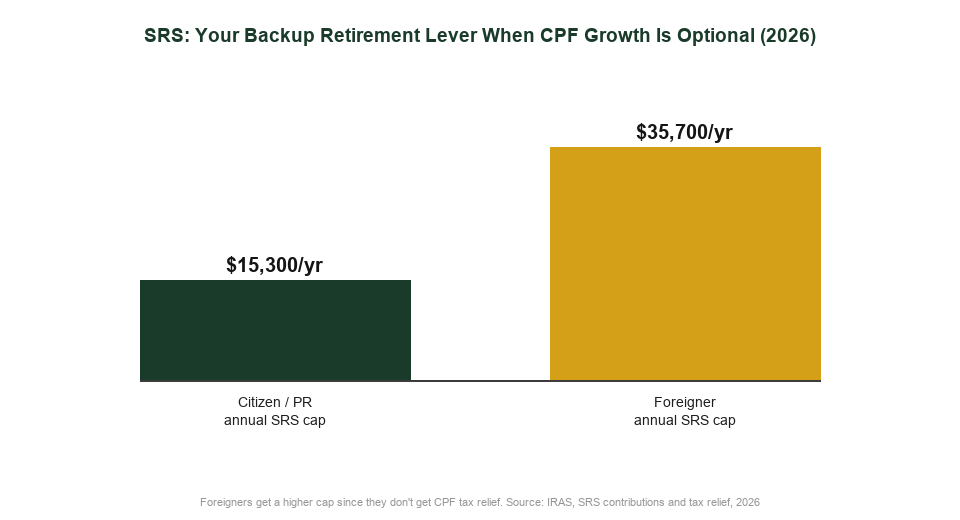
Anyone can open an SRS account with DBS, OCBC, or UOB and contribute cash each year, regardless of how your director’s pay is structured. Singapore Citizens and Permanent Residents can contribute up to $15,300 a year; foreigners get a higher cap of $35,700 a year, since they don’t receive CPF tax relief the way citizens and PRs do. Every dollar contributed reduces your taxable income, up to the overall $80,000 personal income tax relief cap.
Unlike CPF, SRS funds aren’t locked into government-set instruments. You can invest SRS cash in unit trusts, ETFs, Singapore stocks, and selected insurance products, giving you far more control over how the money grows while you’re building it up as a director.
SRS isn’t a full replacement for CPF — it doesn’t come with CPF LIFE’s guaranteed lifetime payout, and withdrawal rules differ. But for a director leaning on fees over salary, it’s the closest tax-advantaged tool available, and it’s worth maxing out before putting extra cash into a fully taxable brokerage account.
Keeping Business and Personal Money Separate
It’s tempting, especially in the early years, to treat your company’s bank account like an extension of your own wallet. Resist that. Co-mingling business and personal money creates real problems: it muddies your bookkeeping, makes it harder to prove legitimate business expenses to IRAS, and can pierce the limited liability protection that’s the whole point of incorporating a private limited company in the first place.
A simple structure works well for most director-run SMEs. Pay yourself a fixed, modest salary each month for CPF and predictable personal cash flow. Vote director’s fees once or twice a year once the company’s performance is clear. Only invest money that’s actually left your business account and landed in your personal one — never invest against expected future company profits.
This also matters for records. The Accounting and Corporate Regulatory Authority (ACRA) and IRAS expect clean separation between company and director transactions. If you’re ever audited, or simply trying to work out your own net worth, a clean split between “the business’s money” and “my money” saves enormous headaches.
Choosing a Pay Structure That Still Builds Your Own Safety Net
There’s no single right answer here — it depends on how much you value CPF’s guaranteed floor rates versus flexibility. But a few practical principles help most directors decide.
If cash flow is unpredictable, lean toward director’s fees, voted after you know the year’s results, and top up SRS and your own investing account manually. You avoid locking yourself into a monthly CPF commitment before you know what the business can actually afford.
If you want steady CPF growth, pay yourself even a modest salary, say $2,000 to $4,000 a month, under a proper contract of service. It’s a small, predictable CPF contribution, but it compounds at CPF’s guaranteed rates over decades, and it also builds your MediSave balance for healthcare needs.
Either way, don’t skip your own SRS and brokerage contributions. CPF is optional for a director. Building some form of retirement savings isn’t. Our guide for self-employed and freelance investors covers similar ground for sole proprietors, who face an even starker version of this problem since they get no CPF contributions at all.
A Worked Example: $8,000/Month Director’s Draw
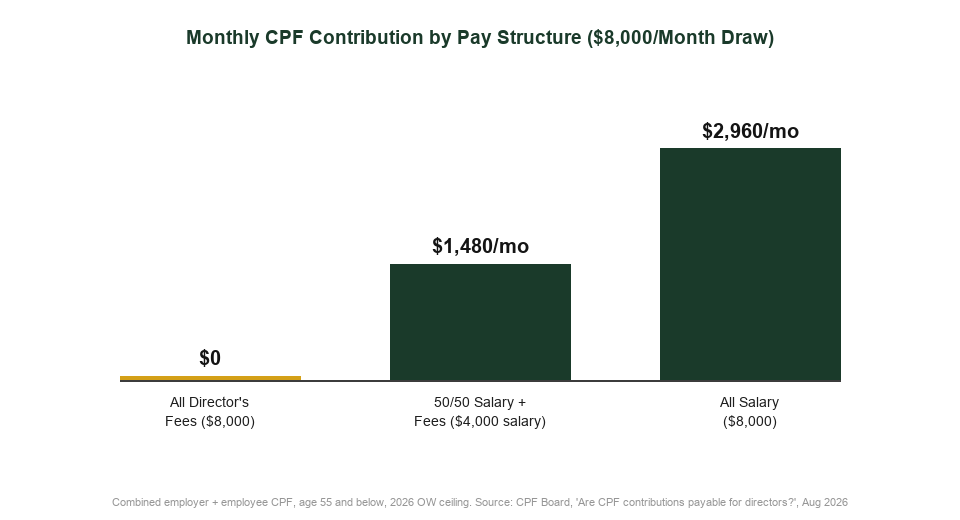
Say your company can comfortably afford to pay you $8,000 a month, and you’re 40 years old. Here’s how three different pay structures play out.
| Pay Structure | Monthly CPF (Combined) | What You Still Need to Do |
|---|---|---|
| All director’s fees | $0 | Max out SRS ($15,300/yr) and invest the rest yourself |
| 50/50 salary + fees | $1,480 (on $4,000 salary) | Still worth topping up SRS on top of the CPF you’re getting |
| All salary | $2,960 (on $8,000 salary, within OW ceiling) | CPF is doing more of the work; SRS still useful for extra tax relief |
Illustrative example only, age 55 and below, 2026 CPF Ordinary Wage ceiling of $8,000/month. Actual pay structure decisions should factor in your company’s cash flow and your personal tax bracket.
None of these is automatically “correct.” A director taking all fees isn’t doing anything wrong, as long as they’re deliberately building savings elsewhere — SRS, a brokerage account, or both. The mistake is drifting into the all-fees route by default and only realising years later that CPF barely grew.
What to Do This Week
Step 1: Check your last few years of payslips or board resolutions — are you taking mostly fees, mostly salary, or a mix?
Step 2: If your CPF Ordinary and Special Account balances look flat, decide whether to start a modest monthly salary or lean harder into SRS and personal investing instead.
Step 3: Open or top up an SRS account before the calendar year ends if you haven’t already claimed this year’s tax relief.
Step 4: Review your bookkeeping to confirm business and personal transactions are cleanly separated — ask your company secretary or accountant if you’re unsure.
Not financial advice. Every company’s cash flow and every director’s tax situation is different — consider speaking with a licensed financial adviser or accountant about your specific circumstances. Data verified as at 14 August 2026.
Frequently Asked Questions
Do director's fees attract CPF contributions in Singapore?
No. According to CPF Board’s official guidance, director’s fees voted and approved by shareholders at a general meeting are not considered “wages” under the CPF Act, so they don’t attract CPF contributions for the director or the company.
Does a director's salary get CPF contributions?
Yes, if the director is also employed under a contract of service performing executive or day-to-day duties. That salary is treated as ordinary employment income, and CPF contributions are compulsory on it at the standard rates, 37% combined (17% employer, 20% employee) for Singapore Citizen and PR directors aged 55 and below in 2026.
Can I take only director's fees and no salary at all?
Yes, this is common, especially for SME founders managing cash flow. It’s legal, but it means your CPF Ordinary and Special Account balances won’t grow from your director’s pay. Many directors in this position compensate by maxing out SRS contributions and investing personally instead.
How much can I contribute to SRS as a company director?
The same caps apply to everyone regardless of employment status: up to $15,300 a year for Singapore Citizens and Permanent Residents, or $35,700 a year for foreigners, subject to the overall $80,000 personal income tax relief cap.
Should I mix director's fees and salary, or pick just one?
Many directors use a mix: a modest fixed monthly salary for predictable CPF growth and personal cash flow, plus director’s fees voted once or twice a year once the company’s performance is known. There’s no single correct split — it depends on your cash flow needs and how much you value CPF’s guaranteed floor rates.
Is it okay to invest company profits as if they're my own money?
No. Only invest money that has actually been paid out to you personally as salary or approved director’s fees. Treating undistributed company profits as personal funds co-mingles business and personal money, which creates accounting, tax, and legal problems, and can undermine the limited liability protection of your company.
Ready to Build Your Own Safety Net Alongside the Business?
Open a brokerage or robo-advisor account through our referral links, and use our retirement calculator to see how your numbers add up.
This article was researched with the help of AI. While we strive to keep all information accurate and up to date, there may be errors. If you notice any discrepancies, please contact us.