Trust Bank + GXS Bank: The Two-Bucket Cash Strategy for Singapore Savers (2026)
Trust Bank’s headline rate needs work. GXS’s needs patience. Here’s how to use both.
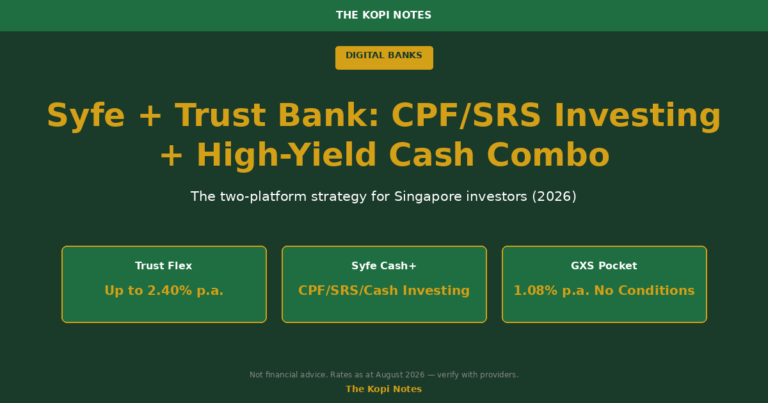
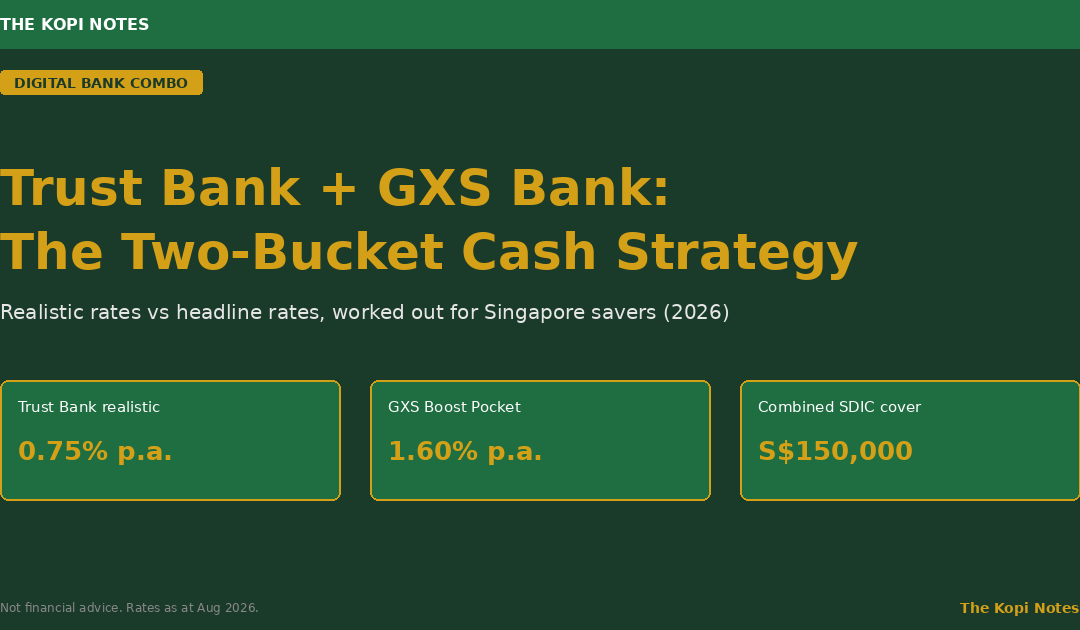
Trust Bank’s Flex plan advertises up to 2.40% p.a., but most savers who skip the S$20,000 TrustInvest purchase and card referral scoop will realistically earn closer to 0.75% p.a. GXS’s 12-month Boost Pocket pays a guaranteed 1.60% p.a. with zero admin, plus a S$10-per-S$10,000 “SG61” cashback promo running until 18 August 2026. Splitting cash between both also doubles your SDIC coverage to S$150,000.
Not financial advice. All figures are for educational reference only. Data as at August 2026 unless noted.
- Trust Bank’s 2.40% p.a. headline needs a S$20,000 TrustInvest purchase and a credit card referral each month — most savers realistically earn around 0.75% p.a. from 3 easy scoops instead.
- GXS’s 12-month Boost Pocket pays a guaranteed 1.60% p.a. with no card spend or referral required, plus a limited-time “SG61” cashback promo.
- Using both banks instead of one also spreads your cash across two separate SDIC-insured institutions, doubling your protected coverage to S$150,000.
Table of Contents
Contents — Click to expand
- Trust Bank vs GXS: Quick Look
- Why Pair an “Effort” Bank With a “Lock-In” Bank?
- The Trust Bank Side: Your Realistic Yield
- The GXS Side: Guaranteed Rate + SG61 Promo
- Worked Example: Splitting S$20,000
- SDIC Protection: Doubling Your Coverage
- How to Set It Up
- Who This Combo Is Best For
- Risks and Limitations
- FAQ
Trust Bank vs GXS: Quick Look
Before the strategy, here’s how the two banks actually pay you — not just the “up to” numbers in their marketing.
| Feature | Trust Bank (Flex) | GXS Bank |
|---|---|---|
| Headline rate | Up to 2.40% p.a. on first S$1.2M | Up to 1.60% p.a. (12-month Boost Pocket) |
| What unlocks it | 3 of 8 monthly “scoops” — biggest are a card referral (+1.20%), S$20K TrustInvest purchase (+0.70%), salary GIRO (+0.45%) | Just lock cash in a Boost Pocket for 12 months — no spend or referral needed |
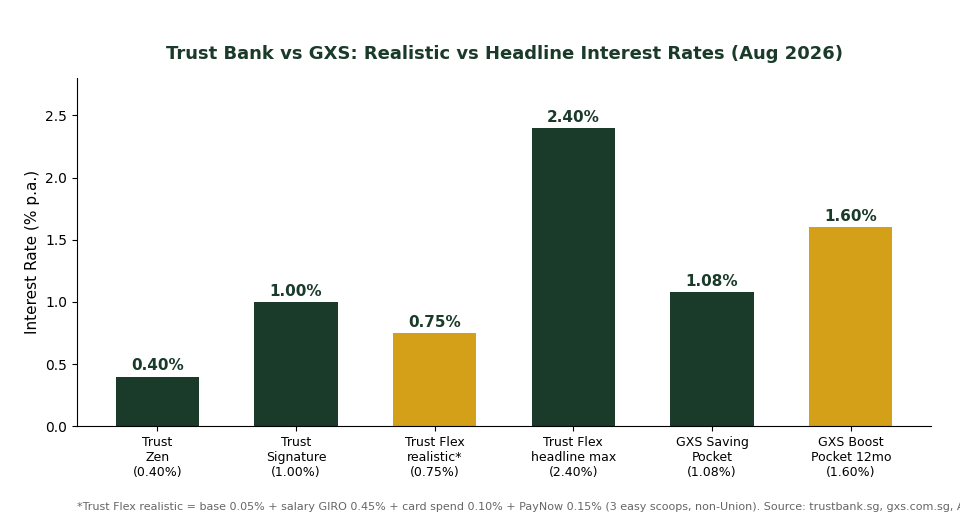
| No-hoops rate | 0.40% p.a. (Zen plan) or 1.00% p.a. (Signature, the default) | 0.88% p.a. (Main) / 1.08% p.a. (Saving Pocket, no lock-in) |
| Access to funds | Fully flexible, withdraw anytime | Main/Saving Pockets liquid; Boost Pocket locked for its tenure |
| Live promo | None currently running | “SG61” — S$10 cashback per S$10,000 in a 12-month Boost Pocket, till 18 Aug 2026 |
| Accepts CPF/SRS | No | No |
| SDIC insured | Yes, up to S$75,000 | Yes, up to S$75,000 |
Source: trustbank.sg, gxs.com.sg — rates as at August 2026, correct at time of writing.
Why Pair an “Effort” Bank With a “Lock-In” Bank?
Most of our previous digital bank combos pair a cash-only bank with an investing platform like Endowus or Syfe. This one is different — Trust Bank and GXS are both cash-only banks, but they reward you in completely different ways.
Trust Bank’s Flex plan rewards behaviour. You pick 3 of 8 monthly “scoops” — things like referring a friend for a credit card, crediting your salary, or spending on your Trust card. Hit the two biggest scoops (the credit card referral and a S$20,000 TrustInvest purchase) and you touch the full 2.40% p.a. Skip those two — which most people do, since they’re not everyday actions — and you’re left with smaller, easier scoops worth far less.
GXS rewards commitment, not behaviour. Lock cash away for 12 months in a Boost Pocket, and you get 1.60% p.a. guaranteed — no card spend, no referrals, no investment purchase. The only “cost” is that you can’t touch that money for a year.
Pairing them lets you use each bank for what it’s actually good at: Trust Bank for cash tied to things you’re doing anyway (salary crediting, everyday card spend), and GXS for cash you’re comfortable locking away.
The Trust Bank Side: Your Realistic Yield
Trust Bank’s Flex plan starts at a 0.05% p.a. base rate, then lets you choose any 3 of 8 bonus “scoops” each month. Miss a scoop next month, and you lose that bonus interest — there’s no averaging or carryover.
The two biggest scoops — referring a new Trust credit card customer (+1.20% p.a.) and purchasing S$20,000 of eligible TrustInvest funds (+0.70% p.a.) — aren’t things most savers do every single month. Referrals run out once you’ve told your friends, and few people want to move S$20,000 into a new investment fund purely to chase 0.70% of interest on their savings.
Here’s the scoop combination most Singaporeans can realistically hit without changing their financial life: crediting a S$1,500+ monthly salary via GIRO (+0.45% p.a.), making 5 debit or credit card spends of S$30 or more (+0.10% p.a. for non-Union members, +0.20% for NTUC members), and receiving S$1,500 in incoming PayNow transfers (+0.15% p.a.).
That’s a 1.65 percentage-point gap between the advertised headline and what an ordinary saver actually earns. It’s still better than the 0.40% p.a. Zen plan or the 1.00% p.a. Signature default — but it’s a fraction of the marketed number. For a deeper breakdown of every scoop and which ones are realistic for your situation, see our Trust Bank interest rate guide.
The GXS Side: Guaranteed Rate + SG61 Promo
The GXS Savings Account pays 0.88% p.a. on your Main Account, or 1.08% p.a. if you move cash into a no-lock-in Saving Pocket — both with zero conditions. But the Boost Pocket is where GXS earns its keep: choose a tenure of 1, 3, 4, 8 or 12 months, and you’ll earn 0.88% p.a. base interest daily, plus bonus interest at maturity that climbs to 0.72% p.a. for the 12-month tenure — a combined 1.60% p.a.
You can open up to 5 Boost Pockets at once, with a combined deposit limit of S$95,000. Unlike Trust Bank’s scoops, there’s nothing to keep doing every month — you lock the money once and the rate is guaranteed for that tenure.
Right now, GXS is also running a National Day-themed promo called “SG61”. Deposit into a 12-month Boost Pocket named exactly “SG61”, and GXS pays S$10 cashback for every S$10,000 you deposit, on top of the 1.60% p.a. rate. This promo is valid until 18 August 2026 — if you’re reading this close to that date, check the GXS app first, since it may have already ended or been replaced by a new one.
Worked Example: Splitting S$20,000
Say you have S$20,000 in cash. Here’s what a 50/50 split between Trust Bank Flex (3 realistic scoops) and a GXS 12-month Boost Pocket would earn over a year, versus leaving the full amount in one Trust Bank plan and doing nothing extra.
| Scenario | 1-Year Return |
|---|---|
| S$10,000 in Trust Bank Flex at 0.75% p.a. (3 realistic scoops) | S$75 |
| S$10,000 in GXS 12-month Boost Pocket at 1.60% p.a. + S$10 SG61 cashback | S$170 |
| Combo total (S$20,000 split), Year 1 with SG61 promo | S$245 |
| Combo total, ongoing years (no promo) | S$235 |
| All S$20,000 in Trust Bank Signature, the default plan (1.00% p.a.) | S$200 |
| All S$20,000 in Trust Bank Zen, the no-strings plan (0.40% p.a.) | S$80 |
Source: The Kopi Notes calculation based on trustbank.sg and gxs.com.sg official rates, August 2026. Illustrative only — actual returns depend on which scoops you hit and current promo terms.
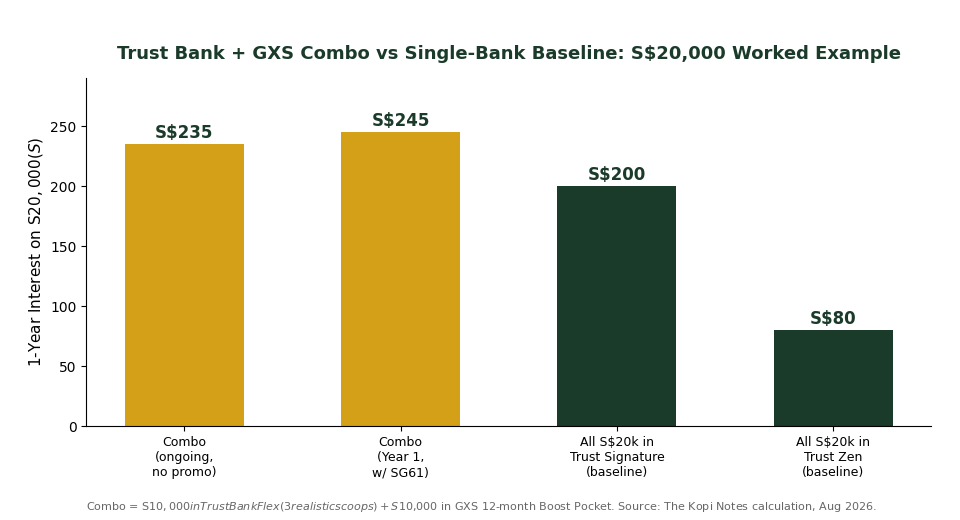
The gap is modest against Trust Bank’s Signature default — S$45 more in year 1, S$35 more ongoing — but it’s real and checkable, and it comes with zero extra risk. Against doing nothing and leaving cash on the no-strings Zen plan, the combo earns S$155–S$165 more per year. Either way, you’re not chasing Trust Bank’s unrealistic 2.40% ceiling to get there.
SDIC Protection: Doubling Your Coverage
Beyond the rate difference, there’s a second reason to hold both banks: insurance diversification. The Singapore Deposit Insurance Corporation (SDIC) insures Singapore dollar deposits up to S$75,000 per depositor, per Scheme member bank. Trust Bank and GXS are separately licensed digital full banks and separate SDIC Scheme members.
That means if your cash buffer is approaching or above S$75,000, concentrating it all in one bank leaves part of it uninsured in the (unlikely) event that bank fails. Splitting it across Trust Bank and GXS keeps you fully covered up to a combined S$150,000.
This matters even if you’re not chasing the extra interest — for larger cash balances, the insurance diversification alone can be reason enough to split.
How to Set It Up
Opening both accounts takes about 15 minutes combined, all done through each bank’s app with Singpass MyInfo.
Trust Bank: Download the Trust app, sign up with Singpass, and select the Flex plan (Signature is the default if you don’t actively choose). Each month, tap into the app and select your 3 scoops — salary crediting and card spend usually happen automatically once set up, but you’ll need to actively opt into PayNow or other scoops depending on your habits.
GXS Bank: Download the GXS app, sign up with Singpass, and fund your Savings Account. To catch the SG61 promo before it ends, create a new Boost Pocket, set the tenure to 12 months, and name it exactly “SG61” before depositing — GXS matches the promo by Boost Pocket name, so a typo means missing out.
Both banks let you enter a referral code at sign-up for a welcome bonus on top of the rates above.
Who This Combo Is Best For
This split makes the most sense for someone who already banks with a debit/credit card on a daily basis, gets their salary paid via GIRO, and has at least S$10,000–S$20,000 in cash sitting idle. If you’re already doing the “easy” Trust Bank scoops as part of normal life, capturing that 0.75% p.a. costs you nothing extra — it’s free money you might otherwise be leaving as Signature’s 1.00% p.a. or, worse, sitting in a big bank account earning close to zero.
It also suits savers who can clearly separate their cash into “spending money that stays liquid” (Trust Bank Flex) and “money I won’t touch for a year” (GXS Boost Pocket). If you’re not sure you can commit any cash for 12 months, skip the GXS side for now and keep everything in GXS’s no-lock-in Saving Pocket at 1.08% p.a. instead.
If your total cash buffer is under S$5,000, the effort of managing two banking apps for a few dollars of extra interest probably isn’t worth it — pick whichever bank’s no-hoops rate is simplest for you and move on. The combo starts paying off in earnest once you’re holding S$20,000 or more, and matters even more once you cross S$75,000 and SDIC diversification becomes relevant.
Trust Bank Referral Code
Code: HTWYQP95
GXS Bank Referral Code
Code: YONG477
Risks and Limitations
This is a savings strategy, not an investing one. Neither bank’s rate is guaranteed to beat inflation by much, and both can change their rates or scoop structure with notice. Trust Bank has adjusted its scoop menu before, and GXS’s SG61 promo is time-limited by design.
Locking money into a GXS Boost Pocket means you can’t access it for 12 months without breaking the tenure early — doing so forfeits the bonus interest, leaving you with just the 0.88% p.a. base rate for however long the money was actually locked. Only commit cash you’re confident you won’t need.
Trust Bank’s scoops require ongoing effort. If you stop crediting your salary via GIRO or your card spending drops one month, you lose that scoop’s bonus interest for the month — there’s no penalty beyond the missed interest, but it means the realistic 0.75% p.a. figure isn’t guaranteed either; it depends on your habits staying consistent.
Neither bank accepts CPF or SRS funds — this combo works for cash savings only. If you’re looking to put CPF-OA or SRS money to work instead, see our guide on CPF investment strategy.
Finally, SDIC coverage protects your deposit if a bank fails — it doesn’t protect you from inflation. Treat this combo as your emergency fund and short-term savings layer, not your entire net worth strategy.
Frequently Asked Questions
Is Trust Bank's 2.40% p.a. interest rate real?
Is it safe to split my savings between Trust Bank and GXS?
What is the SDIC insurance limit for digital banks in Singapore?
What happens if I need my GXS Boost Pocket funds before the 12-month lock ends?
Can I use Trust Bank or GXS for my CPF or SRS funds?
Which pays more — Trust Bank or GXS?
How do I open both a Trust Bank and a GXS account?
Want the full three-way breakdown? Check our Digital Bank Interest Rates guide, our GXS vs Trust Bank vs MariBank comparison, or plan your idle cash with our Savings Rate Calculator.
This article was researched with the help of AI. While we strive to keep all information accurate and up to date, there may be errors. If you notice any discrepancies, please contact us.