S-REITs vs Money Market Funds Singapore 2026: Which Gives Better Income?
Real SGD yield, risk and liquidity numbers to help you decide where your spare cash should go.
S-REITs paid an average yield of around 5.8% in 2026, versus 1.1% to 2.7% for Singapore’s top money market funds. S-REITs pay more because you take on share price risk and possible dividend cuts. Money market funds barely move in value, making them better for cash you cannot afford to lose. Most Singapore investors use both, for different jobs.
Not financial advice. All figures are for educational reference only. Data as at August 2026 unless noted.
- S-REITs yield roughly 3-4 times more than money market funds, but your capital can swing double digits in a bad year.
- Money market funds barely move in value — they’re for money you need soon, not for growing wealth.
- On S$50,000, S-REITs could pay about S$2,900 a year versus S$560-S$1,350 from a money market fund.
Table of Contents
Contents — Click to expand
- Quick Answer
- Key Differences at a Glance
- Yield Comparison: S-REITs vs Money Market Funds (2026)
- Risk and Volatility: Capital Growth vs Capital Preservation
- Liquidity and Access to Your Cash
- Tax Treatment for Singapore Investors
- Who Should Pick Which — or Both?
- How to Buy Both in Singapore
- Frequently Asked Questions
Quick Answer
If you want income and are comfortable with your capital rising and falling, S-REITs (Singapore Real Estate Investment Trusts) usually win on yield. If you need the money soon, or simply cannot stomach seeing the value drop, a money market fund is the safer home for it.
Here’s why: S-REITs are listed on the Singapore Exchange (SGX) and must, by law, distribute at least 90% of their taxable income to unitholders each year. That rule alone pushes yields well above what a bank deposit or a short-duration bond fund can offer. But S-REIT unit prices move with interest rates, property values and rental income — sometimes sharply. Money market funds hold short-term, high-quality debt instruments and bank deposits, so their unit price barely budges. You give up yield for that stability.
Key Differences at a Glance
| Feature | S-REITs | Money Market Funds |
|---|---|---|
| 2026 Yield / Return | ~5.0% – 7% (avg ~5.8%) | ~1.1% – 2.7% p.a. |
| Capital Stability | Can swing double digits in a downturn | Low volatility, minor fluctuations possible |
| Underlying Assets | Physical real estate (malls, offices, data centres, industrial) | Bank deposits, short-term bonds, money market instruments |
| Where You Buy It | SGX, through any brokerage | Robo-advisor or brokerage cash management account |
| Liquidity | T+2 settlement, sell any trading day | Usually T+0 to T+3, no lock-in on flexi products |
| SDIC Protection | No — not a deposit | No — not a deposit either |
| Best For | Long-term passive income, growth | Emergency funds, short-term parking |
Source: CSOP iEdge S-REIT Leaders Index factsheet; DollarsAndSense.sg cash management guide, June 2026
Yield Comparison: S-REITs vs Money Market Funds (2026)
Numbers make this easier to picture. As at August 2026, the CSOP iEdge S-REIT Leaders Index — which tracks SGX’s most liquid REITs, including Keppel DC REIT, CapitaLand Ascendas REIT and Frasers Centrepoint Trust — carries an average sector yield of roughly 5.8%. That’s broadly in line with what our own best S-REITs in Singapore 2026 roundup shows across large-cap names.
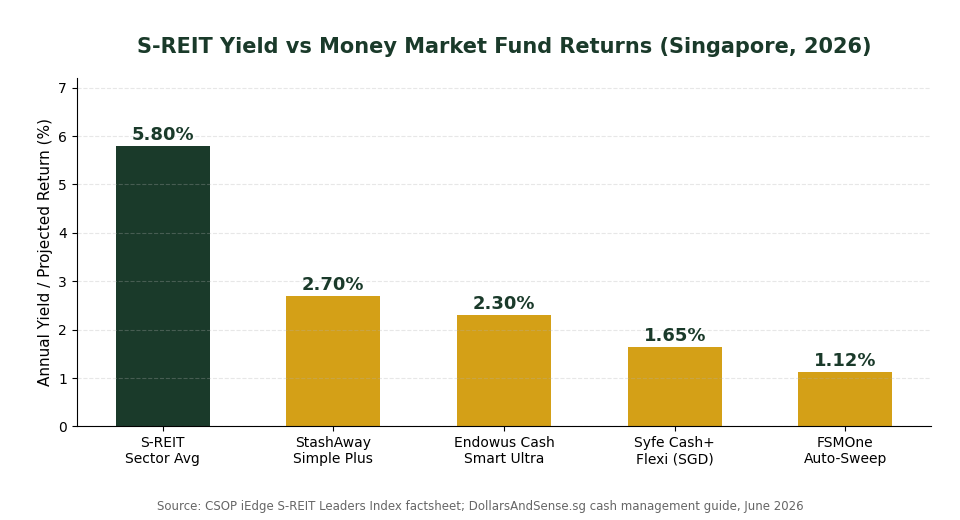
Compare that against Singapore’s leading cash management accounts, as at June 2026: StashAway Simple Plus projects 2.70% p.a., Endowus Cash Smart Ultra projects 2.30% p.a., Syfe Cash+ Flexi (SGD) sits at 1.6%-1.7% p.a., and FSMOne’s SGD Auto-Sweep Account trails at around 1.12% p.a. Even the highest-yielding money market option here still pays less than half of the S-REIT sector average.
| Platform | Product | Projected SGD Yield |
|---|---|---|
| StashAway | Simple Plus | 2.70% |
| Endowus | Cash Smart Ultra | 2.30% |
| Endowus | Cash Smart Enhanced | 1.80% |
| Syfe | Cash+ Flexi (SGD) | 1.60%-1.70% |
| Endowus | Cash Smart Secure | 1.30% |
| FSMOne | SGD Auto-Sweep Account | 1.12% |
Source: DollarsAndSense.sg complete guide to cash management accounts in Singapore, updated June 2026
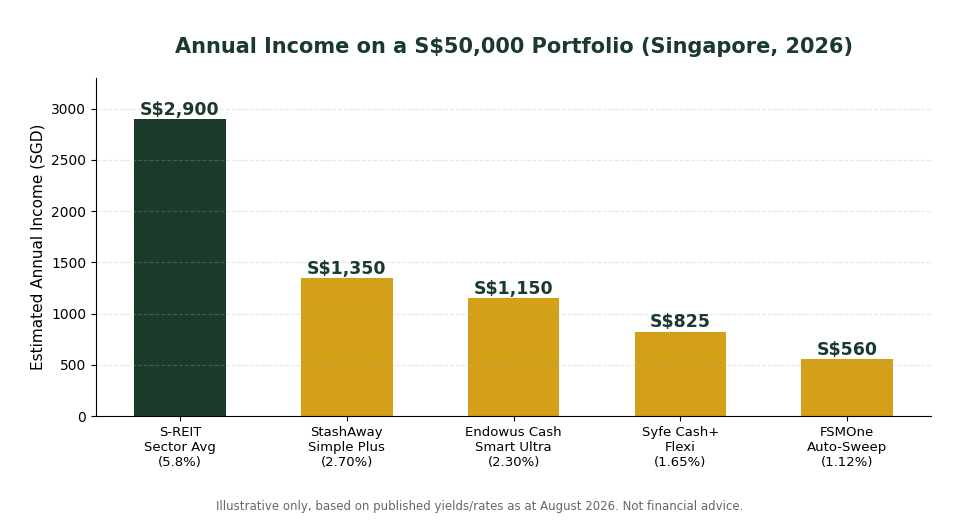
On a S$50,000 portfolio, that gap is real money. At the sector average of 5.8%, S-REITs would pay you roughly S$2,900 a year. StashAway Simple Plus at 2.70% pays about S$1,350. FSMOne’s Auto-Sweep at 1.12% pays just S$560. That’s a difference of over S$2,300 a year on the same starting sum.
Risk and Volatility: Capital Growth vs Capital Preservation
Yield is only half the story. The bigger question is what happens to your capital.
S-REITs trade on the stock market. Their unit prices move with interest rate expectations, occupancy rates, rental reversions and broader risk sentiment. During past rate-hike cycles, S-REIT prices fell double digits even while distributions held up — you were paid your dividend, but your capital was underwater on paper. Some REITs also cut their Distribution Per Unit (DPU) — basically how much cash each unit pays you per quarter — when a property faces a downturn or a fundraising exercise dilutes existing unitholders.
Money market funds are built to avoid that. Endowus discloses that its highest-risk Cash Smart Ultra portfolio has a historical maximum loss of just -2.88%, and that’s the most aggressive fund in this comparison. Most money market fund investors never see their balance dip at all — the underlying short-term bonds and bank deposits are simply too stable to move much.
You don’t have to look far for a real example. Between 2022 and 2023, as global interest rates rose sharply, the FTSE ST REIT Index fell by roughly 20% peak-to-trough, even though most S-REITs kept paying distributions throughout. Investors who sold near the bottom locked in that loss. Investors who held on — or kept buying through the dip via dollar-cost averaging — ended up better off as prices recovered and yields normalised. That’s the trade-off: S-REITs reward patience, but they can test it first.
That said, neither product is covered by the Singapore Deposit Insurance Scheme (SDIC). Unlike a bank fixed deposit, both S-REIT units and money market fund holdings carry some investment risk — it’s just a very different size of risk.
Liquidity and Access to Your Cash
Both options are more liquid than a fixed deposit. You can sell S-REIT units on any trading day and typically receive funds in your brokerage account within two business days (T+2). Most money market fund “flexi” products — Syfe Cash+ Flexi, Endowus Cash Smart, StashAway Simple — let you withdraw with no lock-in, though the actual cash usually lands in your bank account within one to three business days depending on the platform.
A handful of money market products do lock your funds up. StashAway Fixed and Syfe Cash+ Guaranteed both hold your money in fixed deposits for a set term — anywhere from one to twelve months — in exchange for a small guaranteed-rate bump. If you might need the cash on short notice, stick to the flexi versions.
Tax Treatment for Singapore Investors
Here’s some good news either way: Singapore does not tax capital gains, so neither S-REIT price appreciation nor money market fund growth is taxed at the individual level.
On income specifically, the Inland Revenue Authority of Singapore (IRAS) exempts individual investors from tax on S-REIT distributions, provided you’re not receiving them through a partnership or as part of carrying on a trade or business. IRAS also allows REITs to pay these distributions to individuals on a gross basis — no tax is withheld at source. Money market fund returns are typically structured as capital growth within the fund rather than a taxable distribution, so most retail investors won’t see a separate tax event there either.
Because the tax treatment is broadly favourable on both sides, the decision really comes down to yield versus stability, not tax drag.
Who Should Pick Which — or Both?
Choose S-REITs if: you’re investing for long-term passive income, you don’t need this money in the next one to two years, and you’re comfortable watching the value rise and fall in exchange for a meaningfully higher payout. This fits well alongside a broader passive income strategy in Singapore.
Choose a money market fund if: this is your emergency fund, money set aside for a wedding or renovation, or cash you’re waiting to deploy into the market. You want it to still be there, roughly intact, whenever you need it.
In practice, most Singapore investors use both. A common structure: keep three to six months of expenses in a money market fund for emergencies, then build your S-REIT position over time using dollar-cost averaging for the long-term income sleeve. If you’d rather not pick individual REITs, a Singapore REIT ETF gives you diversified exposure to the same sector average yield in a single trade.
How to Buy Both in Singapore
For S-REITs, you’ll need a brokerage account — any SGX-linked broker will do, and you buy units the same way you’d buy any stock (search the ticker, place a market or limit order, settle T+2).
For money market funds, sign up directly on the platform that offers the fund you want. Syfe’s Cash+ Flexi account is a common starting point and can be opened alongside its Syfe referral code sign-up bonus, with no minimum deposit. Endowus Cash Smart also accepts SRS funds if you’d rather park idle SRS cash somewhere better than 0.05% — open an account through our Endowus referral code page for the current sign-up offer. Before you commit new capital either way, it’s worth running the numbers through our S-REIT Yield vs SGS Bond Spread Calculator to see whether the current REIT risk premium looks attractive versus risk-free government bonds.
Not financial advice. Yields and projected returns change over time — always check the latest rate on the provider’s own website before investing. Data in this article is as at August 2026.
Frequently Asked Questions
What's the main difference between S-REITs and money market funds for Singapore investors?
S-REITs are shares in a portfolio of real estate that pay you a slice of the rental income, and their price moves with the stock market. Money market funds hold short-term bonds and bank deposits and barely move in value. S-REITs pay more but carry more capital risk; money market funds pay less but are far more stable.
Which pays a higher yield — S-REITs or money market funds — in 2026?
S-REITs, by a wide margin. The S-REIT sector averaged around 5.8% as at August 2026, versus 1.1% to 2.7% for Singapore’s leading money market fund options like StashAway Simple Plus and Endowus Cash Smart Ultra.
Are S-REIT dividends taxed in Singapore?
No, not for most individual investors. IRAS exempts S-REIT distributions from tax at the individual level, as long as you’re not receiving them through a partnership or as part of a trade or business. REITs can also pay these distributions to individuals gross, without withholding any tax.
Can I lose money in a money market fund in Singapore?
It’s possible but rare. Money market funds are not deposits and aren’t SDIC-protected, so their unit price can dip slightly if underlying bond values move. Endowus, for example, discloses a historical maximum loss of -2.88% for its most aggressive Cash Smart Ultra portfolio — small compared to what a REIT or stock can lose in a downturn.
Should I hold both S-REITs and money market funds in my portfolio?
Most Singapore investors do. A common approach is keeping three to six months of expenses in a money market fund for emergencies, then building S-REIT exposure over time as the long-term income sleeve of your portfolio.
Which is more liquid — S-REITs or a cash management account?
They’re similar in practice. S-REITs settle T+2 on the stock exchange, while most flexi money market fund products let you withdraw with no lock-in, usually landing in your bank account within one to three business days. Locked products like Syfe Cash+ Guaranteed or StashAway Fixed trade some liquidity for a small guaranteed-rate bump.
Ready to Put Your Cash to Work?
Whether it’s a money market fund for your emergency cushion or S-REITs for long-term income, open an account through our referral links for exclusive sign-up offers.
This article was researched with the help of AI. While we strive to keep all information accurate and up to date, there may be errors. If you notice any discrepancies, please contact us.