Syfe + GXS Bank: The CPF/SRS Investing + High-Yield Cash Combo for Singapore Savers (2026)
Syfe handles your CPF, SRS, and long-term cash investing, while GXS Bank’s Boost Pockets pay up to 1.6% p.a. on your emergency fund. Together, they solve two different jobs: growing your long-term money and earning real interest on cash you might need next month. Neither platform does both jobs well alone.
Not financial advice. All figures are for educational reference only. Data as at August 2026 unless noted.
- Use Syfe for CPF-OA, SRS, and cash investing into diversified portfolios — not for short-term parking
- Use GXS Boost Pockets for your emergency fund — up to 1.6% p.a., and right now there’s a S$10 cashback per S$10,000 in the “SG61” 12-month pocket (valid till 18 August 2026)
- Splitting cash this way can earn you S$150-S$300 more a year on a S$20,000 buffer than leaving it in a regular savings account
Table of Contents
What Is Syfe, and What Is It Good For?
What Is GXS Bank, and What Is It Good For?
Why Combine Them Instead of Using Just One
Rate Comparison: GXS vs Syfe Cash+ Flexi
The August 2026 GXS SG61 Boost Pocket Promo
How to Set Up the Combo, Step by Step
Risks and Things to Watch
Frequently Asked Questions
What Is Syfe, and What Is It Good For?
Syfe is a Monetary Authority of Singapore (MAS)-licensed robo-advisor and cash management platform, per the Syfe Cash+ Flexi product page. You can invest your cash, CPF Ordinary Account (CPF-OA), and Supplementary Retirement Scheme (SRS) funds into diversified equity and bond portfolios, or park cash in Cash+ products.
You would open Syfe if you want your CPF-OA or SRS money to grow beyond the CPF-OA’s 2.5% floor rate or a bank’s SRS interest of near-zero. Syfe’s Syfe referral code and sign-up bonus also gives new users a welcome credit worth up to a few hundred dollars, depending on the funding tier at sign-up.
However, Cash+ Flexi is not a bank deposit. It invests in short-duration money market and bond funds, so the yield floats with interest rates and isn’t SDIC-insured the way a bank account is. That’s exactly why it shouldn’t be your only home for cash.
What Is GXS Bank, and What Is It Good For?
GXS Bank is a full digital bank in Singapore, backed by Grab and Singtel, and regulated by MAS. Rate details are published on the GXS Savings Account page. Deposits are SDIC-insured up to S$100,000 per depositor — the same protection as a traditional bank.
Your GXS Main Account earns 0.88% p.a. daily interest with no minimum balance or salary crediting required. Where GXS really stands out is Boost Pockets — sub-accounts that pay up to 1.6% p.a. for a fixed tenure of 1, 3, 4, 8, or 12 months, across up to five pockets and a combined S$95,000 deposit limit.
Because it’s SDIC-insured with a locked-in rate for the tenure you pick, GXS is the better home for money you can’t afford to see fluctuate — your emergency fund, or cash you’ll need on a known date. You can find sign-up details on the GXS Bank referral code page.
Why Combine Them Instead of Using Just One
Here’s the mistake many Singaporeans make: they pick one platform and force all their money into it. That’s a problem because Syfe and GXS are built for different jobs.
Syfe’s CPF-OA and SRS portfolios need time to compound. They can dip in value in a bad quarter, which is fine if you won’t touch the money for 5-10 years. However, that volatility makes Syfe a poor place for your emergency fund. If you needed to withdraw during a downturn, you’d lock in a loss.
GXS, on the other hand, gives you a fixed, SDIC-insured rate. That’s perfect for money you need to protect, but its ceiling of 1.6% p.a. won’t build real long-term wealth the way a properly invested CPF-OA or SRS portfolio can.
For example, a Singapore investor with S$30,000 in CPF-OA sitting idle earns a flat 2.5% p.a. from CPF. Moving part of that into a Syfe CPF-OA portfolio targets higher long-term returns, while keeping 3-6 months of expenses in a GXS Boost Pocket protects you from having to sell investments in an emergency.
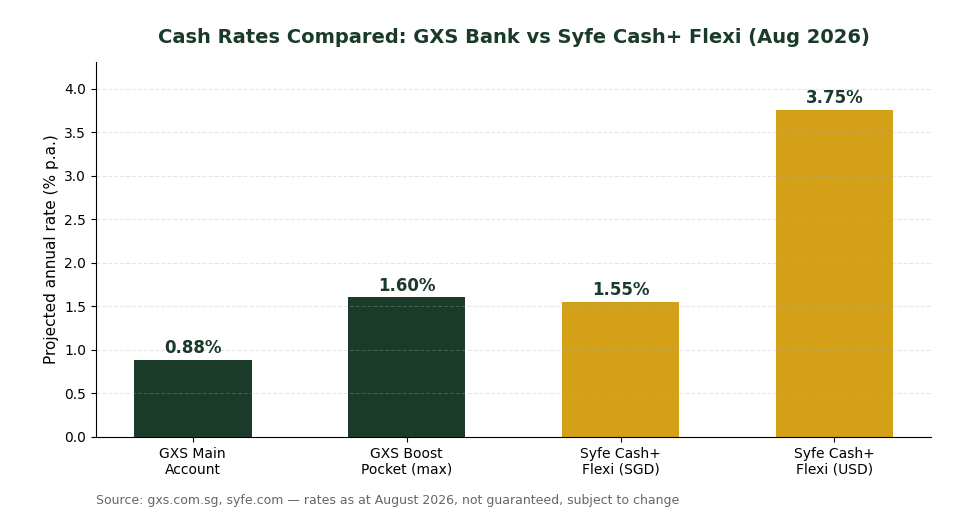
Rate Comparison: GXS vs Syfe Cash+ Flexi
| Product | Rate (p.a.) | Protection | Best For |
|---|---|---|---|
| GXS Main Account | 0.88% | SDIC-insured | Everyday spending cash |
| GXS Boost Pocket (max tenure) | Up to 1.6% | SDIC-insured | Emergency fund, known-date cash |
| Syfe Cash+ Flexi (SGD) | ~1.5-1.6% (projected) | Not SDIC-insured | Cash you can leave for months |
| Syfe Cash+ Flexi (USD) | ~3.7-3.8% (projected) | Not SDIC-insured | USD holders, higher risk appetite |
Source: gxs.com.sg, syfe.com — rates as at August 2026, projected returns are not guaranteed and can change.
What This Actually Means in Dollars
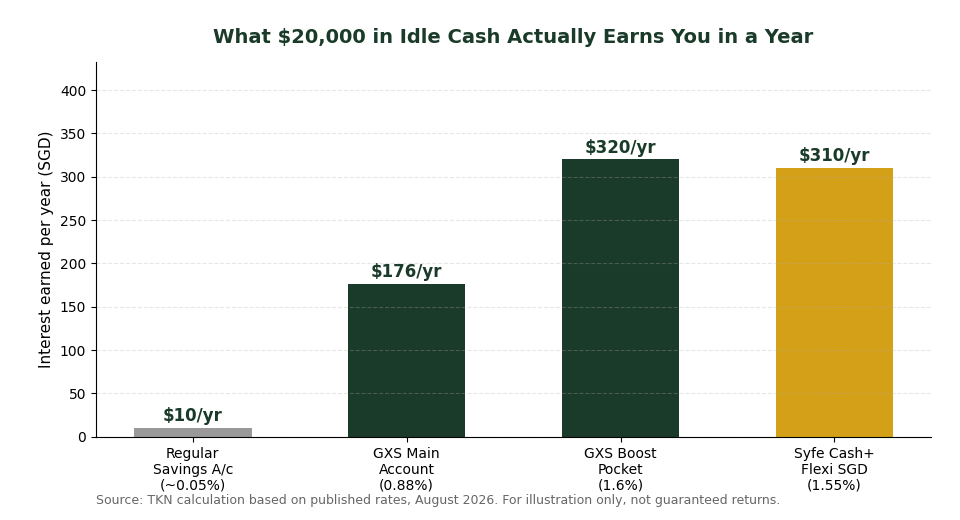
Numbers on a rate sheet don’t mean much until you see them applied to a real amount. Here’s what S$20,000 in idle cash earns across four options over one year.
| Where the S$20,000 sits | Rate | Interest per year |
|---|---|---|
| Regular bank savings account | ~0.05% | ~S$10 |
| GXS Main Account | 0.88% | ~S$176 |
| GXS Boost Pocket (max) | 1.6% | ~S$320 |
| Syfe Cash+ Flexi (SGD) | 1.55% | ~S$310 |
Source: TKN calculation based on published rates, August 2026. For illustration only, not guaranteed returns.
The August 2026 GXS SG61 Boost Pocket Promo
Right now, GXS is running a National Day-themed promo called “SG61”. If you deposit into a 12-month Boost Pocket named SG61, GXS pays you S$10 cashback for every S$10,000 you deposit. The promo is valid until 18 August 2026.
For example, if you moved S$50,000 into an SG61 Boost Pocket before the deadline, you’d receive S$50 cashback on top of the 1.6% p.a. interest for the 12-month tenure. That’s a meaningful boost if you already have emergency fund cash sitting idle in a low-interest account.
However, don’t chase a promo with money you might need before the 12-month tenure ends. Boost Pockets lock in a rate for the full term, so early withdrawal can mean forfeiting the bonus interest.
How to Set Up the Combo, Step by Step
1. Work out your emergency fund target — typically 3-6 months of essential expenses.
2. Open a GXS Bank account and move your emergency fund into a Boost Pocket. If it’s before 18 August 2026, consider naming a 12-month pocket “SG61” to capture the cashback.
3. Open a Syfe account for money beyond your emergency fund — your CPF-OA above the amount you need for near-term housing payments, and SRS funds you don’t plan to withdraw for years.
4. Review both accounts every 6-12 months. Interest rates on both platforms move with the broader rate environment, so today’s numbers won’t be permanent.
5. Keep the split simple: protect what you need soon in GXS, grow what you don’t need soon in Syfe.
Risks and Things to Watch
Syfe Cash+ Flexi is not principal-guaranteed. It invests in money market and short-duration bond funds, and while losses are historically rare for this asset class, they’re not impossible — especially during sharp rate moves.
GXS Boost Pockets are SDIC-insured up to S$100,000 combined per depositor, per bank, but locking cash into a fixed tenure means you can’t access it early without losing the bonus interest.
Rates on both platforms are variable and can fall. The figures in this article are accurate as at August 2026 — always check the live rate on each platform before committing new money.
Neither Syfe nor GXS should hold 100% of your money. This combo strategy works because it splits risk and time horizon across two purpose-built tools, not because either one is universally “better”.
Ready to Set Up the Combo?
TKN may earn a referral fee if you sign up through these links — at no extra cost to you.
Related Reading
If you’re building out a full financial plan, these guides go deeper: CPF investment strategy, passive income Singapore, and the Singapore retirement calculator to see how your CPF-OA and SRS investing choices affect your retirement number. You can also check FSMOne referral code if you’d rather compare a CPF/SRS-compatible brokerage against Syfe before deciding.
Frequently Asked Questions
Can I use Syfe for my CPF-OA and SRS at the same time as GXS?
Yes. Syfe and GXS serve different accounts. Your CPF-OA and SRS go into Syfe’s investment portfolios, while your cash savings and emergency fund sit separately in a GXS Bank account. There’s no conflict between the two.
Is GXS Bank actually SDIC-insured?
Yes. GXS Bank is a full digital bank licensed by MAS, and deposits are covered by the Singapore Deposit Insurance Corporation (SDIC) up to S$100,000 per depositor, per bank.
Is Syfe Cash+ Flexi guaranteed to return 1.5-1.6% p.a.?
No. Cash+ Flexi’s return is a projected yield based on the underlying money market and bond funds, not a guaranteed rate like a bank deposit. It can move up or down as interest rates change, and Syfe itself states this is not a guarantee.
What is the GXS SG61 Boost Pocket promo?
It’s a National Day-themed promotion where GXS pays S$10 cashback for every S$10,000 deposited into a 12-month Boost Pocket named “SG61”. The promo is valid until 18 August 2026, based on GXS’s published terms at the time of writing.
How much emergency fund should I keep in GXS before investing the rest through Syfe?
A common guideline is 3-6 months of essential expenses. The exact amount depends on your job stability, dependents, and other liquid assets — there’s no single right number for everyone.
Does moving CPF-OA into Syfe mean I lose the CPF-OA's 2.5% guaranteed interest?
Yes, any amount you invest through Syfe (or any CPFIS-included platform) stops earning the CPF-OA’s guaranteed interest rate for as long as it’s invested. This is a real trade-off — only invest CPF-OA money you’re comfortable seeing fluctuate in exchange for potentially higher long-term returns.
This article was researched with the help of AI. While we strive to keep all information accurate and up to date, there may be errors. If you notice any discrepancies, please contact us.