Mapletree Pan Asia Commercial Trust (MPACT) Share Price Target 2026: What DBS & Maybank Are Predicting (SGX: N2IU)
DBS and Maybank both trimmed their targets after MPACT’s 1Q FY26/27 results — but both kept their BUY calls. Here’s what’s behind the numbers.
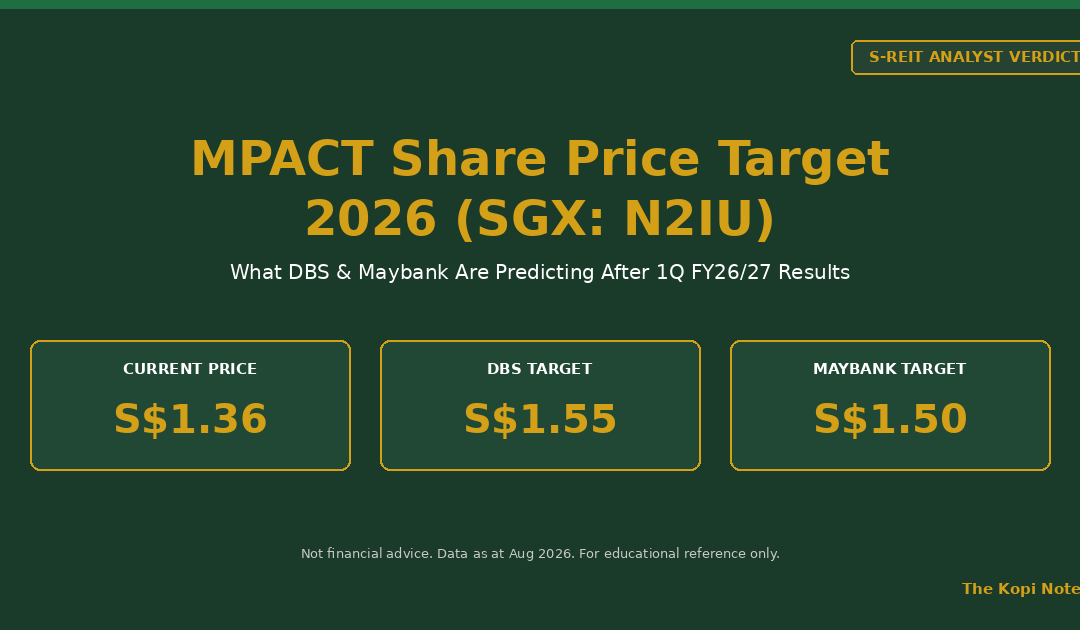
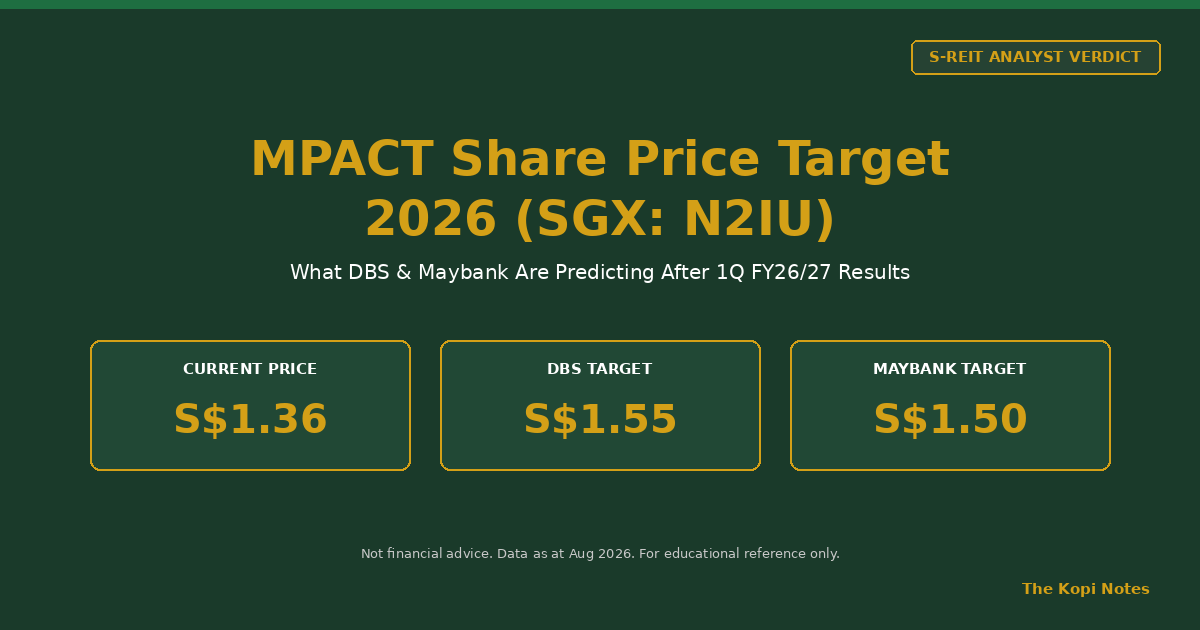
Two brokers cut their Mapletree Pan Asia Commercial Trust (MPACT) target prices after its 1Q FY26/27 results, but both kept a BUY rating. DBS lowered its target to S$1.55 (from S$1.65) on 3 August 2026, while Maybank set S$1.50 on 31 July 2026. Against a S$1.36 reference price, that implies 10–14% upside, with resilient Singapore assets offsetting overseas weakness in Japan and China.
Not financial advice. All figures are for educational reference only. Data as at August 2026 unless otherwise noted.
- DBS (3 Aug 2026): BUY maintained, target cut to S$1.55 from S$1.65. Maybank (31 Jul 2026): BUY, target S$1.50.
- 1Q FY26/27 DPU fell 2.5% year-on-year to 1.96 cents — driven by weaker Japan and China contributions, not a Singapore problem.
- VivoCity is still the engine: tenant sales up 4.9% and rental reversion in the mid-teens. That’s why both brokers stayed BUY despite the cuts.
DBS vs Maybank: The Two Target Prices
Two brokers published fresh MPACT calls within days of each other, right after the REIT’s 1Q FY26/27 business update on 30 July 2026. Both cut their targets. Both stayed BUY.
| Broker | Report Date | Rating | Target Price | Prior Target |
|---|---|---|---|---|
| DBS Group Research | 3 Aug 2026 | BUY (maintained) | S$1.55 | S$1.65 |
| Maybank Research | 31 Jul 2026 | BUY (maintained) | S$1.50 | ~S$1.55 (DDM trimmed 3%) |
Source: DBS Group Research (3 Aug 2026) and Maybank Research Pte Ltd (31 Jul 2026), both via minichart.com.sg excerpts.
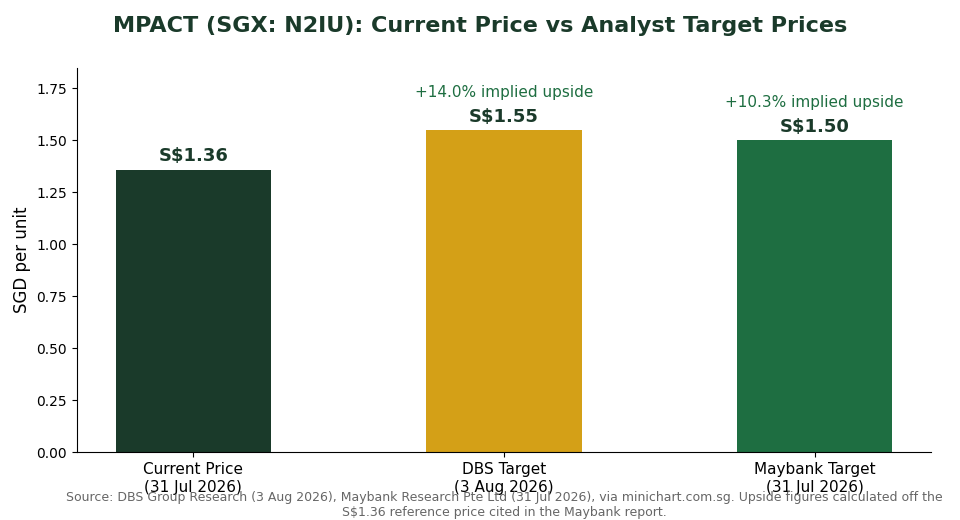
Using the S$1.36 reference price cited in Maybank’s report, DBS’s S$1.55 target implies about 14.0% upside, and Maybank’s own S$1.50 target implies about 10.3% upside. That’s a meaningful gap from where MPACT traded a year ago — you’re not looking at a REIT priced for perfection here. You’re looking at one priced for a bumpy overseas recovery.
1Q FY26/27 Results: What Actually Happened
MPACT released its 1Q FY26/27 business update on 30 July 2026, covering the quarter ended 30 June 2026. Distribution Per Unit (DPU) — basically how much cash each MPACT unit pays you — came in at 1.96 Singapore cents, down 2.5% year-on-year and payable on 16 September 2026.
Gross revenue fell 5.6% year-on-year to S$206.5 million, and net property income (NPI, revenue minus direct property costs) dropped 6.8% to S$154.8 million. That’s not a Singapore story. It’s a currency and overseas-asset story: the Singapore dollar strengthened against both the Hong Kong dollar and the Japanese yen over the period, and MPACT no longer has income from assets it divested in FY2026.
| Metric | 1Q FY26/27 | YoY Change |
|---|---|---|
| DPU | 1.96 cents | -2.5% |
| Gross Revenue | S$206.5m | -5.6% |
| Net Property Income | S$154.8m | -6.8% |
| Finance Expenses | S$40.9m | -18.4% |
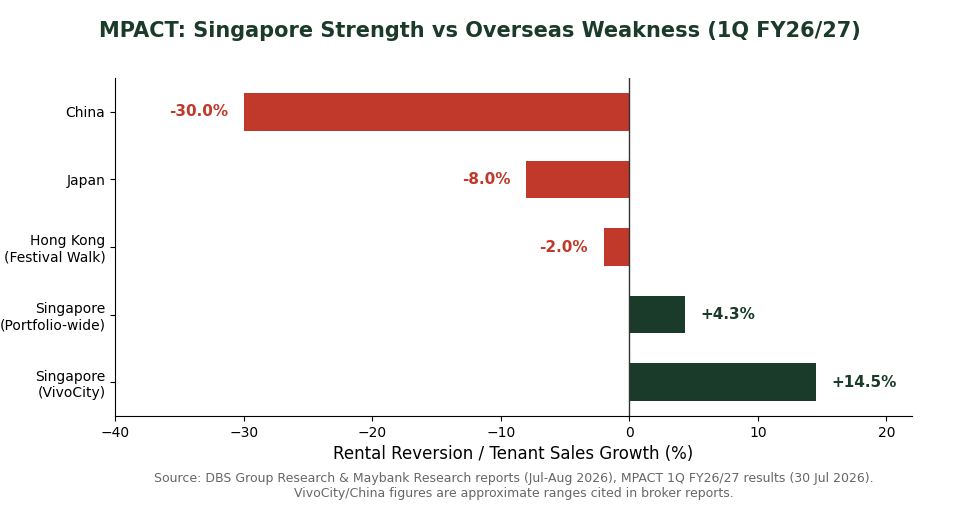
| Portfolio Rental Reversion | +4.3% | — |
Source: MPACT 1Q FY26/27 Business Update (30 Jul 2026); DBS & Maybank research reports.
Here’s the part that matters for your read on the stock: finance expenses fell 18.4% even as revenue dropped. MPACT redeemed a S$250 million perpetual security and refinanced with a new S$200 million note at a lower 2.53% coupon. That’s active balance sheet management working in the REIT’s favour while the top line struggles — a detail both brokers flagged as a genuine positive, not just a footnote.
Why Singapore Assets Are Carrying the REIT
If you own MPACT, VivoCity is doing most of the heavy lifting. Tenant sales at the mall grew 4.9% year-on-year, and rental reversion — the percentage change in rent when a lease renews — came in at a mid-teens positive rate for the quarter. That’s a strong number for a mature suburban mall.
Singapore assets, which include VivoCity, Mapletree Business City (MBC), mTower and Mapletree Anson, made up roughly 61% of MPACT’s total assets under management and 66% of net property income in DBS’s breakdown. In practice, that means: when you’re evaluating MPACT, you’re mostly evaluating Singapore commercial real estate, with an overseas tail attached.
That said, occupancy across the total portfolio softened to 84.4% due to expected non-renewals and lease slippages — but management flagged that key leases at MBC are set to commence later in the year, which should help occupancy recover.
The Overseas Drag: Japan and China
Here’s why both brokers trimmed their targets instead of raising them. MPACT’s overseas portfolio — Japan, China, and Hong Kong — is going through a genuinely rough patch, and it’s dragging down the numbers that would otherwise look quite good.
In Japan, occupancy fell to around 56%. That’s a low number by any REIT standard, and DBS expects improvement to take several quarters, not one or two. In China, rental reversions are running close to negative 30% — meaning tenants renewing leases are paying roughly 30% less than the outgoing tenant did. That’s the kind of number that shows up directly in DPU.
Hong Kong’s Festival Walk is the relative bright spot among the overseas assets: performance has been stabilising rather than deteriorating further, even if it hasn’t turned meaningfully positive yet.
DBS’s own framing is blunt: it expects another year of DPU decline in FY2027, with a real recovery delayed until FY2028. Its FY2027 DPU forecast was cut 3.6% to 7.82 Singapore cents (down 1.9% year-on-year), before growth resumes in FY2028 at an estimated 7.99 cents (up 2.2%), implying a forward yield of around 6.0% at current prices.
Balance Sheet and Leverage
MPACT’s aggregate leverage sits at 37.7%, comfortably below MAS’s 50% regulatory ceiling for S-REITs, though not as low as some of its blue-chip peers. The REIT’s active debt management this quarter is arguably the most underrated part of the story.
MPACT redeemed a S$250 million perpetual security and replaced it with a new S$200 million note carrying a lower 2.53% coupon. Combined with broader refinancing at better rates, that pushed overall financing costs down to 2.94% and helped finance expenses fall 18.4% year-on-year — even as gearing ticked up slightly to fund the move. If you’re holding MPACT for income, lower financing costs directly protect your distributions from further erosion, which matters more right now than it would in a REIT with a cleaner overseas book.
What DBS and Maybank Expect Next
Both brokers are telling a similar story, just with slightly different numbers. According to the DBS Group Research report dated 3 August 2026, portfolio optimisation is now the priority: recycling non-core overseas assets and reinvesting in Singapore, including potential asset enhancement initiatives (AEIs) at VivoCity. DBS explicitly flags slower leasing recovery at MBC, prolonged Japan vacancies, and persistent negative China reversions as the key risks to watch.
The Maybank Research report dated 31 July 2026 makes a similar case, pointing to MPACT’s improved balance sheet and proactive capital management as reasons the BUY call held even as near-term DPU visibility weakened. Maybank’s biggest flagged risk is further non-renewal of anchor leases overseas.
In plain English: neither broker thinks MPACT is broken. Both think FY2027 will be a transition year before things look better in FY2028. That’s a very different read from “sell now” — it’s closer to “understand what you’re buying before you add more.”
Buy, Hold or Sell?
If you already hold MPACT for income, the story here is: your distributions are being protected by lower financing costs even as overseas income drops, and the highest-quality asset in the portfolio (VivoCity) is performing well. That’s a reasonable hold case.
If you’re considering starting a position, the 6.0% forward yield DBS cites and the 0.8x price-to-book valuation both point to a REIT priced for its current problems, not one being given the benefit of the doubt. The upside case rests on Japan and China stabilising faster than either broker currently expects — and that’s genuinely uncertain, not a formality.
Either way, this isn’t a REIT to buy on autopilot right now. It’s one where you should have a specific view on how quickly Japan and China recover, because that view is what determines whether S$1.36 today looks cheap or fairly priced.
Related Reading
For MPACT’s full DPU history and yield trend, see our MPACT dividend and DPU guide. If you’re comparing across the sector, we’ve also covered the Keppel DC REIT share price target and the Frasers Centrepoint Trust share price target using the same DBS/analyst-verdict framework.
For a broader view of the sector, check our best S-REITs in Singapore 2026 roundup, or our guide to building passive income in Singapore through dividend-paying assets. If you’re mapping this into a retirement plan, our Singapore retirement calculator can help you model how S-REIT income fits alongside CPF LIFE and other sources.
Building a Singapore Income Portfolio?
Compare brokers and access S-REITs, ETFs and global markets with Syfe — get started with our referral code and see current sign-up offers.
Frequently Asked Questions
What is MPACT's share price target for 2026?
DBS Group Research set a target of S$1.55 on 3 August 2026 (lowered from S$1.65), and Maybank Research set a target of S$1.50 on 31 July 2026. Both brokers maintained a BUY rating despite cutting their targets, citing resilient Singapore assets against a weaker overseas portfolio.
Why did DBS and Maybank both lower their MPACT target price?
Both cuts followed MPACT’s 1Q FY26/27 results (30 July 2026), which showed DPU down 2.5% year-on-year to 1.96 cents. The decline was driven by weaker contributions from Japan and China, not from MPACT’s Singapore assets, which remained strong.
What was MPACT's DPU for 1Q FY26/27?
MPACT declared a 1Q FY26/27 DPU of 1.96 Singapore cents, down 2.5% year-on-year, payable on 16 September 2026.
Is MPACT still a BUY according to analysts?
Yes. Both DBS and Maybank maintained BUY ratings on MPACT even after cutting their target prices, pointing to VivoCity’s strong performance, improved financing costs, and a 6.0% forward yield as reasons to stay positive.
Why is MPACT's overseas portfolio underperforming?
Japan occupancy fell to around 56%, and China rental reversions are running close to negative 30% as tenants renew at lower rents. Hong Kong’s Festival Walk has stabilised but not yet turned meaningfully positive. DBS expects the overseas recovery to take several quarters.
What is MPACT's aggregate leverage?
MPACT’s aggregate leverage stood at 37.7%, below MAS’s 50% regulatory ceiling for Singapore REITs. The REIT also lowered its financing costs by redeeming a S$250 million perpetual security and issuing a new S$200 million note at a 2.53% coupon.
How much of MPACT's income comes from Singapore?
Singapore assets, including VivoCity, Mapletree Business City, mTower and Mapletree Anson, made up roughly 61% of MPACT’s assets under management and 66% of net property income as at 1Q FY26/27, according to DBS.
When will MPACT's DPU recover according to analysts?
DBS forecasts another year of DPU decline in FY2027 (down 1.9% to 7.82 cents), with growth resuming only in FY2028 (up 2.2% to 7.99 cents), implying a forward yield of around 6.0% at current prices.
This article was researched with the help of AI. While we strive to keep all information accurate and up to date, there may be errors. If you notice any discrepancies, please contact us.