Suntec REIT Share Price Target 2026: What DBS & CGS International Are Predicting (SGX: T82U)
New sponsor, rising leverage and a 24.8% DPU jump — here’s what two brokerages think Suntec REIT is worth in 2026.
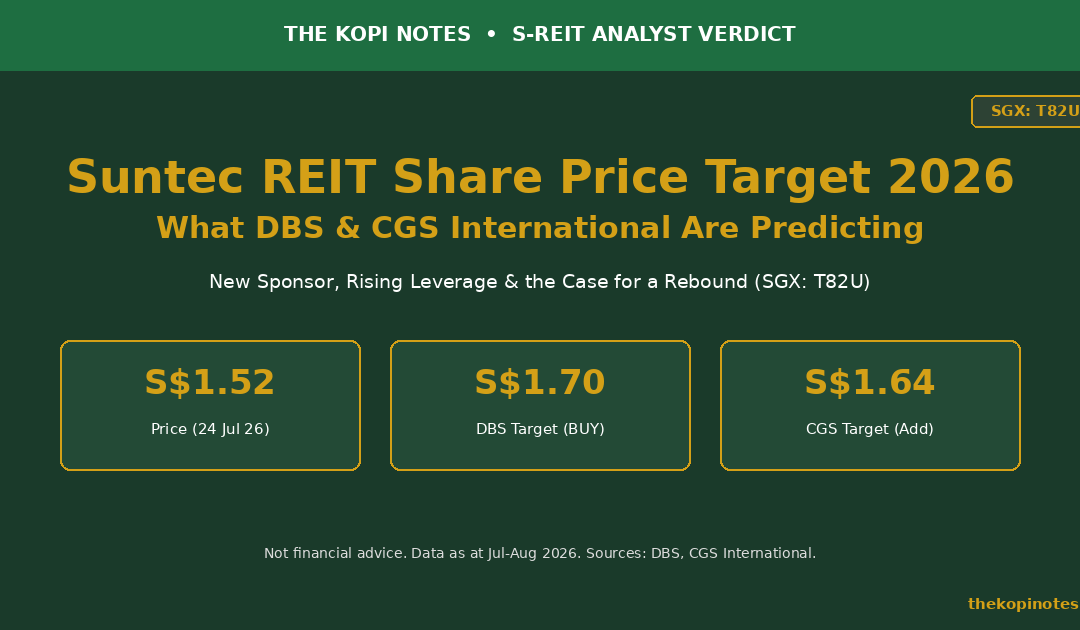
Suntec REIT (SGX: T82U) traded around S$1.52 as at 24 July 2026. DBS Group Research has a BUY call with a S$1.70 target price, while CGS International rates it Add at S$1.64 — implying roughly 8–12% upside. Both brokers point to a 24.8% DPU jump in 1H2026, near-full Singapore occupancy and a new sponsor, though rising leverage (now 43%) is the key risk to watch.
Not financial advice. All figures are for educational reference only. Data as at July–August 2026 unless otherwise noted.
- DBS raised its target to S$1.70 (BUY); CGS International raised its target to S$1.64 (Add) — both brokers turned more bullish after 1H2026 results beat expectations.
- DPU growth is accelerating (+23.9% in 1Q2026, +24.8% in 1H2026), driven by Singapore office and retail rental reversions above 9%.
- The catch: gearing climbed from 41.6% to 43% in the same period, so watch whether Suntec follows through on its divestment plans under new sponsor Tang Organisation.
Table of Contents
Contents — Click to expand
Suntec REIT Share Price Today
Suntec REIT closed at S$1.52 on 24 July 2026, the reference price DBS Group Research used in its latest BUY call. Different data providers show the counter trading in a S$1.45–1.52 band in the days since, which is normal noise for a stock that just posted a strong results beat.
That’s still meaningfully below Suntec REIT’s pre-pandemic highs above S$2.00, but it’s also up from the multi-year lows the counter touched when interest rates were at their peak. You’re looking at a REIT that’s recovering, not one that’s already priced for perfection.
That DPU growth is the single biggest reason both DBS and CGS International have been raising, not cutting, their targets through 2026.
Analyst Price Targets: DBS vs CGS International
Here’s what the two brokerages with the most recent, individually verifiable calls on Suntec REIT are saying. We’re only including targets we could confirm directly from a dated report excerpt — not vague “consensus” numbers pulled from unverified aggregators.
| Broker | Rating | Target Price | Report Date | Implied Upside* |
|---|---|---|---|---|
| DBS Group Research | BUY (reiterated, target raised) | S$1.70 | 27 Jul 2026 | ~11.8% |
| CGS International | Add (target raised from S$1.58) | S$1.64 | 27 Apr 2026 | ~7.9% |
*Upside calculated against S$1.52 (Suntec REIT’s price as at 24 Jul 2026, per DBS’s report). Source: DBS Group Research (27 Jul 2026), CGS International (27 Apr 2026), via minichart.com.sg.
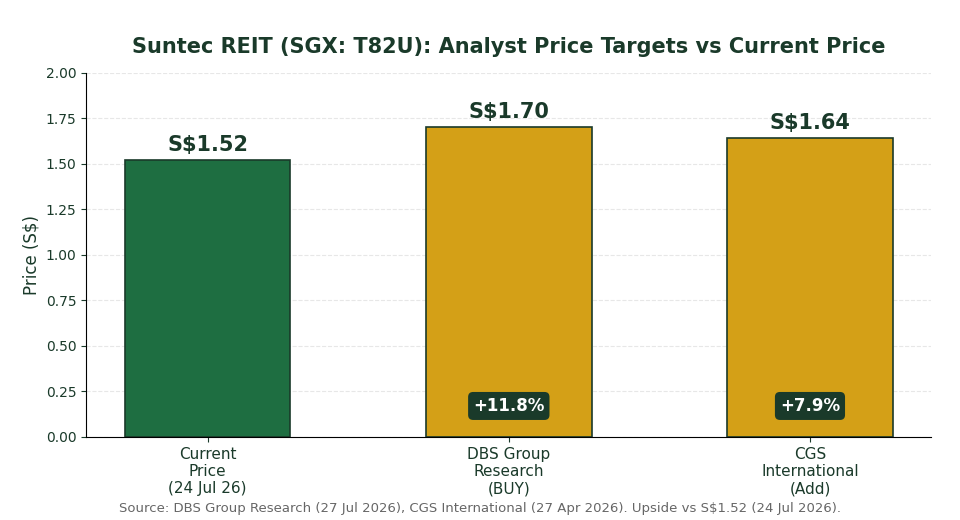
Both brokers moved in the same direction: up. DBS raised its call after 1H2026 results came in ahead of expectations. CGS International raised its target back in April after 1Q2026 already showed the same trend — strong Singapore rental reversions offsetting softer overseas performance. That consistency across two separate reporting periods is more meaningful than either single data point on its own.
1H2026 Results: Why Analysts Turned Bullish
Distribution Per Unit (DPU) — basically how much cash each REIT unit pays you — rose 24.8% year-on-year to 3.936 cents in 1H2026. That’s an acceleration from the already-strong 23.9% DPU growth Suntec REIT posted in 1Q2026.
Three things drove it, according to both DBS and CGS International:
Singapore office strength. Committed occupancy hit 98.8%, with rental reversions above 9.5%. In plain English: as older, cheaper leases roll over, they’re being replaced with new leases at rents nearly 10% higher, and almost every square foot is leased out.
Suntec City Mall momentum. Occupancy at 99%, with reversions as high as 15% following an Asset Enhancement Initiative (AEI). Retail rents are catching up fast to pre-pandemic levels.
Lower financing costs and no more MIT tax drag. Suntec REIT’s overseas assets had been provisioning for extra Australian withholding tax. Confirmation of its Managed Investment Trust (MIT) status removed that drag, freeing up distributable income.
Management is guiding for continued positive reversions into FY2026 — roughly 5% for office and closer to 10% for retail. If that holds, DPU growth doesn’t need a single acquisition to keep climbing.
New Sponsor, New Strategy: Tang Organisation Takes Over
Here’s the part of the story that doesn’t show up in a DPU chart. On 17 March 2026, Tang Organisation — through its wholly owned subsidiary Acrophyte Asset Management — completed its acquisition of ESR Trust Management (Suntec), the manager of Suntec REIT. That made Tang Organisation the new sponsor, replacing ESR Group.
UOB Kay Hian’s research team flagged that the new sponsor’s real estate execution track record includes the redevelopment of 9 Penang Road in the Dhoby Ghaut precinct, which successfully secured UBS Singapore as its sole anchor office tenant — a proof point that the new manager can execute, not just collect fees.
UOB Kay Hian’s coverage has also noted Hongkong Land emerging as a competing party in the situation, adding a layer of uncertainty to how the ownership and strategic direction ultimately settle. Tang Organisation has said it will work with management on a strategic review covering capital efficiency, portfolio optimisation and asset recycling.
For unitholders, a sponsor change is neither automatically good nor bad — it’s a variable that adds both opportunity (a more proactive, hands-on owner) and uncertainty (a still-unsettled ownership situation) to the investment case.
The Leverage Story: Why Divestments Matter Now
This is the number that should temper any excitement from the DPU headlines. Suntec REIT’s aggregate leverage (gearing) climbed from 41.6% in 1Q2026 to 43% by 1H2026, according to CGS International and DBS respectively.
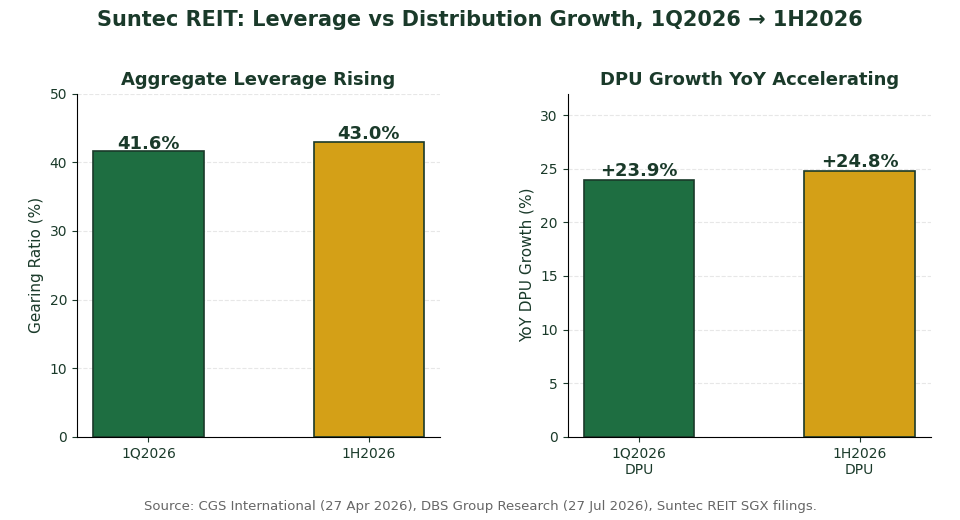
At 43%, Suntec REIT sits at the higher end of the S-REIT peer range. MAS caps aggregate leverage for S-REITs at 50%, so there’s still headroom — but less than most of the diversified-commercial peers you’d compare it against.
DBS specifically called out a low interest-rate hedging ratio of around 57% as a related risk: with over 40% of its debt unhedged, Suntec REIT is more exposed than most S-REITs to further rate moves, particularly on its overseas Australian and UK borrowings.
That’s exactly why UOB Kay Hian titled its latest report “Divestment Gains Importance With Uptick In Leverage.” The bull case doesn’t just need rental reversions to keep going — it needs Suntec REIT to actually execute on asset recycling (selling non-core assets to pay down debt) rather than just discussing it as a strategic option.
Suntec REIT Portfolio Snapshot
Suntec REIT isn’t a pure office play or a pure retail play — it’s a diversified mix across Singapore, Australia and the UK, with the Singapore assets doing most of the heavy lifting right now.
| Segment | Key Assets | 1H2026 Signal |
|---|---|---|
| Singapore Office | Suntec City Office, One Raffles Quay (33.3% stake), MBFC (33.3% stake) | 98.8% occupancy, +9.5% reversion |
| Singapore Retail | Suntec City Mall (post-AEI) | 99% occupancy, up to +15% reversion |
| Convention & Exhibition | Suntec Singapore Convention & Exhibition Centre | Stable, event-driven income |
| Australia | Office assets in Sydney & Melbourne | MIT status confirmed — removes withholding tax drag |
| United Kingdom | Central London office exposure | Gradual improvement, occupancy still a watch item |
Source: DBS Group Research (27 Jul 2026), CGS International (27 Apr 2026), SGX company filings.
The pattern is clear: Singapore is carrying the REIT right now, while Australia and the UK are still works in progress. That’s also exactly where any future divestment activity is most likely to be aimed — trimming the harder-to-manage overseas exposure to fund debt paydown or reinvestment closer to home.
Risks to the Bull Case
No REIT is a one-way bet, and Suntec REIT has a few specific risks worth weighing before you buy in at today’s price.
Leverage is the headline risk. At 43% gearing with a ~57% interest-rate hedge ratio, Suntec REIT is more sensitive to rate surprises than most large-cap S-REITs. If global rates move higher than expected, financing costs on the unhedged portion rise immediately.
Ownership uncertainty isn’t fully resolved. With Tang Organisation newly installed as sponsor and Hongkong Land reportedly in the picture, the strategic direction — and pace of any promised divestments — is still being worked out. Strategy pivots take time to show up in unit price.
Overseas assets remain a drag, not a driver. Australia and UK occupancy are described as “gradually improving,” which is analyst-speak for “not yet where management wants it.” If Singapore’s momentum slows before overseas catches up, DPU growth could stall.
Valuations already reflect some optimism. A ~0.7x price-to-book ratio (per DBS) is cheap in isolation, but Suntec REIT has traded at a discount to book for years. It’s a value trap risk if the growth story doesn’t keep delivering.
Our Verdict
Two brokers, two separate reporting periods, both landed in the same place: raise the target, keep a BUY/Add rating. That consistency — not any single price target — is the strongest signal here. When analysts are upgrading through consecutive quarters rather than downgrading, it usually means the underlying operating momentum is real, not a one-off beat.
That said, the S$1.64–S$1.70 target range implies single-digit-to-low-double-digit upside from current levels, not a multi-bagger setup. You’re being asked to underwrite a turnaround story that’s already partly priced in, with leverage as the main thing that could derail it.
If you already hold Suntec REIT, the 1H2026 results and both brokers’ updated targets are reasons for cautious optimism, not reasons to exit. If you’re considering a new position, the leverage trend and the still-unsettled sponsor situation are worth watching for another quarter or two before sizing up meaningfully. For income-focused investors comparing options across the sector, it’s worth checking Suntec REIT against the broader field in our best S-REITs in Singapore 2026 roundup.
For the full 1H2026 numbers behind this update, see our Suntec REIT 1H2026 results deep-dive, and for a broader look at the REIT’s history and portfolio, our Suntec REIT investor guide covers the fundamentals in more depth.
Fitting Suntec REIT Into Your Portfolio
S-REIT income is only one leg of a Singapore retirement plan. If you’re building out a broader passive-income strategy, our passive income Singapore guide walks through how REIT dividends compare against other income sources. If you’re using CPF funds to invest, our CPF investment strategy guide covers what’s eligible and how to think about risk inside CPFIS.
You can also plug Suntec REIT’s projected distributions into our free Singapore retirement calculator to see how a REIT-heavy income sleeve affects your overall retirement timeline.
Want to start or top up a brokerage account to trade S-REITs directly? Compare fees and platforms through our Syfe referral code and sign-up bonus page before opening an account.
Frequently Asked Questions
What is Suntec REIT's share price target for 2026?
DBS Group Research has a BUY rating with a S$1.70 target price (27 Jul 2026), while CGS International rates it Add at S$1.64 (27 Apr 2026). Both targets imply upside of roughly 8–12% from Suntec REIT’s S$1.52 price as at 24 July 2026.
Is Suntec REIT a buy in 2026?
Both DBS and CGS International rate Suntec REIT a BUY/Add as at their latest reports. The bull case rests on accelerating DPU growth and near-full Singapore occupancy, while the main risk flagged by both brokers is rising leverage (43% as at 1H2026).
What was Suntec REIT's DPU in 1H2026?
Suntec REIT’s 1H2026 DPU was 3.936 cents, up 24.8% year-on-year, driven mainly by stronger Singapore office and retail performance plus lower financing costs.
Who is Suntec REIT's new sponsor?
Tang Organisation, through its subsidiary Acrophyte Asset Management, completed its acquisition of ESR Trust Management (Suntec) — the REIT’s manager — on 17 March 2026, replacing ESR Group as sponsor.
Why did Suntec REIT's gearing ratio increase?
Aggregate leverage rose from 41.6% in 1Q2026 to 43% in 1H2026, according to CGS International and DBS. This is why analysts are watching whether Suntec REIT follows through on planned asset divestments to bring leverage back down.
What is Suntec REIT's dividend yield?
DBS projects a distribution yield of approximately 5.3% for FY2026, based on its forecast distributable income and target price assumptions. Actual yield will vary with the unit price you pay.
What assets does Suntec REIT own?
Suntec REIT’s portfolio spans Singapore office (Suntec City Office, stakes in One Raffles Quay and Marina Bay Financial Centre), Singapore retail (Suntec City Mall), the Suntec Singapore Convention & Exhibition Centre, and office assets in Australia and the United Kingdom.
Is Suntec REIT's high leverage a serious risk?
At 43% gearing, Suntec REIT is below the MAS regulatory cap of 50% but at the higher end of the S-REIT peer range. Combined with a relatively low ~57% interest-rate hedging ratio, it makes the counter more sensitive to interest rate surprises than many peers — a key reason both brokers flag divestments as important going forward.
Ready to Build Your S-REIT Income Portfolio?
Open a brokerage account and start investing in S-REITs like Suntec REIT today.
This article was researched with the help of AI. While we strive to keep all information accurate and up to date, there may be errors. If you notice any discrepancies, please contact us.