How to Invest in Singapore When the Market Crashes: A Practical Survival Guide (2026)
Real STI crash data, a 5-step playbook, and why panic-selling is the single costliest investing mistake you can make.
Table of Contents
Contents -- Click to expand
Markets crash. The Straits Times Index has fallen more than 30% at least twice since 2008, and it will happen again. The single biggest driver of investor losses isn’t the crash itself — it’s panic-selling near the bottom. This guide covers what actually happens to your portfolio during a Singapore market crash, and the exact steps to take, and avoid, when it happens.
Not financial advice. All figures are for educational reference only. Historical STI data verified as at 25 July 2026 against publicly reported market data; illustrative portfolio examples are simplified estimates, not actual historical STI total returns.
- The STI has fallen more than 30% twice since 2008 — the 2008/09 Global Financial Crisis and the 2020 COVID crash — and it eventually recovered both times.
- Panic-selling during a crash locks in your losses permanently. Staying invested, or buying more, is what actually built wealth for long-term Singapore investors.
- Your CPF Ordinary Account keeps earning a guaranteed 2.5% no matter what the stock market does. Use it as your psychological anchor when everything else looks red.
Why Every Singapore Investor Needs a Crash Plan
As at 20 July 2026, the Straits Times Index sits near an all-time closing high of around 5,521 points, up close to 33% over the past year. That’s exactly when a crash plan matters most, not when the next one arrives.
If you only started investing in Singapore after 2020, you may never have lived through a real, sustained downturn. Markets have mostly gone up. That’s a problem, because how you’re going to react to a 20% or 30% drop is much easier to plan calmly today than to figure out in the middle of a panic, when every headline says the world is ending.
Downturns aren’t a risk you can diversify away entirely. They’re a recurring, structural part of investing in any stock market, including Singapore’s. What separates investors who come out ahead from those who don’t usually isn’t stock-picking skill. It’s whether they had a plan for the crash before it happened, and whether they stuck to it.
This matters even more if you’re building your portfolio through a beginner investing plan for Singapore or figuring out your personal risk profile — because your real risk tolerance is only tested when your portfolio is actually falling, not when you’re filling out a questionnaire.
How Bad Can It Get? Singapore’s Worst Market Crashes
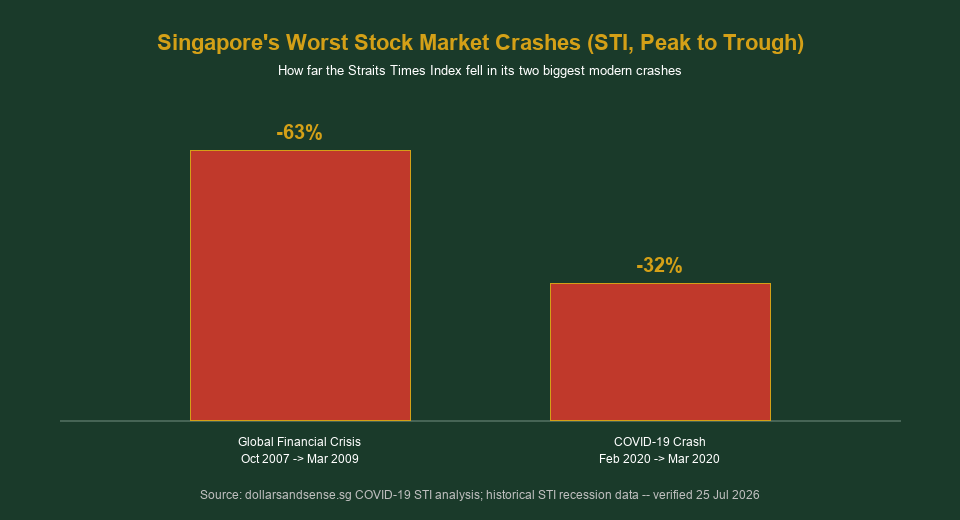
The Straits Times Index has fallen sharply on two major occasions since 2008. Knowing the actual scale, not the headline panic, helps you calibrate how bad “bad” really looks.
During the Global Financial Crisis, the STI peaked near 3,906 points in October 2007 and bottomed around 1,455 points in March 2009 — a decline of roughly 63%, one of the steepest drawdowns in the index’s history. Recovery took years, not months.
During the COVID-19 crash, the STI fell around 32% from its six-month high in a matter of weeks, with the sharpest single-day fall coming on 10 March 2020, when the index dropped 6% in a single session — its worst one-day move since October 2008. Unlike the GFC, this crash was followed by a comparatively faster rebound as markets absorbed the shock and central banks stepped in with support.
| Crash | Peak | Trough | STI Decline |
|---|---|---|---|
| Global Financial Crisis | ~3,906 pts (Oct 2007) | ~1,455 pts (Mar 2009) | ~63% |
| COVID-19 Crash | 6-month high (early 2020) | 23 Mar 2020 | ~32% |
Source: dollarsandsense.sg COVID-19 STI analysis; publicly reported historical STI index levels — figures rounded, verified 25 July 2026.
The lesson isn’t that a crash of this size is likely every year — it isn’t. It’s that when a real one arrives, a 25-35% drop is well within normal historical range for Singapore equities, not some unprecedented catastrophe. Planning around that range, rather than being blindsided by it, is the entire point of this guide.
The Real Cost of Panic-Selling
A crash only becomes a permanent loss the moment you sell. Before that, a 30% drop on paper is uncomfortable, but it’s not final — your units, or shares, are still sitting in your account, still owned by you, still able to recover.
Selling at the bottom does two things at once: it locks in the loss for real, and it takes you out of the market right before the recovery usually begins. The sharpest rebound days in market history tend to cluster in the weeks right after the worst days — which means investors who panic-sell during the crash often also miss the fastest part of the bounce-back, because by the time it feels “safe” to buy back in, much of the recovery has already happened.
That’s the uncomfortable math of drawdowns: losses and the gains needed to reverse them aren’t symmetrical. The deeper the fall, the harder the climb back. This is precisely why staying invested through the fall, rather than selling in and buying back later, matters so much.
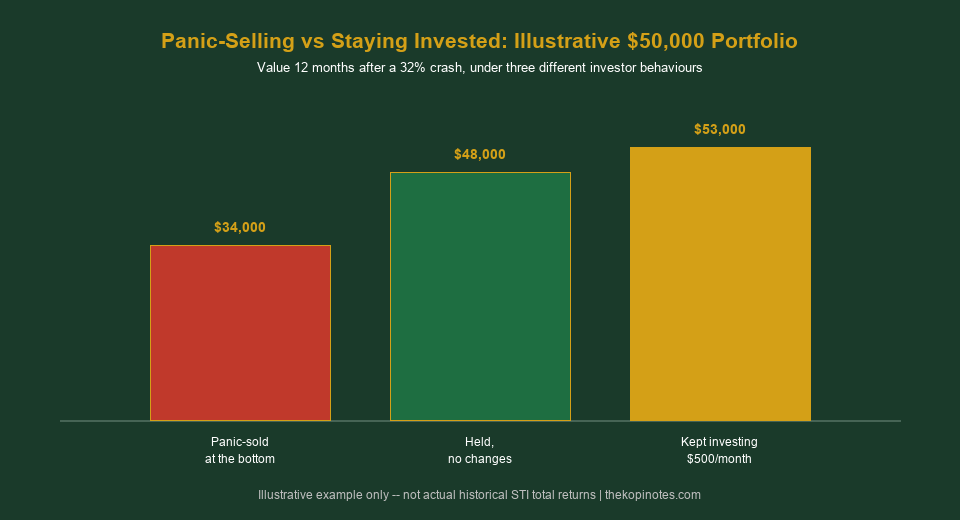
| Investor | Action During the Crash | Illustrative Value 12 Months Later* |
|---|---|---|
| Investor A | Panic-sold near the bottom, stayed in cash | ~$34,000 |
| Investor B | Held the existing portfolio, made no changes | ~$48,000 |
| Investor C | Kept investing $500/month through the dip | ~$53,000 |
*Illustrative example only, starting from a $50,000 portfolio and a ~32% crash. Not actual historical STI total returns — simplified for teaching purposes.
Investor A’s loss is the only one that became permanent, purely because of the decision to sell. Investor C came out ahead of Investor B for one simple reason: buying more units while prices were down, then benefiting when those units recovered in value too.
Your 5-Step Market Crash Playbook
Here’s what to actually do, in order, when your portfolio is down sharply and every headline is telling you to panic.
1. Check your emergency fund, not your portfolio. If you have 3-6 months of essential expenses set aside somewhere safe, like a T-bill or fixed deposit, you don’t need to touch your invested money at all during a downturn. That buffer is the entire reason you built it.
2. Stop checking your portfolio daily. Watching a falling balance in real time makes emotional decisions far more likely. Checking in monthly, or even quarterly, during a crash isn’t burying your head in the sand — it’s removing a trigger for panic.
3. Keep your recurring investments running. If you have a monthly RSP or robo-advisor contribution set up, don’t pause it. A crash is exactly when your fixed dollar amount buys you the most units. Pausing contributions during a downturn is one of the most common ways SG investors accidentally sabotage their own long-term returns.
4. Don’t try to call the exact bottom. Waiting for “the bottom” before buying back in sounds smart, but nobody — including professional fund managers — reliably calls it in real time. Time in the market has consistently mattered more than timing the market for long-term SG investors.
5. Write your plan down now, while markets are calm. Decide today what you’ll do if your portfolio falls 20%, 30%, or 40% — for example, “I will not sell, and I will continue my monthly contribution.” A plan written in advance is far easier to follow than a decision made in the middle of a panic.
Why Your CPF Is a Behavioural Anchor, Not Just a Retirement Account
One underrated reason Singapore investors can afford to stay calmer than most during a crash: a large part of most people’s retirement savings isn’t in the stock market at all.
Your CPF Ordinary Account (OA) earns a guaranteed minimum interest rate of 2.5% per year, set by law as a floor, according to the CPF Board’s official interest rate page. Your Special, MediSave and Retirement Account monies earn an even higher guaranteed floor of 4% per year, extended by the government through 31 December 2026. Neither of these rates moves when the STI falls 30%.
That’s a real, guaranteed floor sitting underneath your total net worth, completely untouched by a stock market crash. It won’t replace the growth potential of equities over the long run, but it’s a useful psychological anchor: even in the worst month of a crash, a meaningful chunk of your retirement savings didn’t lose a single dollar. For a deeper look at balancing CPF against your invested portfolio, see our CPF investment strategy guide.
Should You Keep Dollar-Cost Averaging During a Crash?
In almost every case, yes. Dollar-cost averaging (DCA) means investing a fixed dollar amount on a regular schedule, regardless of what the market is doing. During a crash, that fixed amount buys more units, because prices are lower — which is exactly the mechanism that helped Investor C in the earlier example come out ahead.
Robo-advisors like Syfe support recurring monthly investments from as little as $10, and fund platforms like FSMOne offer a Regular Savings Plan (RSP) from $50 a month, letting you keep this habit running automatically without needing to manually “decide” to buy during a scary week. If you’re only just starting out and wondering what a reasonable starting amount looks like, our guide to minimum investment amounts in Singapore breaks down exact figures by platform.
The one exception: if a crash coincides with a genuine emergency, like job loss, pause contributions to protect your cash flow, not because the market looks scary. The goal is never to invest money you’ll need in the next 3-5 years, crash or no crash.
When (and How) to Rebalance After a Crash
Rebalancing means bringing your portfolio back to its original target mix — for example, 70% equities and 30% bonds — after market moves have pushed it out of line. A crash can quietly shift your allocation to be more conservative than you intended, simply because your equity portion fell in value while your bond or cash portion didn’t.
Don’t rebalance in the middle of the panic itself — wait for some signs of stabilisation, typically once volatility has meaningfully calmed down, rather than trying to catch the exact bottom. Rebalancing is a discipline, not a market-timing tool: you’re restoring your intended risk level, not trying to predict what happens next.
How aggressively you rebalance should match your risk profile, not what feels emotionally satisfying in the moment. If you haven’t worked out your risk tolerance yet, our risk profile guide for Singapore investors is a useful starting point before your next crash, not during it.
3 Mistakes Singapore Investors Make During Downturns
Mistake 1: Selling everything and waiting for “certainty”. Certainty never arrives before a recovery — by the time a crash feels obviously over, prices have usually already moved up significantly. Waiting for a green light that never comes is how investors miss the rebound entirely.
Mistake 2: Raiding the emergency fund instead of the plan. Some investors dip into cash reserves meant for emergencies to “buy the dip” more aggressively, leaving themselves exposed if a real emergency, like job loss, follows the market downturn. Keep the two goals separate.
Mistake 3: Comparing your portfolio to a friend’s “lucky” timing. Someone who happened to buy right at a bottom got lucky, not skilled — it’s not a repeatable strategy. Chasing that outcome by trying to time future crashes usually costs more in missed growth than it ever gains.
If you’re still building the fundamentals of a long-term plan, it’s worth revisiting the right order to invest across CPF, SRS and cash — getting the structure right before a crash hits makes it far easier to stay disciplined when one does.
Ready to Build a Portfolio That Can Handle a Crash?
Open an account and use these referral codes for sign-up perks on your first qualifying deposit.
Frequently Asked Questions
What should I do with my Singapore investments during a market crash?
Avoid selling in a panic, keep any recurring monthly investments running, and rely on an emergency fund rather than your invested portfolio for near-term cash needs. Historically, Singapore’s STI has recovered from every major crash, though the timeline has varied significantly.
Should I sell my stocks when the STI crashes?
Generally no, unless you need that specific money within the next few years. Selling during a crash converts a temporary paper loss into a permanent, realised one, and also risks missing the recovery that historically follows.
How long does it take for the Singapore stock market to recover after a crash?
It varies widely by crash. The COVID-19 crash saw a comparatively faster rebound within roughly a year, while recovery from the 2008/09 Global Financial Crisis took considerably longer. There’s no fixed timeline, which is exactly why staying invested rather than trying to time re-entry matters.
Is my CPF Ordinary Account safe during a stock market crash?
Yes. CPF OA savings earn a guaranteed minimum interest rate of 2.5% per year set by the CPF Board, unaffected by stock market movements. Special, MediSave and Retirement Account savings carry an even higher guaranteed floor of 4% per year, extended through 31 December 2026.
Should I keep dollar-cost averaging during a market downturn?
In most cases, yes. A fixed monthly investment buys more units when prices are lower, which is one of the main mechanisms that helps long-term investors benefit from a downturn rather than just endure it. Pause only if you face a genuine cash-flow emergency, not because of market headlines.
How do I know when to start investing again after a crash?
If you’re already invested and following a plan, there’s no need to “start again” — staying invested and continuing contributions is the strategy. If you’re on the sidelines, waiting for a confirmed bottom usually means missing much of the recovery; a gradual re-entry on a fixed schedule is generally more reliable than trying to time it perfectly.
Not financial advice. Historical STI figures verified as at 25 July 2026 against publicly reported market data and CPF Board official sources; illustrative portfolio examples are simplified estimates for educational purposes only and are subject to change. The Kopi Notes may earn referral fees when you sign up using our codes.
This article was researched with the help of AI. While we strive to keep all information accurate and up to date, there may be errors. If you notice any discrepancies, please contact us.