Manulife US REIT 2026 (SGX: BTOU): Why the Dividend Is Still Frozen
July 2026 | S-REITs | Manulife US REIT Deep Dive
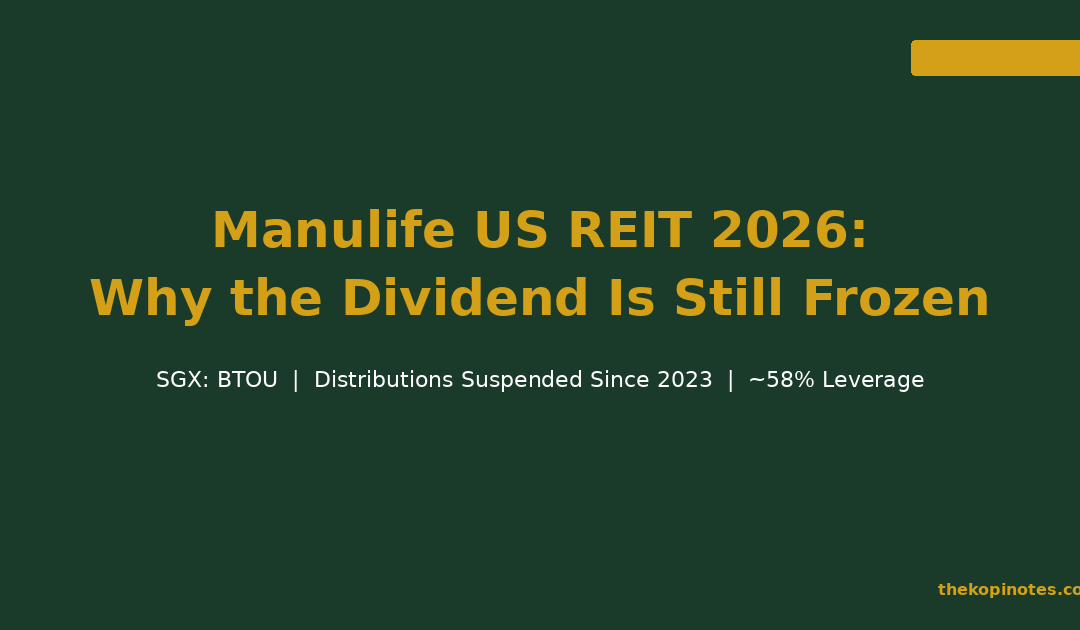
Manulife US REIT (SGX: BTOU) has not paid a distribution since 2023. Its lenders forced a restructuring deal, aggregate leverage sits around 58% — above MAS’s 50% limit but covered by a devaluation waiver — and unitholders just approved a pivot away from pure US office into industrial, multifamily and retail assets across the US and Canada.
Not financial advice. All figures are for educational reference only. Data as at July 2026 unless noted.
- Distributions have been suspended since 2023 and stay frozen until MUST meets its lenders’ conditions, including an interest coverage ratio above 1.5x
- Aggregate leverage is around 58%, above MAS’s 50% cap — but a devaluation waiver, not a breach, applies while the Manager is barred from taking on new debt
- MUST has repaid roughly US$389 million of debt since November 2024 through asset sales, and is now diversifying beyond US office
What Is Manulife US REIT?
Manulife US REIT (MUST) listed on the SGX in 2016. It was the first pure-play US office REIT listed in Asia, giving Singapore investors direct access to Class A office towers in cities like Los Angeles, Atlanta, and Washington DC.
That pitch worked well for a few years. Then remote work, rising US interest rates, and a brutal office-vacancy cycle hit at the same time. Office values across the US fell sharply, and MUST’s borrowing costs climbed just as its rental income came under pressure.
By 2023, the REIT’s lenders stepped in. Distributions were suspended, and MUST entered a Master Restructuring Agreement (MRA) — a formal deal that trades unitholder income for breathing room to sell assets and pay down debt.
| Key Metric | Value (July 2026) |
|---|---|
| SGX Ticker | BTOU (USD-denominated) |
| Listed | 2016 — first pure-play US office REIT in Asia |
| Portfolio | 7 office properties, ~3.5 million sq ft NLA (as at 31 Mar 2026) |
| Distribution Status | Suspended since 2023 |
| Unit Price (approx.) | ~US$0.05 (52-week range US$0.05–US$0.09) |
| Market Cap (approx.) | ~US$91 million |
Source: Manulife US REIT SGX filings; Google Finance, July 2026.
That last row is worth sitting with. A REIT that once held a multi-billion-dollar portfolio now trades with a market cap under US$100 million. This is a cautionary tale as much as an investment case — which is exactly why it deserves a clear-eyed look.
Why Distributions Are Still Suspended
Here’s the short version: MUST’s lenders control the payout switch, not the REIT manager.
Under the Master Restructuring Agreement, distributions stay frozen until MUST satisfies a set of lender conditions. The most important one is the interest coverage ratio (ICR) — basically how many times over the REIT’s rental income can cover its interest bill. Lenders require this above 1.5 times before they’ll even consider letting payouts resume.
To put a number on what’s at stake: had a certain property sale been completed by end-2025, MUST’s pro forma DPU (Distribution Per Unit — the REIT version of a dividend) would have worked out to just 1.33 US cents. That’s not a typo. It shows how far the payout has fallen from MUST’s pre-2023 levels, even in a hypothetical “if distributions resumed today” scenario.
Meanwhile, the REIT’s fundamentals kept sliding. FY2025 gross revenue fell 32% year-on-year to US$113.9 million, as office leases rolled off and tenants downsized or left. That kind of revenue drop is one of the sharpest you’ll see among SGX-listed REITs.
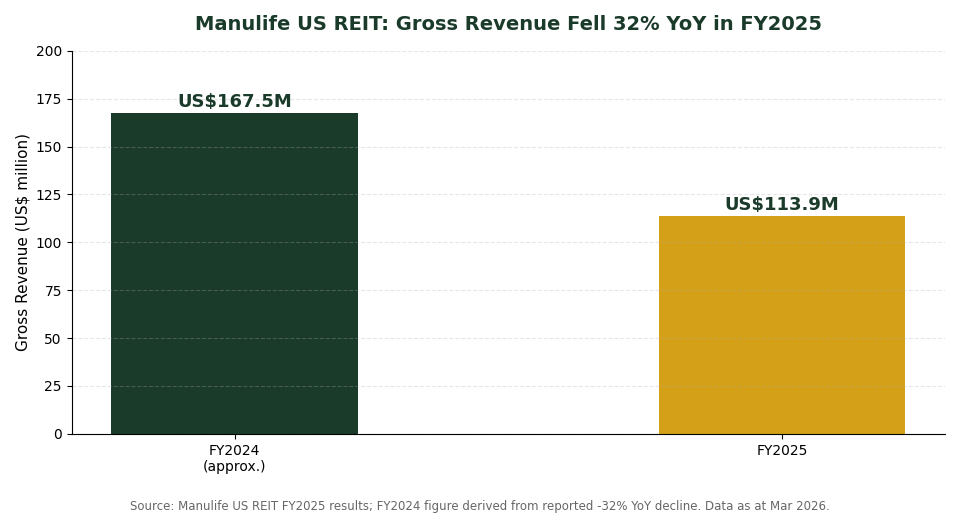
For context, even quality office REITs elsewhere have not seen revenue fall this fast. This is the core reason lenders are unwilling to let cash leave the building until the balance sheet is repaired.
MUST’s 1H2026 results briefing is scheduled for 6 August 2026 — a date worth marking if you’re tracking whether the suspension shows any signs of easing.
The Aggregate Leverage Problem
Since 28 November 2024, the Monetary Authority of Singapore (MAS) applies one uniform rule to every S-REIT: a maximum aggregate leverage of 50%, alongside a minimum interest coverage ratio of 1.5 times. This replaced the old two-tier system where REITs could gear up to 50% only if their ICR cleared a higher 2.5x bar.
MUST’s aggregate leverage sat at roughly 58% at the end of 2025 — well above that 50% ceiling.
| Metric | Figure | MAS Requirement |
|---|---|---|
| Aggregate Leverage (Dec 2025) | ~58% | Max 50% |
| Pro Forma Leverage (post-Figueroa sale) | ~55.4% | Max 50% |
| Interest Coverage Ratio Covenant | Relaxed to 1.5x until 31 Dec 2026 | Min 1.5x |
Source: Manulife US REIT SGX filings, MAS Property Funds Appendix, July 2026.
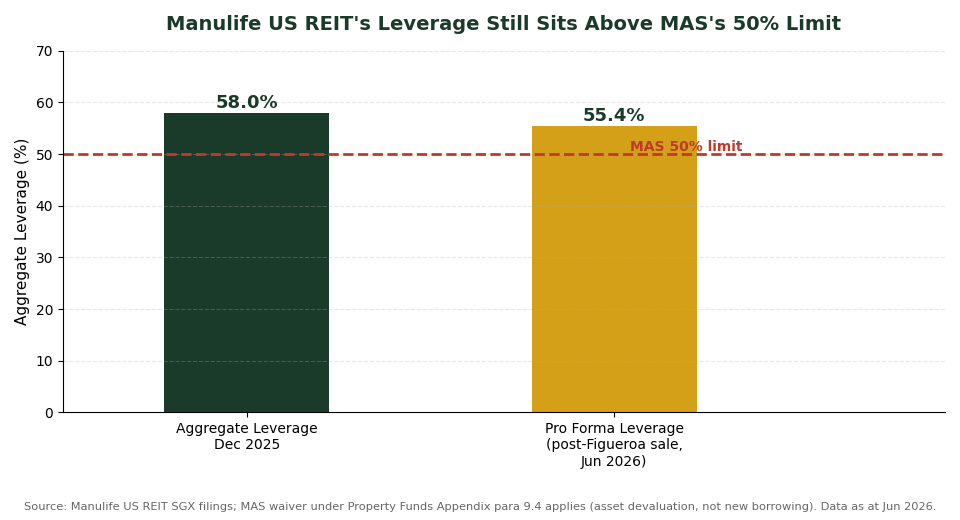
Here’s the nuance that most headlines miss: MUST is not technically in breach of the 50% limit. Under paragraph 9.4 of MAS’s Property Funds Appendix, exceeding the leverage limit doesn’t count as a breach if it happened because of asset devaluation — circumstances beyond the Manager’s control — rather than new borrowing. Since MUST’s leverage climbed because its US office properties lost value, not because it borrowed more, MAS granted a waiver.
That waiver comes with a catch: the Manager cannot take on additional borrowings or new deferred payment arrangements while leverage stays above 50%. In practice, that locks MUST out of using debt to fund the very acquisitions its diversification strategy will eventually need — reinforcing why asset sales, not fresh borrowing, are doing all the heavy lifting right now.
Debt Paydown & Asset Sale Progress
To its credit, MUST’s management has made real progress on the one lever it fully controls: selling assets and using the proceeds to retire debt.
In June 2026, MUST completed the sale of Figueroa, a 35-storey Grade A office tower in downtown Los Angeles, for US$92.5 million. Net proceeds of roughly US$82 million went straight toward retiring 2026 debt maturities and chipping away at 2027 obligations.
That Figueroa sale — together with earlier divestments — pushed MUST past its Minimum Sale Target of US$328.7 million under the MRA. Clearing that threshold matters because it’s one of the key conditions for MUST to eventually exit the restructuring agreement altogether.
Since November 2024, MUST has repaid about US$316.7 million of debt largely through asset sales and balance sheet cash. Counting earlier disposals too, cumulative debt repayment reaches roughly US$389 million — a meaningful dent, even if the REIT still has a long runway back to compliance.
The trade-off is obvious: every property sold is a smaller REIT, with a shrinking asset base to eventually generate distributable income from. This is the tension at the heart of any distressed-REIT recovery story — you have to shrink to survive before you can grow again.
The 2026 Diversification Pivot
In April 2026, MUST’s Manager put a bold plan to unitholders: stop being a pure US office REIT. At the AGM, unitholders approved a mandate letting MUST acquire industrial, multifamily (residential/”living”) and retail assets — and, for the first time, properties in Canada as well as the US.
The logic is straightforward. US office demand faces structural headwinds that may not fully reverse for years. Industrial and multifamily assets, by contrast, have held up far better through the same rate cycle. Diversifying away from office reduces MUST’s dependence on a single, currently out-of-favour property type.
There’s a catch built into the new acquisition mandate, though: any new acquisition must carry an interest coverage ratio of at least 1.6 times so long as MUST’s aggregate leverage stays above 50%. Given where leverage sits today, that’s a high bar — it likely limits MUST to smaller, conservatively-financed deals in the near term rather than transformative ones.
Realistically, this pivot is a multi-year project. Don’t expect a fully diversified portfolio by the 1H2026 results in August — expect a gradual shift as offices continue to be sold and new sectors are added in size that leverage covenants allow.
How MUST Compares to Other US REITs on SGX
MUST isn’t the only SGX-listed REIT with US property exposure — but it is, by far, the most distressed. Here’s how it stacks up against its closest peers.
| REIT | Ticker | Sector | Distribution Status | Verdict |
|---|---|---|---|---|
| Manulife US REIT | BTOU | US Office (diversifying) | Suspended since 2023 | ⚠️ Survival mode, not a yield play |
| Prime US REIT | OXMU | US Office | Resumed, DPU recovering | ⚠️ Still occupancy-recovery dependent |
| United Hampshire US REIT | ODBU | US Grocery-Anchored Retail & Self-Storage | Paying, ~8.8% yield | ✅ Most stable of the three |
Source: SGX filings, company announcements, July 2026. Figures approximate.
The pattern here is instructive: not all “US REIT” exposure is equal. United Hampshire US REIT‘s grocery-anchored retail and self-storage portfolio has proven far more resilient than office. Prime US REIT sits in between — it resumed distributions and occupancy is recovering, but it hasn’t escaped office-sector headwinds entirely.
MUST is the cautionary end of the spectrum. If you already own it, this comparison is a useful benchmark for how much worse its situation is than sector peers. If you’re considering buying it fresh, the same comparison should give you pause.
Is There a Recovery Case? Buy, Hold or Avoid
Let’s be direct about what MUST is right now: a distressed, deep-value speculation — not an income investment. Anyone buying it for yield today is mistaken, because there is no yield. There hasn’t been one since 2023, and there won’t be one until leverage falls meaningfully below 50% and the ICR clears 1.5x on a sustainable basis.
| Investor Type | Verdict | Reasoning |
|---|---|---|
| Income/dividend investor | AVOID | No distributions; reinstatement timeline is uncertain and conditional |
| Existing unitholder | HOLD & MONITOR | Debt paydown is real progress; watch the 6 Aug 2026 results for ICR trend |
| Speculative deep-value investor | ⚠️ HIGH RISK, EYES OPEN | Turnaround is plausible but multi-year, with real dilution/write-down risk |
Not financial advice. July 2026.
The bull case: MUST has cleared its Minimum Sale Target, cut debt by roughly US$389 million since November 2024, and now has a broader acquisition mandate to diversify away from its weakest sector. If US office values stabilise and a few more sales land well, the path back to a smaller — but sustainable — distributing REIT is visible.
The bear case: the REIT is still above MAS’s leverage limit (waiver notwithstanding), can’t borrow to fund its own turnaround plan, and has already sold some of its better assets to survive. A market cap of roughly US$91 million against a portfolio that was once valued in the billions tells you how much value has already been destroyed. There is no guarantee distributions resume on any specific date — or that unitholders aren’t diluted further before they do.
If MUST’s story appeals to you as a speculative, small-position bet, treat it exactly like that — a small position, not a core passive income Singapore holding. For dependable S-REIT income today, our best S-REITs in Singapore 2026 guide is a better starting point.
Whatever you decide, run the numbers through our Singapore retirement calculator first — a speculative REIT position should never be sized as if it were a stable income asset.
Frequently Asked Questions
Why has Manulife US REIT stopped paying dividends?
Manulife US REIT’s lenders suspended distributions in 2023 after US office values fell sharply and the REIT’s leverage climbed. Under the Master Restructuring Agreement, payouts stay frozen until MUST meets specific lender conditions, including an interest coverage ratio above 1.5 times.
What is MUST's current aggregate leverage?
Aggregate leverage stood at roughly 58% at the end of 2025, improving to a pro forma 55.4% after the June 2026 Figueroa sale. Both figures are above MAS’s uniform 50% leverage limit, but a waiver applies because the increase stems from asset devaluation, not new borrowing.
Is Manulife US REIT in breach of MAS rules?
Not technically. Under paragraph 9.4 of MAS’s Property Funds Appendix, exceeding the 50% aggregate leverage limit is not considered a breach when it results from circumstances beyond the Manager’s control, such as asset devaluation. MUST obtained a waiver on this basis, though it remains barred from taking on additional borrowings while leverage stays elevated.
How much debt has Manulife US REIT repaid?
MUST has repaid approximately US$389 million of debt since November 2024, primarily through asset sales including the Figueroa office tower in Los Angeles (US$92.5 million, completed June 2026). This progress helped MUST clear its US$328.7 million Minimum Sale Target under the MRA.
What is Manulife US REIT's diversification plan?
In April 2026, unitholders approved a mandate letting MUST acquire industrial, multifamily/living, and retail properties in both the US and, for the first time, Canada — moving beyond its original pure-play US office focus. Any new acquisition must carry an interest coverage ratio of at least 1.6x while leverage stays above 50%.
When will Manulife US REIT resume distributions?
There is no confirmed date. Reinstatement depends on MUST sustainably meeting lender covenants, including the 1.5x interest coverage ratio requirement (relaxed from 2.0x until 31 December 2026) and reducing aggregate leverage well below the current ~55-58% range. MUST’s 1H2026 results briefing on 6 August 2026 is the next scheduled update.
Is Manulife US REIT a good buy in 2026?
For income-focused investors, no — there is currently no yield to collect. For speculative investors comfortable with high risk, MUST’s debt paydown progress and diversification mandate offer a plausible but multi-year turnaround story. It should only be sized as a small, speculative position, never as a core income holding.
How does Manulife US REIT compare to Prime US REIT and United Hampshire US REIT?
Manulife US REIT is the most distressed of the three SGX-listed US-exposed REITs — its distributions remain suspended, unlike Prime US REIT (resumed, recovering) and United Hampshire US REIT (paying, ~8.8% yield). United Hampshire’s grocery-anchored retail and self-storage focus has proven more resilient than office exposure across all three REITs.
What is Manulife US REIT's market capitalisation?
As at July 2026, Manulife US REIT’s market capitalisation is approximately US$91 million, with roughly 1.78 billion units outstanding trading around US$0.05 per unit. This is a fraction of its market cap at listing in 2016, reflecting the scale of value destruction from the office-sector downturn.
Disclaimer: This article is for informational and educational purposes only. It does not constitute financial advice, investment recommendations, or an offer to buy or sell any securities. Manulife US REIT is a distressed asset undergoing restructuring — its unit price and financial position may change materially and quickly. Please do your own due diligence and consider consulting a licensed financial adviser before making investment decisions. The Kopi Notes may receive referral fees from the platforms mentioned above. Sources: Manulife US REIT SGX filings and investor relations disclosures, MAS Property Funds Appendix, company announcements — all as at July 2026.
This article was researched with the help of AI. While we strive to keep all information accurate and up to date, there may be errors. If you notice any discrepancies, please contact us.