Can You Use MediSave to Pay Your Integrated Shield Plan Premium?
The 2026 Additional Withdrawal Limit (AWL) rules explained, with real premium numbers and a MediSave-vs-cash breakdown by age.
Yes, MediSave can pay your Integrated Shield Plan (ISP) premium, but only up to a limit. Your MediShield Life portion is fully MediSave-payable. The additional private insurance portion is capped by the Additional Withdrawal Limit (AWL): S$300/year if you are 40 and below, S$600 for ages 41 to 70, and S$900 for age 71 and above. Anything above that comes out of your own pocket in cash, and rider premiums cannot use MediSave at all.
Not financial advice. All figures are for educational reference only. Data verified as at 23 July 2026 against official CPF Board and MOH sources unless otherwise noted.
- MediShield Life is fully covered by MediSave. Your Shield Plan’s private component is capped at S$300 to S$900 a year, depending on your age.
- Riders — the add-on that reduces your co-payment — must always be paid in cash, even after the April 2026 rule changes.
- The older you get, the bigger the gap between what MediSave covers and what your premium actually costs. Budget for cash outlay before you retire.
Table of Contents
Contents — Click to expand
- What Is the MediSave Additional Withdrawal Limit (AWL)?
- MediSave AWL by Age in 2026
- What MediSave Can and Can’t Pay For
- Worked Example: MediSave vs Cash by Age
- Why Rider Premiums Are Cash-Only
- How the April 2026 Rider Changes Affect Your Wallet
- Using a Family Member’s MediSave
- What to Do If Your Premium Exceeds the AWL
- Frequently Asked Questions
What Is the MediSave Additional Withdrawal Limit (AWL)?
Your Integrated Shield Plan premium is actually two premiums bundled into one bill. The first part is your MediShield Life premium — the compulsory national health insurance layer everyone in Singapore has. The second part is the “additional private insurance coverage” component, sold by a private insurer like AIA, Prudential, Great Eastern, NTUC Income, or Singlife.
You can pay your MediShield Life premium fully from MediSave. No cash needed there. But the private insurance component is different. Since 2015, CPF Board has capped how much MediSave you can use for this portion each year. That cap is called the Additional Withdrawal Limit, or AWL.
Here’s why the cap exists. MediSave is meant to last you a lifetime of healthcare costs, not just this year’s insurance bill. If there were no limit, older policyholders with expensive plans could drain their MediSave on premiums alone, leaving nothing for an actual hospital stay. The AWL strikes a balance: enough MediSave to make premiums affordable, but not so much that it crowds out your future healthcare buffer.
For context on how MediSave fits into your broader healthcare savings, see our complete guide to MediSave limits and top-ups.
MediSave AWL by Age in 2026
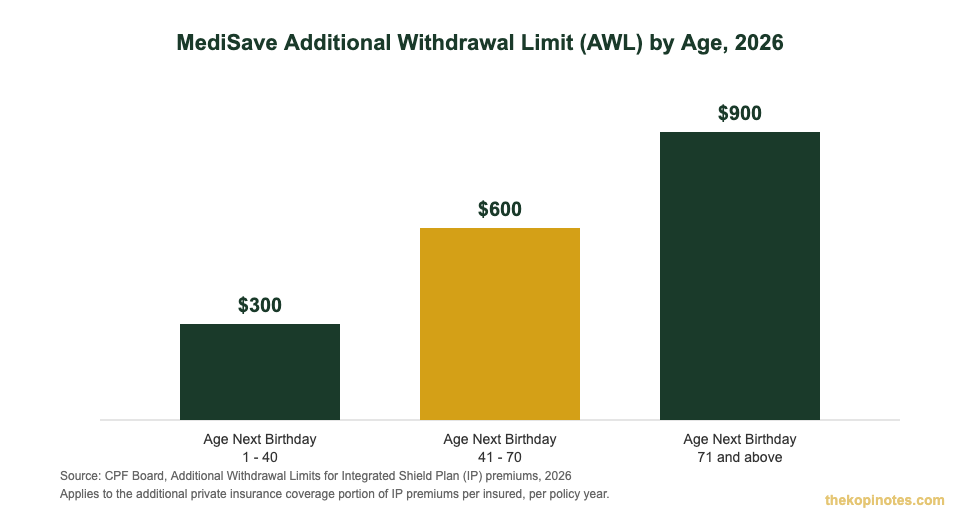
The AWL is banded by “age next birthday” — your age at your next birthday, not your current age. There are three bands, and they haven’t changed since MediShield Life launched in 2015.
| Age Next Birthday | Additional Withdrawal Limit (AWL) |
|---|---|
| 1 – 40 | S$300 per year |
| 41 – 70 | S$600 per year |
| 71 and above | S$900 per year |
Source: CPF Board, Additional Withdrawal Limits for IP premiums, 2026.
These limits apply per insured person, per policy year, to the private insurance component only. Your MediShield Life premium sits outside this cap entirely — it’s fully MediSave-payable no matter your age. Your Basic Healthcare Sum (BHS), the overall cap on how much you can hold in MediSave, is a separate figure: S$79,000 for CPF members below 65 in 2026, according to the CPF Board’s official BHS page. The AWL is not deducted from your BHS — it’s simply the annual spending cap for this specific use.
What MediSave Can and Can’t Pay For
It helps to think of your total ISP bill in three layers. Each layer has different MediSave rules.
Layer 1 — MediShield Life: Fully payable by MediSave, net of any subsidies. You never pay cash for this layer.
Layer 2 — Private insurance coverage (base plan): Payable by MediSave, but capped at your AWL. If the premium for this layer is below your AWL, MediSave covers it in full. If it’s above, you pay the difference in cash.
Layer 3 — Rider: Not MediSave-payable at all. This is a separate premium, and it must be paid in cash every time, regardless of your age or AWL.
Many Singaporeans assume “MediSave-approved plan” means the whole bill comes out of MediSave. It doesn’t. Your insurer will automatically deduct what it can from MediSave, then bill you in cash for the rest — usually via GIRO, once a year at renewal.
Worked Example: MediSave vs Cash by Age
Numbers make this clearer than rules alone. Let’s use real 2026 premium data from AIA HealthShield Gold Max Plan A, one of the more comprehensive private-hospital ISPs in Singapore. Full rates are in our AIA HealthShield Gold Max premium table.
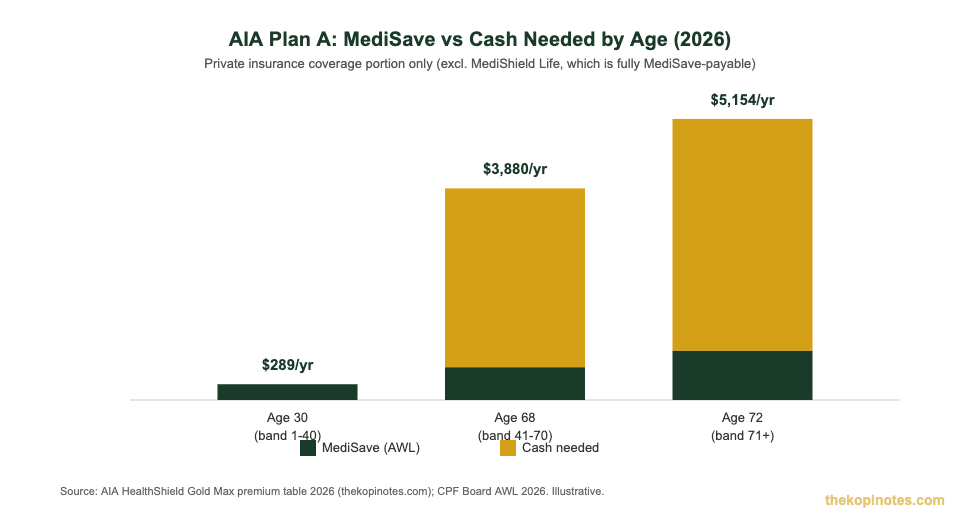
A 42-year-old policyholder (band 41–45) pays S$529.91 for MediShield Life and S$995.20 for the Plan A private component — S$1,525.11 in total. MediShield Life is fully covered. Of the S$995.20 private component, MediSave covers up to the S$600 AWL for this age band. The remaining S$395.20 is billed in cash.
| Age (AWL Band) | Plan A Private Component | MediSave Covers | Cash You Pay |
|---|---|---|---|
| 30 (band 1–40) | ~S$289/yr | S$289 (in full) | S$0 |
| 68 (band 41–70) | S$3,879.90/yr | S$600 | S$3,279.90 |
| 72 (band 71+) | S$5,153.70/yr | S$900 | S$4,253.70 |
Source: AIA HealthShield Gold Max premium table 2026; CPF Board AWL 2026. Excludes MediShield Life (fully MediSave-payable) and any rider premium (cash-only). Illustrative — actual premiums vary by insurer, gender, and smoker status.
Notice the pattern: at 30, MediSave covers your entire private component. By your late 60s and beyond, MediSave covers a shrinking fraction of a fast-rising bill. This is the single biggest blind spot in most people’s retirement healthcare planning — the AWL hasn’t moved since 2015, but premiums for older age bands have climbed steadily. If you’re mapping out how much cash buffer you’ll need in retirement, our Singapore retirement calculator can help you factor this gap in alongside your other expenses.
Why Rider Premiums Are Cash-Only
If you’ve added a rider to reduce your co-payment and deductible, you’ll notice it billed separately, always in cash. This isn’t a technical oversight — it’s deliberate policy.
Riders exist to shrink your out-of-pocket cost when you’re hospitalised. But when a rider covers almost the entire bill, including the deductible, patients and doctors have less reason to be cost-conscious. MOH found that private hospital ISP policyholders with riders were 1.4 times more likely to make a claim, with claims 1.4 times larger on average than policyholders without a rider. That drives up claims across the whole insurance pool, which then pushes premiums higher for everyone — rider or no rider.
Keeping rider premiums cash-only is meant to keep the true cost of over-insurance visible to the person paying for it. It’s a nudge, not a technicality. For more on how riders fit into your overall ISP, read our explainer on what an Integrated Shield Plan actually covers.
How the April 2026 Rider Changes Affect Your Wallet
MOH’s new rider design rules took effect on 1 April 2026, and they change the shape of your out-of-pocket cost — even though they don’t touch the MediSave rules for premiums directly.
Two things changed for new riders bought after that date. First, riders can no longer cover the MOH-set minimum deductible — you’ll always pay at least the deductible yourself before co-insurance kicks in. Second, the annual co-payment cap rose from S$3,000 to a minimum of S$6,000. In exchange, new rider premiums are roughly 30% cheaper on average than the older, more generous versions.
Here’s the part that connects back to MediSave: while your rider premium is still cash-only, the deductible and co-payment amount you owe when you actually make a claim can be paid from MediSave, subject to the prevailing hospitalisation withdrawal limits (up to S$700 per day for ward stays, separate from the AWL). So a higher co-payment cap under the new rider rules doesn’t automatically mean a bigger cash bill at claim time — MediSave still helps absorb part of it. Full details are in our breakdown of the April 2026 ISP rider rule changes.
If you bought your rider before 27 November 2025, you keep your existing terms until your first renewal after 1 April 2028 — the new rules only bite when you renew after that date.
Using a Family Member’s MediSave
You’re not limited to your own MediSave account. CPF Board allows you to use a family member’s MediSave to pay for your ISP premium, and vice versa — you can use yours to pay for theirs.
Eligible family members are your spouse, children, parents, grandparents, and siblings. Grandparents and siblings must be Singapore Citizens or PRs for this to apply. This is useful for retirees whose own MediSave balance is thin relative to their rising premiums at older ages — an adult child with a healthy MediSave balance can help cover the gap, up to that child’s own AWL for the parent’s policy.
One rule to note: each insured person can only have one MediSave-approved ISP paid via MediSave at a time, whether it’s their own MediSave or a family member’s. You can’t split a single premium across multiple people’s MediSave accounts to get around the AWL. Source: CPF Board FAQ on using MediSave for family members’ ISP premiums.
What to Do If Your Premium Exceeds the AWL
If your private insurance component costs more than your AWL — which is common once you pass your mid-40s on a Plan A or private-hospital tier — you have a few practical options.
Budget for the cash gap ahead of renewal. Your insurer will usually notify you of the total premium and how much is MediSave-payable before the GIRO deduction. Treat the cash portion as a fixed annual expense, not a surprise bill.
Consider a lower plan tier. Downgrading from a private-hospital plan to a Class A ward plan, for instance, often brings the private component back under or closer to your AWL — though this changes your ward entitlement, so weigh coverage against cost carefully. See how the major insurers stack up in our Integrated Shield Plan comparison for 2026.
Top up a family member’s MediSave. If a spouse or adult child has spare MediSave capacity and room under their own AWL, this can offset part of your cash gap — voluntary MediSave top-ups also qualify for income tax relief for the person topping up.
Don’t let the cash portion push you to drop coverage entirely. A gap of a few hundred to a few thousand dollars a year in cash is still far cheaper than an uninsured private hospital bill, which can run into six figures for serious conditions.
Disclaimer: This article is for educational purposes only and does not constitute financial, insurance, or medical advice. AWL and BHS figures are sourced from CPF Board and MOH as at July 2026 and are subject to change. Always verify current limits on cpf.gov.sg or with a licensed financial adviser before making decisions about your MediSave or Integrated Shield Plan.
Frequently Asked Questions
Can I use MediSave to pay my Integrated Shield Plan premium in 2026?
Yes. Your MediShield Life premium is fully payable by MediSave. The additional private insurance component is also MediSave-payable, but only up to your Additional Withdrawal Limit (AWL): S$300/year if you’re 40 and below, S$600 for ages 41 to 70, and S$900 for age 71 and above. Any amount above your AWL is billed to you in cash.
What is the MediSave Additional Withdrawal Limit (AWL) for 2026?
The AWL in 2026 is S$300 per year for those aged 40 and below (age next birthday), S$600 per year for ages 41 to 70, and S$900 per year for age 71 and above. These limits have been unchanged since MediShield Life launched in 2015 and apply only to the private insurance component of your ISP premium, per insured person, per policy year.
Can MediSave pay for my Integrated Shield Plan rider?
No. Rider premiums must always be paid in cash, regardless of your age or AWL. This has been the rule since MOH’s 2021 rider reform and was not changed by the April 2026 rider design updates. However, the deductible and co-payment you owe when you actually claim on your rider can be paid from MediSave, subject to the standard hospitalisation withdrawal limits.
What happens if my Shield Plan premium exceeds my MediSave AWL?
Your insurer collects the amount above your AWL in cash, typically via GIRO at your policy renewal date. This is common for older policyholders or those on private-hospital plan tiers, where the private insurance component often runs into the thousands of dollars a year, far above the S$600 or S$900 AWL.
Does the April 2026 rider change affect how much MediSave I can use for premiums?
No, the AWL for premiums is unaffected by the April 2026 changes. What changed is the rider’s coverage design: new riders can no longer cover the MOH minimum deductible, and the co-payment cap rose to a minimum of S$6,000. Rider premiums remain cash-only either way, though the deductible and co-payment you pay at claim time can still draw on MediSave within existing hospitalisation withdrawal limits.
Can I use my parents' or spouse's MediSave to pay my Shield Plan premium?
Yes. CPF Board allows you to use a family member’s MediSave — spouse, children, parents, grandparents, or siblings — to pay for your ISP premium, and they can use yours for theirs. Grandparents and siblings must be Singapore Citizens or PRs. Each insured person can only have one MediSave-approved ISP paid via MediSave at any time.
Plan Your Healthcare Cash Flow Ahead of Time
Know your MediSave limits, compare Shield Plans, and build the cash buffer you’ll need as premiums rise with age.
Get Free Insurance Advice
Speak with a licensed insurance advisor. No obligation, no cost.
By submitting this form, you agree to our Privacy Policy.
This article was researched with the help of AI. While we strive to keep all information accurate and up to date, there may be errors. If you notice any discrepancies, please contact us.