Singlife Shield Plan 3 Review 2026: Class B1 Coverage & Rider Changes
The entry-level tier of Singlife’s Integrated Shield Plan — what it covers, who can buy it, and what the April 2026 rider changes mean for your out-of-pocket costs.
Singlife Shield Plan 3 is the entry-level tier of Singlife’s Integrated Shield Plan, covering Class B1 wards at public hospitals with a S$500,000 yearly limit. It sits on top of MediShield Life, Singapore’s basic government health insurance. Only Singapore Citizens and PRs can buy it. From April 2026, new riders can no longer cover the deductible, so understanding what Plan 3 pays for matters more than ever.
Not financial advice. All figures are for educational reference only. Data verified as at 21 July 2026 against Singlife’s official product page and premium schedule, unless otherwise stated.
- Plan 3 covers Class B1 wards up to S$500,000 a year — the smallest of Singlife’s three tiers, but still well above MediShield Life alone.
- It’s only open to Singapore Citizens and PRs. Foreigners cannot apply for Plan 3, though they may qualify as dependants under Plan 1 or 2.
- From 1 April 2026, new MOH rules mean fresh riders no longer cover your deductible and carry a co-payment cap of at least S$6,000 — but they cost roughly 30% less than the old “maximum coverage” riders.
Table of Contents
What Is Singlife Shield Plan 3?
Every Singapore Citizen and PR is automatically covered by MediShield Life. It’s a basic hospitalisation plan administered by the CPF Board, and the premiums are fully payable from your MediSave account.
The catch: MediShield Life alone caps out well below what a serious hospital stay can cost. That’s where an Integrated Shield Plan (IP) comes in. An IP is a private insurer’s plan layered on top of MediShield Life, and it raises your annual claim limit and widens the ward classes you’re covered for.
Singlife Shield is Singlife’s IP. It comes in three tiers — Plan 1, Plan 2, and Plan 3. Plan 3 is the smallest and most affordable. It covers treatment at Class B1 wards in public (restructured) hospitals: 4-bed, air-conditioned rooms with a shared bathroom and television. If you’re comfortable being treated at a public hospital and don’t need a private room, Plan 3 gives you meaningfully more coverage than MediShield Life alone, at a lower premium than Plan 1 or Plan 2.
Key Facts at a Glance
| Feature | Detail |
|---|---|
| Ward Class Covered | Class B1 (4-bed, air-conditioned, restructured/public hospital) |
| Policy Year Limit | S$500,000 |
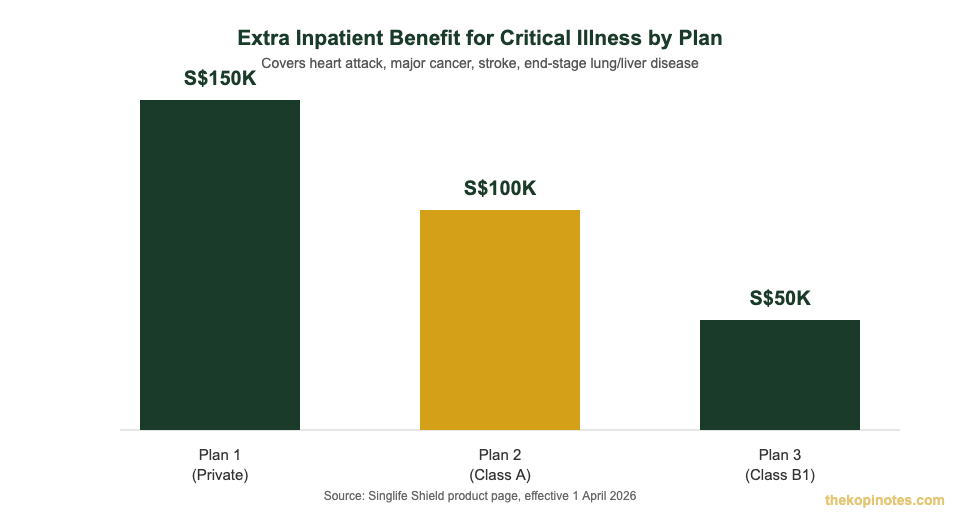
| Extra Inpatient Benefit | S$50,000 per policy year for 5 critical illnesses† |
| Pre-Hospitalisation Cover | Up to 180 days before admission |
| Post-Hospitalisation Cover | Up to 365 days after discharge |
| Eligibility | Singapore Citizens and PRs only — not open to foreigners |
| Premiums Last Revised | 1 April 2026 |
Source: Singlife Shield product page, accessed 21 July 2026. †Covers heart attack of specified severity, major cancer, stroke, end-stage lung disease, and end-stage liver disease.
Who Can Buy Plan 3?
Here’s a detail that trips people up: Plan 3 is not available to foreigners. Only Singapore Citizens and Permanent Residents can be the main policyholder.
If you’re a foreigner working in Singapore, you can still get Singlife Shield — just not Plan 3. You’d need Plan 1 or Plan 2 instead, or you may qualify for dependant cover under a Singaporean spouse’s Plan 1 or Plan 2 policy if you hold an eligible pass. This is worth checking before you assume Plan 3 is an option, especially if you’re comparing it against other insurers’ Class B1 plans that don’t carry the same restriction.
The April 2026 Rider Changes
This is the part every Integrated Shield Plan holder in Singapore needs to know about, regardless of insurer. MOH tightened the rules for IP riders — the add-ons that reduce your co-insurance and deductible — with effect from 1 April 2026.
The goal is to slow down claims growth and keep premiums sustainable across the whole industry. In practice, it means new riders are leaner than before, but also cheaper.
| Change | Before 1 Apr 2026 | From 1 Apr 2026 |
|---|---|---|
| Deductible coverage | New riders could cover your full deductible | New riders can no longer cover the minimum IP deductible |
| Co-payment cap (new riders) | Varied by insurer and plan | Raised to a minimum of S$6,000 (excludes the deductible) |
| New rider premiums | — | About 30% lower on average than the old “maximum coverage” riders |
| Riders bought before 26 Nov 2025 | — | Unaffected. Existing contract terms continue to apply |
| Riders bought 27 Nov 2025 – 31 Mar 2026 | — | Keep old terms until your policy renews on or after 1 April 2028 |
Source: MOH press release, New Requirements for Integrated Shield Plan Riders and Singlife April 2026 Shield & Health Plus update, both accessed 21 July 2026.
Deductibles for Class B1-tier IPs like Plan 3 typically fall toward the lower end of the S$1,500–S$3,500 range MOH has set across ward classes, with private-hospital plans like Plan 1 sitting at the higher end. That means if you’re hospitalised, you’ll pay the deductible out of pocket before your Health Plus rider (if you have one bought after April 2026) starts sharing the co-insurance with you, up to the new S$6,000 cap.
If you want the full breakdown of how these MOH-wide rider changes affect every insurer, not just Singlife, we’ve covered that separately in our guide to the new ISP rider rules for 2026.
Plan 3 vs Plan 2 vs Plan 1
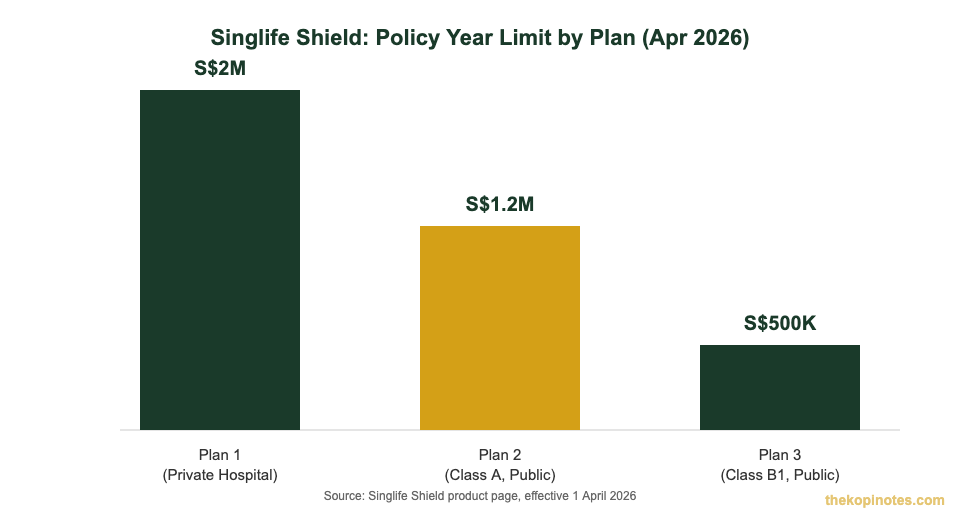
Singlife Shield’s three plans exist so you can pick the ward class and claim limit that fits your budget. Here’s how Plan 3 stacks up against the other two.
| Feature | Plan 1 | Plan 2 | Plan 3 |
|---|---|---|---|
| Ward Class | Any standard ward, private hospital | Class A, public hospital | Class B1, public hospital |
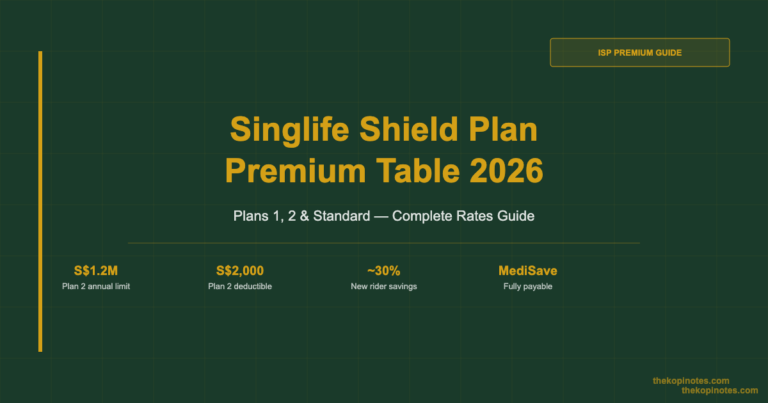
| Policy Year Limit | S$2,000,000 | S$1,200,000 (highest in the market for Class A) | S$500,000 |
| Extra Inpatient Benefit | S$150,000 | S$100,000 | S$50,000 |
| Eligibility | SC/PR, plus eligible foreign dependants | SC/PR, plus eligible foreign dependants | SC/PR only |
| Best For | Private hospital access and specialist choice | High coverage at a lower cost than Plan 1 | The lowest-cost Singlife Shield tier |
Source: Singlife Shield product page, accessed 21 July 2026.
If Class A or private-hospital access matters to you, our Singlife Shield Plan 2 review and Singlife Shield Plan 1 review break down those tiers in the same detail as this guide.
Singlife Health Plus: Capping Your Out-of-Pocket Cost
Plan 3 on its own still leaves you paying a deductible and a share of co-insurance. Singlife Health Plus is the optional rider that caps your total out-of-pocket cost at S$9,500 per policy year, on top of your Plan 3 coverage.
Stay claim-free and you’re rewarded for it. Singlife gives a 20% No Claims Discount on Health Plus if you haven’t made a claim (excluding MediShield Life) in your assessment period. From April 2026, there’s also a new Recovery Support benefit: up to S$20,000 over 2 years for home nursing and rehabilitation, if you hold both Singlife CareShield (Standard or Plus) and Health Plus, and you’re certified for the Severe Disability Benefit.
Remember: as explained above, riders bought from 1 April 2026 onward no longer cover your deductible. Budget for that first S$1,500–S$2,000-ish out of pocket before Health Plus kicks in on the co-insurance portion.
Paying Your Premiums with MediSave
MediShield Life, the base layer everyone has, is fully payable from MediSave. You don’t pay cash for it.
Plan 3’s additional premium (the top-up over MediShield Life) works differently. Part of it can be paid using your MediSave Additional Withdrawal Limit, and the rest is payable in cash. The exact split changes as you get older — premiums step up in age bands, and the cash-outlay portion tends to grow faster than the MediSave-payable portion once you’re past your 60s. For your exact premium at your current age, Singlife publishes a full Singlife Shield and Health Plus premium schedule (nofollow, external PDF) that’s updated each time rates change.
If you’re unsure how much MediSave you have available for this, or want to plan around your CPF balances more broadly, our guide to whether MediShield Life is compulsory covers the CPF and MediSave mechanics in more depth.
Who Should Choose Plan 3?
Plan 3 is a reasonable fit if: you’re comfortable being warded at a public hospital, you don’t need to pick your own specialist for routine admissions, and you want meaningfully more coverage than bare MediShield Life without paying Plan 1 or Plan 2 premiums. For most healthy adults without a strong preference for private care, Plan 3 plus a Health Plus rider is a sensible, budget-friendly base.
Consider Plan 2 instead if: you want Class A coverage (single or fewer-bed rooms) at public hospitals without paying private-hospital premiums — Plan 2’s S$1,200,000 limit is the highest in the market for that tier.
Consider Plan 1 instead if: you want the option of private hospitals like Gleneagles, Mount Elizabeth, or Raffles, and you’re willing to pay meaningfully higher premiums for that flexibility.
One more thing worth checking before you decide: run the maths on how much of your MediSave balance the premiums will actually draw down over the next 10–20 years, especially once you’re in your 60s and 70s when premiums rise sharply across all Integrated Shield Plans, not just Singlife’s. Our Integrated Shield Plan comparison guide is a good next stop if you want to see how Singlife Shield stacks up against AIA, Great Eastern, Prudential, and NTUC Income’s plans at the same ward tier.
Frequently Asked Questions
What is Singlife Shield Plan 3?
Singlife Shield Plan 3 is the entry-level tier of Singlife’s Integrated Shield Plan. It covers Class B1 wards at public (restructured) hospitals in Singapore, with a policy year limit of S$500,000. It sits on top of MediShield Life and is only available to Singapore Citizens and Permanent Residents.
Is Singlife Shield Plan 3 the same as MediShield Life?
No. MediShield Life is the basic government hospitalisation scheme that every Singapore Citizen and PR is automatically covered by, and its premiums are fully payable from MediSave. Singlife Shield Plan 3 is a private Integrated Shield Plan layered on top of MediShield Life, giving you a higher claim limit and defined ward-class coverage.
Can foreigners buy Singlife Shield Plan 3?
No. Plan 3 is restricted to Singapore Citizens and Permanent Residents as the main policyholder. Foreigners working in Singapore can still apply for Singlife Shield Plan 1 or Plan 2, or may qualify as a dependant under a spouse’s Plan 1 or Plan 2 policy if they hold an eligible pass.
How much does Singlife Shield Plan 3 cost?
Premiums are based on your age next birthday and step up in age bands, with the MediShield Life portion fully MediSave-payable and part of the Plan 3 top-up also claimable from your MediSave Additional Withdrawal Limit. Rates were last revised on 1 April 2026. For your exact premium by age, refer to Singlife’s official premium schedule on their website, since rates can change at renewal.
What changed for Integrated Shield Plan riders from April 2026?
From 1 April 2026, MOH’s new rules mean riders sold across all insurers, including Singlife, can no longer cover your minimum IP deductible, and the co-payment cap on new riders rose to at least S$6,000. In exchange, new rider premiums are roughly 30% cheaper on average than the old “maximum coverage” riders. If you bought your rider before 26 November 2025, your existing terms are unaffected.
Should I choose Plan 3, Plan 2, or Plan 1?
Choose Plan 3 if you’re comfortable at a public hospital’s Class B1 ward and want the lowest-cost Singlife Shield tier. Choose Plan 2 if you want Class A coverage with a higher S$1,200,000 limit. Choose Plan 1 if you want the option of private hospitals like Mount Elizabeth or Gleneagles. Your choice should balance your budget today against the premiums you’ll be paying decades from now, since all Integrated Shield Plan premiums rise with age.
Planning Your Healthcare and Retirement Budget?
See how your CPF, MediSave, and other savings fit together, and explore ways to grow your money outside CPF.
Get Free Insurance Advice
Speak with a licensed insurance advisor. No obligation, no cost.
By submitting this form, you agree to our Privacy Policy.
This article was researched with the help of AI. While we strive to keep all information accurate and up to date, there may be errors. If you notice any discrepancies, please contact us.