Hospital Insurance Singapore Comparison 2026: MediShield Life vs Integrated Shield Plans
MediShield Life, Integrated Shield Plans, and riders explained side by side — what each one costs, what Medisave covers, and how to pick the right combination.
Singapore’s hospital insurance has three layers: MediShield Life, which is compulsory and covers every Citizen and PR; an Integrated Shield Plan (ISP), an optional private upgrade for better wards and panel doctors; and an ISP rider, an optional add-on that lowers your cash outlay when you claim. MediShield Life is fully Medisave-payable. ISP premiums are Medisave-payable up to an annual limit. Riders must be paid entirely in cash.
Not financial advice. All figures are for educational reference only. Data verified as at July 2026 against CPF Board, Ministry of Health, and insurer premium tables unless otherwise noted.
- MediShield Life is compulsory and fully Medisave-payable — every Singapore Citizen and PR already has it, no application needed.
- An Integrated Shield Plan adds private hospital or higher-ward coverage. Medisave covers S$300–S$900 a year of the extra premium depending on your age; anything above that is cash.
- A rider cuts what you pay at the point of claim, but the premium is 100% cash — and since 1 April 2026, riders no longer cover your deductible and carry a minimum S$6,000 co-payment cap.
Table of Contents
Contents — Click to expand
- Singapore’s Three Layers of Hospital Insurance
- MediShield Life: The Compulsory Baseline
- Integrated Shield Plans: The Private Upgrade
- ISP Riders: What Changed in April 2026
- Medisave Withdrawal Limits Explained
- Premium Comparison: MediShield Life vs MediShield Life + ISP
- Which Combination Should You Choose?
- Frequently Asked Questions
Singapore’s Three Layers of Hospital Insurance
If you’ve ever compared hospital insurance in Singapore, you’ve probably seen three terms thrown around: MediShield Life, Integrated Shield Plan, and rider. They’re not competing products. They stack on top of each other, and each layer does a different job.
MediShield Life is the foundation. It’s a national insurance scheme run by the CPF Board and MOH. Every Singapore Citizen and Permanent Resident is automatically covered, from birth to death, with no opt-out. It pays for large hospital bills and selected outpatient treatments at public hospital subsidised rates.
An Integrated Shield Plan (ISP) is optional. It’s sold by a private insurer and “integrates” with MediShield Life to cover higher ward classes — Class A wards or private hospitals — plus a wider panel of specialists. You choose whether to buy one, and which insurer.
A rider is an optional add-on to your ISP. Your ISP alone still leaves you with a deductible and co-insurance to pay before full coverage kicks in. A rider reduces that out-of-pocket amount, usually down to a small co-payment. Riders are the most expensive layer per dollar of protection, and — this is the detail most people miss — they can only be paid in cash.
MediShield Life: The Compulsory Baseline
You don’t need to apply for MediShield Life — if you’re a Singapore Citizen or PR, you’re already covered. Premiums are billed once a year and paid automatically from your Medisave account, in full, with no annual limit on the MediShield Life portion.
Premiums rise with age, in bands. Here’s what MediShield Life costs before any Government subsidies, rebates, or means-tested support:
| Age Next Birthday | MediShield Life Premium (before subsidies) |
|---|---|
| 26–30 | S$295 |
| 41–45 | S$637 |
| 56–60 | S$903 |
| 66–70 | S$1,326 |
| 71–73 | S$1,643 |
Source: Income Insurance, IncomeShield Standard Plan premium table, effective 1 April 2026 (incorporates the official MediShield Life premium schedule). Rates include 9% GST and apply before means-tested subsidies, which can lower what most Singapore Citizens actually pay.
Because premiums are fully Medisave-payable, most people never see a cash bill for MediShield Life alone. That changes once you add an ISP.
Integrated Shield Plans: The Private Upgrade
Five insurers are approved by MOH to sell Integrated Shield Plans in Singapore: AIA, Great Eastern, Prudential, Singlife, and Income (formerly NTUC Income). Each ISP “integrates” with your MediShield Life, meaning you pay one combined premium that covers both layers — you don’t pay MediShield Life and your ISP separately.
Your ISP premium has two parts: the MediShield Life component (unlimited Medisave withdrawal) and the private insurer’s additional component (Medisave withdrawal capped by your age — more on that below). Here’s a real worked example from an official 2026 premium table: a 30-year-old on the lowest-tier ISP pays S$295 for the MediShield Life portion and S$49 for the private insurer’s additional portion — S$344 total, all payable from Medisave.
Choosing an ISP mainly means choosing a ward class: Class B1 (subsidised ward with ISP top-up), Class A (unsubsidised public hospital ward), or Private (private hospital). Moving up a ward class roughly doubles your premium at every age band, since you’re paying for a more expensive standard of room and a wider panel of doctors, not just insurance risk.
For a closer look at how the five insurers compare feature-by-feature, see the integrated shield plan comparison guide, or check individual insurer premium tables like the shield plan comparison Singapore 2026 breakdown.
ISP Riders: What Changed in April 2026
Even with an ISP, you’re not covered 100%. Two things stand between you and a fully-paid bill: the deductible (a fixed amount you pay first, once a year) and co-insurance (a percentage of the bill above the deductible). A rider is designed to absorb most or all of that.
Riders come with a catch that surprises many policyholders: they must be paid entirely in cash. MOH has barred Medisave withdrawal for rider premiums since 2021, specifically to stop rider costs from eroding retirement healthcare savings.
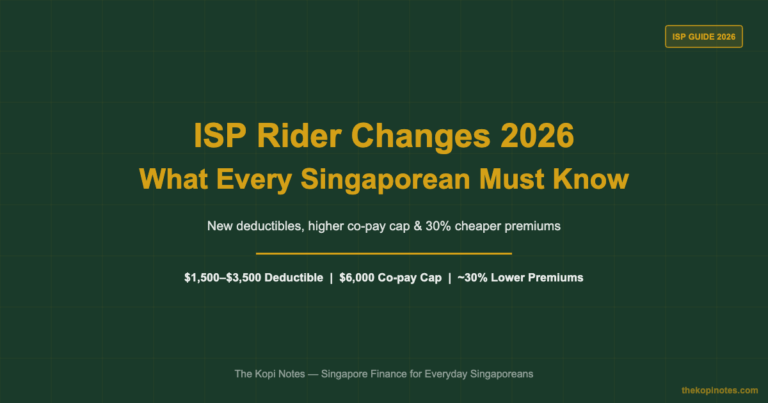
From 1 April 2026, MOH tightened the rules further. Under the new ISP rider rules for 2026, newly sold riders can no longer cover your deductible at all, and every policyholder must bear a minimum 5% co-payment on their bill, with the co-payment cap raised from S$3,000 to at least S$6,000. In exchange, MOH expects the new riders to be about 30% cheaper than the old maximum-coverage riders they replace — an estimated average saving of S$600 a year for private hospital rider holders and S$200 a year for public hospital rider holders.
Full details of the reform are in the MOH official Integrated Shield Plan rider framework announcement (moh.gov.sg).
The trade-off is real: lower premium, but a bigger bill if you’re hospitalised. Whether that trade-off makes sense for you depends on how much emergency cash you can access without stress.
Medisave Withdrawal Limits Explained
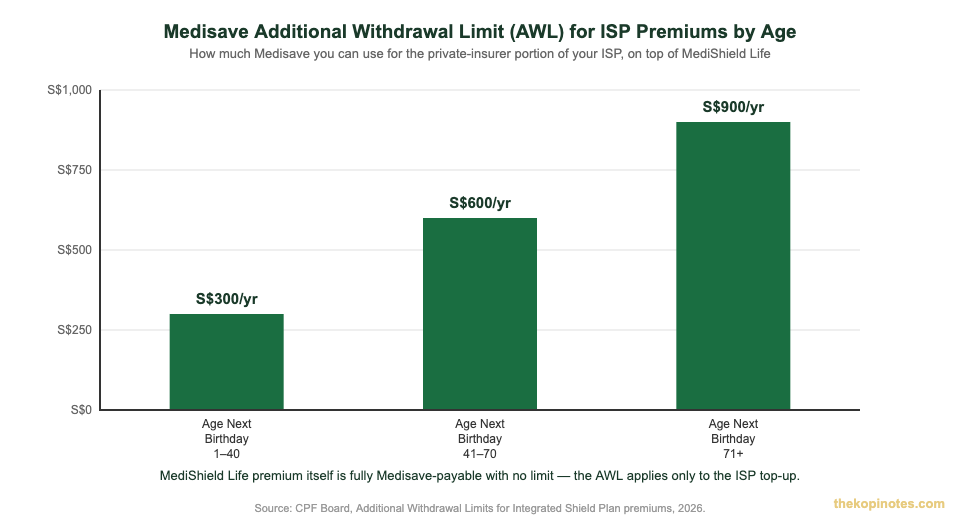
Medisave is generous for MediShield Life but capped for the ISP top-up. CPF Board calls this cap the Additional Withdrawal Limit (AWL), and it applies only to the private insurer’s portion of your ISP premium — not to MediShield Life, and not to riders (which are cash-only regardless of AWL).
The AWL rises in three simple bands based on your age next birthday:
| Age Next Birthday | Additional Withdrawal Limit (AWL) |
|---|---|
| 1–40 | S$300 / year |
| 41–70 | S$600 / year |
| 71 and above | S$900 / year |
Source: CPF Board, Additional Withdrawal Limits for Integrated Shield Plan premiums, 2026.
You can check the current AWL directly on the CPF Board AWL FAQ page (cpf.gov.sg).
For most people on a basic-tier ISP, the AWL comfortably covers the entire additional premium well into their 70s — the earlier worked example (S$49/year at age 30) is nowhere near the S$300 limit. Cash top-ups only start to bite once you move to a higher ward class, add a rider, or reach very advanced age, where the additional premium eventually exceeds even the S$900 limit.
Premium Comparison: MediShield Life vs MediShield Life + ISP
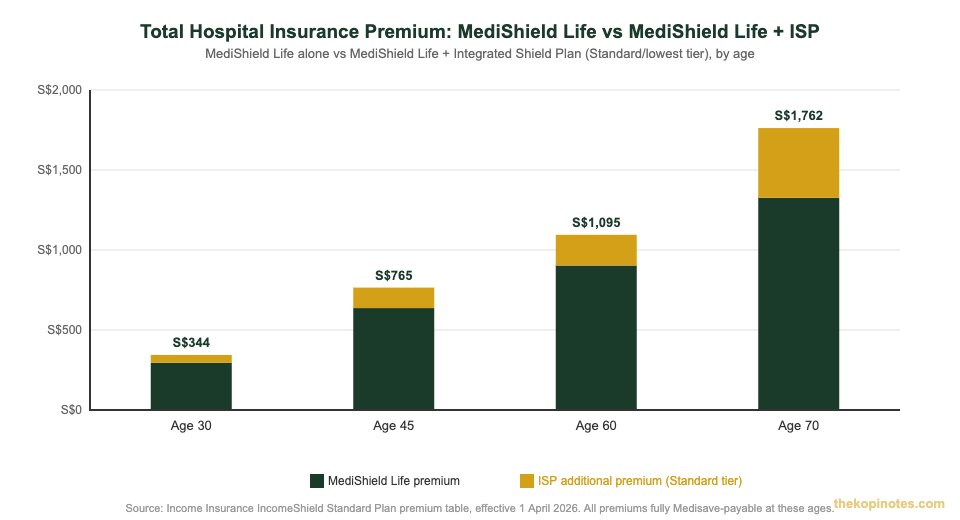
So what does stacking an ISP on top of MediShield Life actually cost? Using the same official 2026 premium table, here’s the combined premium at four life stages, for the lowest ISP tier (broadly comparable to a subsidised-ward top-up):
| Age | MediShield Life | ISP Additional Premium | Total Premium | Cash Needed? |
|---|---|---|---|---|
| Age 30 | S$295 | S$49 | S$344 | No |
| Age 45 | S$637 | S$128 | S$765 | No |
| Age 60 | S$903 | S$192 | S$1,095 | No |
| Age 70 | S$1,326 | S$436 | S$1,762 | No |
Source: Income Insurance, IncomeShield Standard Plan premium table, effective 1 April 2026. “Cash Needed” reflects the Standard/lowest tier only — Class A, Private ward plans, and riders cost substantially more and will require cash top-ups sooner.
The pattern holds up to roughly age 75 on a basic-tier plan: Medisave alone can carry the full cost. That changes fast once you add a rider (100% cash, no exceptions) or step up to Class A or Private ward cover, where the additional premium climbs quickly enough to outpace the AWL. For exact figures on higher-tier plans, the Medisave Singapore guide walks through withdrawal rules for other CPF-linked healthcare costs too.
Which Combination Should You Choose?
There’s no single right answer — it depends on your ward-class preference, cash flow, and how much financial cushion you have for a surprise bill. Here’s a rough guide by life stage.
Young and healthy, early career. MediShield Life plus a basic ISP (B1 or Class A, no rider) is usually enough. Premiums are low, mostly or fully Medisave-payable, and you avoid locking in a rider you may not need yet. You can always add a rider later — though be aware that upgrading may involve health underwriting if your health has changed.
Family breadwinner, 30s–50s. This is where a rider earns its keep. A hospitalisation you can’t easily absorb in cash is a real risk to your household’s finances at this stage. A moderate rider — one that meets the post-April-2026 minimum co-payment rather than the priciest option — balances protection with cost.
Approaching retirement, 50s–60s. Review your rider carefully here. Rider premiums are 100% cash and grow faster than your income typically does at this age. If your emergency fund is solid, consider dropping to a lower-tier rider or none at all, and redirecting that cash into your CPF investment strategy or retirement plan instead.
Retirees, 70+. The Medisave AWL is at its highest here (S$900/year), which helps. But rider cash costs are also at their highest, and this is precisely the life stage where fixed income makes cash top-ups hardest to absorb. Many retirees choose to keep their base ISP but drop or downgrade the rider, accepting a larger deductible in exchange for a smaller, predictable cash premium. Running the numbers through a Singapore retirement calculator can help you see how this fits your overall retirement budget.
Not financial advice. Speak to a licensed financial adviser or MOH’s official comparison tools before switching or purchasing hospital insurance — premiums, riders, and product features change and this article does not capture your personal circumstances.
Frequently Asked Questions
What's the difference between MediShield Life and an Integrated Shield Plan?
MediShield Life is a compulsory national scheme that covers every Singapore Citizen and PR for subsidised public hospital care, with no application needed. An Integrated Shield Plan (ISP) is an optional plan from a private insurer that adds on top of MediShield Life, letting you claim for higher ward classes such as Class A or Private, plus access to a wider panel of specialists. You pay one combined premium for both — you don’t buy them separately.
Do I need an Integrated Shield Plan if I already have MediShield Life?
Not strictly — MediShield Life alone covers subsidised treatment at public hospitals (B2/C ward level). Whether you need an ISP on top depends on whether you want the option of a higher ward class, shorter waiting times, or your preferred specialist. Many Singaporeans buy at least a basic Class A-level ISP because the extra premium is modest and mostly Medisave-payable at younger ages.
Can I use Medisave to pay for my ISP rider?
No. MOH has prohibited Medisave withdrawal for ISP rider premiums since 2021, and this remains unchanged under the April 2026 rider reforms. Rider premiums must be paid entirely in cash, by GIRO, credit card, or cheque. This is separate from your ISP’s own premium, which is Medisave-payable up to the Additional Withdrawal Limit for your age.
What changed with ISP riders in April 2026?
From 1 April 2026, new ISP riders can no longer cover your MOH-set deductible, and every policyholder must bear a minimum 5% co-payment on their bill, with the co-payment cap raised from S$3,000 to at least S$6,000. In exchange, MOH expects new riders to cost about 30% less than the maximum-coverage riders they replace — an estimated average saving of S$600/year for private hospital rider holders and S$200/year for public hospital rider holders. Existing riders sold before April 2026 transition to compliant versions at each policyholder’s next renewal, no later than 1 April 2028.
Which insurers offer Integrated Shield Plans in Singapore?
Five insurers are MOH-approved to sell Integrated Shield Plans: AIA (HealthShield Gold Max), Great Eastern (Supreme Health), Prudential (PRUShield), Singlife (Singlife Shield), and Income (Enhanced IncomeShield). Premiums for the same ward class are typically within 5–15% of each other; the bigger differences are in panel hospital access, pre/post-hospitalisation benefits, and claims service.
How much Medisave can I use for my ISP premium?
Your MediShield Life component has no Medisave limit — it’s fully payable from Medisave. The private insurer’s additional component is capped by the Additional Withdrawal Limit (AWL): S$300/year if you’re 40 or below (age next birthday), S$600/year if you’re 41–70, and S$900/year if you’re 71 or above. Any additional premium above the AWL, and all rider premiums, must be paid in cash.
Compare Your Hospital Insurance Options
See how the five ISP insurers stack up, and plan your healthcare costs into retirement.
Get Free Insurance Advice
Speak with a licensed insurance advisor. No obligation, no cost.
By submitting this form, you agree to our Privacy Policy.
This article was researched with the help of AI. While we strive to keep all information accurate and up to date, there may be errors. If you notice any discrepancies, please contact us.