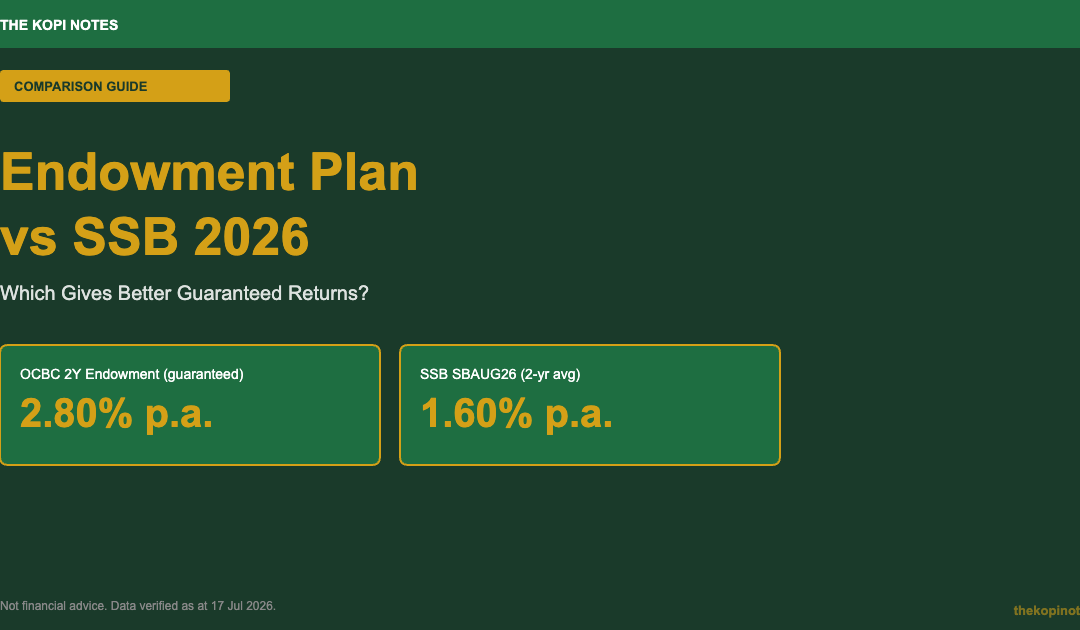
Endowment Plan vs SSB Singapore 2026: Which Gives Better Guaranteed Returns?
OCBC’s 2-Year Endowment Plan guarantees 2.80% p.a. today. The latest Singapore Savings Bond averages just 1.60% over the same two years. Here’s the full breakdown, plus the one thing the SSB does better than any endowment plan.
An OCBC 2-Year Endowment Plan guarantees 2.80% p.a. right now, beating the Singapore Savings Bond’s (SSB) current 1.60% two-year average and even its full 10-year average of 2.06%. But you can redeem an SSB any month with zero capital loss, while breaking an endowment plan early usually costs you money. Your choice comes down to rate versus flexibility.
Not financial advice. All figures are for educational reference only. Data verified as at 17 July 2026 against MAS, CPF Board, OCBC and SDIC sources.
- OCBC’s 2-Year Endowment guarantees 2.80% p.a. — higher than the SSB’s current 2-year average (1.60%) and even its 10-year average (2.06%)
- The SSB wins on flexibility: redeem in any month with no penalty and get back your full capital plus accrued interest
- Break an endowment plan early and you could get back less than you paid in — always check the surrender value table first
Table of Contents
Contents — Click to expand
Key Differences at a Glance
Both are considered “guaranteed” products in Singapore, but they work very differently. Here’s the short version before we get into the numbers.
| Feature | Endowment Plan (OCBC 2Y) | Singapore Savings Bond (SSB) |
|---|---|---|
| Guaranteed rate | 2.80% p.a., fixed for the full 2 years | 1.46% (Year 1) stepping up to 2.72% (Year 10) |
| Minimum investment | S$10,000 (varies by insurer) | S$500 |
| Tenure | Fixed 2 years | Up to 10 years, redeemable any month |
| Early exit | Surrender value — can be less than what you paid in | Full principal + accrued interest, minus a S$2 fee |
| Backed by | Insurer, protected under the PPF Scheme (caps apply) | Singapore Government (full backing) |
| Best for | Locking in a known return for money you won’t touch | Keeping options open while still beating a bank account |
Source: OCBC, MAS — as at 17 July 2026.
Current Guaranteed Rates Compared (as at 17 July 2026)
Before comparing outcomes, here’s every guaranteed-return option a Singapore saver is realistically weighing right now, side by side. Rates below are drawn directly from MAS’s SBAUG26 issuance page and the CPF Board’s Q3 2026 interest rate announcement.
| Product | Rate |
|---|---|
| CPF Ordinary Account (OA) | 2.50% p.a. (floor, unchanged Jul-Sep 2026) |
| SSB SBAUG26 — Year 1 | 1.46% p.a. |
| SSB SBAUG26 — 2-year average | 1.60% p.a. |
| SSB SBAUG26 — 10-year average | 2.06% p.a. |
| 6-month T-bill (latest auction) | 1.55% p.a. (21 Jul 2026 auction) |
| Average big-bank fixed deposit | ~1.00%–1.40% p.a. |
| Best market fixed deposit (GXS Boost Pocket, 12-month) | 1.60% p.a. |
| OCBC 2-Year Endowment Plan (guaranteed) | 2.80% p.a. |
Source: CPF Board, MAS (SBAUG26 GX26080T, BS26114W T-bill auction), Growbeansprout, OCBC — verified 17 July 2026.
Notice the gap: OCBC’s endowment rate beats every other guaranteed option on this list today, including the SSB’s best-case 10-year average. That’s the headline. The rest of this article is about whether that gap is actually worth the trade-offs. If you want the full breakdown of this specific product, see our OCBC 2-Year Endowment Plan review, or browse our wider endowment plan buyer’s guide for other insurers’ rates.
S$20,000 Worked Example: 2 Years, Side by Side
Numbers are easier to compare than percentages. Here’s what S$20,000 actually earns in guaranteed interest over exactly 2 years, assuming today’s rates hold.
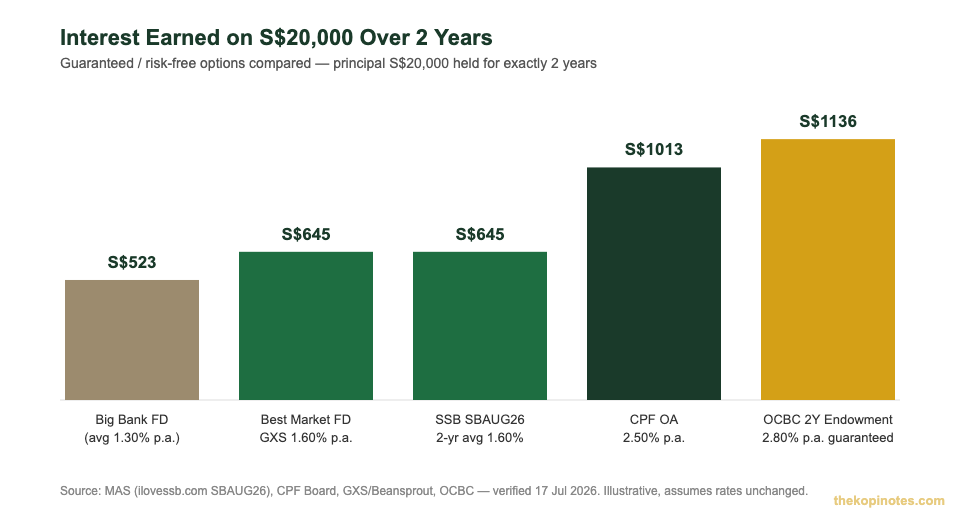
| Product | Rate (p.a.) | Interest on S$20,000 (2 yrs) | Maturity value |
|---|---|---|---|
| Average big-bank FD | 1.30% | S$523 | S$20,523 |
| Best market FD (GXS Boost Pocket) | 1.60% | S$645 | S$20,645 |
| SSB SBAUG26 (2-yr average) | 1.60% | S$645 | S$20,645 |
| CPF OA | 2.50% | S$1,013 | S$21,013 |
| OCBC 2-Year Endowment (guaranteed) | 2.80% | S$1,136 | S$21,136 |
Source: MAS, CPF Board, OCBC, Growbeansprout — figures compounded annually for illustration, verified 17 July 2026.
The endowment earns S$491 more than the SSB on the same S$20,000 over the same 2 years. That’s real money — but it’s locked in. If you cash out the SSB after just 1 year instead, at the 1.46% Year 1 rate, you’d walk away with about S$292 in interest and zero penalty. Try that with most endowment plans in year 1 and you could end up with less than your S$20,000 back.
Why the SSB’s Step-Up Rate Doesn’t Catch Up
The SSB is designed to reward patience. Its interest rate rises every year you hold it, from 1.46% in Year 1 to 2.72% in Year 10 for the current SBAUG26 issue. You might expect that if you just hold long enough, it eventually overtakes a 2.80% endowment. It doesn’t — not within the SSB’s entire 10-year lifespan.
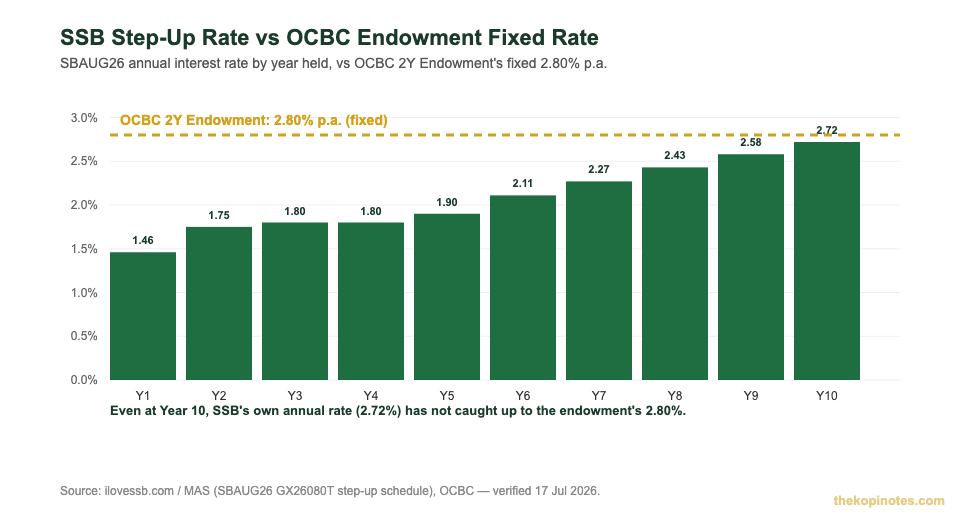
Even the Year 10 annual rate (2.72%) sits below the endowment’s fixed 2.80%, and the 10-year average return (2.06%) is further behind still. That’s the trade-off in plain terms: the SSB’s flexibility comes at the cost of a lower ceiling, not just a lower starting point.
This doesn’t make the SSB a bad product — it makes it a different product. It’s built for money you might need back at any point, not money you’re happy to lock away.
Liquidity and Early Exit
This is where the two products diverge the most. An SSB is one of the most liquid guaranteed products in Singapore. Redeem in any month, and you get back 100% of your principal plus every dollar of interest you’ve accrued so far — you only lose a flat S$2 transaction fee. There’s no market risk, no penalty, no waiting period beyond the redemption cycle.
An endowment plan is the opposite. You agree to a fixed term upfront, and the guaranteed rate only applies if you hold to maturity. Exit early and the insurer pays you the policy’s surrender value instead — a figure disclosed in your policy illustration, and one that’s very often below your total premiums paid in the first year or two. Depending on the plan and how early you exit, you could get back significantly less than S$20,000.
If there’s a real chance you’ll need this specific pot of money before the term is up, that risk alone can outweigh the extra 1.20 percentage points OCBC is offering.
Safety and Protection Schemes
Both products are considered very safe by Singapore standards, but the protection mechanics differ.
The SSB is a bond issued and fully backed by the Singapore Government — one of a small number of sovereigns holding the highest possible credit rating. There’s no scheme or cap involved; the guarantee is the Government’s own creditworthiness.
An endowment plan’s guaranteed benefits are backed by the issuing insurer and protected under the Policy Owners’ Protection (PPF) Scheme, administered by the Singapore Deposit Insurance Corporation (SDIC). If the insurer fails, PPF Scheme coverage is capped at S$500,000 of sum assured and S$100,000 of surrender value per policyholder per insurer. For a S$20,000 policy, you’re comfortably inside both caps — but it’s worth knowing the ceiling exists if you’re placing a much larger sum.
Fixed deposits, for comparison, sit under the separate Deposit Insurance (DI) Scheme, capped at S$100,000 per depositor per Scheme member bank — also administered by SDIC.
Pros and Cons
| Singapore Savings Bond (SSB) | Endowment Plan (e.g. OCBC 2Y) |
|---|---|
| ✅ Redeem any month, no capital loss ✅ Government-backed, no scheme caps ✅ Low S$500 minimum ❌ Lower guaranteed rate today ❌ Rate resets each new monthly issue |
✅ Higher guaranteed rate today ✅ Rate locked for the full term ❌ Early exit can mean a capital loss ❌ Higher minimum (often S$10,000+) ❌ PPF Scheme caps apply on large sums |
Who Should Choose Which
| If you… | Consider |
|---|---|
| Might need the cash back before the term ends | SSB |
| Are confident you won’t touch this money for 2+ years | Endowment plan |
| Want to start with a small amount | SSB (S$500 minimum) |
| Have a specific savings goal on a known date (e.g. a 2-year renovation fund) | Endowment plan, if the date matches the term exactly |
| Want to keep reassessing your options monthly | SSB |
Other Alternatives to Consider
SSB and endowment plans aren’t the only two guaranteed-return options. Depending on your timeline, a few others are worth a look:
- Singapore T-bills — the 6-month T-bill’s latest cut-off yield is 1.55% p.a. (21 July 2026 auction), similar to the SSB’s short-term rate. T-bills have a shorter, fixed 6-month commitment, but you take on reinvestment risk every cycle — the next auction’s yield isn’t guaranteed. See our Singapore T-Bill auction results and yields for the latest numbers.
- CPF voluntary top-ups — if the money is truly for retirement and you won’t need it before age 55, CPF’s Special/MediSave/Retirement Accounts pay a 4% p.a. floor rate (unchanged Jul-Sep 2026) — well above both the SSB and most endowment plans. The trade-off is that CPF top-ups are effectively locked until retirement age. Read our CPF investment strategy guide before committing.
- Cash management accounts — platforms like Endowus (referral code 2V343) and Syfe (referral code SRPRFFFCD) offer flexible cash management portfolios that invest in short-duration bonds and money market funds. Yields fluctuate daily and aren’t government-guaranteed like the SSB, but they offer same-day-ish liquidity with no lock-in.
If you’ve already compared endowment plans against fixed deposits, our Endowment Plan vs Fixed Deposit comparison covers that trade-off in the same worked-example format as this article.
Frequently Asked Questions
Is the SSB or an endowment plan safer?
What is the SSB's interest rate right now (July 2026)?
Can I withdraw from an endowment plan early like I can with an SSB?
Does every endowment plan guarantee 2.80% p.a. like OCBC's?
How much would S$20,000 earn in 2 years in each option?
What happens if I need my money before the endowment plan matures?
Is CPF OA a better guaranteed option than both?
Are SSB and endowment plan returns taxed in Singapore?
Which is better for a first-time saver — SSB or endowment plan?
Ready to Put Your Savings to Work?
Compare your options before you commit a lump sum. Our free calculator shows how small rate differences add up over time.
Want a flexible cash option instead? Explore a cash management portfolio with a referral bonus:
Get Free Insurance Advice
Speak with a licensed insurance advisor. No obligation, no cost.
By submitting this form, you agree to our Privacy Policy.
This article was researched with the help of AI. While we strive to keep all information accurate and up to date, there may be errors. If you notice any discrepancies, please contact us.