Group Insurance in Singapore: A 2026 Guide for Employers
What’s compulsory, what’s optional, and how SME owners and HR teams should set up employee cover in 2026.
Group insurance is one policy an employer buys to cover all eligible employees, usually blending group term life, hospital and surgical, and personal accident cover. In Singapore, some of it is compulsory. You must buy work injury compensation insurance under WICA, and at least $60,000 in medical insurance for every Work Permit and S Pass holder.
Not financial advice. All figures are for educational reference only. Data verified as at July 2026 unless otherwise noted.
- Group insurance bundles Group Term Life, Group Hospital & Surgical, Group Personal Accident, and Work Injury Compensation (WIC). WIC and foreign worker medical insurance are compulsory; the rest is optional.
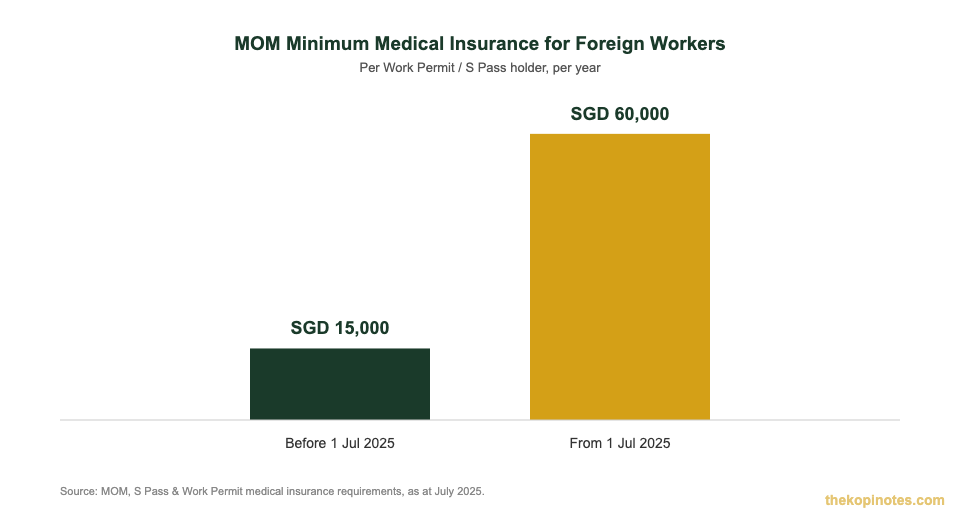
- Since 1 July 2025, MOM requires at least $60,000 in medical insurance per Work Permit or S Pass holder, and you cannot pass this cost on to the worker.
- Premiums are usually tax-deductible as staff costs, but medical expense deductions are capped at 1% of total employee remuneration (2% with a portable medical benefits scheme).
Why Group Insurance Matters in Singapore
Every Singapore employer carries some legal exposure for their workforce. If an employee gets injured on the job and you have not bought the right insurance, you are still on the hook to pay compensation under the Work Injury Compensation Act (WICA). The insurance just decides whether an insurer pays that bill, or you do out of pocket.
Beyond compliance, group insurance is also a hiring tool. In an SME employee benefits survey cited by Liberty Insurance Singapore, nine in ten SME staff said they want health coverage, and 60% said they would be more willing to join a company that offers it. In a tight labour market, a basic Group Hospital & Surgical (GHS) plan can be the difference between winning and losing a candidate to a competitor.
Group insurance also spreads risk across your whole workforce. Because insurers price the policy on your entire employee pool rather than each person’s individual health history, most standard group plans come with “guaranteed issue” cover up to a set limit. No medical questionnaire needed. That is a real advantage over individual insurance, where older employees or anyone with a pre-existing condition can face higher premiums or outright exclusions.
For a small business with 5 to 20 staff, this is often the most cost-effective way to give your team meaningful protection. But it comes with real compliance obligations you cannot skip. The next two sections walk through exactly what is compulsory, what is optional, and what the Ministry of Manpower (MOM) and Inland Revenue Authority of Singapore (IRAS) require you to get right.
The Types of Group Insurance in Singapore
Singapore employers can mix and match five main types of group insurance. Two are compulsory. The rest are optional, but common in competitive industries.
Work Injury Compensation (WIC) — compulsory
This covers medical leave wages, medical expenses, and compensation for permanent incapacity or death from a workplace injury, as required under WICA. Since 1 January 2021, your WIC policy must come from a MOM-designated insurer and meet MOM’s compulsory terms. You cannot just buy any commercial policy and assume it counts.
Foreign Worker Medical Insurance — compulsory for Work Permit and S Pass holders
You must buy at least $60,000 a year in medical insurance covering inpatient care and day surgery for every Work Permit or S Pass holder you employ. This is separate from WIC and covers general illness or injury, not just workplace accidents.
Group Term Life (GTL) — optional
Pays a lump sum to an employee’s beneficiaries if they die or become totally and permanently disabled while the policy is active. Cover is usually a multiple of annual salary, commonly 1x to 4x, and most insurers offer it without medical underwriting up to a “free cover limit.”
Group Hospital & Surgical (GHS) — optional
Reimburses hospital bills and day-surgery costs, and some plans extend to outpatient specialist visits or dental. This is the benefit employees notice and value most day-to-day.
Group Personal Accident (GPA) and Group Critical Illness (GCI) — optional
GPA pays out for accidental death, disablement, or medical expenses from an accident, on the job or off it. GCI pays a lump sum on diagnosis of a covered condition like cancer, stroke, or heart attack, on top of whatever MediShield Life or an Integrated Shield Plan already covers.
| Type | What It Covers | Mandatory? |
|---|---|---|
| Work Injury Compensation (WIC) | Medical leave wages, medical bills, compensation for permanent incapacity or death from workplace injury | Yes — manual workers (any salary), non-manual workers earning ≤$2,600/month |
| Foreign Worker Medical Insurance | Min $60,000/year inpatient & day-surgery cover | Yes — every Work Permit & S Pass holder |
| Group Term Life (GTL) | Lump sum on death or total permanent disability | No |
| Group Hospital & Surgical (GHS) | Hospital & day-surgery bill reimbursement | No |
| Group Personal Accident (GPA) | Payout for accidental death, disability, or medical costs | No |
| Group Critical Illness (GCI) | Lump sum on diagnosis of a critical illness | No |
Source: Ministry of Manpower (MOM), Work injury compensation insurance and S Pass medical insurance requirements, as at July 2026.
MOM and IRAS Rules Employers Must Know
WICA: who you must insure, and what changed in 2025
Under the Work Injury Compensation Act, you must buy WIC insurance for all employees doing manual work, regardless of salary, and all non-manual employees earning $2,600 or less a month, excluding overtime, bonus, and allowances. This applies to local and foreign employees alike. Get it wrong and you risk a fine of up to $10,000, up to 12 months’ jail, or both, according to MOM.
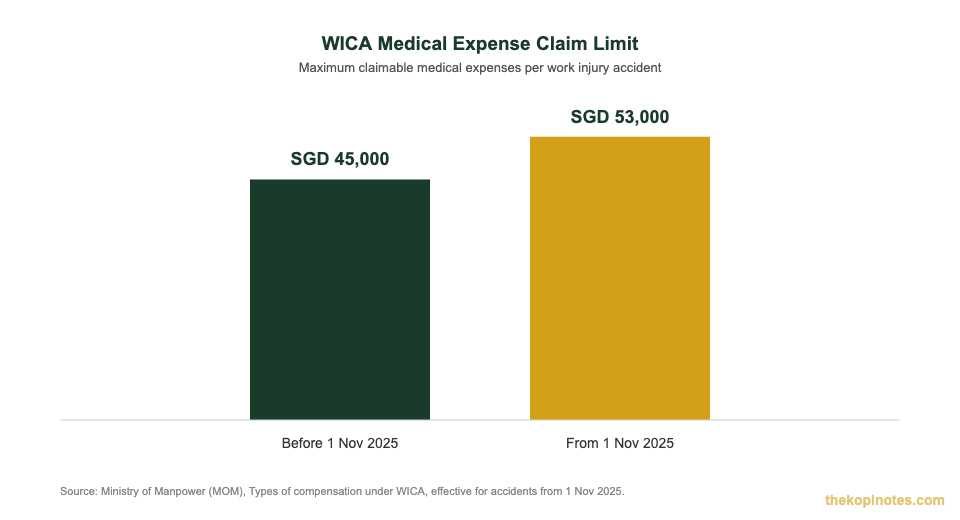
Since 1 January 2021, your WIC insurer must be a MOM-designated insurer, and the policy must meet MOM’s compulsory terms. This closed a loophole where cheaper, non-compliant policies left workers under-covered. MOM also raised the WICA medical expense claim limit from $45,000 to $53,000 per accident, effective for accidents occurring on or after 1 November 2025, so budget for slightly higher premiums at your next renewal.
Foreign worker medical insurance: the $60,000 rule
If you employ Work Permit or S Pass holders, MOM requires you to buy at least $60,000 a year in medical insurance covering inpatient care and day surgery for each of them. This threshold jumped from $15,000, effective 1 July 2025. You bear the first $15,000 of claims, then share costs with the insurer on a 75:25 basis up to the $60,000 cap. Critically, you cannot pass this cost on to the worker.
How IRAS treats your group insurance premiums
According to IRAS, group insurance premiums are generally deductible as a staff cost when your employees are the intended beneficiaries, either they are named directly, or you are contractually obliged to pass the payout to them or their next-of-kin.
IRAS also offers an administrative concession, available since Year of Assessment 2013. If you choose not to claim the tax deduction for group insurance premiums, your employees will not be taxed on the value of their share of the premium. You have to apply this consistently across everyone covered by the policy. You cannot cherry-pick which employees get the concession.
Medical expenses, including group medical insurance premiums, are capped at 1% of your total employee remuneration for the year. That cap rises to 2% if you run a portable medical benefit scheme, provide qualifying inpatient insurance, or make ad-hoc contributions to employees’ MediSave accounts, capped at $2,730 per employee per year. This is worth checking against our CPF MediSave cap 2026 guide if you are weighing that route.
| Compulsory Insurance | Who It Covers | Key Threshold | Effective |
|---|---|---|---|
| Work Injury Compensation | Manual workers (any salary); non-manual earning ≤$2,600/month | Medical expense cap $53,000/accident | Cap raised 1 Nov 2025 |
| Foreign Worker Medical Insurance | Every Work Permit & S Pass holder | Min $60,000/year cover | Raised to $60k on 1 Jul 2025 (from $15k) |
Source: MOM (work injury compensation, S Pass medical insurance) and IRAS (understanding the tax treatment, insurance premium), as at July 2026.
Group Insurance vs Individual Insurance
Group insurance is not a replacement for an employee’s own personal life insurance and Integrated Shield Plan. It is a supplement. Understanding where group cover stops matters for both you and your staff.
Group Term Life typically pays a multiple of annual salary, often 1x to 4x, which may fall well short of what a family actually needs if the main breadwinner passes away. Someone earning SGD 60,000 a year with a 2x GTL benefit gets SGD 120,000, which covers a few years of expenses at most. Compare that to a properly sized personal term life insurance policy, which can be structured around actual mortgage, dependents, and income replacement needs. For a deeper look at how individual cover compares, see our term insurance vs life insurance breakdown or our roundup of the best term life insurance in Singapore.
The other major gap: group coverage ends when someone leaves your company. If an employee is diagnosed with a health condition and later resigns or is retrenched, their GTL and GHS protection disappears with the job, right when they may struggle to get affordably underwritten individual cover elsewhere. This is why HR teams increasingly educate staff to hold a base level of personal insurance alongside group benefits, not instead of them.
| Feature | Group Insurance | Individual Insurance |
|---|---|---|
| Who pays | Employer (mostly) | Employee |
| Underwriting | Often guaranteed-issue up to a free cover limit | Full health declaration usually required |
| Coverage ends | When employment ends | Stays with the individual for life, if kept in force |
| Sum assured | Capped, often 1x-4x salary for GTL | Sized to the individual’s needs |
| Tax treatment | Deductible as staff cost, or admin concession applies | Personal Life Insurance Relief, subject to eligibility caps |
How to Set Up Group Insurance for Your Business
Step 1: Confirm your compulsory obligations first. Check whether your workforce triggers WICA insurance (manual workers, or non-manual staff earning ≤$2,600/month) and whether you employ any Work Permit or S Pass holders who need the $60,000 medical insurance minimum. These are not optional, and MOM enforcement includes real penalties.
Step 2: Get your headcount and salary data accurate. Insurers price group policies off your declared headcount, occupations, and wages. Under-declaring to save on premiums is a common mistake. MOM explicitly warns this can leave claims disputed or denied when you need them most.
Step 3: Decide which optional layers make sense for your budget. A lean startup might start with just GHS. A company competing for senior hires might add GTL, GPA, and GCI. Review what similar-sized companies in your industry typically offer, since this shapes candidate expectations.
Step 4: Compare quotes from at least two or three insurers. Major group insurance providers in Singapore include AIA, Great Eastern, Prudential, NTUC Income, and Manulife, either directly or through a corporate insurance broker. Packaged plans with fixed pricing and no health declarations suit smaller teams; customised plans suit larger or higher-risk workforces.
Step 5: Decide on the IRAS administrative concession. Work out with your accountant whether claiming the tax deduction or passing the tax-free benefit to employees makes more sense for your situation, then apply it consistently.
Step 6: Review annually. Headcount, salaries, and MOM/IRAS thresholds all change. Book your renewal review at least a month before your policy expires so you are not scrambling to meet MOM’s 21-day pre-commencement requirement.
Employees who want to understand what is not covered by their employer’s group plan can start with our life insurance association Singapore guide, or check the Singapore retirement planning calculator to see how their overall protection and retirement savings fit together.
Not financial advice. Group insurance requirements change as MOM and IRAS update policy — always confirm current thresholds with your insurer or a licensed corporate insurance broker before renewing.
Frequently Asked Questions
What is group insurance in Singapore?
Group insurance is a single policy that an employer buys to cover a group of employees, usually combining group term life, group hospital and surgical, group personal accident, and sometimes group critical illness. Instead of each employee applying individually, the employer manages one policy that covers everyone who qualifies.
Is group insurance compulsory for employers in Singapore?
Some of it is. You must buy work injury compensation insurance under WICA for manual workers of any salary and non-manual workers earning $2,600 or less a month, plus at least $60,000 in medical insurance for every Work Permit or S Pass holder. Group term life, hospital and surgical, and personal accident cover are optional.
What is the difference between group insurance and individual insurance?
Group insurance is priced and underwritten across your whole workforce, so it is usually cheaper and easier to qualify for, but coverage ends when someone leaves the company and the sum assured is often capped. Individual insurance stays with the person for life and can be sized to their specific needs, but requires full underwriting.
Are group insurance premiums tax-deductible for Singapore employers?
Generally yes, as a staff cost, if your employees are the named beneficiaries or you are contractually obliged to pass the payout to them. IRAS also offers an administrative concession where you can skip the deduction so employees are not taxed on their share of the premium, but you must apply this consistently across the whole policy.
Do I need medical insurance for my Work Permit or S Pass holders?
Yes. MOM requires at least $60,000 a year in medical insurance covering inpatient care and day surgery for every Work Permit and S Pass holder, effective 1 July 2025. You bear the first $15,000 of claims, split costs 75:25 with the insurer up to the cap, and cannot charge this cost to the worker.
How much does group insurance cost for a small business in Singapore?
Cost depends on headcount, ages, occupations, and which benefits you include. WIC alone costs far less than a full GTL plus GHS plus GPA package. Most insurers offer packaged plans with fixed, published pricing for small teams, so it is worth requesting quotes from two or three insurers before committing.
Setting Up Employee Benefits or Planning Your Own Cover?
Compare your options and make sure your own protection and retirement savings are on track too.
Get Free Insurance Advice
Speak with a licensed insurance advisor. No obligation, no cost.
By submitting this form, you agree to our Privacy Policy.
This article was researched with the help of AI. While we strive to keep all information accurate and up to date, there may be errors. If you notice any discrepancies, please contact us.