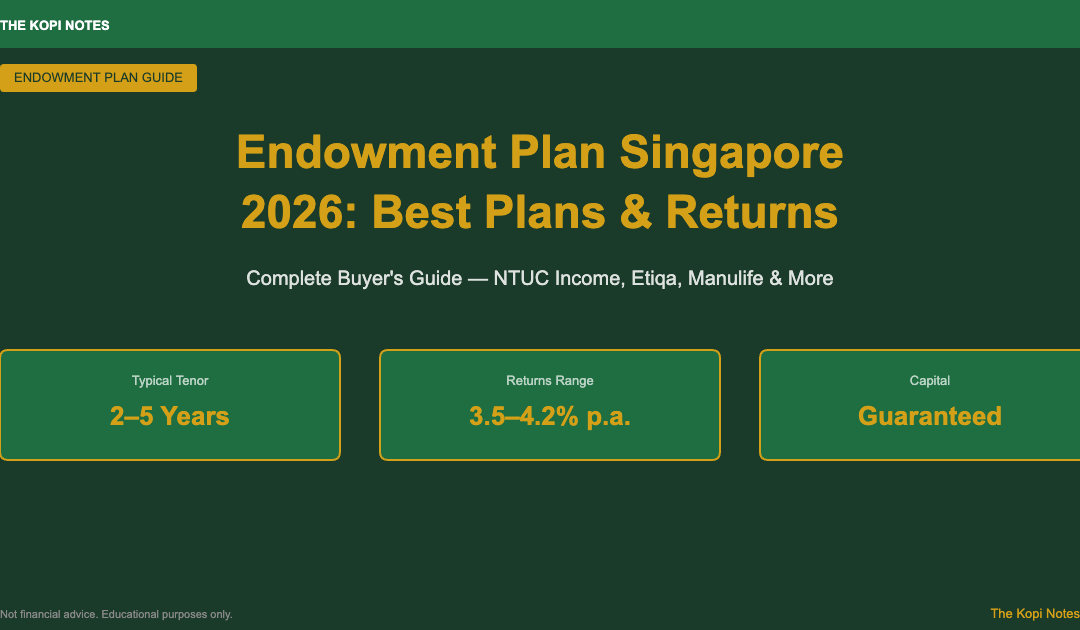
Endowment Plan Singapore 2026: Best Plans, Returns & Complete Buyer’s Guide
An endowment plan is a savings-linked insurance policy that guarantees your capital at maturity and adds non-guaranteed bonuses on top. Singapore’s top plans in 2026 — from NTUC Income, Etiqa, Manulife, and Great Eastern — offer tenors from 2 to 25 years with indicative total returns of 3.5–4.2% per annum, making them a compelling alternative to fixed deposits (currently ~1.45–1.60% p.a.) and Singapore Savings Bonds (2.11% 10yr avg) for risk-averse savers who want a disciplined savings structure.
Not financial advice. All figures are for educational reference only. Data verified as at July 8, 2026.
- Endowment plans guarantee your capital at maturity — you won’t lose the principal if you hold to term
- Short-term plans (2–3 years) offer 3.5–4.2% p.a. returns — beating current T-bill yields of 1.50% (Jul 2026) and FD rates of ~1.45–1.60%
- Best for risk-averse savers wanting a forced savings structure; not for those needing liquidity
Table of Contents
Table of Contents — Click to Expand
- What Is an Endowment Plan?
- How Does an Endowment Plan Work in Singapore?
- Best Endowment Plans in Singapore 2026
- Endowment Plan Returns vs Alternatives
- Short-Term vs Long-Term Endowment Plans
- Using SRS to Boost Endowment Plan Returns
- Who Should (and Should Not) Buy an Endowment Plan?
- How to Buy an Endowment Plan: Step-by-Step
- Frequently Asked Questions
What Is an Endowment Plan?
An endowment plan is a life insurance policy with a savings component. You pay premiums over a fixed period — or a lump sum upfront — and the insurer pays you a guaranteed maturity sum at the end, plus potential bonuses from the par fund.
Think of it as a disciplined savings account that locks your money away for a set period, grows it at a predetermined minimum rate, and pays out a lump sum when time is up. The insurance wrapper also provides a small death benefit — typically 101–105% of the sum assured — if you pass away during the policy term.
In Singapore, endowment plans are regulated by the Monetary Authority of Singapore (MAS) and sold by licensed insurers like NTUC Income, Etiqa, Manulife, AIA, Great Eastern, and Prudential.
There are two main types you’ll encounter:
- Participating endowment plans — invest your premiums in the insurer’s par fund (a mix of bonds, equities, and properties). Returns have a guaranteed component plus non-guaranteed bonuses that depend on par fund performance
- Non-participating (non-par) endowment plans — fully guaranteed returns, usually slightly lower but with no uncertainty. Popular for short-term single-premium plans
How Does an Endowment Plan Work in Singapore?
Here’s the mechanics, step by step:
1. You pay premiums. Either a single lump sum upfront (single-premium plan) or monthly/annual payments over the premium term (regular premium plan). Most short-term plans (2–3 years) are single-premium or limited-pay structures.
2. The insurer invests in the par fund. For participating plans, your premiums go into a pooled fund investing mostly in bonds (60–75%) with the remainder in equities, property, and cash. This is why endowment returns are relatively stable but not fixed.
3. Bonuses accumulate. Par fund profits are distributed as reversionary bonuses (added annually, cannot be taken away once credited) and a terminal bonus (paid only at maturity or death). The total of guaranteed sum + accumulated bonuses = your maturity value.
4. At maturity, you receive the payout. The full maturity value is paid out as a lump sum. Some plans also offer an income option — monthly payouts over a set period instead of one lump sum.
Key Endowment Terms Explained
| Term | What It Means for You |
|---|---|
| Sum Assured | The guaranteed minimum payout at maturity (also paid as death benefit) |
| Reversionary Bonus | Annual bonus credited to your policy — once added, it’s yours regardless of future par fund performance |
| Terminal Bonus | One-time bonus paid only at maturity or death. Not guaranteed — depends on par fund performance at that time |
| Surrender Value | Cash value if you terminate early — usually less than total premiums paid in the first few years |
| Policy Loan | Borrow against your surrender value (usually 90%) without surrendering the policy — subject to interest |
| Maturity Date | The fixed date when the policy ends and the full maturity sum is paid out |
Source: MAS, insurer policy documents. Data verified as at July 8, 2026.
Best Endowment Plans in Singapore 2026
Here’s a side-by-side comparison of the top endowment plans from Singapore’s major insurers as at July 2026. Note that returns are illustrative and subject to par fund performance for participating plans.
| Plan | Insurer | Tenor | Type | Indicative Return (p.a.) | Min. Premium |
|---|---|---|---|---|---|
| NTUC Income Growth | NTUC Income | 2–3 yrs | Non-par | ~3.6–3.8% | S$10,000 |
| Etiqa Endowment | Etiqa Insurance | 2–5 yrs | Non-par | ~4.0–4.2% | S$5,000 |
| Manulife ReadyBuilder | Manulife | 5–20 yrs | Participating | ~3.5–4.0% | S$200/mth |
| GE GoldenLife Ready | Great Eastern | 5–25 yrs | Participating | ~3.4–4.1% | S$300/mth |
| AIA Savvy Saver | AIA | 3–10 yrs | Non-par | ~3.5–3.9% | S$5,000 |
| Prudential PRUSave | Prudential | 5–20 yrs | Participating | ~3.3–4.2% | S$200/mth |
Source: Insurer websites, MoneyOwl, MAS product comparison. Returns are illustrative; non-par returns are guaranteed. Minimum premiums may vary by plan variant. Data verified as at July 8, 2026.
A few things to note when comparing plans:
Non-par plans (like NTUC Income Growth and Etiqa) give you certainty — the return is fixed at inception. Participating plans (Manulife, GE, Prudential) offer potentially higher returns over longer tenors but the non-guaranteed bonus portion depends on the insurer’s par fund performance.
If you’re parking money for 2–3 years, non-par short-term plans typically offer better value. For 10+ years of disciplined savings, participating plans may build more wealth through compounding bonuses.
Endowment Plan Returns vs Alternatives in 2026
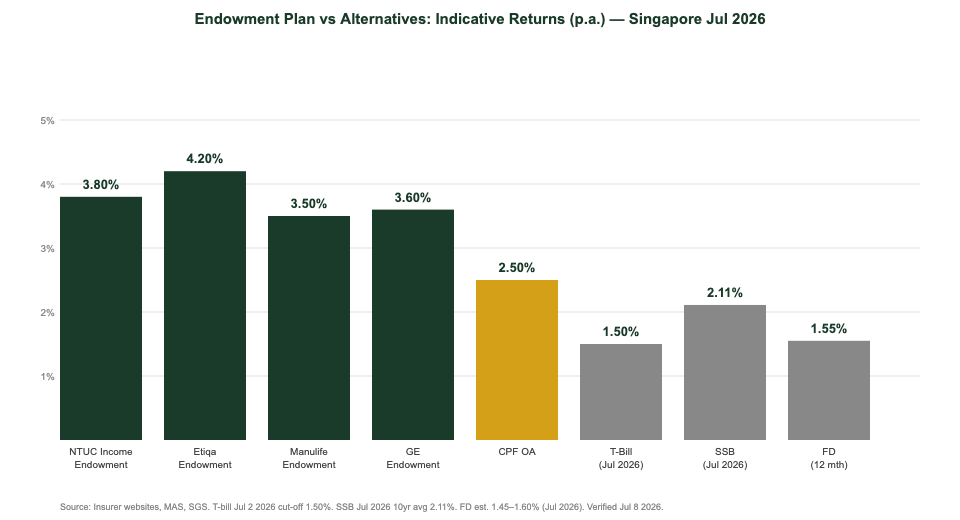
With T-bill yields now at just 1.50% (July 2 2026 cut-off) and fixed deposits yielding ~1.45–1.60% p.a., endowment plans — especially short-term non-par plans at 3.5–4.2% — offer the strongest guaranteed returns among capital-protected products. Here’s how they stack up for a Singapore saver with S$50,000 to put away for 2–3 years:
| Product | Indicative Return | Capital Guarantee | Liquidity | SDIC Protected | Best For |
|---|---|---|---|---|---|
| Endowment Plan (2–3yr) | 3.5–4.2% p.a. | ✅ Yes (at maturity) | ❌ Locked-in | ✅ Up to S$100k | Disciplined savers |
| Singapore Savings Bonds | 2.11% (10yr avg, Jul 2026) | ✅ Yes (Govt-backed) | ✅ Redeem anytime | ✅ Govt-backed | Flexibility seekers |
| T-Bills (6-month) | 1.50% (Jul 2 2026) | ✅ Yes (Govt-backed) | ⚠️ 6-month lock | ✅ Govt-backed | Short-term parking |
| Fixed Deposit (12 mth) | ~1.45–1.60% p.a. | ✅ Yes (principal) | ⚠️ Penalty if early | ✅ Up to S$100k | Short-term certain |
| CPF OA | 2.5% p.a. | ✅ Yes (Govt-backed) | ❌ CPF rules apply | ✅ Govt-backed | CPF money only |
| Robo-Advisor (income) | 4.0–6.0% p.a.* | ❌ No (market risk) | ✅ T+3 withdrawal | ❌ No | Return maximisers |
| S-REIT ETF | 5.5–7.0% yield* | ❌ No (price fluctuates) | ✅ Market hours | ❌ No | Income investors |
*Robo-advisor and S-REIT returns are not guaranteed. Source: MAS, CPF Board, SGS, bank websites. T-bill: Jul 2 2026 cut-off. SSB: Jul 2026 10yr avg. FD: Jul 2026 market rates. Data verified Jul 8, 2026.
The key insight: short-term endowment plans currently offer the best guaranteed returns among capital-protected products — by a wide margin over T-bills (1.50%) and FDs (~1.45–1.60%). The gap has widened as interest rates have fallen.
That said, you give up liquidity. If you might need the money before maturity, an SSB (redeemable anytime) or high-yield savings account is a better fit. You can explore passive income Singapore strategies for a broader comparison of income options.
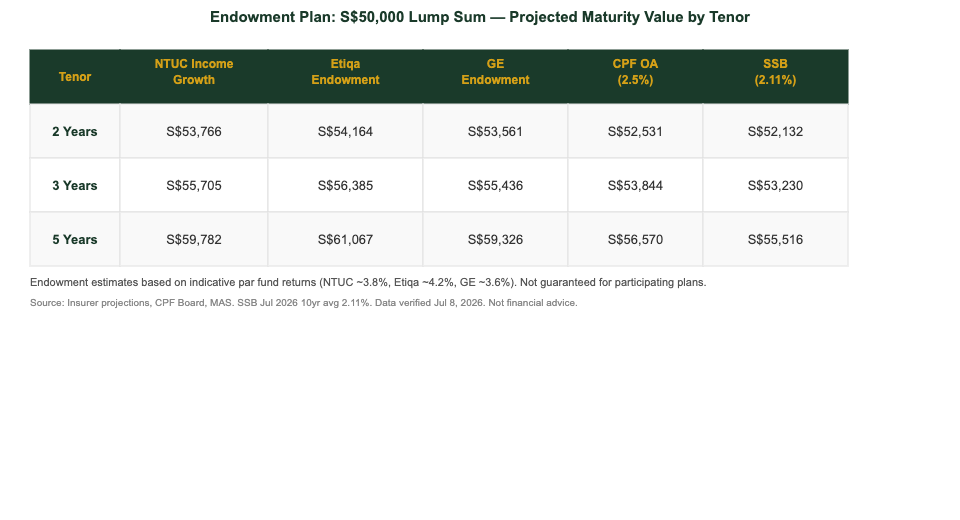
Short-Term vs Long-Term Endowment Plans: Which Is Better?
This is the most common question. The answer depends on what you’re trying to do with your money.
| Factor | Short-Term (2–5 Years) | Long-Term (10–25 Years) |
|---|---|---|
| Returns | 3.5–4.2% p.a. (non-par, guaranteed) | 3.5–5.0% p.a. (par, some non-guaranteed) |
| Capital Certainty | High (typically non-par) | Medium (par fund bonus uncertainty) |
| Best Use Case | Emergency fund top-up, known future expense (home down payment, wedding) | Retirement corpus building, children’s education fund |
| Premium Structure | Usually single-premium or 1–2 year pay | Regular monthly premiums over 5–20 years |
| Surrender Risk | Lower (shorter commitment) | Higher (long commitment — life changes happen) |
| SRS Compatibility | Yes (both types) | Yes — especially powerful for long-term tax relief |
Source: Insurer product documents, MAS. Data verified as at July 8, 2026.
For most working Singaporeans in their 30s and 40s, a combination works well: a short-term plan for medium-term goals (3–5 years) and a long-term plan for retirement supplementation. You don’t have to pick just one.
One important strategic point: with T-bills yielding just 1.50% (July 2026) and FDs at ~1.45–1.60%, locking in a 2–3 year non-par endowment plan today at 3.6–4.2% offers significant guaranteed returns at minimal risk. The window to lock in these attractive endowment rates may narrow if rates change.
Using SRS to Boost Endowment Plan Returns
This is the part most Singaporeans miss. If you contribute to the Supplementary Retirement Scheme (SRS) and use those funds to buy an endowment plan, you get a double benefit: tax relief on the SRS contribution AND the endowment plan return.
Here’s how it works. You contribute up to S$15,300 per year to SRS (Singapore citizens and PRs). Every dollar you contribute reduces your taxable income by that amount. A Singaporean earning S$120,000 p.a. (24% marginal rate) saves S$3,672 in taxes from a full S$15,300 SRS contribution.
Then those SRS dollars go into a multi-year endowment plan earning ~3.8% p.a. The combined effective return — tax savings + plan returns — can be significantly higher than the headline plan rate.
| Annual Income | Marginal Tax Rate | SRS Contribution | Tax Saved | Effective Return Boost |
|---|---|---|---|---|
| S$80,000 | 15% | S$15,300 | S$2,295 | +15% on year 1 |
| S$120,000 | 24% | S$15,300 | S$3,672 | +24% on year 1 |
| S$200,000 | 22% | S$15,300 | S$3,366 | +22% on year 1 |
Source: IRAS tax rates 2026. Tax savings shown for Year of Assessment 2027. SRS withdrawal at 50% concession at retirement age. Data verified Jul 8, 2026.
The SRS-endowment strategy is most powerful for people in the 24%+ tax brackets who are building their retirement nest egg and don’t need the money for 5+ years. Note: SRS funds withdrawn before 63 (the statutory retirement age) are subject to 5% penalty plus full income tax — so commit only money you won’t need before retirement.
For a deeper dive on optimising your SRS allocations, check out our SRS Tax Savings Calculator.
Who Should (and Should Not) Buy an Endowment Plan?
| Profile | Should Buy? | Reason |
|---|---|---|
| Risk-averse saver with 3–5 year horizon | ✅ Yes | Guaranteed capital + returns of 3.5–4.2% beat T-bills (1.50%), SSBs (2.11%) and FDs (~1.45–1.60%) at similar horizon |
| Parent saving for child’s university (10–15 yrs) | ✅ Yes | Long-term par plan builds disciplined savings corpus, often includes life coverage |
| Higher-income earner using SRS (24%+ bracket) | ✅ Yes | Tax relief + plan returns = powerful combined benefit |
| Investor who might need emergency funds | ⚠️ Caution | Early surrender means potential capital loss. Ensure 6-month emergency fund in liquid accounts first |
| Growth investor with long time horizon | ❌ Not ideal | ETFs and REITs historically offer higher long-term returns than endowment plans at the cost of short-term volatility |
| Recent retiree parking retirement lump sum | ✅ Yes | Short-term non-par plan provides safe, significantly higher-than-FD returns for 2–3 years |
Source: MAS, insurer product documents. Data verified as at July 8, 2026.
The single biggest mistake people make with endowment plans: surrendering early. In the first 2–3 years of a long-term plan, the surrender value is typically less than what you paid in. Insurers front-load costs. Only commit money you’re truly comfortable locking away for the full tenor.
If you’re building a broader income portfolio — combining endowment plans with dividend-paying REITs and ETFs — check out our guide to best S-REITs in Singapore 2026 to round out your strategy.
How to Buy an Endowment Plan: Step-by-Step
You have two routes: direct-purchase online (no adviser) or through a licensed financial adviser (FA).
Route 1 — Buy Online (Direct Purchase Insurance, DPI):
- Compare plans on CompareFirst.sg — MAS’s official comparison tool
- Go directly to the insurer’s website (NTUC Income, Etiqa, AIA, etc.)
- Fill in the online application and complete identity verification
- Pay the first premium via PayNow or GIRO
- Receive the policy document (usually digital) — review the benefit illustration carefully
Route 2 — Through a Licensed FA:
- Consult a fee-only adviser or insurance agent for needs analysis
- Request policy illustrations from multiple insurers for comparison
- Review the product summary and benefit illustration — ask what happens at surrender year 3, 5, 7
- Check adviser’s MAS licence at MAS Register of Representatives
- Sign the form and make the first payment; free-look period is 14 days (28 days for direct purchase)
For most straightforward short-term plans, the online route is perfectly adequate. For complex long-term plans or SRS integration, an FA can be helpful to navigate the options.
If you’re also comparing platforms for your investment portfolio alongside your endowment plan, the Endowus referral code (2V343) gets you up to S$20 off Endowus Access Fee for CPF/SRS investing — a natural complement to your savings strategy. Similarly, the Syfe referral code and sign-up bonus (SRPRFFFCD) offers cash rewards when you start a Syfe portfolio for the investment portion of your plan.
For a complete financial plan including endowment plans, use our Singapore retirement calculator to see how your endowment plan fits into your overall retirement picture.
Start Building Your Savings Plan
Compare platforms alongside your endowment plan strategy
Frequently Asked Questions
What is an endowment plan in Singapore?
Are endowment plan returns guaranteed?
What happens if I surrender my endowment plan early?
Can I use SRS to buy an endowment plan?
How are endowment plans taxed in Singapore?
What is the minimum investment for a Singapore endowment plan?
Endowment plan vs fixed deposit — which is better in 2026?
Is NTUC Income endowment plan SDIC insured?
What is the difference between endowment and whole life insurance?
Can I take a policy loan against my endowment plan?
Get Free Insurance Advice
Speak with a licensed insurance advisor. No obligation, no cost.
By submitting this form, you agree to our Privacy Policy.
This article was researched with the help of AI. While we strive to keep all information accurate and up to date, there may be errors. If you notice any discrepancies, please contact us.