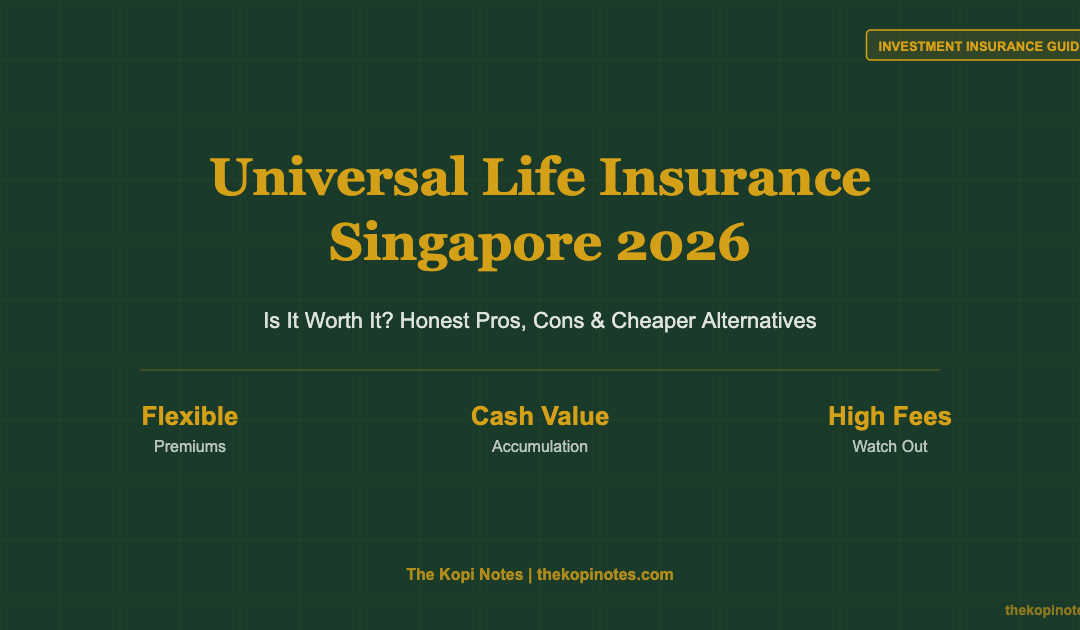
Universal Life Insurance Singapore 2026: Is It Worth It? Pros, Cons & Alternatives
Understand how ULI works, what it really costs, and whether a simpler strategy beats it

Universal life insurance (ULI) is a permanent life insurance policy that combines lifelong death benefit coverage with a cash value savings component. In Singapore, ULI policies are sold by major insurers like AIA, Prudential, and Manulife, typically with flexible premium payments and coverage that lasts your entire life. The cash value earns interest linked to the insurer’s credited rate — usually 2–4% per year — and grows while the policy is in force. However, ULI comes with high internal charges that can significantly erode your returns, making it essential to compare it against simpler alternatives like term life plus an ETF portfolio before signing up.
Not financial advice. All figures are for educational reference only. Data as at June 2026 unless noted.
- Universal life insurance combines lifelong coverage + cash value savings — but charges are significantly higher than term life
- ULI suits high-net-worth Singaporeans with estate planning needs; it’s not ideal for typical wealth-builders
- For most Singaporeans, buying term life + investing the savings in ETFs via Syfe or Endowus produces better outcomes over 20+ years
Table of Contents
Jump to section
- What Is Universal Life Insurance?
- How Universal Life Insurance Works in Singapore
- Types of Universal Life Insurance Plans
- The Real Costs: What You’re Actually Paying
- Pros and Cons of Universal Life Insurance
- Alternatives: Term Life + ETF vs ULI
- Who Should Consider Universal Life Insurance?
- How to Buy: 5-Step Guide
- Frequently Asked Questions
What Is Universal Life Insurance?
Universal life insurance (ULI) is a type of permanent life insurance. Unlike term life insurance, which covers you for a fixed period (say, 20 or 30 years), ULI covers you for your entire life — as long as you keep paying premiums.
What makes ULI different from whole life insurance is flexibility. You can adjust your premium payments up or down within certain limits. You can also vary the death benefit amount over time. This flexibility is useful if your financial situation changes significantly.
At the core of every ULI policy is a cash value account. When you pay your premium, part of it covers insurance costs (called the Cost of Insurance, or COI), policy fees, and administrative charges. The remainder goes into the cash value account, which earns interest at a rate credited by the insurer.
Over time, this cash value can be borrowed against or partially withdrawn — though doing so reduces your death benefit and can cause the policy to lapse if not managed carefully.
In Singapore, ULI is popular among high-net-worth individuals (HNWIs) who use it for estate planning and legacy purposes — passing on wealth efficiently across generations.
How Universal Life Insurance Works in Singapore
Here’s what happens when you pay a ULI premium each month:
- Insurance deduction (COI): The insurer deducts the cost of providing your death benefit. This rises as you age — a 60-year-old pays far more COI than a 35-year-old for the same cover.
- Policy charges: Administration fees, surrender charges (usually for the first 10–15 years), and other costs are deducted.
- Cash value accumulation: Whatever remains earns interest at the insurer’s credited rate — typically 2–3.5% in Singapore as of 2026.
The key risk: if your cash value falls too low because of high COI or insufficient premium payments, the policy can lapse. This is called a “cash value death spiral” — the insurer draws more from cash value to cover rising COI, and if you don’t top up, the policy terminates with zero payout.
Policyholders must review their ULI policy at least annually to ensure the cash value is on track. Many Singapore financial advisors recommend re-running policy illustrations every 3–5 years to catch potential lapses early.
Universal Life Insurance vs Whole Life: Key Differences
| Feature | Universal Life (ULI) | Whole Life |
|---|---|---|
| Premium flexibility | High — adjust up/down | Fixed |
| Death benefit flexibility | Yes — can vary | Typically fixed |
| Cash value transparency | Moderate (can see COI) | Lower (par fund) |
| Lapse risk | Higher if underfunded | Lower |
| Typical credited rate (2026) | 2–3.5% | 2–4% (incl. non-guaranteed bonus) |
Source: LIA Singapore, MAS, insurer product summaries, June 2026
Types of Universal Life Insurance Plans Available in Singapore
Singapore insurers offer several ULI variants. Understanding which type you’re being sold matters a lot for long-term outcomes:
1. Traditional Universal Life
The most straightforward type. Your cash value earns a fixed or current credited rate set by the insurer — similar to a savings account rate. The insurer can change this rate, so your returns aren’t guaranteed. In a low-interest environment, this can be a problem.
2. Indexed Universal Life (IUL)
Growing in popularity in Singapore. Instead of a fixed rate, the cash value interest is tied to the performance of a stock market index (e.g. S&P 500). You get a “participation rate” (e.g. 80% of index gains), a cap (e.g. maximum 10% credited per year), and a floor (e.g. 0% minimum). IUL sounds attractive but the caps significantly limit your upside in a bull market.
3. Variable Universal Life (VUL)
Similar to an investment-linked policy (ILP). You choose from a range of sub-funds for your cash value. Returns are market-linked with no floor — your cash value can fall in a bad year. This is the highest-risk, highest-potential-return type of ULI available in Singapore.
| Type | Returns Based On | Capital Protected? | Complexity |
|---|---|---|---|
| Traditional ULI | Insurer credited rate | Not guaranteed | Medium |
| Indexed ULI (IUL) | Index (capped) | 0% floor | High |
| Variable ULI (VUL) | Sub-funds (market) | No | Very High |
Source: MAS, LIA Singapore product classification, June 2026
The Real Costs: What You’re Actually Paying
This is where many policyholders get a nasty surprise. ULI has multiple layers of fees that quietly reduce your cash value:
Cost of Insurance (COI)
The COI is the monthly charge the insurer deducts to provide your death benefit. It’s priced per S$1,000 of net amount at risk (NAR). As you age, the COI rate rises sharply. A 40-year-old might pay S$1.50 per S$1,000 NAR; a 70-year-old might pay S$20+ per S$1,000 NAR.
Premium Expense Charges
Many ULI policies deduct a percentage (typically 5–10%) from your first few years of premiums before investing the rest. Your actual invested amount in early years is much lower than what you paid.
Policy Administration Fee
A fixed monthly deduction — often S$10–S$30/month — covering administrative costs. Small individually, but compounds significantly over 20–30 years.
Surrender Charges
If you cancel the policy in the first 10–15 years, you’ll face significant surrender charges — often 30–50% of your cash value in year 1, declining to zero by year 15. This makes ULI very illiquid in the short to medium term.
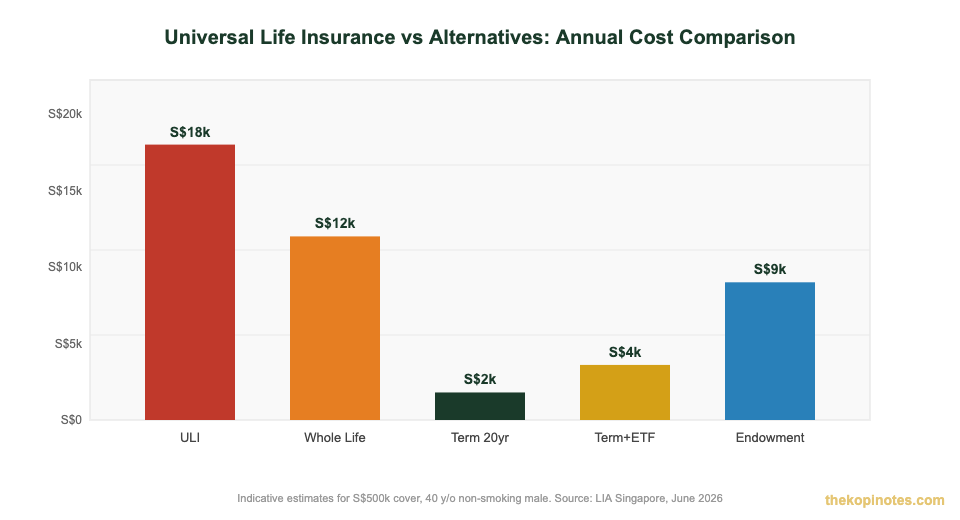
Source: Indicative cost estimates for S$500k cover, 40 y/o non-smoking male. June 2026.
Pros and Cons of Universal Life Insurance
Pros
- Lifelong coverage: Unlike term life, ULI never expires. Your beneficiaries are guaranteed a payout regardless of when you die, as long as the policy stays in force.
- Premium flexibility: You can reduce or even skip premiums in difficult years (as long as cash value covers COI). This suits business owners with variable income.
- Cash value access: You can borrow against or withdraw from cash value for emergencies or retirement income without cancelling the policy.
- Estate planning tool: For HNWIs, ULI is a tax-efficient way to transfer wealth. In Singapore, it can provide liquidity to beneficiaries quickly at death.
- Potential for higher returns (IUL): Indexed ULI offers equity market upside (capped) with a zero-floor — useful for very risk-averse individuals who still want some market exposure.
Cons
- High internal costs: COI + admin charges + surrender fees eat significantly into your effective return. Your net return on cash value is often lower than advertised.
- Lapse risk: If cash value falls below the COI amount — especially in later years when COI spikes — the policy can lapse after decades of paying premiums.
- Complexity: ULI illustrations are notoriously difficult to understand. Many policyholders don’t realise their policy is at lapse risk until it’s too late.
- Illiquidity: Surrender charges lock your money in for 10–15 years.
- Better alternatives often exist: For most Singaporeans, buying term life and investing in a Singapore REIT ETF or global ETF produces better risk-adjusted outcomes over 20+ years.
Alternatives: Term Life + ETF vs Universal Life Insurance
The most important comparison for any Singaporean considering ULI is the “buy term and invest the rest” (BTIR) strategy. Here’s how it stacks up over 20 years:
Scenario: Male, aged 35, non-smoker. S$500,000 life coverage needed. Total budget: S$1,500/month.
- ULI route: Pay S$1,500/month into ULI. Coverage: S$500k lifelong. Cash value at year 20 (2.5% net after charges): estimated S$310,000–S$390,000.
- BTIR route: Pay S$120/month for 20-year term life (S$500k), invest remaining S$1,380/month into a diversified ETF portfolio (e.g. VWRA at 7% historical CAGR). Portfolio value at year 20: estimated S$720,000–S$780,000.
The BTIR route produces a portfolio roughly 2× larger than ULI cash value, while providing the same death benefit during the coverage period. Use Syfe (code SRPRFFFCD) or Endowus (code 2V343) to invest in VWRA and CSPX with S$0 commission.
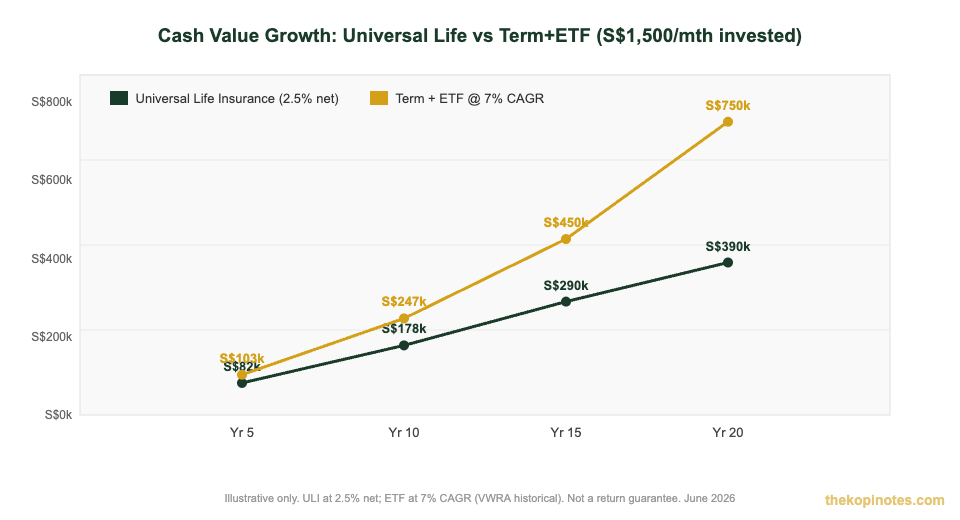
Illustrative projections. ULI at 2.5% net credited rate; ETF at 7% CAGR (VWRA long-term historical). Not a guarantee of future returns. June 2026.
To plan how much you need for retirement, use our Singapore retirement calculator. For the broader picture on building passive income in Singapore, our 2026 guide covers S-REITs, ETFs, T-bills, and SSBs side by side.
Who Should (and Should Not) Consider Universal Life Insurance?
ULI May Be Suitable If You Are:
- High-net-worth (S$3M+ investable assets): You have complex estate planning needs, want to leave a guaranteed lump sum to heirs, or need liquidity at death to settle estate costs.
- Business owner with variable income: Premium flexibility means you can pay more in good years and reduce payments when cash flow is tight — without losing coverage.
- Concerned about future insurability: Once a ULI is in force, coverage continues regardless of health changes. If you fear becoming uninsurable at 60–70, locking in ULI now provides lifelong certainty.
ULI Is Probably NOT Suitable If You Are:
- A typical working Singaporean with a mortgage and dependants: Your priority is maximum affordable coverage during your working years. Term life + ETF investing is almost certainly more efficient.
- Saving for a specific goal: An endowment plan, Singapore Savings Bond, T-bill, or regular ETF RSP will serve you better with lower costs and more liquidity.
- Under 50 and in good health: You can get excellent term life coverage at low cost. No need to pay for a lifelong policy when a 30-year term covers you through your highest-risk period.
- Fee-conscious: Low-cost index ETFs (TER 0.07–0.22%) via FSMOne beat ULI by a wide margin over 20+ years in pure wealth accumulation.
How to Buy Universal Life Insurance in Singapore: 5-Step Guide
- Define your need clearly: How much death benefit do you need? What is your primary goal — estate transfer, lifelong coverage, or cash value accumulation? Be specific before meeting any advisor.
- Get policy illustrations from at least 3 insurers: Request a detailed illustration showing year-by-year cash value, COI, charges, and projected surrender value at 2% and 4% credited rates. Major ULI providers: AIA, Prudential, Manulife, Sun Life, HSBC Life.
- Ask for the “break-even” year: At what year does your total cash value exceed total premiums paid? For most ULI policies, this is year 12–20. Be very clear on this before signing.
- Disclose all medical history: ULI underwriting is strict. Non-disclosure of pre-existing conditions can void the policy claim. Be completely honest during underwriting.
- Review annually: Once in force, review your policy every year. Ask your insurer to run a lapse projection. Adjust premiums if the credited rate drops.
Important: Under MAS regulations, all life insurance products in Singapore must be sold by a licensed financial advisor. Verify your advisor is MAS-registered at the MAS Financial Institutions Directory.
Frequently Asked Questions: Universal Life Insurance Singapore
What is universal life insurance in Singapore?
Is universal life insurance a good investment in Singapore?
What is the difference between universal life and whole life insurance?
Can universal life insurance in Singapore lapse?
What is the typical credited rate for ULI in Singapore 2026?
How does universal life insurance compare to an endowment plan?
Where can I buy universal life insurance in Singapore?
Get Free Insurance Advice
Speak with a licensed insurance advisor. No obligation, no cost.
By submitting this form, you agree to our Privacy Policy.
This article was researched with the help of AI. While we strive to keep all information accurate and up to date, there may be errors. If you notice any discrepancies, please contact us.