Keppel REIT 1Q 2026 Results: DPU, Rental Reversion & What It Means for You
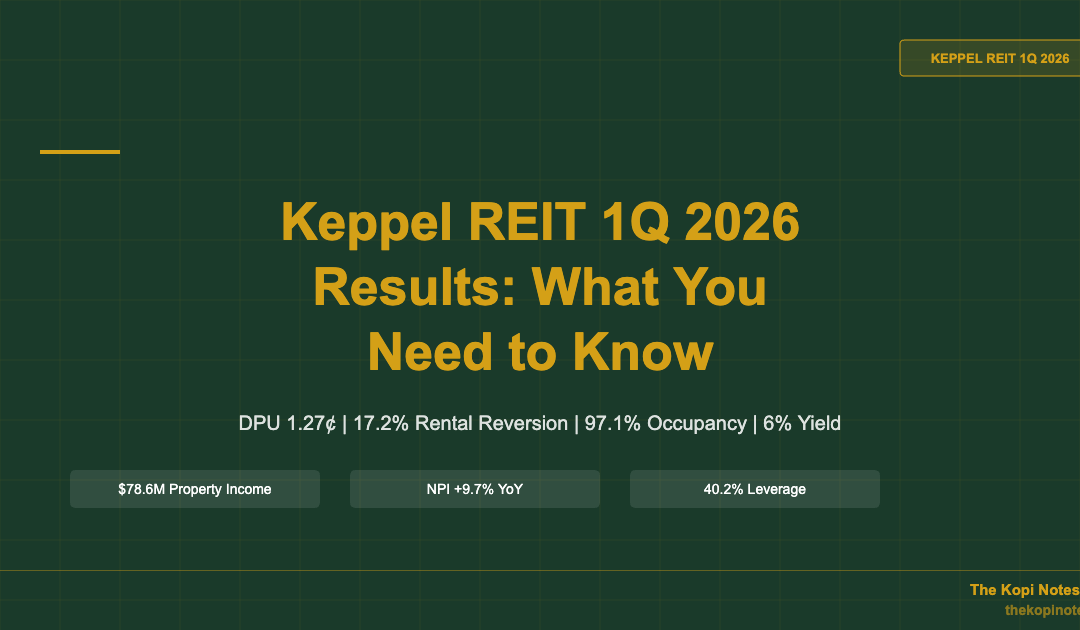
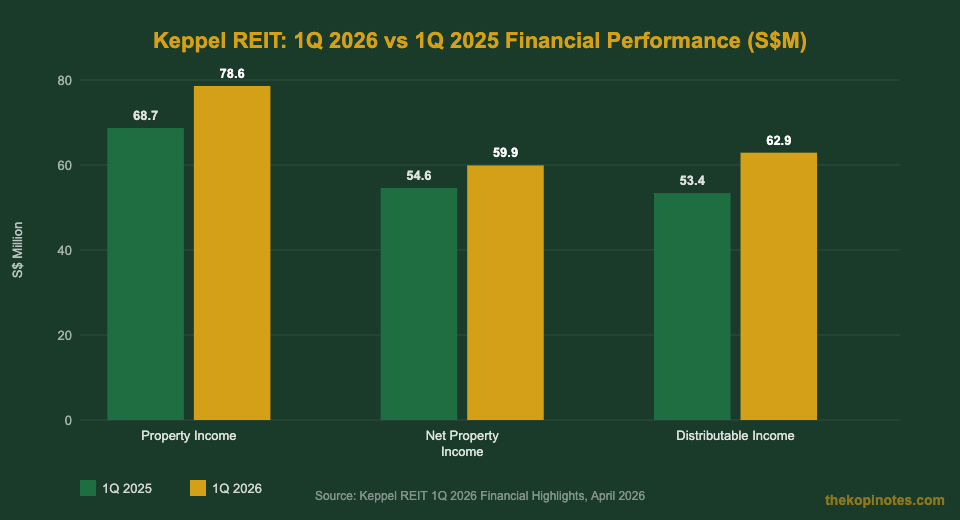
Keppel REIT (SGX: K71U) delivered a strong set of 1Q 2026 results, with distributable income climbing 17.8% year-on-year to S$62.9 million. Property income rose 14.4% to S$78.6 million, driven by the newly acquired Top Ryde City Shopping Centre and improved occupancy at Ocean Financial Centre. Portfolio occupancy reached 97.1% while rental reversion hit 17.2% — one of the highest among Singapore office REITs. The estimated DPU for 1Q 2026 is 1.27 cents, putting the annualised yield at approximately 6% at the current share price of S$0.865.
Not financial advice. All figures are for educational reference only. Data as at April 2026 unless noted.
- Keppel REIT’s distributable income grew 17.8% YoY to S$62.9M in 1Q 2026 — a strong beat driven by new acquisitions and higher rentals.
- Portfolio occupancy of 97.1% and rental reversion of 17.2% signal robust demand for Grade A office space in Singapore’s CBD.
- At ~S$0.865, Keppel REIT trades at a 28% discount to NAV and offers a ~6% forward yield — a potentially attractive entry for income investors.
Table of Contents
Jump to a section
- 1. 1Q 2026 Key Highlights at a Glance
- 2. Financial Performance: Income Growth Breakdown
- 3. Portfolio Review: Occupancy, Reversions & Leasing
- 4. Capital Management: Leverage, Debt & Interest Cover
- 5. Geographic Breakdown: Singapore, Australia, Korea & Japan
- 6. DPU & Yield: What Unitholders Are Getting
- 7. Analyst View & Price Targets
- 8. Should You Buy Keppel REIT Now?
- 9. FAQ
1. 1Q 2026 Key Highlights at a Glance
Keppel REIT released its 1Q 2026 business update on 21 April 2026. While distributions are paid half-yearly (not quarterly), the quarterly update gives investors a clear window into how the REIT is tracking.
Here are the headline numbers in one place:
| Metric | 1Q 2026 | 1Q 2025 | Change |
|---|---|---|---|
| Property Income | S$78.6M | S$68.7M | +14.4% |
| Net Property Income (NPI) | S$59.9M | S$54.6M | +9.7% |
| Share of JV Results | S$41.7M | S$30.3M | +37.6% |
| Distributable Income (incl. Anniversary) | S$62.9M | S$53.4M | +17.8% |
| Estimated 1Q 2026 DPU | 1.27 cents | — | Half-yearly payout |
| Portfolio Occupancy | 97.1% | — | ↑ from 96.7% (4Q25) |
Source: Keppel REIT 1Q 2026 Financial Highlights, 21 April 2026
2. Financial Performance: Income Growth Breakdown
Keppel REIT’s 1Q 2026 results showed meaningful income growth across every line item. Let’s break down what drove it.
Property Income: Up 14.4% to S$78.6M
The 14.4% jump in property income came from two main sources. First, the December 2025 acquisition of a 75% interest in Top Ryde City Shopping Centre in Sydney added a brand-new revenue stream from Day 1 of 2026. Second, higher occupancy at Ocean Financial Centre in Singapore’s Raffles Place — a flagship Grade A office tower — contributed additional rental income.
Net Property Income (NPI) grew a more modest 9.7% to S$59.9M. The gap between revenue growth and NPI growth reflects higher property expenses associated with managing a larger, more diversified portfolio. That’s normal for REITs that are actively growing through acquisitions.
Joint Venture Income: The Real Star — Up 37.6%
The biggest upside surprise in the results came from joint venture income, which surged 37.6% year-on-year to S$41.7 million. This was driven by Keppel REIT’s acquisition of an additional one-third interest in Marina Bay Financial Centre (MBFC) Tower 3 on 31 December 2025, giving it a two-thirds stake in one of Singapore’s most prestigious office addresses.
Higher rentals across the MBFC portfolio and lower borrowing costs at the JV level amplified the income uplift further. This JV income is separate from direct property income but flows through to unitholders via distributable income.
Total distributable income (including the annual S$5M Anniversary Distribution) reached S$62.9M for the quarter. That’s a strong result — and it lays the foundation for a solid half-year payout when distributions are announced for the period ending 30 June 2026.
3. Portfolio Review: Occupancy, Reversions & Leasing
Behind the financial results is a portfolio that is genuinely firing on all cylinders. Here’s what stood out.
97.1% Occupancy — Near Full
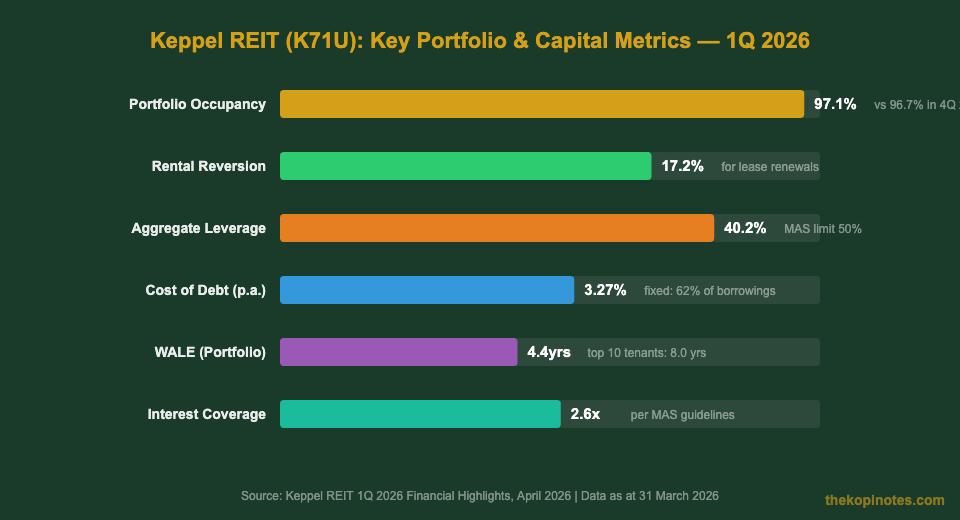
Portfolio occupancy ticked up to 97.1% in 1Q 2026 from 96.7% in 4Q 2025. For a REIT with an S$11.8 billion portfolio spanning Singapore, Australia, South Korea and Japan, maintaining near-full occupancy is a testament to the quality of assets and proactive leasing management.
For context, CBRE reported Singapore’s core CBD Grade A office average occupancy at 96.7% in 1Q 2026 — Keppel REIT is tracking above market.
17.2% Rental Reversion — Exceptional Pricing Power
Rental reversion is the percentage change in rent when a lease is renewed. Keppel REIT achieved 17.2% positive reversion in 1Q 2026 — meaning tenants who renewed their leases in this period paid 17.2% more than their previous rates.
Why is this significant? It means Keppel REIT’s existing portfolio rents are still catching up to market rates. The weighted average signing rent for Singapore CBD office leases in 1Q 2026 was S$13.26 psf per month, compared to an average expiring rent of S$11.98 psf pm. That gap of S$1.28 psf represents embedded organic growth as more leases roll over.
vs expiring average S$11.98 psf pm → built-in growth runway
Leasing: 450,000 sf Committed in 1Q 2026
More than 450,000 square feet (attributable area ~240,800 sf) of new and renewed leases were committed in the quarter. The dominant tenant sector was banking, insurance and financial services at 73.9% — high-credit-quality tenants that Singapore’s CBD is famous for.
The portfolio WALE (Weighted Average Lease Expiry) stands at 4.4 years, with the top 10 tenants at 8.0 years. Long WALEs mean income stability — you are unlikely to see sudden occupancy drops from a single large tenant departure.
4. Capital Management: Leverage, Debt & Interest Cover
Capital management is where some caution is warranted. Here’s the picture:
| Capital Metric | As at 31 Mar 2026 | What It Means |
|---|---|---|
| Aggregate Leverage | 40.2% | Below MAS 50% limit — some headroom |
| Weighted Avg Cost of Debt | 3.27% p.a. | Manageable; 62% on fixed rates |
| Interest Coverage Ratio | 2.6x | Adequate; above MAS minimum |
| Avg Term to Maturity (WATM) | 2.6 years | Watch for refinancing risk in 2027–28 |
| Sustainability-Linked Debt | 79% | Strong ESG credentials |
Source: Keppel REIT 1Q 2026 Financial Highlights, April 2026
The 40.2% leverage is not alarming by itself — it leaves 9.8 percentage points of headroom before hitting the MAS regulatory cap. However, with a weighted average term to maturity of just 2.6 years, a meaningful chunk of Keppel REIT’s debt will need to be refinanced by 2027–2028. If interest rates remain elevated, that could put upward pressure on borrowing costs and squeeze distributable income.
The good news: 62% of borrowings are on fixed rates, and 79% are sustainability-linked — both factors that help reduce refinancing risk and open access to green financing at potentially tighter spreads.
5. Geographic Breakdown: Singapore, Australia, Korea & Japan
Keppel REIT has an S$11.8 billion portfolio spread across four countries. Here’s how the geographic mix looks:
| Market | Portfolio Weight | Key Assets |
|---|---|---|
| Singapore | 78.9% | Ocean Financial Centre, MBFC (JV), One Raffles Quay (JV), Keppel Bay Tower |
| Australia | 18.1% | 255 George St (Sydney), 8 Exhibition St (Melbourne), Top Ryde City, Victoria Police Centre, Pinnacle Office Park |
| South Korea | 2.3% | T Tower (Seoul) |
| Japan | 0.7% | KR Ginza II (Tokyo) |
Source: Keppel REIT 1Q 2026 Financial Highlights, April 2026
Singapore dominates at nearly 79% of the portfolio — which is a positive for Singapore-based investors. You are largely buying Singapore Grade A office exposure when you hold K71U. The Australia allocation has grown meaningfully following the Top Ryde City acquisition in late 2025, adding retail diversification beyond pure office.
The small Korea and Japan allocations add geographic diversification but are not needle-movers at the portfolio level. Seoul CBD Grade A occupancy improved from 91.5% to 93.1% in 1Q 2026, and Tokyo central five wards Grade A occupancy held steady at 99.3% — both positive signals for these small but high-quality exposures.
If you want broader exposure to the best S-REITs in Singapore 2026, Keppel REIT stands out for its pure-play CBD office focus backed by blue-chip tenants.
6. DPU & Yield: What Unitholders Are Getting
Keppel REIT pays distributions on a half-yearly basis — not quarterly. This is an important detail: you will not see a cash payment for 1Q 2026 in isolation. Instead, the 1Q 2026 distributable income of S$62.9M is pooled with 2Q 2026 results and paid out after June 30.
Based on 4,955 million units in issue as at 31 March 2026, the estimated DPU for 1Q 2026 alone is 1.27 cents. Annualising this gives an indicative DPU of approximately 5.08 cents — which at the current price of S$0.865 represents a forward yield of around 5.9–6.0%.
Note also that Keppel REIT has a special Anniversary Distribution of S$5M per half-year (S$10M per year), which runs until June 2027. This supplements the operating distributable income and is included in the 1.27 cents estimate. When it ceases after mid-2027, all else equal, DPU will dip slightly.
Forward yield ~5.9% at S$0.865 | Paid half-yearly
If you are building a passive income strategy in Singapore, Keppel REIT’s ~6% yield from Singapore Grade A office is a meaningful contributor — especially compared to the sub-4% yields available from Singapore Savings Bonds or T-bills at current rates.
You can use our Singapore retirement planning calculator to model how a K71U position fits into your income goals.
7. Analyst View & Price Targets
The 1Q 2026 results were well-received by the analyst community. The consensus view heading into mid-2026:
- Average 12-month price target: S$0.98 to S$1.01 (sources vary) — implying ~13–17% upside from ~S$0.865
- High target: S$1.187
- Low target: S$0.889
- Consensus recommendation: Hold / Buy
- Discount to NAV: Approximately 28% — historically wide for a blue-chip office REIT of this quality
The investment thesis for bulls centres on: (1) embedded organic growth from positive rental reversions as Singapore Grade A office rents continue rising; (2) the MBFC Tower 3 full-year contribution boosting JV income through 2026; (3) a potential rerating as the discount to NAV narrows when rate expectations shift.
For bears, the key concerns are: (1) refinancing risk as WATM of 2.6 years means significant debt rollovers in 2027–28; (2) the upcoming end of the S$5M Anniversary Distribution in mid-2027 which will create a one-off DPU headwind; (3) broader macro uncertainty and the impact of US tariffs on Singapore’s trade-oriented economy.
This analysis is for informational purposes only and is not a buy or sell recommendation. Always do your own research before investing.
8. Should You Buy Keppel REIT Now?
Let’s cut to the practical question: is K71U worth adding to your portfolio right now?
The case for buying: Keppel REIT is delivering genuine income growth — not just financial engineering. The 17.2% rental reversion and near-full 97.1% occupancy show that real demand exists for its Singapore CBD office assets. At a 28% discount to NAV and a ~6% yield, you are getting a blue-chip Singapore REIT at a meaningful valuation discount. The MBFC Tower 3 acquisition adds a long-term income kicker that will compound over the coming years.
The case for waiting: The 2.6-year debt maturity profile means significant refinancing in 2027–28. If interest rates do not fall meaningfully, refinancing at higher costs will compress future DPU. And the Anniversary Distribution windfall ends mid-2027, creating a natural DPU step-down even if operating income holds up.
Practical approach for income investors: If you are building a diversified S-REIT income portfolio, Keppel REIT at ~6% yield with a 28% NAV discount offers a reasonable risk-reward for a core position. Dollar-cost averaging over the next 12 months — rather than a lump sum — hedges against short-term macro uncertainty.
If you want to buy K71U, you can do so through platforms like Syfe (via their REIT+ portfolio), or direct on SGX through IBKR. Check our Syfe referral code and sign-up bonus for any available promotions. You can also access Keppel REIT through the Endowus referral code platform if you are investing via CPF or SRS.
For more context on how Keppel REIT compares to peers, read our guide on the best S-REITs in Singapore 2026 which covers yield, gearing and coverage ratios across the sector.
FAQ: Keppel REIT 1Q 2026 Results
What is the Keppel REIT DPU for 1Q 2026?
What is Keppel REIT's dividend yield in 2026?
What drove Keppel REIT's strong 1Q 2026 results?
Is Keppel REIT's 40.2% leverage a concern?
What is Keppel REIT's NAV per unit?
How do I buy Keppel REIT (SGX: K71U) in Singapore?
When is the next Keppel REIT distribution payment date?
Disclaimer: The content on The Kopi Notes is for educational and informational purposes only. It does not constitute financial advice. Always consult a licensed financial adviser before making investment decisions. Past performance is not indicative of future results.
This article was researched with the help of AI. While we strive to keep all information accurate and up to date, there may be errors. If you notice any discrepancies, please contact us.