Travel Credit Card Singapore 2026: Citi, DBS, UOB, HSBC & OCBC Miles Cards Compared
Your complete Singapore guide to miles-earning travel credit cards — earn rates, annual fees, lounge access, and which card suits your travel style.
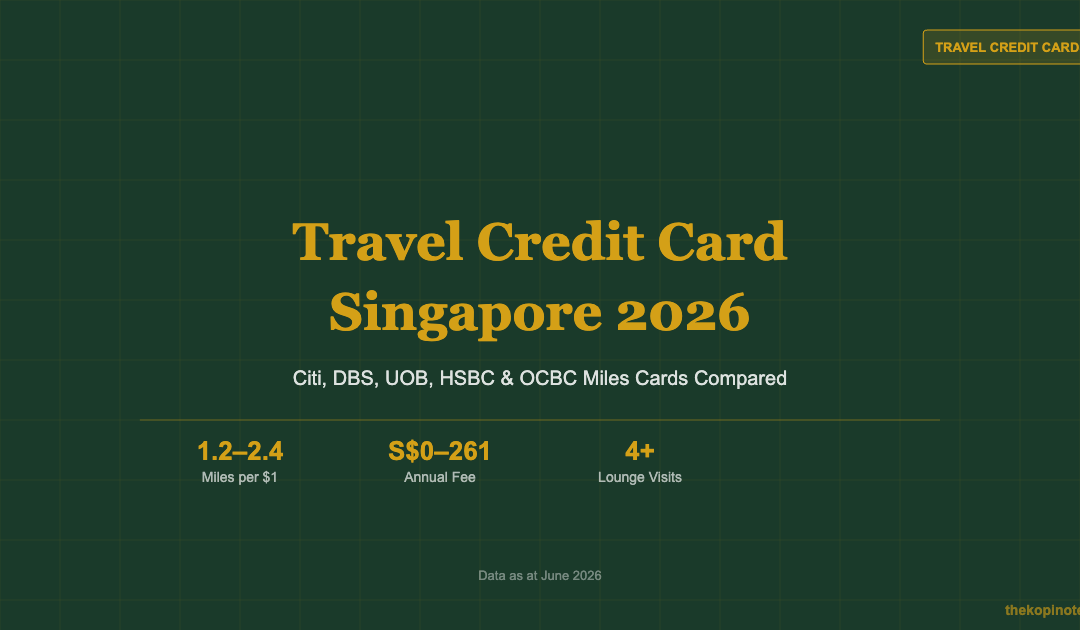
A travel credit card in Singapore earns you air miles on everyday spending — typically 1.2 to 2.4 miles per dollar locally, and up to 4 miles per dollar overseas. The top cards in 2026 are the Citi PremierMiles, DBS Altitude, UOB PRVI Miles, OCBC 90°N, and HSBC Revolution. Most charge S$196.20 per year in annual fees, though HSBC Revolution is free. The right card depends on how often you fly, whether you prefer flexibility or top earn rates, and how much you spend each month.
Not financial advice. All figures are for educational reference only. Data as at June 2026 unless noted.
- Most Singapore travel cards earn 1.2–1.4 mpd locally and 2.1–2.4 mpd overseas — overseas spend is where you get the best value.
- HSBC Revolution earns 4 mpd on all online and contactless spend with no annual fee — a standout option if you don’t need lounge access.
- For frequent flyers who want lounge access and broad transfer partners, Citi PremierMiles or UOB PRVI Miles are the top picks.
What Is a Travel Credit Card?
A travel credit card earns you air miles — or points that convert to miles — on every dollar you spend. Instead of cashback, you accumulate miles that can be redeemed for flights, upgrades, or hotel stays.
In Singapore, most travel cards work by earning miles on your everyday spend: groceries, dining, online shopping, and bills. The miles sit in your card’s rewards programme until you transfer them to a frequent flyer programme like KrisFlyer (Singapore Airlines) or Asia Miles (Cathay Pacific).
Two numbers matter most when comparing cards: the local earn rate (miles per dollar spent in Singapore) and the overseas earn rate (miles per dollar spent abroad or in foreign currency). Overseas rates are typically 1.5–2x higher because foreign transactions generate more interchange revenue for the bank.
Top Travel Credit Cards in Singapore (2026)
Here are the six strongest travel credit cards available to Singapore residents in 2026, based on earn rates, transfer partners, annual fees, and practical benefits.
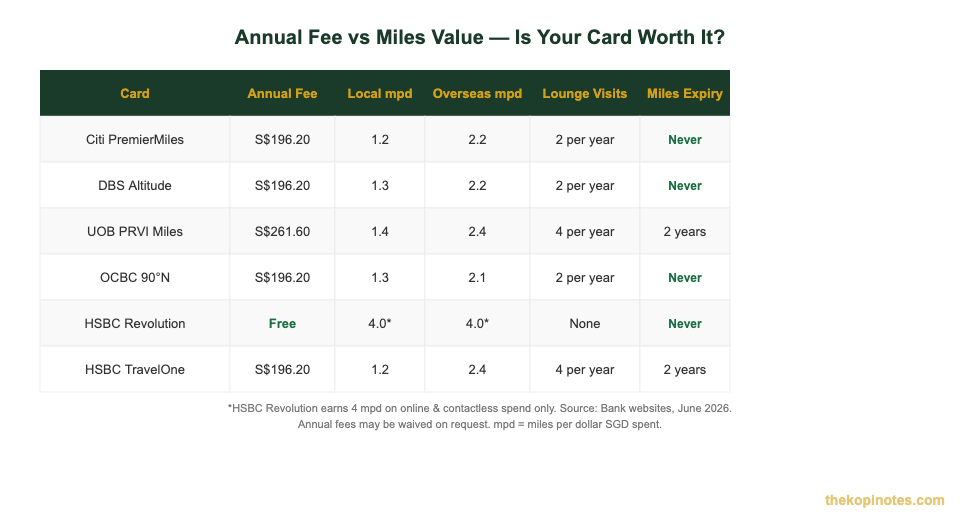
| Card | Best For | Local mpd | Overseas mpd | Annual Fee |
|---|---|---|---|---|
| Citi PremierMiles | Most transfer partners | 1.2 | 2.2 | S$196.20 |
| DBS Altitude | Points never expire | 1.3 | 2.2 | S$196.20 |
| UOB PRVI Miles | Highest overseas rate | 1.4 | 2.4–3.0* | S$261.60 |
| OCBC 90°N | Hotel bookings (Agoda 7 mpd) | 1.3 | 2.1 | S$196.20 |
| HSBC Revolution | No annual fee, online spend | 4.0** | 4.0** | Free |
| HSBC TravelOne | Most lounge visits | 1.2 | 2.4 | S$196.20 |
*UOB PRVI Miles earns 3.0 mpd in Malaysia, Indonesia, Thailand, and Vietnam. **HSBC Revolution earns 4 mpd on online and contactless spend only — not all categories. Source: Bank websites, June 2026.
Miles Earn Rates Compared
The earn rate is the single most important number when picking a travel credit card. It tells you how many miles you earn for every dollar you spend — higher is better.
Most Singapore travel cards split their earn rate into two tiers: local spend and overseas or foreign-currency spend. Here’s how to think about each.
Local Spend (Spending in Singapore in SGD)
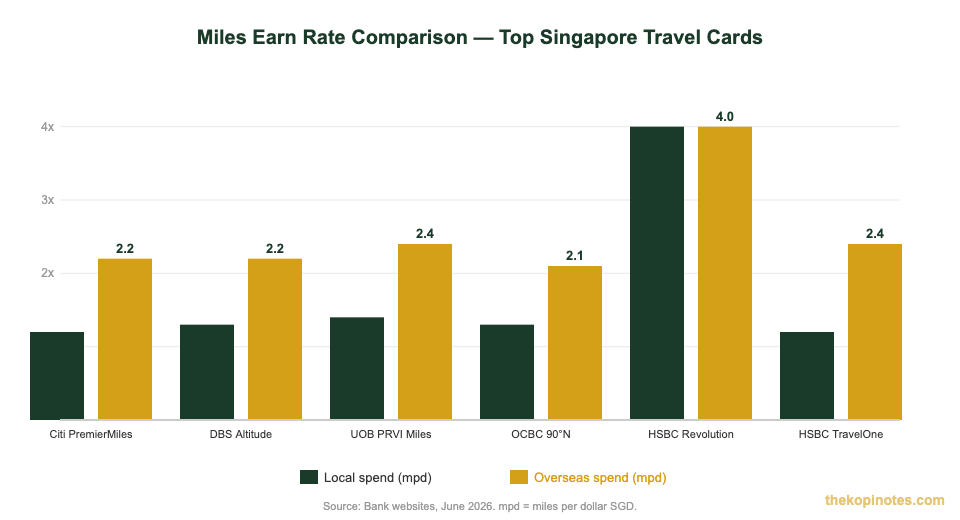
For day-to-day Singapore spending — groceries at NTUC, dining at hawker centres, online shopping — the HSBC Revolution stands alone at 4 mpd. That’s three times what most other cards earn locally.
However, the Revolution only gives you 4 mpd on online transactions and contactless payments. Pay by inserting your card at a terminal and you earn far less. If most of your Singapore spending is contactless (tapping your phone or card), Revolution is the clear winner for local spend.
Among traditional travel cards, UOB PRVI Miles leads at 1.4 mpd locally, followed by DBS Altitude and OCBC 90°N at 1.3 mpd, then Citi PremierMiles and HSBC TravelOne at 1.2 mpd.
Overseas Spend (Foreign Currency or Travel Bookings)
When you travel or book flights and hotels, your earn rate jumps. UOB PRVI Miles earns 2.4 mpd on all overseas spend and 3.0 mpd in four key ASEAN countries. HSBC TravelOne also hits 2.4 mpd overseas.
For a Singapore resident who spends S$5,000 on an overseas holiday, using UOB PRVI Miles earns 12,000 miles. The same spend on DBS Altitude earns 11,000 miles. Over a few trips, that gap compounds into a meaningful free flight or upgrade.
Transfer Partners — Where Your Miles Go
Miles earned on Singapore bank cards typically sit in a bank rewards currency (Citi Miles, DBS Points, UNI$, etc.) until you transfer them to a frequent flyer programme. More partners mean more flexibility.
| Card | Miles Currency | Key Transfer Partners | Transfer Ratio |
|---|---|---|---|
| Citi PremierMiles | Citi Miles | KrisFlyer, Asia Miles + 9 more | 1:1 |
| DBS Altitude | DBS Points | KrisFlyer, Asia Miles | 1,000 pts = 1,000 miles |
| UOB PRVI Miles | UNI$ | KrisFlyer, Asia Miles, Kris+ | 10,000 UNI$ = 10,000 KF miles |
| OCBC 90°N | 90°N Miles | KrisFlyer, Asia Miles, Agoda | 1:1 |
| HSBC Revolution / TravelOne | HSBC Points | KrisFlyer, Asia Miles, ANA + more | 1,000 pts = 1,000 miles |
Source: Bank websites and KrisFlyer partner pages, June 2026. Transfer fees may apply (S$25–S$43 per transfer for most banks).
Annual Fees and Lounge Access
Most premium travel credit cards charge around S$196.20 per year. That sounds like a lot — but if your card earns you a free one-way Business Class redemption every two years, the fee pays for itself many times over.
Here’s the honest maths for a typical Singaporean spending S$2,500 per month: at 1.3 mpd locally, you’d earn about 39,000 miles per year. A KrisFlyer Economy redemption to Bangkok starts at 17,500 miles. That one annual fee buys you roughly two round-trips to Southeast Asia in savings.
Can You Waive the Annual Fee?
Yes, in most cases. Singapore banks commonly waive the annual fee if you call or chat and request a waiver — especially if you’ve spent above a threshold that year. DBS, Citi, UOB, OCBC, and HSBC all have waiver policies. It never hurts to ask before paying.
Lounge Access by Card
| Card | Annual Fee | Lounge Network | Free Visits/Year |
|---|---|---|---|
| UOB PRVI Miles | S$261.60 | Priority Pass | 4 visits |
| HSBC TravelOne | S$196.20 | LoungeKey | 4 visits |
| Citi PremierMiles | S$196.20 | Priority Pass | 2 visits |
| DBS Altitude | S$196.20 | Priority Pass | 2 visits |
| OCBC 90°N | S$196.20 | Priority Pass | 2 visits |
| HSBC Revolution | Free | None | 0 |
Source: Bank websites, June 2026. Lounge visit counts apply per primary cardholder per year. Guest fees apply beyond free quota.
Which Travel Card Is Right for You?
There’s no single best travel credit card for everyone in Singapore. It depends on how you spend and what you value most. Here’s how to think through the choice.
Choose Citi PremierMiles if…
You want the most flexibility for miles redemption. Citi Miles never expire and transfer 1:1 to 11 airline and hotel partners including KrisFlyer and Asia Miles. If you’re still building your miles strategy and aren’t sure which airline you’ll fly most, Citi’s breadth makes it the safest default card.
Choose DBS Altitude if…
You’re a DBS or POSB customer and prefer managing everything in one app. DBS Points never expire, earn rates are competitive at 1.3 mpd locally and 2.2 mpd overseas, and there’s a 10,000 bonus miles on annual renewal. The card also earns 3 mpd on online flight and hotel bookings, which boosts value significantly if you book travel directly.
Choose UOB PRVI Miles if…
You travel frequently to ASEAN destinations and want the highest overseas earn rates. At 3.0 mpd in Malaysia, Indonesia, Thailand, and Vietnam — plus 4 Priority Pass visits per year — this card suits frequent regional business travellers. The higher annual fee of S$261.60 is justified if you take 4+ overseas trips annually.
Choose OCBC 90°N if…
You book a lot of hotels through Agoda. The 90°N earns 7 mpd on Agoda bookings, which is the highest hotel earn rate on any Singapore card. Combined with miles that never expire and competitive overseas earn rates, it’s a strong choice for hotel-heavy travellers. You can also use your Syfe referral code savings to help fund travel.
Choose HSBC Revolution if…
You spend heavily online or via contactless payments and don’t want to pay an annual fee. Four miles per dollar on online transactions — including online shopping, food delivery, ride-hailing, and streaming — is genuinely exceptional for a free card. The trade-off: no lounge access and the 4 mpd rate doesn’t apply to all spend categories.
Consider alternatives if…
You rarely travel overseas (less than once a year), carry a balance month-to-month (interest charges will wipe out miles value), or your monthly spending is under S$800 (the miles earned won’t offset the annual fee). In those cases, a cashback card or a digital bank savings account may serve you better. Consider checking the Singapore retirement calculator to see whether your savings rate is on track before committing card spend to travel rewards.
How to Maximise Your Miles
Getting the most from your travel credit card takes a bit of strategy. Here are five practical moves Singapore cardholders use to accelerate miles accumulation.
1. Stack Your Card with a Miles Portal
Some brokers and robo-advisors offer miles for investing. For example, using your Endowus referral code to sign up may come with KrisFlyer miles promotions. Check for current offers before funding new accounts.
2. Pay for Big Expenses on Card
Insurance premiums, income tax (via PayNow or GIRO alternatives that accept cards), and school fees can generate thousands of miles at once. Verify your card earns full miles on these categories — some cards exclude tax payments.
3. Use the Right Card for Each Spend Category
Consider holding two cards: HSBC Revolution for all online and contactless spend (4 mpd), and Citi PremierMiles or UOB PRVI Miles for travel bookings and in-person overseas spend. This two-card stack maximises earn across all categories without much complexity.
4. Time Your Transfers to KrisFlyer
KrisFlyer miles expire 36 months after earning. But bank rewards points often never expire (Citi Miles, DBS Points, OCBC 90°N Miles). Keep points in your bank account until you’re ready to redeem — then transfer just what you need, when you need it.
5. Combine with Referral Bonuses
Many Singapore digital banks offer sign-up bonuses that can be used alongside your existing miles card strategy. The MariBank referral code gives new users a cash bonus you can redirect into travel savings, and the Endowus referral code may include bonus miles on first investment. See also the passive income Singapore guide for ways to offset travel costs with investment returns.
Frequently Asked Questions
What is the best travel credit card in Singapore for 2026?
The best travel credit card depends on your spending pattern. For most Singaporeans, the Citi PremierMiles is the most versatile — it earns 1.2 mpd locally and 2.2 mpd overseas, Citi Miles never expire, and there are 11 transfer partners including KrisFlyer and Asia Miles. If you spend mostly online and contactless, the HSBC Revolution earns 4 mpd with zero annual fee, making it exceptionally strong for everyday accumulation.
How many miles per dollar do Singapore travel credit cards earn?
Most Singapore travel credit cards earn between 1.2 and 1.4 miles per dollar (mpd) on local SGD spend, and between 2.1 and 2.4 mpd on overseas or foreign-currency spend. The exception is the HSBC Revolution, which earns 4 mpd on all online and contactless transactions regardless of currency. UOB PRVI Miles earns a market-leading 3.0 mpd in Malaysia, Indonesia, Thailand, and Vietnam.
Can I get a travel credit card in Singapore with no annual fee?
Yes. The HSBC Revolution Card has a permanently waived annual fee and earns 4 mpd on online and contactless spend — making it the strongest no-fee travel card in Singapore. Most other premium travel cards charge S$196.20 per year, but annual fees can often be waived on request if you’ve spent above a threshold. Call your bank before the renewal date to request a waiver.
Which Singapore travel credit card gives the most lounge access?
For lounge access, UOB PRVI Miles and HSBC TravelOne both offer 4 complimentary lounge visits per year — the most of any standard Singapore travel card. UOB PRVI Miles uses the Priority Pass network (1,400+ lounges globally); HSBC TravelOne uses LoungeKey. Citi PremierMiles, DBS Altitude, and OCBC 90°N offer 2 visits per year via Priority Pass. The free HSBC Revolution has no lounge access.
Do Singapore air miles credit card points expire?
It depends on the card. Citi Miles, DBS Points, and OCBC 90°N Miles never expire — you can hold them indefinitely until you’re ready to redeem. UNI$ (UOB PRVI Miles) expire 2 years after the statement month they were earned. HSBC Points expire 37 months after earning. Note that once you transfer miles to KrisFlyer, those miles expire 36 months from the date of earning in KrisFlyer, so don’t transfer until you’re ready to redeem.
Can foreigners apply for travel credit cards in Singapore?
Yes, foreigners with valid Singapore employment passes (EP, S Pass, or Personalised EP) can apply for most Singapore travel credit cards. You typically need a minimum annual income of S$40,000–S$60,000 for premium travel cards. Requirements vary by bank: Citi, DBS, UOB, OCBC, and HSBC all accept EP holders. You may need to provide additional documents such as your EP, passport, and latest 3 months’ payslips.
Ready to Start Earning Miles?
Compare Singapore’s top travel cards and use our tools to plan your financial journey.
This article was researched with the help of AI. While we strive to keep all information accurate and up to date, there may be errors. If you notice any discrepancies, please contact us.