MediShield Life vs Integrated Shield Plan: How They Work Together (2026)
The two-tier health insurance system explained — with the April 2026 rider changes you need to know.
MediShield Life is Singapore’s compulsory national health insurance — it covers subsidised B2 and C-ward hospitalisation for all Citizens and PRs. An Integrated Shield Plan (ISP) is an optional private policy that sits on top, extending coverage to A-ward and private hospitals. The two work as one “integrated” policy: MediShield Life pays first, then the ISP covers the remainder. From April 2026, new ISP riders can no longer cover your deductible — but average rider premiums also dropped by ~30%, saving private hospital policyholders roughly S$600 per year.
Not financial advice. All figures are for educational reference only. Data as at June 2026 unless noted.
- MediShield Life (compulsory) + ISP (optional) = one integrated policy — MediShield Life pays first, ISP tops up
- From April 2026, new riders no longer cover your deductible — but premiums fell ~30%
- You can still use Medisave for deductibles and co-payments; riders must be paid in cash
Table of Contents
Contents — Click to expand
What Is MediShield Life?
MediShield Life is Singapore’s mandatory national health insurance scheme. It covers all Singapore Citizens and Permanent Residents automatically — you cannot opt out. Premiums are paid from your Medisave account each year without any action on your part.
The scheme pays for large hospitalisation bills at subsidised B2 and C-ward public hospitals. It has an annual claim limit of S$150,000 and covers approved outpatient treatments, certain day surgeries, and selected chronic disease management.
However, MediShield Life alone has meaningful gaps. It does not cover A-ward or private hospital stays at full cost. If you stay in a private hospital, MediShield Life still pays — but only at the subsidised B2/C rate. You foot the rest of the bill.
What Is an Integrated Shield Plan?
An Integrated Shield Plan (ISP) is a private health insurance policy from one of seven MOH-approved insurers. It “integrates” with MediShield Life — meaning the two plans are treated as a single combined policy.
ISPs extend coverage in two ways. First, they raise the annual claim limit — enhanced plans cover S$1 million or more per year. Second, they cover higher ward classes: A-ward or private hospital, depending on the tier you choose.
There are seven approved ISP providers as at June 2026: AIA (HealthShield Gold Max), Great Eastern (Supreme Health), Prudential (PruShield), NTUC Income (IncomeShield), Singlife (Singlife Shield), HSBC Life (myShield), and Raffles Health Insurance (Raffles Shield). You can only hold one ISP at a time.
ISP premiums are partly payable from Medisave, within the Additional Withdrawal Limit (AWL) set by MOH. The AWL ranges from S$300 to S$900 per year depending on your age. Cash top-ups apply for amounts above this limit.
How MediShield Life and ISPs Work Together
The “integrated” in Integrated Shield Plan is the key word. When you hold an ISP, you do not have two separate policies. You have one unified policy administered by your insurer. MediShield Life and your ISP work as a team.
Here is the order of operations when you are hospitalised:
- MediShield Life pays first — it covers its share according to the MediShield Life benefit table
- You pay the deductible — a fixed amount before your ISP kicks in (S$3,500 for private hospital for most adults in 2026)
- Co-insurance applies — you pay a minimum 5% of the remaining bill
- Your ISP covers the balance — everything above deductible and co-insurance, up to your plan’s annual limit
If you have a rider add-on, the rider absorbs the co-insurance portion (subject to the new 2026 rules). But from April 2026, no rider can cover the deductible — you must pay that S$3,500 yourself, from Medisave or cash.
For a full side-by-side comparison, see our shield plan comparison across all seven Singapore insurers.
A Real Claim Example: Who Pays What
Let us use a real example from MOH’s own case study. A 60-year-old with a private hospital ISP and the new 2026 rider undergoes knee joint replacement surgery. The bill is S$56,900.
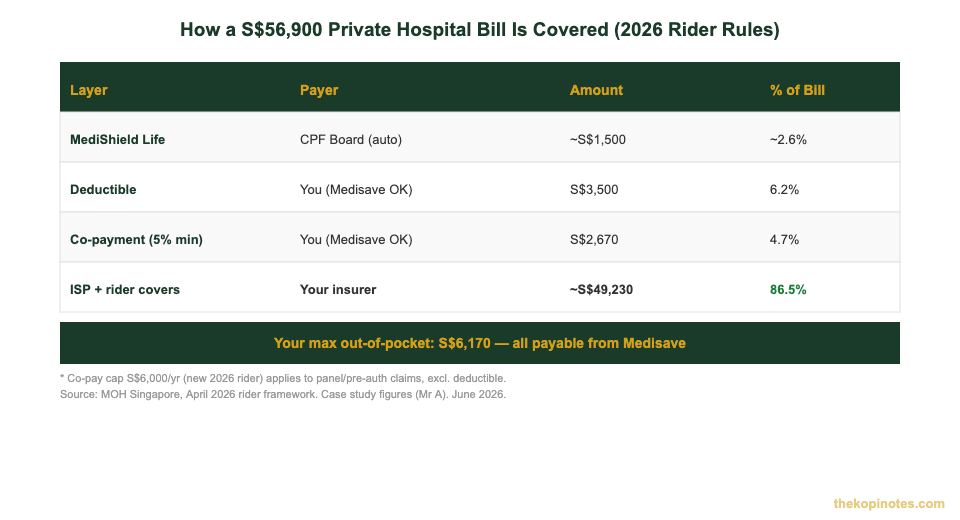
Source: MOH Singapore, April 2026 rider framework. Bill amounts from MOH’s published case study (Mr A). June 2026.
| Bill Component | Amount | Who Pays |
|---|---|---|
| Total bill | S$56,900 | — |
| MediShield Life portion | ~S$1,500 | CPF Board (auto) |
| Deductible (private ward) | S$3,500 | You (Medisave OK) |
| Co-payment (5% of balance) | S$2,670 | You (Medisave OK) |
| ISP + rider covers | ~S$49,230 | Your insurer |
Source: MOH Singapore case study, November 2025 press release. Actual figures vary by procedure and insurer.
Your total out-of-pocket is S$6,170 — entirely payable from Medisave under the 2026 withdrawal limits. Compare that to S$56,900 with no ISP at all. That is the value of the combined MediShield Life + ISP system.
MOH also notes that a 60-year-old switching to the new 2026 rider saves S$1,600 in cash premiums in the first year — enough to offset the slightly higher co-pay over multiple years without hospitalisation.
The April 2026 Rider Changes Explained
The biggest change to Singapore’s ISP system in years took effect on 1 April 2026. MOH announced the changes in November 2025 to address rising healthcare costs and an unsustainable spiral of claims pushing premiums higher each year.
Here is what changed — and what stayed the same.
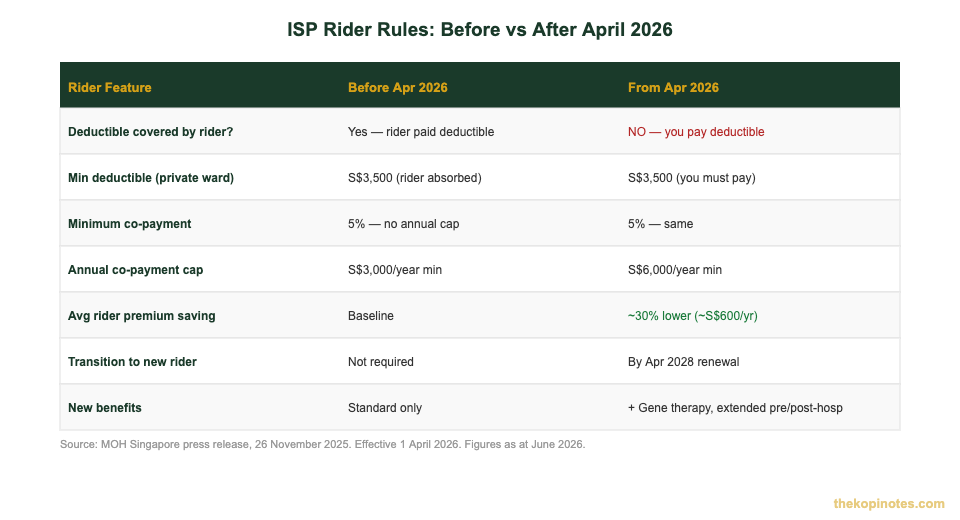
Source: MOH Singapore, 26 November 2025 press release. Effective 1 April 2026.
The core change: New riders sold from 1 April 2026 can no longer cover the minimum deductible. You must pay at least S$3,500 out of pocket (from Medisave) before the rider kicks in for private hospital stays.
The co-pay cap: The annual co-payment cap rose from S$3,000 to S$6,000. This cap applies to panel or pre-authorised claims only, and excludes the deductible itself.
The good news: Rider premiums dropped by about 30% on average. For private hospital riders, that is roughly S$600 per year in cash savings. For public hospital riders, about S$200 per year.
Transition rules: If you bought a rider before 27 November 2025, you are grandfathered. Policies bought between 27 November 2025 and 31 March 2026 must switch to new-compliant riders no later than their first renewal after 1 April 2028.
Why did MOH do this? Data showed that private hospital ISP policyholders with riders were 1.4 times as likely to make a claim, with average claim sizes 1.4 times larger than those without riders. Comprehensive “last-dollar” coverage was driving over-servicing. The reforms restore cost discipline without leaving policyholders exposed to catastrophic bills.
Using Medisave for Both MediShield Life and ISP
One of the most confusing parts of the system is knowing what you can pay with Medisave. Here is a clean breakdown.
| Payment Item | Medisave OK? | Limit / Notes |
|---|---|---|
| MediShield Life premiums | ✅ Yes (automatic) | Auto-deducted from Medisave annually |
| ISP premiums (within AWL) | ✅ Yes | AWL: S$300–S$900/yr depending on age |
| ISP premiums above AWL | ❌ Cash only | Pay excess via GIRO or cash |
| ISP Rider premiums | ❌ Cash only | 100% cash — no Medisave allowed |
| Deductible (hospitalisation) | ✅ Yes | Subject to Medisave withdrawal limits |
| Co-payments (ISP claims) | ✅ Yes | Subject to Medisave withdrawal limits |
Source: CPF Board, MOH Singapore, June 2026. AWL = Additional Withdrawal Limit set annually by MOH.
The AWL for 2026 ranges from S$300/year for those under 40 to S$900/year for those aged 80 and above. Your insurer handles the Medisave deduction automatically — you do not manually transfer funds.
For broader financial planning, pair your ISP with a Singapore retirement planning calculator to estimate how much to set aside for healthcare costs in your 60s and 70s, when ISP premiums are highest.
Do You Need an ISP on Top of MediShield Life?
MediShield Life alone provides solid base protection. You will not face catastrophic bills for subsidised public hospital stays. But you give up choice, comfort, and speed of access.
You should seriously consider an ISP if you want private hospital access, are self-employed with no employer group insurance, have dependants who depend on your financial stability, or simply want a known ceiling on your worst-case out-of-pocket costs.
Some Singaporeans skip the rider and invest the premium savings instead — through Endowus or low-cost ETFs. With 2026 rider premiums now 30% lower, the maths has shifted. A private hospital rider has become more accessible for people who previously could not justify the cost.
One key point: employer group insurance is tied to your job. If you leave or are retrenched, you lose that cover immediately. An ISP is portable and renews regardless of employment. This matters most as you approach your 50s and 60s — when switching insurers becomes expensive and pre-existing conditions accumulate.
See our MOH integrated shield plan guide for the official comparison of all seven plans, and our new ISP rider rules 2026 deep dive for the full details on the April 2026 changes.
Beyond health insurance, building a healthy investment portfolio matters equally. A Syfe referral code gets you a sign-up bonus, while our CPF investment strategy guide shows how to put idle Medisave and OA savings to work within CPF rules.
Disclaimer: This article is for educational purposes only and does not constitute financial or insurance advice. Figures accurate as at June 2026 and subject to change. Consult a licensed financial adviser before purchasing any insurance product.
Frequently Asked Questions
What is the difference between MediShield Life and an Integrated Shield Plan?
MediShield Life is compulsory for all Singapore Citizens and PRs — it covers subsidised B2 and C-ward hospitalisation at public hospitals with an annual claim limit of S$150,000. An ISP is optional. It tops up MediShield Life to extend coverage to A-ward or private hospital stays, with higher annual claim limits up to S$2 million. The two work as one “integrated” policy — MediShield Life pays first, then the ISP covers the remainder. You cannot replace MediShield Life with an ISP; they are complementary layers.
Do I need an ISP if I already have MediShield Life?
Not necessarily. MediShield Life alone is sufficient if you are comfortable with subsidised B2/C-ward care in a public hospital. Clinical quality is world-class regardless of ward type — the difference is mainly privacy, waiting time, and specialist choice. You should consider an ISP if you want private hospital access, are self-employed, have dependants, or want greater certainty about your maximum out-of-pocket costs.
What changed with ISP riders in April 2026?
From 1 April 2026, new ISP riders sold in Singapore can no longer cover the minimum deductible set by MOH. The minimum deductible for private hospital stays is S$3,500 — you must pay this from Medisave or cash before the rider applies. The annual co-payment cap also rose from a minimum of S$3,000 to S$6,000. In exchange, average rider premiums fell by about 30%, saving private hospital policyholders roughly S$600 per year. Existing riders bought before 27 November 2025 are grandfathered until at least April 2028.
Can I use Medisave to pay for both MediShield Life and my ISP?
Yes — both MediShield Life premiums and ISP premiums are payable from Medisave, up to the Additional Withdrawal Limit (AWL). The AWL ranges from S$300 to S$900 per year depending on your age. Amounts above the AWL must be paid in cash. ISP riders are not Medisave-eligible — rider premiums are fully cash. Your insurer handles the Medisave deduction automatically each year.
What is the minimum deductible for an ISP in 2026?
The minimum deductible depends on your ward class. For private and A-ward stays, the 2026 minimum is S$3,500 per policy year. For B1 wards it is S$2,500. For B2 wards S$2,000. For C wards S$1,500. The deductible resets each policy year — multiple bills in the same year count cumulatively toward it. Deductibles are payable via Medisave.
Should I switch to a new 2026 ISP rider or keep my old one?
If you are healthy and hospitalised infrequently, switching to a 2026 rider likely saves you money. The average 60-year-old saves S$1,600/year in rider premiums — enough to offset the higher co-pay over multiple years without hospitalisation. If you have a known condition requiring regular hospital stays, run the numbers carefully. The higher deductible (S$3,500) and raised co-pay cap (S$6,000) may mean you pay more per admission. Consult a licensed financial adviser before switching. Existing grandfathered riders do not need to switch until after April 2028 renewal.
How does the insurer know how much MediShield Life paid?
When you are discharged, your hospital submits the claim to both CPF Board (for MediShield Life) and your ISP insurer simultaneously. The insurer receives the MediShield Life payout information and automatically calculates the remaining balance under your ISP policy. You typically receive one bill showing the net amount due from you, after both layers are deducted. The process is largely seamless — you do not manage separate claims.
Protect Your Health. Grow Your Savings.
Once your ISP is sorted, put your savings to work. Use our referral codes for sign-up bonuses.
Get Free Insurance Advice
Speak with a licensed insurance advisor. No obligation, no cost.
By submitting this form, you agree to our Privacy Policy.
This article was researched with the help of AI. While we strive to keep all information accurate and up to date, there may be errors. If you notice any discrepancies, please contact us.