Revolut Singapore Review 2026: Is It Worth It for Travellers?
Zero FX fees, real interbank rates, and a free card — here’s the full Singapore verdict.
Revolut is a UK-founded digital finance app available in Singapore that gives you a multi-currency account, a Visa debit card, and interbank FX rates with no markup on weekdays. You can spend in over 150 currencies abroad, hold SGD and foreign currencies in the same app, and send money internationally at competitive rates — all with no annual card fee on the Standard (free) plan.
Not financial advice. All figures are for educational reference only. Data as at June 2026 unless noted.
- Revolut gives you interbank FX rates (0% markup on weekdays) — much better than any Singapore bank card
- The free Standard plan is sufficient for most occasional travellers spending under SGD 3,000/month in foreign currency
- For heavy travellers, YouTrip offers unlimited 0% FX with no weekend surcharge — a simpler alternative
What Is Revolut?
Revolut started in the UK in 2015 as a travel money card and has grown into one of the world’s largest neobanks, with over 50 million customers globally. In Singapore, Revolut operates under a Major Payment Institution (MPI) licence issued by the Monetary Authority of Singapore (MAS), meaning it’s a regulated financial institution — not a fly-by-night app.
The core product is simple: you download the Revolut app, sign up, and receive a Visa debit card (physical or virtual). You top up the card from your Singapore bank account. Then, when you spend overseas — whether in Japan, Europe, the US, or Malaysia — Revolut converts your SGD at the real interbank exchange rate, with zero markup on weekday transactions under the Standard plan’s monthly FX allowance.
Beyond travel, Revolut also offers stock trading, cryptocurrency, savings vaults, and international transfers. But for most Singapore users, the travel FX feature is the headline draw. That’s what we’ll focus on in this review.
Key Facts at a Glance
| Feature | Detail |
|---|---|
| Card Type | Visa debit (physical + virtual) |
| Annual Fee | Free (Standard plan) |
| FX Markup (Weekdays) | 0% up to SGD 3,000/month (Standard) |
| FX Markup (Weekends) | 0.5–1% surcharge (Standard plan) |
| Currencies Supported | 150+ |
| MAS Licensed | Yes — Major Payment Institution (MPI) |
| ATM Withdrawals (Free) | SGD 350/month (Standard), then 2% fee |
| International Transfers | Yes — competitive rates, fee varies by destination |
| Referral Code | Available in-app — both parties earn rewards |
Source: Revolut Singapore published terms, June 2026. Always verify current limits at Revolut’s official site.
Revolut Plans in Singapore: Free vs Paid
Revolut offers three main tiers in Singapore. The free Standard plan works well for most occasional travellers. Here’s how they compare:
| Feature | Standard (Free) | Premium (~SGD 9.99/mo) | Metal (~SGD 19.99/mo) |
|---|---|---|---|
| Monthly FX Limit (0% markup) | SGD 3,000 | Unlimited | Unlimited |
| ATM Free Withdrawal | SGD 350/mo | SGD 700/mo | SGD 1,400/mo |
| Travel Insurance | None | Medical + delay cover | Comprehensive |
| Lounge Access | None | None | Limited (LoungeKey) |
| Card Design | Standard Visa (white) | Premium (black) | Metal card |
Source: Revolut Singapore pricing page, June 2026. Prices and benefits subject to change.
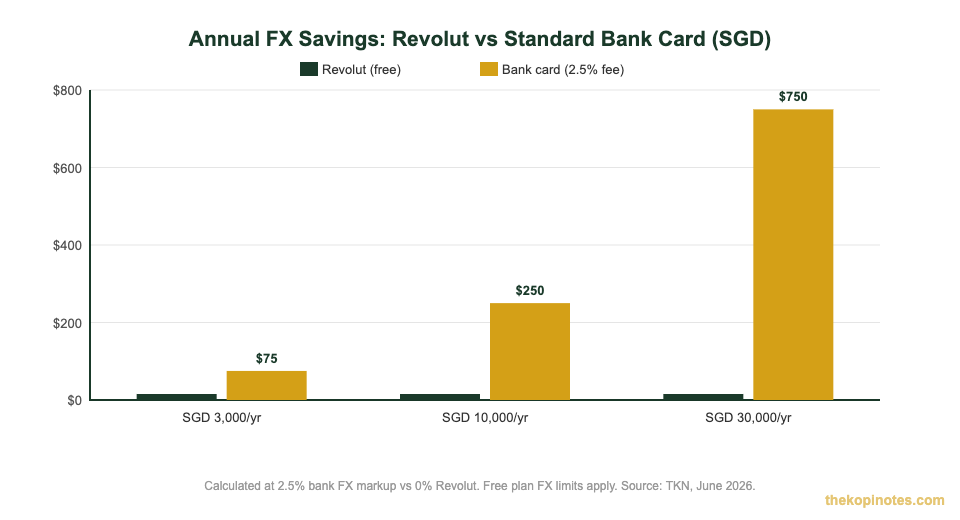
For most Singapore travellers, the free Standard plan is all you need. The SGD 3,000/month FX limit covers a typical 1–2 week holiday spend. If you’re a frequent traveller spending more than SGD 3,000/month overseas, the Premium plan pays for itself through savings alone — at a 2.5% bank card markup, SGD 3,000 extra spend would cost you SGD 75 in unnecessary fees.
FX Rates and Fees Explained
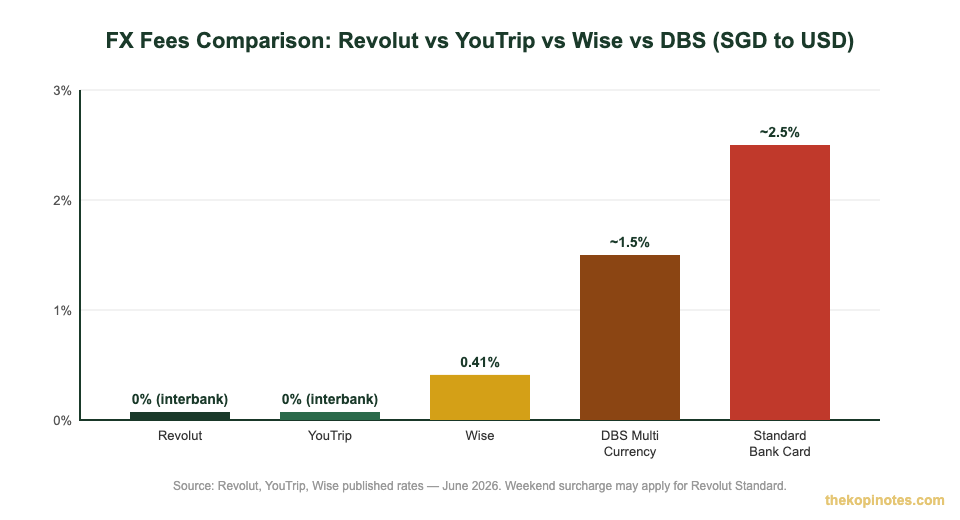
This is where Revolut shines for Singapore users. Most Singapore bank cards charge an FX conversion fee of 1.5%–3.5% on top of the exchange rate whenever you spend in a foreign currency. On SGD 10,000 of overseas spending per year, that’s SGD 150–350 quietly disappearing from your pocket.
Revolut uses the interbank mid-market rate — also called the “real” exchange rate you see on Google or XE.com. There’s no hidden markup built into the rate itself. You pay what the market rate says, nothing more.
However, there are two caveats to know:
Weekend surcharge: Revolut adds a 0.5%–1% surcharge on FX conversions during weekends (Saturday midnight to Sunday midnight UTC). This is because interbank FX markets are closed on weekends, so Revolut quotes a slightly wider rate to protect itself from Monday gap risk. If you’re spending heavily abroad on a weekend, convert your currency manually to SGD in the app beforehand — this locks in Friday’s rate.
Monthly FX limit (Standard plan): Free users get 0% FX on the first SGD 3,000 converted per calendar month. Beyond that, a 0.5% fee applies. For most holiday spends, SGD 3,000 is more than enough. But if you’re doing a long trip or have heavy overseas business expenses, upgrade to Premium.
Compare this to a typical Singapore bank card that charges you via the Singapore Savings Bonds guide or the moomoo Singapore review — the savings add up fast. For a SGD 10,000/year overseas spender, Revolut saves you around SGD 200–300 compared to a standard bank card with a 2.5% FX fee.
Revolut vs YouTrip vs Wise: Which Is Better for Singapore Travellers?
This is the question most Singapore users ask. All three offer 0% FX markup on weekday transactions. The differences come down to features, limits, and use cases.
| Feature | Revolut Standard | YouTrip | Wise |
|---|---|---|---|
| Annual Fee | Free | Free | Free (card delivery fee ~SGD 14) |
| FX Markup (Weekday) | 0% (up to SGD 3k/mo) | 0% (unlimited) | 0.41%–1.78% |
| Weekend Surcharge | 0.5%–1% | None | None |
| ATM Free Withdrawal | SGD 350/mo | SGD 400/mo | SGD 350/mo (2 withdrawals) |
| International Transfers | Yes | No | Yes — Wise’s core feature |
| Stock / Crypto Trading | Yes | No | No |
| Best For | Frequent travellers who want an all-in-one app | Simple, no-fuss travel card — great for beginners | International money transfers, freelancers paid in USD |
Source: Revolut, YouTrip, Wise published Singapore terms, June 2026. Rates subject to change.
The bottom line: If you want a pure, simple travel card with no monthly limits and no weekend surprises, YouTrip is hard to beat. If you want a full financial super-app — with transfers, trading, and premium insurance — Revolut’s paid plans pull ahead. Wise is best if you frequently receive or send money internationally.
For most Singapore travellers comparing Revolut vs YouTrip, the free tiers are comparable. YouTrip wins on simplicity (no FX limits, no weekend fee). Revolut wins on breadth (more features in one app). If you can only pick one card for a holiday, flip a coin — both will save you money versus any local bank card. Many Singapore travellers carry both and use whichever is topped up.
If you’re building a wider investment portfolio alongside your travel spending, you may also want to consider a Singapore retirement calculator to see how much your FX savings could compound over time when invested systematically.
How to Sign Up for Revolut in Singapore (Step-by-Step)
Getting started with Revolut takes about 10 minutes. Here’s exactly what to do:
Step 1: Download the Revolut app. Search “Revolut” in the App Store or Google Play. Install and open it.
Step 2: Enter your Singapore mobile number. Revolut will send you an SMS OTP to verify.
Step 3: Complete identity verification. You’ll need to upload a photo of your NRIC or passport, then take a selfie for facial recognition. This is a MAS-required Know Your Customer (KYC) check. It usually takes a few minutes to a few hours.
Step 4: Choose your plan. Select the free Standard plan to start. You can always upgrade later. Revolut will ask if you want to add your referral code here — use a friend’s code (or share yours) to earn bonus rewards.
Step 5: Order your physical card. The Revolut physical card is free on Standard. Delivery to Singapore takes 5–10 business days. You’ll also get an instant virtual card you can add to Apple Pay or Google Pay immediately.
Step 6: Top up via PayNow or bank transfer. Link your Singapore bank account. Use PayNow (instant, free) to top up SGD into your Revolut account. Set aside the amount you plan to spend overseas, or top up as needed.
Step 7: Spend abroad. Use your Revolut card anywhere Visa is accepted. Revolut auto-converts your SGD at the interbank rate. For manual control, you can pre-convert currencies in the app before you travel — useful for locking in a good rate or avoiding the weekend surcharge.
For comparison, you can sign up for Syfe to invest the FX savings you accumulate over time — a good habit for building long-term wealth.
Who Should Use Revolut in Singapore?
Revolut makes sense if you:
- Travel internationally at least 2–3 times a year and want to avoid bank card FX fees
- Want one app for FX spending, international transfers, stock trading, and savings — rather than separate apps for each
- Travel frequently on weekends but remember to pre-convert currency beforehand to avoid the weekend surcharge
- Need to send money to family overseas (e.g. remittance to Malaysia, Philippines, or India) at competitive rates
- Want the option to trade US stocks or crypto without opening a separate brokerage
Consider alternatives if you:
- Want the absolute simplest travel card with no limits or weekend surprises → YouTrip is a better fit
- Frequently send large sums internationally and want the best transfer rates → Wise specialises in this
- Prefer a card that earns miles or cashback on overseas spending → a premium travel credit card from DBS, UOB, or OCBC may serve you better (though they charge FX fees)
- Don’t travel often enough to justify carrying an extra card
Revolut is also not a full bank replacement in Singapore — it doesn’t offer SDIC-insured deposits the way DBS or OCBC does. Keep your emergency fund and salary in a local bank. Use Revolut for what it’s designed for: efficient foreign currency spending.
If you’re building your broader financial picture, check out our guide to CPF investment strategy and the passive income Singapore guide for ideas on making your savings work harder.
Disclaimer: This article is for educational purposes only and does not constitute financial advice. FX rates, fees, and plan features are subject to change. Always verify current terms on Revolut’s official website before signing up.
Frequently Asked Questions
Is Revolut safe to use in Singapore?
Yes. Revolut holds a Major Payment Institution (MPI) licence issued by the Monetary Authority of Singapore (MAS), which means it’s regulated and subject to MAS oversight. However, Revolut is not a bank — your funds are not covered by the Singapore Deposit Insurance Corporation (SDIC) in the way DBS or OCBC deposits are. Revolut is required under its MPI licence to safeguard customer funds in a segregated account. Keep large savings in an SDIC-insured bank account and use Revolut for day-to-day travel spending.
Is the Revolut Standard plan really free?
Yes — the Standard plan has no monthly fee and no annual card fee. You get a free physical Visa card delivered to Singapore, 0% FX markup on weekday transactions up to SGD 3,000 per month, and up to SGD 350 in free ATM withdrawals per month. After these limits, small fees apply (0.5% for excess FX, 2% for excess ATM withdrawals). For most occasional travellers, the free plan covers everything without any charges.
Does Revolut charge fees on weekends?
Yes — on the Standard and some paid plans, Revolut charges a weekend FX surcharge of approximately 0.5%–1% on foreign currency transactions made during the weekend (Saturday midnight to Sunday midnight UTC, which is approximately Saturday 8am to Monday 8am Singapore time). To avoid this, you can manually convert your SGD to the destination currency in the Revolut app before the weekend while rates are at the interbank rate. This locks in the weekday rate for your weekend spending.
Revolut vs YouTrip — which is better for Singapore travellers?
Both are excellent free travel cards with 0% FX markup. YouTrip has the edge for simplicity — no monthly FX limits and no weekend surcharge, making it truly zero-fee for any amount of overseas spending. Revolut wins on features — international transfers, stock trading, savings vaults, and paid plans with travel insurance. If you want a simple travel card, YouTrip is slightly better. If you want an all-in-one financial app, Revolut’s paid tiers pull ahead. Many Singapore travellers carry both.
Can I use Revolut in Malaysia, Japan, and other Asian countries?
Yes — Revolut’s Visa card works wherever Visa is accepted, which covers over 200 countries and territories including Malaysia, Japan, Thailand, Indonesia, South Korea, and most of Europe. FX conversion happens automatically at the interbank rate. For Malaysia specifically, Revolut converts SGD to MYR at the mid-market rate, which is typically better than money changers at Singapore’s land checkpoints. For China, note that Visa acceptance can be limited at smaller merchants — carrying some CNY cash as backup is advisable.
How do I top up Revolut in Singapore?
The easiest way is via PayNow — it’s instant and free. Open the Revolut app, tap “Add Money”, select PayNow, and scan the QR code with your Singapore banking app. You can also top up via local bank transfer (FAST), which typically arrives within a few minutes. Revolut does not currently support credit card top-ups in Singapore (to prevent misuse). Keep enough SGD in your Revolut account before you travel — topping up works fine from overseas via the app, but internet access is needed.
Save Money on Every Trip
Sign up for Revolut or YouTrip today and stop paying FX fees to your bank. Then invest the savings.
This article was researched with the help of AI. While we strive to keep all information accurate and up to date, there may be errors. If you notice any discrepancies, please contact us.