Covered Call Strategy: The Beginner’s Guide to Earning Premium Income
Learn how to sell covered calls on stocks you own to generate consistent monthly income.
A covered call is when you sell a call option against shares you already own. You collect the option premium as immediate income. In exchange, you agree to sell your shares at the strike price if the stock rises above it by expiration. It is the most popular options income strategy, widely considered the safest starting point for beginners, and is approved for retirement accounts at most brokers. Covered calls work best when you expect the stock to stay flat or rise only modestly.
Not financial advice. All figures are for educational reference only. Data as at June 2026 unless noted.
- Sell a call option against 100 shares you own — collect the premium as income immediately
- Your upside is capped at the strike price, but the premium lowers your cost basis and cushions downside
- Target 1-3% monthly return by selling calls 5-10% out of the money with 30-45 days to expiration
Table of Contents
What Is a Covered Call?
A covered call is a two-part position: you own 100 shares of a stock (the “cover”), and you sell one call option against those shares. The call gives the buyer the right to purchase your shares at the strike price before the option expires. In return, you receive the option premium — cash deposited into your account immediately.
The word “covered” is important. It means your obligation to sell shares is backed by shares you already own. This is completely different from selling a “naked” call, where you sell a call without owning the underlying shares — which carries theoretically unlimited risk. Covered calls are one of the safest options strategies because your risk profile is the same as owning the stock, minus the premium received.
Here is a simple analogy: imagine you own a house worth $500,000. A buyer offers you $5,000 for the right to buy your house at $550,000 within the next 60 days. If the house stays below $550,000, you keep the $5,000 and your house. If it rises above $550,000, you sell at $550,000 — a nice profit, though you miss any gains above that. Either way, you got paid $5,000 just for agreeing to the deal. That is a covered call.
If you are brand new to options, read our options trading beginner’s guide first to understand the fundamental concepts.
How a Covered Call Works (Step by Step)
Step 1: Own 100 shares. You must own at least 100 shares of the stock (options trade in blocks of 100). If you own 300 shares, you can sell up to 3 covered calls.
Step 2: Choose a strike price. Select a strike price above the current stock price. This is the price at which you agree to sell your shares if the option is exercised. A higher strike gives you more room for the stock to appreciate, but the premium is smaller. A lower strike generates more premium but increases the chance your shares are called away.
Step 3: Choose an expiration date. Select how long until the option expires. Most covered call sellers use 30-45 day expirations (monthly cycles) because this timeframe captures the most aggressive portion of theta decay — meaning the option loses time value fastest, which benefits you as the seller.
Step 4: Sell the call option. Place a “Sell to Open” order for one call contract at your chosen strike and expiration. The premium is credited to your account immediately. Your brokerage will show this as a short option position.
Step 5: Wait and manage. One of three things happens at expiration. If the stock stays below the strike, the option expires worthless — you keep the premium and your shares, and can sell another call. If the stock rises above the strike, your shares are “called away” — you sell at the strike price and keep the premium. If you want to avoid assignment, you can “roll” the call (buy it back and sell a new one at a later date or higher strike).
Worked Example with Real Numbers
Let us walk through a specific example to make this concrete.
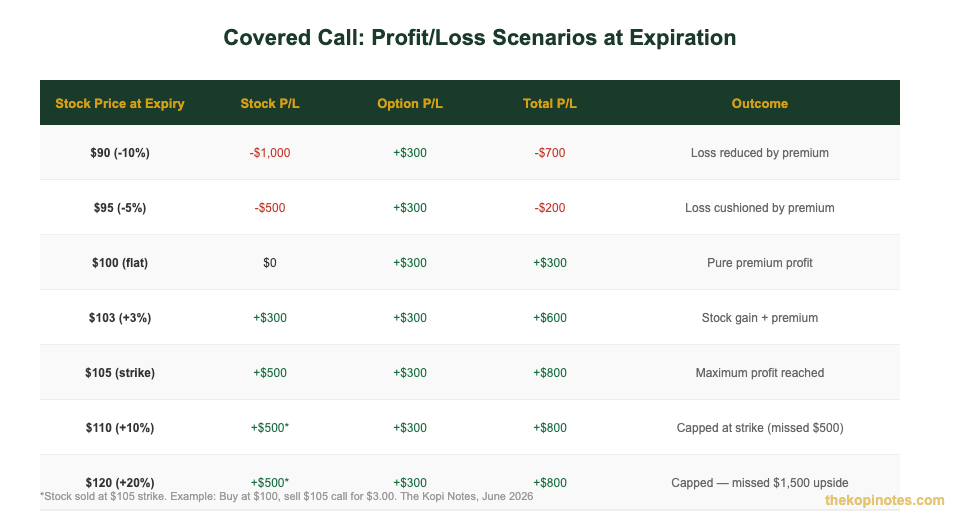
You own 100 shares of a stock trading at $100. You sell one $105 call option expiring in 35 days for $3.00 per share. You immediately receive $300 (100 shares × $3.00) deposited into your account.
Scenario 1 — Stock stays at $100: The call expires worthless. You keep your 100 shares and the $300 premium. Your effective cost basis is now $97 per share. You can sell another call next month. Annualised, this 3% monthly return works out to roughly 36% per year.
Scenario 2 — Stock rises to $103: The call still expires worthless (stock is below the $105 strike). You keep the shares, the $300 premium, and your shares are now worth $300 more. Total gain: $600 (stock appreciation + premium).
Scenario 3 — Stock rises to $110: Your shares are called away at $105. You sell for $105 per share and keep the $3 premium. Total per share: $108 ($105 + $3). On a $100 cost basis, that is an $800 profit. However, if you had not sold the call, you would have made $1,000 (stock going to $110). You gave up $200 of potential upside in exchange for the guaranteed $300 premium.
Scenario 4 — Stock drops to $90: The call expires worthless — you keep the $300 premium. But your shares are now worth $9,000 (down from $10,000). Net loss: $700 ($1,000 stock loss minus $300 premium). Without the covered call, your loss would have been $1,000. The premium provided a $300 cushion.
| Stock at Expiry | Stock P/L | Premium | Total P/L | Outcome |
|---|---|---|---|---|
| $90 | -$1,000 | +$300 | -$700 | Loss cushioned |
| $100 | $0 | +$300 | +$300 | Pure premium profit |
| $105 | +$500 | +$300 | +$800 | Max profit |
| $115 | +$500* | +$300 | +$800 | Capped — missed $500 |
*Shares sold at $105 strike. Example: stock bought at $100, $105 call sold for $3.00. The Kopi Notes, June 2026
When to Use Covered Calls
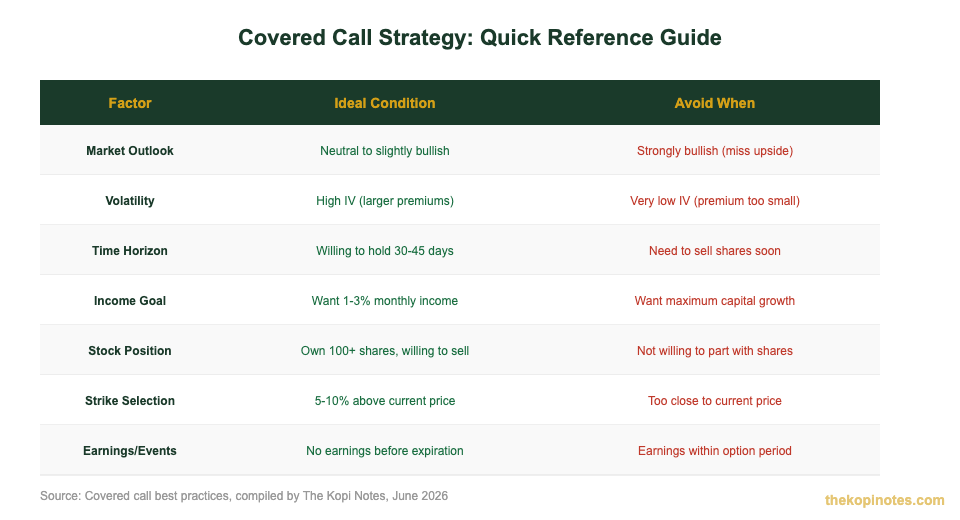
Covered calls work best in specific market conditions. Use them when you expect the stock to stay flat or rise only slightly over the option period. They are ideal in sideways, range-bound markets where the stock is not likely to make a big move in either direction.
They work especially well on stocks with high implied volatility, because higher volatility means larger premiums — and you want to collect as much premium as possible. Earnings season often inflates IV, but be careful selling calls that expire during or right after earnings — the gap risk is significant.
Do not use covered calls on stocks you expect to rise sharply. If you are very bullish on a stock, the covered call caps your upside at the strike price. In a strong bull market, covered calls underperform simply holding shares. They are an income tool, not a growth tool.
Also avoid covered calls on stocks you are thinking about selling anyway. If you want to exit a position, just sell the shares. Using a covered call to “get a better price” can backfire if the stock drops before your call expires. Our wheel strategy guide covers how covered calls fit into a broader income system alongside cash-secured puts.
Choosing Your Strike Price and Expiration
Strike price: The general rule for covered calls is to sell strikes 5-10% above the current stock price (out of the money). This gives you room for some stock appreciation before your shares get called away. In options terms, this corresponds to a delta of roughly 0.20-0.30.
If you want more premium, sell at-the-money calls (strike equal to current price). Delta around 0.50. More income, but much higher chance of assignment. If you want less risk of assignment, sell further out-of-the-money calls (10-15% above). Delta around 0.10-0.15. Less income, but you keep your shares more often.
Expiration: The 30-45 day sweet spot applies to covered calls just as it does to cash-secured puts. This timeframe gives you the best balance of premium collected per day of capital commitment. Weekly covered calls (7 DTE) generate less total premium per cycle and require more frequent management. Longer-dated calls (60+ days) tie up your position for too long relative to the premium received.
| Approach | Strike | Delta | Monthly Return | Assignment Risk |
|---|---|---|---|---|
| Conservative | 10%+ OTM | 0.10-0.15 | 0.5-1% | Low |
| Moderate | 5-10% OTM | 0.20-0.30 | 1-2% | Medium |
| Aggressive | ATM or slightly OTM | 0.40-0.50 | 2-4% | High |
Source: Covered call strike selection guide. Approximate returns vary by IV. The Kopi Notes, June 2026
What Happens If Your Shares Get Called Away
If the stock price is above your call strike at expiration, your shares will be automatically assigned. Your broker sells your 100 shares at the strike price. You keep all the premium you collected. This is not a disaster — you sold at a price you chose, collected premium on top, and locked in a profit.
After assignment, you have several options. You can start fresh by buying the stock back and selling another covered call. You can switch to selling cash-secured puts to get back into the stock at a lower price (this is the wheel strategy). Or you can move on to a different stock entirely.
The emotional trap to avoid is regret. If the stock rockets to $130 after your shares were called away at $105, it is tempting to feel you “lost” $25 per share. But you made a conscious decision to collect premium in exchange for capping your upside. As long as you are happy with the return you achieved, assignment is a success, not a failure.
Rolling Covered Calls
Rolling is the process of buying back your current call option and simultaneously selling a new one — typically at a later expiration date or a different strike price. You roll to avoid assignment, give the stock more time to recover, or lock in more premium.
Roll up and out: If the stock is approaching your strike and you do not want to be assigned, you can buy back the current call and sell a new one at a higher strike and later expiration. This costs you some of the current premium but gives you a higher sell price and more time.
Roll out: Keep the same strike but push to a later expiration. This works when the stock is hovering near your strike and you want to collect more time value without changing the assignment price.
Rolling is not free — it costs money to buy back the current option. Only roll if the math works: the additional premium received from the new call should exceed the cost of closing the old one. If it does not, consider letting assignment happen.
Pros and Cons of Covered Calls
Pros: You earn income on stocks you already own. The premium reduces your cost basis and provides a downside cushion. Covered calls are simple to execute and understand. They are approved for retirement accounts. They work well in flat and moderately bullish markets. You can repeat the strategy monthly for consistent income. When combined with cash-secured puts, covered calls form the wheel strategy — one of the most popular systematic income approaches.
Cons: Your upside is capped at the strike price — in a strong rally, you miss gains above the strike. The premium does not fully protect you in a large crash — your downside is still the stock going to zero (minus the premium). You need to own 100 shares, which requires meaningful capital. Frequent rolling can eat into your profits with transaction costs. In a strong bull market, covered call writers underperform buy-and-hold investors.
If you are looking for a broker with excellent covered call tools, Interactive Brokers offers low commissions and a powerful options chain interface. You can also model how covered call income fits into your long-term wealth plan using our retirement planning calculator.
Not financial advice. Covered calls involve risk of loss on the underlying shares. Past premium income does not guarantee future results. Consult a qualified financial advisor.
Frequently Asked Questions
What is a covered call in simple terms?
A covered call is when you sell someone the right to buy your shares at a specific price (the strike) before a certain date (expiration). In return, you get paid a premium immediately. If the stock stays below the strike, you keep the premium and your shares. If the stock rises above the strike, you sell your shares at that price and keep the premium. It is called “covered” because you already own the shares backing the contract.
How much can you make selling covered calls?
Most covered call sellers target 1-3% per month in premium income, or roughly 12-36% annualised. The actual return depends on the stock’s implied volatility, your strike selection, and market conditions. Higher-volatility stocks generate larger premiums. More conservative (further OTM) strikes generate less premium but have lower assignment risk. In low-volatility markets, monthly returns may be only 0.5-1%.
What happens when a covered call gets assigned?
When assigned, your broker automatically sells your 100 shares at the strike price. You keep all the premium you collected. Your net proceeds are the strike price plus the premium minus your original cost basis. Assignment is not a bad outcome — you sold at a price you chose and collected premium on top. After assignment, you can restart the cycle by selling cash-secured puts or buying the stock back.
Can I sell covered calls in a retirement account?
Yes. Covered calls are classified as a Level 1 options strategy — the most conservative tier — and are approved for most retirement accounts including IRAs, Roth IRAs, and 401(k) plans. You do not need margin to sell covered calls because your shares serve as collateral. Check with your specific broker for their options approval requirements.
What is the biggest risk of covered calls?
The biggest risk is a large drop in the underlying stock price. The premium you collect only provides a small cushion (typically 2-5%). If the stock drops 20% or more, the premium does not offset the loss. The other risk is opportunity cost — if the stock surges past your strike, you miss out on gains above that level. Neither risk is unique to covered calls; they are inherent to stock ownership.
Should I sell covered calls weekly or monthly?
Monthly options (30-45 DTE) are preferred by most covered call sellers. They capture the fastest portion of theta decay, generate more total premium per cycle than weeklies, and require less frequent management. Weekly covered calls can work for experienced traders who want tighter control, but the premium per day is slightly lower and transaction costs add up. Start with monthly expirations.
Continue Learning Options Strategies
Master the fundamentals first, then explore more advanced income strategies.
This article was researched with the help of AI. While we strive to keep all information accurate and up to date, there may be errors. If you notice any discrepancies, please contact us.