The Wheel Strategy Explained: How to Generate Income with Options
A step-by-step guide to the wheel — the most popular options income strategy for patient investors.
The wheel strategy is a systematic options income approach that combines selling cash-secured puts and covered calls in a repeating cycle. You sell puts on stocks you want to own, collect premium while waiting, get assigned shares when the price drops, then sell covered calls against those shares to collect more premium. When shares are called away, you restart the cycle. The wheel generates income at every stage and works best on stable, dividend-paying stocks you are comfortable holding long-term.
Not financial advice. All figures are for educational reference only. Data as at June 2026 unless noted.
- The wheel strategy cycles between selling cash-secured puts and covered calls, collecting premium at every step
- You only use it on stocks you genuinely want to own at the put strike price — it is not a strategy for speculative tickers
- Typical annualised returns range from 10-25% depending on the stock, strike selection, and market conditions
Table of Contents
What Is the Wheel Strategy?
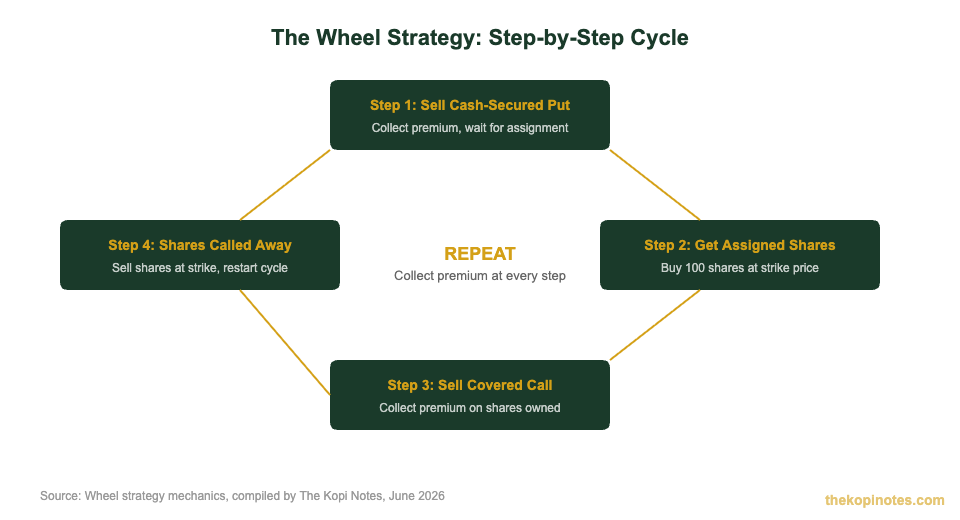
The wheel strategy is an options income strategy that generates premium by systematically selling cash-secured puts and covered calls on stocks you are willing to own. It is called the “wheel” because it operates in a continuous cycle — selling puts, getting assigned, selling calls, getting called away, and starting over.
Unlike speculative options trading, the wheel is a patient, income-focused approach. You are not trying to predict short-term price movements. Instead, you are getting paid (through premium) to buy stocks at prices you like and sell them at prices you are happy with. The premium you collect at each stage reduces your cost basis and generates income regardless of whether the stock goes up, down, or sideways.
The wheel is particularly popular among investors who want to earn consistent income from their brokerage accounts without actively day trading. It works on any optionable stock, but it is most effective on stable, high-quality companies with reasonable implied volatility. If you are new to options, read our options trading beginner’s guide first to understand the fundamentals.
How the Wheel Strategy Works (Step by Step)
The wheel has four distinct phases. Here is exactly how each one works.
Phase 1: Sell a cash-secured put. You choose a stock you want to own and sell a put option at a strike price below the current market price. You must keep enough cash in your account to buy 100 shares at the strike price (hence “cash-secured”). You collect the premium immediately. If the stock stays above your strike price at expiration, the put expires worthless and you keep the entire premium as profit. You can then sell another put and repeat.
Phase 2: Get assigned. If the stock drops below your strike price, you get assigned — meaning you are obligated to buy 100 shares at the strike price. This is not a bad thing. You chose this strike because it is a price you wanted to buy at. Plus, your effective cost basis is the strike price minus all the premium you have collected so far.
Phase 3: Sell a covered call. Now that you own the shares, you sell a call option at a strike price above your cost basis. You collect more premium. If the stock stays below the call strike at expiration, the call expires worthless and you keep the premium. You can sell another call and repeat. Meanwhile, you also collect any dividends the stock pays.
Phase 4: Shares called away. If the stock rises above your call strike, your shares are “called away” — you sell them at the strike price. You keep all the premium collected from both the put and call phases, plus any capital gain between your purchase price and the call strike. The cycle is complete. You now have cash again and can start a new wheel by selling another cash-secured put.
Worked Example: Running the Wheel on a $50 Stock
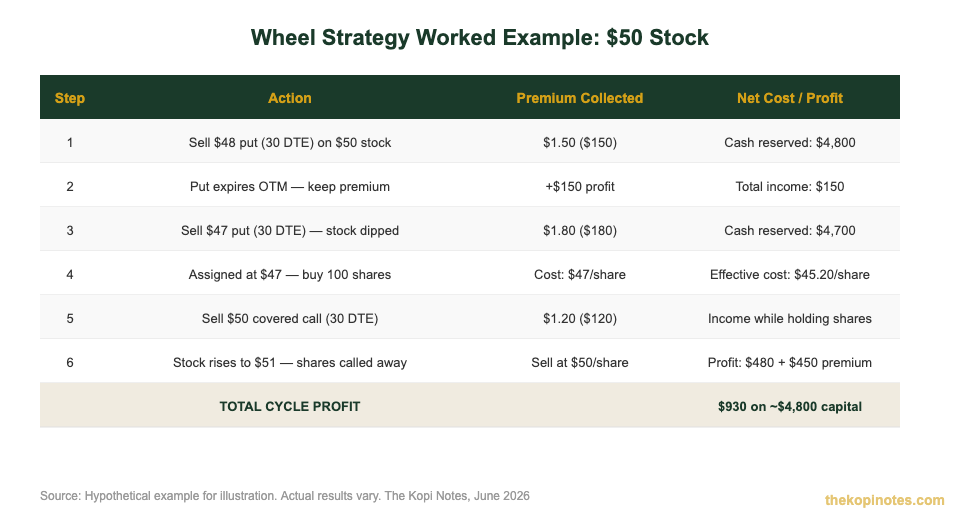
Let us walk through a complete wheel cycle on a hypothetical stock trading at $50. This example uses realistic premium levels for a mid-cap stock with moderate implied volatility.
Round 1 — Sell cash-secured put: You sell a $48 put expiring in 30 days for $1.50 per share ($150 per contract). You set aside $4,800 in cash as collateral. The stock stays above $48 at expiration. The put expires worthless. You keep $150.
Round 2 — Sell another put: The stock has dipped to $49. You sell a $47 put for $1.80 ($180). The stock drops to $46 at expiration. You are assigned — you buy 100 shares at $47. Your effective cost basis is $47 minus the $1.80 premium = $45.20 per share. Including the $150 from Round 1, your net cost is even lower.
Round 3 — Sell covered call: You now own 100 shares. The stock is at $47. You sell a $50 covered call expiring in 30 days for $1.20 ($120). The stock rises to $51 over the month.
Round 4 — Shares called away: Your shares are called away at $50. You sell 100 shares at $50, having bought them at an effective cost of $45.20. Capital gain: $480. Total premium collected across all rounds: $450 ($150 + $180 + $120). Total profit from this complete cycle: $930 on roughly $4,800 of capital.
| Step | Action | Premium | Running Total |
|---|---|---|---|
| 1 | Sell $48 put — expires OTM | +$150 | $150 |
| 2 | Sell $47 put — assigned at $47 | +$180 | $330 |
| 3 | Sell $50 covered call — called away | +$120 | $450 |
| 4 | Capital gain ($50 – $47) × 100 | +$300 | $750 |
| Total Cycle Profit (~3 months) | $750 on $4,800 capital |
Source: Hypothetical example for illustration only. Actual results will vary. The Kopi Notes, June 2026
That is approximately 15.6% return over roughly 3 months — or about 60% annualised if repeated consistently. In practice, not every cycle will be this smooth. Some rounds the stock may drop significantly after assignment, requiring you to sell calls below your cost basis or hold patiently. The wheel rewards patience.
How to Pick Stocks for the Wheel
Stock selection is the single most important decision in the wheel strategy. The rule is simple: only run the wheel on stocks you genuinely want to own at the put strike price. If you would not be happy holding the stock for 6-12 months through a downturn, do not sell puts on it.
Here are the characteristics of ideal wheel stocks. They should be fundamentally strong companies with consistent earnings and revenue growth — think blue chips, not meme stocks. They should have moderate implied volatility (20-40%) to generate decent premium without excessive risk. They should be optionable with liquid options chains (tight bid-ask spreads, high open interest). A stock price between $20 and $200 per contract keeps capital requirements manageable. Dividend-paying stocks are a bonus — you collect dividends while running covered calls.
Popular wheel stocks include names like Apple (AAPL), Microsoft (MSFT), AMD, and many quality ETFs like SPY, QQQ, and IWM. Avoid running the wheel on highly volatile stocks, penny stocks, or biotech companies with binary event risk. You can use a platform like Interactive Brokers which has excellent tools for scanning and filtering options chains.
Choosing Strikes and Expirations
Put strike selection: Most wheel traders sell puts at the 0.20-0.30 delta range, which typically corresponds to strikes 5-10% below the current stock price. This gives you a margin of safety — the stock can drop a bit and your put still expires worthless. Higher deltas (closer to the money) generate more premium but increase your chance of assignment.
Call strike selection: After assignment, sell calls at or above your cost basis. Many traders target the 0.25-0.35 delta range for covered calls. If the stock dropped significantly after assignment, you may need to sell calls at a lower strike to generate meaningful premium — but never below your cost basis unless you are willing to realise a loss on the shares.
Expiration timing: The sweet spot for the wheel is 30-45 days to expiration (DTE). This timeframe captures the steepest part of the theta decay curve — meaning time value erodes fastest in this window, benefiting you as the seller. Weeklies (7 DTE) generate less total premium per cycle. Options 60+ DTE tie up your capital for longer without proportionally more premium.
| Parameter | Recommended Range | Why |
|---|---|---|
| Put Delta | 0.20 – 0.30 | 70-80% probability of expiring OTM |
| Call Delta | 0.25 – 0.35 | Above cost basis, decent premium |
| Days to Expiration | 30 – 45 DTE | Optimal theta decay, manageable capital lock-up |
| Stock Price Range | $20 – $200 | $2k-$20k capital per contract |
| Implied Volatility | 20% – 40% | Enough premium without excessive risk |
Source: Wheel strategy parameters, compiled by The Kopi Notes, June 2026
Wheel Strategy Pros and Cons
Pros: The wheel generates income at every stage of the cycle — you never sit idle. It forces disciplined buying (at prices you are comfortable with) and selling (at prices you are happy with). It is one of the simplest multi-step options strategies to execute and is approved for most retirement accounts (IRA, 401k). The strategy works in flat, bullish, and mildly bearish markets. You also collect dividends while holding shares. For investors looking for consistent income, the wheel is one of the most reliable options approaches — and fits well alongside goals you might track in our retirement planning calculator.
Cons: The biggest risk is a large, sustained drop in the underlying stock after assignment. If you are assigned shares at $47 and the stock drops to $30, you are sitting on a significant unrealised loss — and you cannot sell covered calls above your cost basis without accepting a loss on the shares. The wheel also caps your upside — if the stock rockets higher after you sell a call, you miss the gains above the strike. It requires meaningful capital ($2,000-$20,000+ per stock depending on price). Finally, the wheel underperforms in a strong bull market compared to simply holding shares, because the covered calls cap your gains.
Risk Management for the Wheel
Diversify across multiple stocks. Do not run the wheel on just one stock. Spread your capital across 3-5 different wheel positions in different sectors. If one stock drops sharply, the others can offset the loss with continued premium income.
Size positions appropriately. No single wheel position should represent more than 20-25% of your options capital. If you have $50,000 allocated to the wheel strategy, each individual stock position should use no more than $10,000-$12,500.
Have a max loss rule. Decide in advance: at what point will you stop the wheel and cut your losses? A common rule is to close the position if the stock drops 20-25% below your cost basis. Taking a defined loss is better than hoping for a recovery that may not come.
Avoid earnings and binary events. Do not sell puts or calls with expirations that cross earnings dates, FDA decisions, or other binary events. The overnight gap risk is too high. Either close before the event or choose expirations that avoid it entirely.
Not financial advice. The wheel strategy involves risk of loss. Past performance of any strategy does not guarantee future results. Consult a qualified financial advisor.
Frequently Asked Questions
What is the wheel strategy in options trading?
The wheel strategy is an options income approach that cycles between selling cash-secured puts and covered calls. You sell puts on stocks you want to own, collect premium, get assigned shares when the price drops, then sell covered calls on those shares. When the shares are called away, you restart the cycle. It generates premium income at every stage.
How much capital do I need for the wheel strategy?
You need enough cash to buy 100 shares at the put strike price (since puts are cash-secured). For a $50 stock, that is $5,000 per contract. For a $100 stock, that is $10,000. Most practitioners run the wheel on 3-5 stocks simultaneously, so a practical minimum is $15,000-$25,000 to diversify properly. Lower-priced stocks ($20-$30) allow entry with less capital.
What are the best stocks for the wheel strategy?
The best wheel stocks are fundamentally strong companies you would be happy owning for 6-12 months. Look for: steady earnings growth, moderate implied volatility (20-40%), liquid options with tight bid-ask spreads, and ideally a dividend. Popular choices include Apple (AAPL), Microsoft (MSFT), AMD, and ETFs like SPY and QQQ. Avoid meme stocks, biotech, and anything with binary event risk.
What is the typical return from the wheel strategy?
Most experienced wheel traders report annualised returns of 10-25% from premium income alone, depending on market conditions, stock selection, and strike choices. In low-volatility markets, returns are lower because premiums are smaller. In high-volatility markets, premiums are larger but assignment risk increases. These returns are not guaranteed and actual results vary significantly.
What happens if the stock drops significantly after I get assigned?
This is the main risk of the wheel. If the stock drops well below your cost basis, you face an unrealised loss on the shares. You can continue selling covered calls for income, but may need to sell at lower strikes or wait for a recovery. This is exactly why stock selection matters — only run the wheel on stocks you would hold through a downturn. Having a maximum loss rule (e.g., close if stock drops 25% below cost basis) prevents catastrophic losses.
Can I run the wheel strategy in a retirement account?
Yes. Both cash-secured puts and covered calls are approved for most retirement accounts (IRA, 401k, Roth IRA) at most brokers. These are classified as Level 1 or Level 2 options strategies, which are the most conservative tiers. You cannot use margin or sell naked options in retirement accounts, but the wheel does not require either — it is fully cash-secured by design.
Learn More Options Strategies
The wheel is just one approach. Explore our full library of options guides.
This article was researched with the help of AI. While we strive to keep all information accurate and up to date, there may be errors. If you notice any discrepancies, please contact us.