Options Trading for Beginners: How It Works (Complete Guide)
Everything you need to know about options — calls, puts, pricing, strategies, and how to get started.
Options trading gives you the right to buy or sell a stock at a specific price before a specific date — without the obligation to do so. You pay a premium for this right. Call options profit when stocks rise. Put options profit when stocks fall. Used correctly, options can generate income, hedge your portfolio, or amplify returns with defined risk. This guide covers everything a beginner needs to know to start trading options confidently.
Not financial advice. All figures are for educational reference only. Data as at June 2026 unless noted.
- Options are contracts that give you the right (not obligation) to buy or sell stocks at a set price — calls for buying, puts for selling
- You can use options for income (covered calls), hedging (protective puts), or speculation — with risk limited to the premium you pay as a buyer
- Start with paper trading, learn the Greeks, and begin with simple strategies like covered calls or cash-secured puts before moving to spreads
Table of Contents
What Are Options?
An option is a financial contract between two parties. The buyer pays a premium and receives the right — but not the obligation — to buy or sell an underlying asset (usually a stock) at a predetermined price (the strike price) before a specific date (the expiration date).
Think of it like a deposit on a house. You pay a small amount upfront to lock in the purchase price. If the market moves in your favour, you exercise your right and complete the deal. If it moves against you, you walk away and lose only the deposit. That deposit is the option premium.
Options are traded on exchanges like the Chicago Board Options Exchange (CBOE) and are standardised contracts. Each contract represents 100 shares of the underlying stock. So if you buy one call option on Apple at $3.00 per share, you pay $300 total ($3.00 × 100 shares).
The options market has exploded in popularity. According to the Options Clearing Corporation, over 10 billion contracts traded in 2023 — more than double the volume from 2019. Retail investors now account for a significant portion of daily options volume, driven by commission-free trading and better educational resources.
Call Options vs Put Options
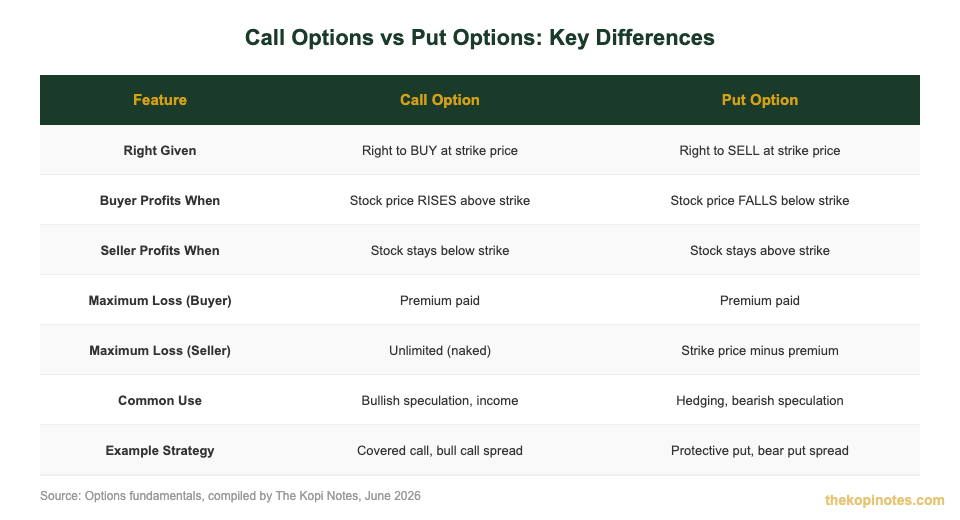
There are only two types of options. Understanding the difference is the foundation of everything that follows.
A call option gives you the right to buy 100 shares at the strike price. You buy a call when you think the stock will go up. For example, if you buy a call option on Apple with a $200 strike price and Apple rises to $220, you can exercise your right to buy at $200 and immediately sell at $220, pocketing $20 per share (minus the premium you paid).
A put option gives you the right to sell 100 shares at the strike price. You buy a put when you think the stock will go down, or when you want to protect shares you already own. If you own Apple shares and buy a $200 put, you are guaranteed the ability to sell at $200 no matter how far the stock falls. That is portfolio insurance.
| Feature | Call Option | Put Option |
|---|---|---|
| Right Given | Right to BUY at strike price | Right to SELL at strike price |
| Buyer Profits When | Stock price rises above strike + premium | Stock price falls below strike – premium |
| Max Loss (Buyer) | Premium paid | Premium paid |
| Max Profit (Buyer) | Unlimited (stock can rise indefinitely) | Strike price minus premium (stock goes to $0) |
| Seller Profits When | Stock stays at or below strike | Stock stays at or above strike |
| Common Strategy | Covered call, bull call spread | Protective put, cash-secured put |
Source: Options fundamentals, compiled by The Kopi Notes, June 2026
Here is the critical mental model: when you buy an option, your maximum loss is the premium. When you sell an option, your maximum loss can be much larger — theoretically unlimited for naked calls. This asymmetry is what makes options both powerful and dangerous.
How Options Pricing Works
The price you pay for an option (the premium) is determined by several factors. Understanding these helps you avoid overpaying and pick better trades.
Intrinsic value is the real, tangible value of an option if you exercised it right now. A call option with a $200 strike on a stock trading at $210 has $10 of intrinsic value. Only in-the-money options have intrinsic value. Out-of-the-money options have zero intrinsic value.
Time value (also called extrinsic value) is the extra premium above intrinsic value. It represents the possibility that the option could become more valuable before expiration. The more time until expiration, the higher the time value — because there is more opportunity for the stock to move.
Time value decays every single day. This is called theta decay, and it accelerates as expiration approaches. An option that is 60 days from expiration loses time value slowly. An option that is 7 days from expiration loses time value rapidly. This is why selling options can be profitable — you collect premium and benefit from time working in your favour.
Implied volatility (IV) also affects pricing significantly. When the market expects a stock to move a lot (earnings announcements, FDA decisions, etc.), option premiums increase. When volatility is low, premiums shrink. Buying options when IV is high means you are paying a lot for the possibility of movement. Selling options when IV is high means you collect larger premiums. This is one of the most important concepts to understand when using our retirement calculator to model how options income fits into long-term planning.
Key Options Trading Terminology
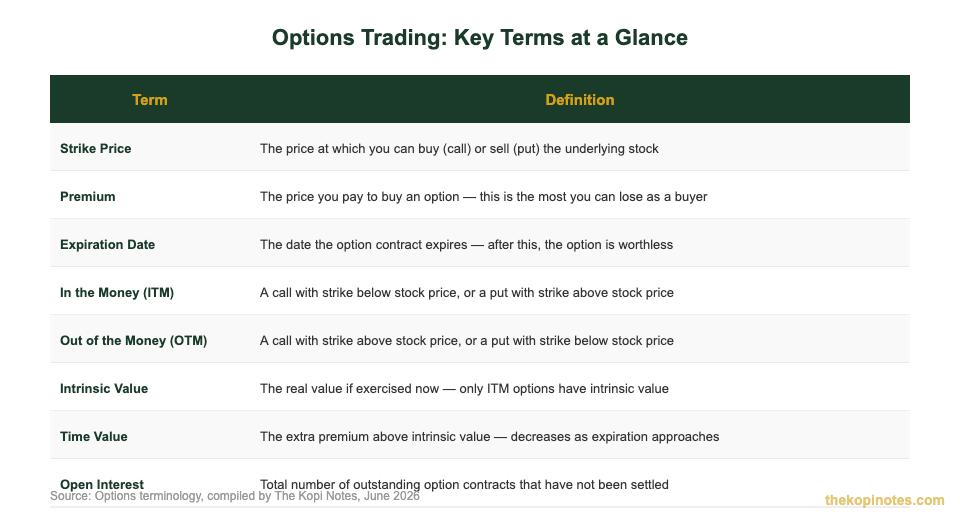
Before you place your first trade, you need to speak the language. Here are the essential terms every options trader must know.
| Term | Definition |
|---|---|
| Strike Price | The price at which you can buy (call) or sell (put) the underlying stock |
| Premium | The price you pay to buy an option — this is the most you can lose as a buyer |
| Expiration Date | The date the option contract expires — after this, the option is worthless |
| In the Money (ITM) | Call with strike below stock price, or put with strike above stock price |
| Out of the Money (OTM) | Call with strike above stock price, or put with strike below stock price |
| At the Money (ATM) | Option with strike price equal (or very close) to the current stock price |
| Exercise | Using your right to buy (call) or sell (put) at the strike price |
| Assignment | Being required to fulfill your obligation as an option seller |
| Open Interest | Total number of outstanding option contracts not yet settled |
| The Greeks | Risk metrics (Delta, Gamma, Theta, Vega) measuring option price sensitivity |
Source: Options terminology, compiled by The Kopi Notes, June 2026
Why Do People Trade Options?
Investors trade options for four main reasons. Each serves a different purpose in a portfolio.
1. Income generation. Selling covered calls on stocks you own generates regular premium income. If you own 100 shares of a stock trading at $50 and sell a $55 call for $1.50, you collect $150 immediately. If the stock stays below $55, you keep the premium and your shares. Many investors use this strategy to earn 1-3% per month on their holdings. Our covered call strategy guide walks through the mechanics step by step.
2. Hedging and protection. Buying put options on stocks or ETFs you own acts as insurance. If you hold a large portfolio and are worried about a market crash, buying puts on the S&P 500 (SPY) limits your downside to a known amount. The cost is the premium — but the peace of mind can be worth it.
3. Leverage. Options let you control 100 shares for a fraction of the cost. Buying one call option on a $100 stock might cost $500 (versus $10,000 to buy 100 shares). If the stock rises 10%, your shares gain $1,000 — but your option might gain $800 or more. The leverage amplifies both gains and losses.
4. Speculation with defined risk. Unlike short selling (where losses are theoretically unlimited), buying options caps your maximum loss at the premium paid. You can bet on a stock dropping by buying puts, and the worst case is losing your premium. This defined risk is what makes options attractive for directional bets.
Basic Options Strategies for Beginners
Do not jump straight into complex strategies. Start with these foundational approaches that have well-understood risk profiles.
Buying calls (long call) is the simplest bullish options trade. You buy a call option when you expect the stock to rise above the strike price plus premium before expiration. Your max loss is the premium paid. Your max profit is theoretically unlimited. The challenge is that most out-of-the-money options expire worthless — you need to be right about direction, magnitude, and timing.
Buying puts (long put) is the simplest bearish trade. You buy a put when you expect the stock to fall. It is also used as insurance on shares you already own (called a protective put). Your max loss is again just the premium.
Covered calls are the most popular income strategy and widely considered the safest options strategy for beginners. You sell a call option against 100 shares you already own. You collect the premium immediately. In exchange, you agree to sell your shares at the strike price if the stock rises above it. This is an excellent starting point for beginners because your risk is no different from owning the stock — but you earn extra income.
Cash-secured puts are the other side of the coin. You sell a put option on a stock you want to buy, and keep enough cash in your account to purchase the shares if assigned. If the stock stays above the strike, you keep the premium as pure profit. If the stock falls below the strike, you buy the shares at a price you were already comfortable with — minus the premium received. The wheel strategy combines cash-secured puts and covered calls into a repeating income cycle.
How to Get Started with Options Trading
Step 1: Open a brokerage account with options approval. Not every brokerage account automatically allows options trading. You need to apply for options approval, which typically involves answering questions about your experience, income, and risk tolerance. Brokers assign you an options level (1-4 or similar) that determines which strategies you can use. Interactive Brokers (IBKR) is one of the most popular platforms for options trading due to low commissions and powerful analytics tools.
Step 2: Learn to read the options chain. The options chain shows all available contracts for a given stock — organised by expiration date and strike price. It displays the bid price (what sellers will pay), ask price (what buyers will pay), volume, open interest, and the Greeks. Spend time studying the chain before placing your first trade.
Step 3: Paper trade first. Most brokers offer paper trading (simulated trading with fake money). Use it. Trade for at least 2-4 weeks on paper before risking real capital. Track your trades in a journal — record why you entered, your target, your stop loss, and the outcome.
Step 4: Start small and simple. Begin with one contract at a time. Use covered calls on stocks you already own, or buy a single call or put on a stock you have a strong opinion about. Do not start with complex multi-leg strategies like iron condors until you understand the basics inside out.
Step 5: Manage your risk. Never risk more than 2-5% of your portfolio on a single options trade. Set rules before you enter: at what point will you take profit? At what point will you cut your loss? Having a plan prevents emotional decisions.
Risks of Options Trading
Options are not free money. Every strategy has risks, and beginners need to understand them clearly before trading.
Time decay works against buyers. Every day that passes, your option loses a little bit of time value. If the stock does not move enough in your favour before expiration, you lose your entire premium even if the stock eventually moves the right way. Studies suggest that roughly 60-80% of options that are held to expiration expire worthless.
Leverage amplifies losses too. The same leverage that can double your money can also wipe out your entire investment in days. A 5% drop in a stock might mean a 50% loss on your option. Options can and do go to zero — and they do it fast.
Selling options carries larger risks. When you sell (write) options, your maximum loss can be much larger than the premium you collected. Naked call sellers face theoretically unlimited losses. Even covered call sellers can miss out on large gains. Cash-secured put sellers can be assigned shares during a market crash, immediately sitting on large unrealised losses.
Complexity and overtrading. Options have more variables than stocks — strike price, expiration, implied volatility, the Greeks. This complexity can lead to analysis paralysis or, worse, overtrading. Stick to a small number of well-understood strategies rather than trying to be clever.
The bottom line: start with the simplest strategies, use small position sizes, and never trade money you cannot afford to lose. Options are a powerful tool, but like any tool, they can cause damage if used incorrectly.
Not financial advice. Options trading involves significant risk and is not suitable for all investors. Consult a qualified financial advisor before trading options.
Frequently Asked Questions
What is options trading for beginners?
Options trading involves buying or selling contracts that give you the right to buy (call options) or sell (put options) a stock at a specific price before a specific date. As a beginner, you pay a premium for this right. If your prediction is correct, you profit. If not, you lose the premium — which is your maximum loss as a buyer. Beginners should start with simple strategies like covered calls or buying calls on stocks they understand well.
How much money do I need to start trading options?
You can start buying options with as little as a few hundred dollars — the cost of one contract premium. However, selling strategies require more capital. A cash-secured put on a $50 stock needs $5,000 in collateral. A covered call requires you to own 100 shares. Most brokers have no specific minimum for options, but you need to be approved for options trading based on your experience and financial situation.
Are options riskier than stocks?
It depends on the strategy. Buying options can lose 100% of the premium — and most out-of-the-money options expire worthless. Selling naked options carries very large risk. However, strategies like covered calls and cash-secured puts are actually considered lower risk than simply owning stocks, because the premium collected reduces your cost basis. Defined-risk strategies like spreads cap your maximum loss to a known amount.
What is the safest options strategy for beginners?
The covered call is widely considered the safest options strategy. You sell a call option against shares you already own, collecting premium income. Your downside risk is the same as owning the stock (it can fall), but the premium reduces your effective cost basis. Cash-secured puts are similarly conservative — you agree to buy a stock you want at a lower price and get paid to wait. Both are approved for retirement accounts at most brokers.
Can I lose more than I invest with options?
If you only buy options, your maximum loss is the premium paid — you cannot lose more than your initial investment. If you sell naked calls, your potential loss is theoretically unlimited because stock prices have no ceiling. Selling naked puts limits your loss to the strike price times 100 minus the premium (the stock can only go to zero). Defined-risk strategies like spreads and covered calls always have a known maximum loss before you enter the trade.
What are the Greeks in options trading?
The options Greeks are risk metrics. Delta measures how much the option price changes per $1 move in the stock. Gamma measures the rate of change of delta. Theta measures time decay — how much value the option loses each day. Vega measures sensitivity to implied volatility. Understanding the Greeks helps you choose the right strikes, manage position risk, and understand why your option is gaining or losing value.
What is the difference between American and European options?
American-style options can be exercised at any time before expiration. European-style options can only be exercised on the expiration date itself. Most stock options in the US are American-style. Most index options (like SPX) are European-style. For beginners trading stock options, the distinction rarely matters in practice because it is almost always more profitable to sell an option than to exercise it early.
Ready to Start Trading Options?
Open a brokerage account and start paper trading today. Use our guides to learn strategies step by step.
This article was researched with the help of AI. While we strive to keep all information accurate and up to date, there may be errors. If you notice any discrepancies, please contact us.