Early Critical Illness Insurance Singapore 2026: Complete Guide to ECI Plans, Coverage & Costs
Get paid at diagnosis — not just at the final stage.
Early critical illness insurance Singapore (ECI) pays out a lump sum when you are diagnosed at the early or intermediate stage of a covered illness — not just when the condition becomes life-threatening. Unlike standard CI plans that only trigger at the late stage, ECI covers 100+ conditions across three severity stages, giving Singapore residents cash for treatment costs, income replacement, and recovery expenses from the moment a diagnosis is made.
Not financial advice. All figures are for educational reference only. Data as at June 2026 unless noted.
- ECI pays at early, intermediate, AND late stage — standard CI only pays at late stage
- Annual premiums cost roughly 25–35% more than standard CI for the same sum assured
- Best for working adults aged 25–45 with dependants and a mortgage — income replacement matters most
Table of Contents
Contents — Click to expand
- What Is Early Critical Illness Insurance?
- ECI vs Standard CI: Key Differences
- How Multi-Stage Payouts Work
- Best Early CI Plans in Singapore 2026
- ECI Premium Comparison by Age
- How Much ECI Cover Do You Need?
- Who Should Buy Early CI Insurance?
- How to Buy ECI Insurance in Singapore
- Frequently Asked Questions
What Is Early Critical Illness Insurance?
Early critical illness insurance — commonly called ECI — is a life insurance product that pays you a lump sum when you are diagnosed with a covered condition at any severity level: early, intermediate, or late stage. Standard CI (critical illness) plans only pay when the illness reaches a defined severe or advanced stage, which often means you have already been through surgery, chemotherapy, or months of treatment before receiving any payout.
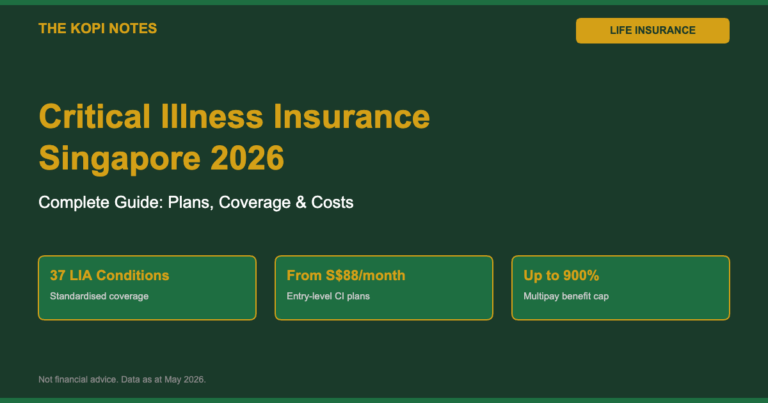
In Singapore, ECI plans are governed by the Life Insurance Association (LIA), which requires all CI and ECI plans to cover at least 37 severe-stage conditions. ECI plans go further — covering the same 37 conditions across all three severity stages, plus dozens of additional early-stage conditions such as carcinoma in situ, ductal carcinoma in situ (DCIS), early-stage thyroid cancer, and intermediate coronary artery disease.
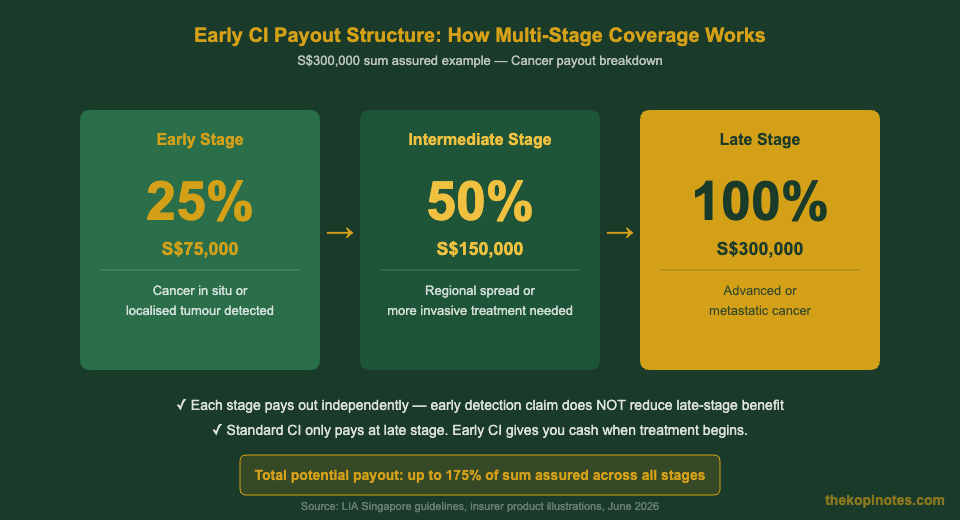
The payout structure typically works like this: if your plan has a S$300,000 sum assured and you are diagnosed with early-stage breast cancer (carcinoma in situ), you receive 25% of the sum assured — S$75,000 — immediately. You remain covered for the remainder of the policy. If the cancer progresses to an intermediate stage later, you receive another 50% payout. At the late stage, you receive the remaining balance up to 100% of the sum assured. Some plans pay out up to 175% to 300% cumulatively across all stages.
This is fundamentally different from standard CI, where S$300,000 pays out only once — and only at the late, severe stage. For most cancers and heart conditions, that means you receive nothing during the critical early treatment window.
ECI vs Standard CI: Key Differences
The core difference is when you get paid. Standard CI pays once, at the severe/late stage. ECI pays multiple times, starting at early diagnosis. Here is a full comparison:
| Feature | Standard CI | Early CI (ECI) |
|---|---|---|
| Payout trigger | Late/severe stage only | Early, intermediate & late stage |
| Number of conditions | 37 (LIA minimum) | 100+ across 3 stages |
| Payout timing | After severe diagnosis confirmed | From first diagnosis — even early stage |
| Number of claims | 1 (plan terminates) | Multiple (each stage independent) |
| Maximum payout | 100% of sum assured | Up to 175%–300% (varies by plan) |
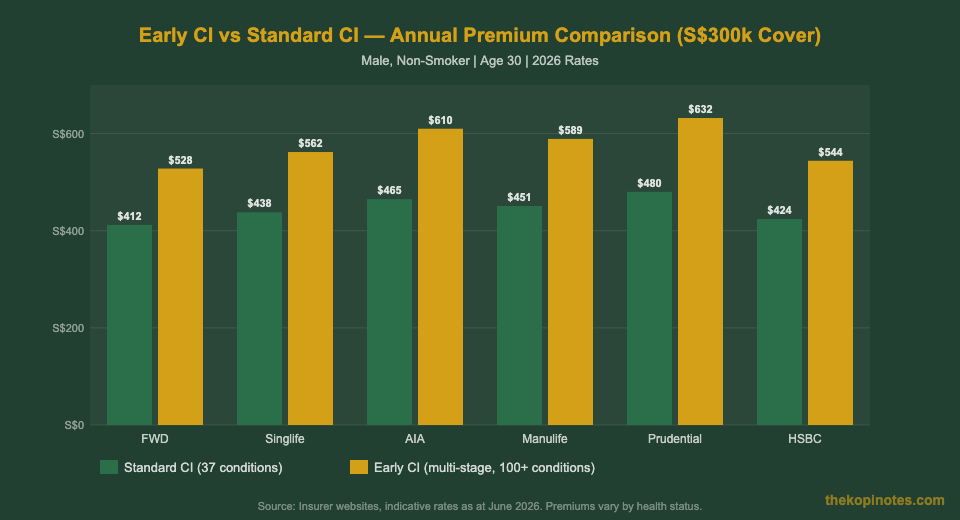
| Annual premium (S$300k, male 30) | ~S$412–S$480 | ~S$528–S$632 |
| Premium difference | — | +25% to +35% more than standard CI |
Source: Insurer websites (FWD, Singlife, AIA, Manulife, Prudential, HSBC Life), indicative rates, June 2026.
The extra premium is the key trade-off. For a 30-year-old male buying S$300,000 of coverage, ECI costs roughly S$100–S$150 more per year than standard CI — about S$8–S$12 per month. Most financial advisers argue this is worth it, because over 60% of CI claims in Singapore are now paid at the early or intermediate stage as screening technology improves and more conditions are caught earlier.
How Multi-Stage Payouts Work
Understanding the three severity stages is critical when comparing ECI plans. Each stage has a defined payout percentage, and the best plans allow you to claim at each stage independently — meaning an early-stage claim does not reduce your total entitlement at the later stages.
| Stage | Typical Payout | Example Condition | When You Receive It |
|---|---|---|---|
| Early | 25% of SA | Carcinoma in situ, early thyroid cancer | At diagnosis — before major surgery |
| Intermediate | 50% of SA | Localised invasive cancer, moderate stroke | After confirmed progression |
| Late / Severe | 100% of SA | Advanced cancer, major organ failure | After severe diagnosis confirmed |
Source: LIA Singapore, insurer product illustrations, June 2026. SA = Sum Assured. Exact definitions vary by insurer and plan.
For a Singapore resident with a S$300,000 ECI plan: if you are diagnosed with breast cancer in situ today, you receive S$75,000 immediately. You can use this to pay for surgery, take unpaid leave during recovery, or clear part of your mortgage while you recover. Your policy remains in force. If the cancer recurs or progresses years later, you have further coverage waiting.
With a standard CI plan, you receive nothing at the early stage. You wait — and bear all treatment costs out of pocket or from Medishield Life and your Integrated Shield Plan — until the condition becomes severe enough to trigger the CI payout definition.
Best Early CI Plans in Singapore 2026
There are six major insurers offering standalone or rider-based ECI plans in Singapore as at June 2026. Here is how they compare on the key criteria: number of conditions covered, maximum cumulative payout, survival period (time you must survive after diagnosis before claiming), and annual premium for a 35-year-old male non-smoker with S$300,000 sum assured.
| Insurer & Plan | Conditions | Max Payout | Survival Period | Annual Premium (M35, S$300k) |
|---|---|---|---|---|
| FWD Big 3 Protect+ | 106 conditions, 3 stages | 300% SA | 0 days (early stage) | ~S$672 |
| Singlife Critical Illness Protect | 100 conditions, 3 stages | 300% SA | 0 days (early stage) | ~S$698 |
| AIA Critical Cover Advance | 130+ conditions, 3 stages | 250% SA | 0 days (early stage) | ~S$756 |
| Manulife CI FlexiCare | 109 conditions, 3 stages | 300% SA | 14 days (early) | ~S$728 |
| Prudential PRUActive Crisis Cover | 136 conditions, 3 stages | 300% SA | 0 days (early) | ~S$796 |
| HSBC Life MultiCare | 110 conditions, 3 stages | 200% SA | 0 days (early) | ~S$668 |
Source: Insurer websites, indicative rates for male non-smoker age 35, S$300,000 sum assured, term to age 75, as at June 2026. Actual premiums depend on health status, smoking status, and plan options selected.
FWD and HSBC Life offer the most competitive premiums for a 35-year-old male. Prudential covers the most conditions (136) but at the highest premium. For most Singapore residents, the sweet spot is FWD or Singlife — broad coverage, 300% SA maximum payout, and zero survival period at the early stage.
If you prefer to buy with CPF Medisave or through a financial adviser, AIA and Prudential have wider distribution networks. FWD is direct-purchase online, making it faster and potentially cheaper due to lower distribution costs. You can also consider Endowus or Syfe referral code for managed insurance and investment bundles.
ECI Premium Comparison by Age
Premiums increase with age, particularly from age 40 onwards as cancer and cardiovascular risk rises. The table below shows indicative annual premiums for a S$300,000 ECI plan for a non-smoking Singapore resident across four age groups, using FWD Big 3 Protect+ as the reference product (one of the most competitively priced in 2026).
| Age at Entry | Male Annual Premium | Female Annual Premium | Monthly Cost (Male) |
|---|---|---|---|
| 25 | ~S$390 | ~S$432 | ~S$32.50 |
| 30 | ~S$528 | ~S$590 | ~S$44 |
| 35 | ~S$672 | ~S$742 | ~S$56 |
| 40 | ~S$920 | ~S$980 | ~S$76.67 |
Source: FWD Big 3 Protect+ indicative premiums, term to age 75, non-smoker, standard health status, June 2026. Female premiums are higher at younger ages due to higher breast and cervical cancer incidence rates.
You will notice female premiums are higher than male for ages 25–35. This reflects the higher statistical risk of early-stage breast cancer and cervical cancer at younger ages. From age 45 onwards, male premiums typically exceed female premiums as cardiovascular and prostate cancer risk increases.
The lesson: buy early. A 25-year-old pays S$390/year vs S$920/year at age 40 — that is a 136% increase in annual premium for the same coverage. Over 10 years, buying at 25 instead of 35 saves you roughly S$2,820 in cumulative premiums for identical protection.
How Much ECI Cover Do You Need?
The standard formula used by Singapore financial planners is: 3–5 years of annual income as your ECI sum assured. This covers income replacement during treatment and recovery, plus out-of-pocket medical costs not covered by Medishield Life or your Integrated Shield Plan (ISP).
Here is a worked example. You earn S$60,000 per year and have a S$500,000 mortgage. You receive an early-stage breast cancer diagnosis. Treatment involves lumpectomy surgery, 6 weeks of radiotherapy, and 12 months of hormone therapy. You take 4 months of no-pay leave during acute treatment.
- Income lost (4 months): S$20,000
- Out-of-pocket medical costs (co-payment, non-covered items): S$15,000–S$25,000
- Domestic help / caregiver costs during recovery: S$5,000–S$10,000
- Mortgage buffer (3 months): S$6,000–S$12,000
- Total gap: S$46,000–S$67,000
An ECI plan with S$200,000 sum assured paying 25% at early stage gives you S$50,000 — enough to close the entire gap. A plan paying 300% cumulative means you still have S$150,000 in future coverage if the condition progresses. This is why most financial planners recommend S$200,000–S$500,000 ECI cover, not the bare minimum.
For a deeper look at your total insurance coverage gap across all types of protection, try the insurance gap calculator Singapore — it estimates your critical illness, life, and disability income shortfall in one tool.
Who Should Buy Early CI Insurance?
ECI is ideal for you if:
- You are aged 25–45 and have dependants or a mortgage — early diagnosis is most likely in this window and the premium is still affordable
- You have a family history of cancer, heart disease, or stroke — early detection is more likely and financially more impactful
- You are self-employed or a sole breadwinner — no employer sick pay means you need income replacement from day one of diagnosis
- You want to future-proof against advances in medical screening — better early detection technology means more early-stage diagnoses over time
Consider standard CI instead if:
- Budget is very tight and you need maximum death + CI cover per dollar — standard CI gives higher death benefit for the same premium
- You already have substantial savings or a spouse’s income to cover early-stage costs
- You are over 55 — at this age, late-stage CI is statistically more common and the premium gap widens significantly
ECI pairs well with term life insurance for a complete protection portfolio. See our term life insurance Singapore 2026 guide for full coverage recommendations by income band, and our best critical illness insurance Singapore 2026 comparison for plans that combine ECI and standard CI in one policy.
How to Buy ECI Insurance in Singapore
There are two main routes: direct purchase online, or through a financial adviser (FA) or independent financial adviser (IFA). Here is a step-by-step guide to both.
Route 1: Buy Direct Online (Faster, No Commission)
- Use the insurance comparison tool — check our life insurance needs calculator to determine your required sum assured
- Go to insurer websites — FWD (fwd.com.sg), Singlife (singlife.com), and HSBC Life (hsbc.com.sg) offer online direct purchase with instant quotes
- Complete the health declaration — answer questions about pre-existing conditions, family history, and lifestyle honestly. Misrepresentation can void your claim
- Receive your policy document — typically within 3–5 business days. Review it carefully within the free-look period (14 days in Singapore) and return it if unsatisfied
Route 2: Through a Financial Adviser (More Personalised, Wider Product Access)
- Find an FA or IFA — the MAS Financial Adviser Register lists all licensed advisers in Singapore
- Get a needs analysis — a good FA will run a full gap analysis (life, CI, disability income, health) before recommending products
- Compare at least 3 quotes — the FA should present multiple insurers, not just their tied insurer’s products
- Review the Product Summary and Benefit Illustration — MAS requires all insurers to provide these. Read them before signing
Whether you buy direct or through an FA, always check: the full list of conditions covered at each stage, the waiting period and survival period definitions, and whether the policy is renewable/guaranteed renewable. For complementary long-term wealth building alongside your insurance, use the Singapore retirement calculator to see how combining ECI protection with regular ETF investing can secure your retirement income.
If you want managed investing alongside your insurance coverage, Endowus referral code 2V343 gives you access to CPF and SRS-eligible funds with no sales charge, while MariBank referral code 2DCT80WQ offers 2.7% p.a. on cash savings for your emergency fund.
Frequently Asked Questions
Is early critical illness insurance necessary in Singapore?
ECI is highly recommended for working adults aged 25–45 in Singapore, particularly those with dependants or a mortgage. Over 60% of CI claims in Singapore are now paid at the early or intermediate stage as medical screening improves, meaning standard CI — which only pays at the late stage — would leave you unprotected during the most common and financially disruptive phase of illness. ECI fills this gap at a cost of roughly S$32–S$77 per month for S$300,000 cover depending on your age.
What is the difference between early CI and critical illness insurance?
Standard CI insurance pays a lump sum only when you are diagnosed with a covered illness at the severe or late stage — typically when the condition is advanced or life-threatening. Early critical illness (ECI) insurance pays out across three severity stages: early, intermediate, and late. ECI covers 100+ conditions vs the LIA minimum of 37 for standard CI. The premium for ECI is roughly 25–35% higher than standard CI for the same sum assured, but you receive protection from the moment of first diagnosis rather than waiting for the condition to worsen.
Can I have both early CI and standard CI insurance?
Yes — many Singapore residents hold both a standard CI policy (often bought earlier or via employer benefits) and a separate ECI plan. Some insurers offer combination plans that include both early-stage and late-stage coverage within a single product, often structured as a multi-pay plan where each stage triggers an independent payout without reducing the overall sum assured. Check with your insurer or FA whether your existing CI plan has early-stage riders, and whether adding a standalone ECI plan would create any duplicate coverage or exclusion issues.
What conditions does early critical illness insurance cover in Singapore?
ECI plans in Singapore typically cover 100–136 conditions across three severity stages. Common early-stage conditions include: carcinoma in situ (early-stage cancer), ductal carcinoma in situ (DCIS — breast), early-stage thyroid cancer, angioplasty (early coronary artery disease treatment), early diabetic complications (retinopathy, nephropathy), mild stroke with no permanent neurological deficit, and early-stage Parkinson’s or Alzheimer’s disease. The exact list varies by insurer and plan. Always review the full policy document before purchasing — particularly the definitions of “early stage” for cancer and neurological conditions, which differ between insurers.
Is early critical illness insurance worth the extra cost?
For most working-age Singapore residents, yes. The additional premium is roughly S$100–S$200 per year compared to standard CI for the same sum assured. Over a 20-year policy, that is S$2,000–S$4,000 extra in total premiums. In return, you get protection from the moment of early diagnosis — when treatment costs, income loss, and caregiver costs are already substantial. Given that 1 in 4 Singaporeans develop cancer in their lifetime, and that most new cancer diagnoses in Singapore are now caught at stage 1 or 2 due to better screening, the probability of making an early-stage claim is meaningfully higher than making a late-stage CI claim.
Can I buy early CI insurance if I have pre-existing conditions?
It depends on the condition. Minor pre-existing conditions (resolved skin conditions, minor orthopaedic issues) may be covered with a loading or exclusion rider. More serious pre-existing conditions — prior cancer diagnosis, heart disease, or chronic conditions currently under treatment — will typically result in exclusion of the related conditions or, in severe cases, rejection of the application. You must declare all pre-existing conditions honestly on your health declaration. Non-disclosure is grounds for voiding your policy and rejecting any future claim. If you have pre-existing conditions, work with an IFA who can approach multiple insurers to find the best terms available for your specific health history.
Does Medisave cover early critical illness insurance premiums?
No — you cannot use CPF Medisave to pay premiums for a standalone early critical illness plan. Medisave can only be used for Medishield Life premiums and Integrated Shield Plan (ISP) premiums (up to the Medisave withdrawal limit). However, you can use your Supplementary Retirement Scheme (SRS) funds to pay for life insurance premiums, including CI and ECI riders that are part of a whole life or term life policy. Some ECI riders attached to whole life plans may also be payable via CPF OA under the CPF Investment Scheme (CPFIS), subject to eligibility. Check with your insurer or CPF Board for the latest rules.
What happens to my ECI policy if I make a claim?
It depends on the plan structure. Multi-pay ECI plans (most modern plans) continue in force after an early-stage or intermediate-stage claim, with the remaining sum assured intact for future claims. Single-pay plans (older or lower-cost plans) may terminate after the first claim — read the policy document carefully. After a late-stage severe CI claim, virtually all ECI plans terminate as the full sum assured has been paid. Some plans offer a premium waiver benefit — you stop paying premiums after the first ECI claim while coverage continues. This is a valuable feature to look for when comparing plans.
Check Your Insurance Coverage Gap
Use our free tools to calculate how much ECI, term life and disability income cover you need — then invest the rest for retirement.
Get Free Insurance Advice
Speak with a licensed insurance advisor. No obligation, no cost.
By submitting this form, you agree to our Privacy Policy.
This article was researched with the help of AI. While we strive to keep all information accurate and up to date, there may be errors. If you notice any discrepancies, please contact us.