Secured Credit Card Singapore: Complete Guide (2026)
Build your credit history from scratch — here’s how secured cards work, which banks offer them, and how to graduate to an unsecured card.
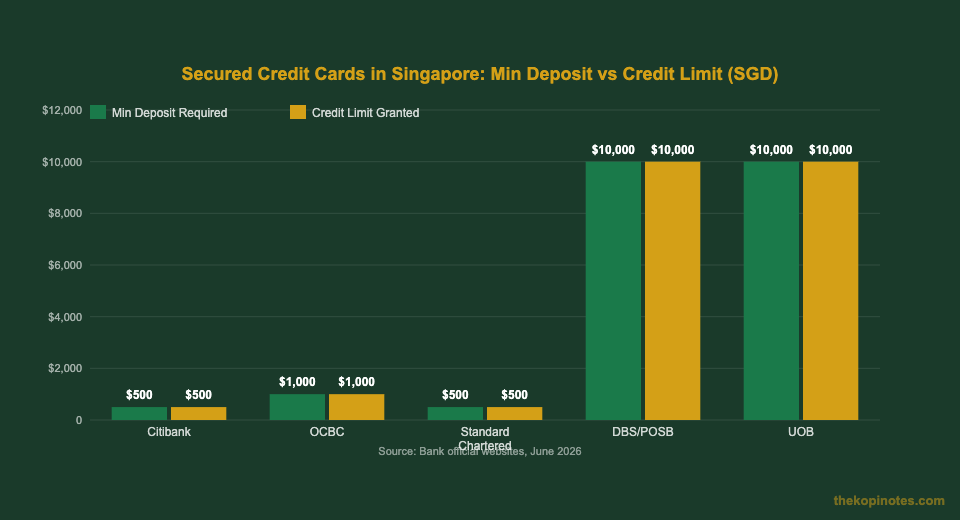
A secured credit card in Singapore requires you to place a fixed deposit as collateral — typically SGD 500 to SGD 10,000 — and your credit limit equals that deposit. Banks report your repayment behaviour to the Credit Bureau of Singapore, making secured cards the most reliable way to build a credit history if you are new to Singapore, a student, or recovering from a low credit score. Once your score improves, most banks let you upgrade to an unsecured card and refund your deposit.
Not financial advice. All figures are for educational reference only. Data as at June 2026 unless noted.
📋 Table of Contents
What Is a Secured Credit Card?
A secured credit card works like a regular credit card — you swipe it for purchases, receive a monthly statement, and pay your bill — but with one key difference: you must place a fixed deposit with the bank as collateral before the card is issued. This deposit reduces the bank’s risk and allows them to approve applicants who would otherwise be rejected for a standard unsecured credit card.
In Singapore, secured credit cards are most commonly offered under names like “secured card”, “credit secured card”, or simply tied to the bank’s fixed deposit product. The credit limit granted is usually equal to the fixed deposit amount, though some banks set it slightly lower (for example, 90% of the deposit).
Unlike a prepaid card or a debit card, a secured credit card reports to the Credit Bureau of Singapore (CBS). This means every on-time payment you make actively builds your credit score — which is exactly what makes secured cards valuable for credit building.
How Secured Cards Work in Singapore
Here is the step-by-step mechanics of a secured credit card in Singapore:
- Place a fixed deposit: You park a lump sum (e.g. SGD 500–SGD 10,000) with the bank as security. This deposit earns interest at the prevailing fixed deposit rate — typically 0.05% to 1% per annum in 2026.
- Receive a credit card: The bank issues you a Visa or Mastercard with a credit limit equal to (or slightly below) your deposit.
- Use the card normally: Pay for groceries, transport, and online purchases. The card works at any merchant that accepts Visa/Mastercard.
- Pay your bill on time: Each month, you receive a statement. Pay at least the minimum sum — ideally the full amount — to avoid interest charges (typically 26–28% per annum).
- Credit Bureau reports your behaviour: The bank reports your repayment history to CBS every month, building your credit score over time.
- Graduate after 12–24 months: Once your credit score is strong enough, apply to convert to an unsecured card. Your fixed deposit is refunded.
One important note: the fixed deposit itself is locked — you cannot withdraw it while the card is active. If you close the card, the bank releases the deposit (plus accrued interest) back to you, usually within 30–45 days.
Best Secured Credit Cards in Singapore (2026)
As of June 2026, these are the main secured credit card options available to Singapore residents:
1. Citibank Ready Credit — Best for Low Entry Deposit
Citibank’s secured offering requires just SGD 500 as a minimum fixed deposit — the lowest among major banks in Singapore. It comes with Citi’s full credit card infrastructure, including access to credit card promotions and cashback. Annual fee is SGD 192.60 but may be waived in the first year upon request. Particularly suitable for foreigners or PR holders building credit from scratch.
Credit limit: Equal to fixed deposit amount (min SGD 500)
Annual fee: SGD 192.60 (first year may be waived)
Cashback: Up to 8% on selected spending categories
Who it’s for: Foreigners, new PR holders, first-time credit card applicants
2. OCBC Frank Card (Secured) — Best for Young Adults
OCBC’s secured card is targeted at younger Singaporeans and students. It requires SGD 1,000 minimum fixed deposit and comes with lifestyle perks including cashback on food delivery, streaming, and transport. The OCBC Frank Card has a strong brand among millennials and the card design is customisable. Annual fee of SGD 80 is competitive.
Credit limit: Equal to fixed deposit (min SGD 1,000)
Annual fee: SGD 80
Cashback: Up to 6% on lifestyle spending
Who it’s for: Students, young adults under 30, first-timers
3. Standard Chartered Visa Card (Secured) — Best for No Annual Fee
Standard Chartered offers a secured card with no annual fee in the first year and a low SGD 500 minimum deposit. The SC secured card reports to CBS and allows you to upgrade to an unsecured card after demonstrating responsible use. Good entry-level option for those watching costs closely.
Credit limit: Equal to fixed deposit (min SGD 500)
Annual fee: SGD 0 first year, SGD 192.60 thereafter
Cashback: Up to 5%
Who it’s for: Cost-conscious applicants, those who plan to upgrade within 12 months
4. DBS/POSB Visa Debit + Fixed Deposit
DBS does not offer a traditional “secured credit card” but provides a credit facility backed by a fixed deposit for higher-balance customers. The minimum is significantly higher at SGD 10,000, making this option less accessible for entry-level applicants. However, DBS has an extensive Singapore branch and ATM network and the card integrates fully with DBS banking services.
Minimum deposit: SGD 10,000
Annual fee: SGD 0 (waived with DBS accounts)
Who it’s for: Customers who already bank with DBS and have higher liquidity
5. UOB One Card (Secured) — Best for Cashback on Everyday Spend
UOB’s secured card offering is linked to their popular One Card and requires SGD 10,000 minimum. The reward structure is strong for everyday spending including petrol, groceries, and dining. At the higher deposit threshold, you’re tying up more capital but gaining access to one of Singapore’s best-structured cashback cards.
Minimum deposit: SGD 10,000
Annual fee: SGD 192.60 (waivable)
Cashback: Up to 5% on UOB’s qualifying categories
Who it’s for: Higher-income individuals wanting credit building with premium rewards
Deposit Requirements Compared
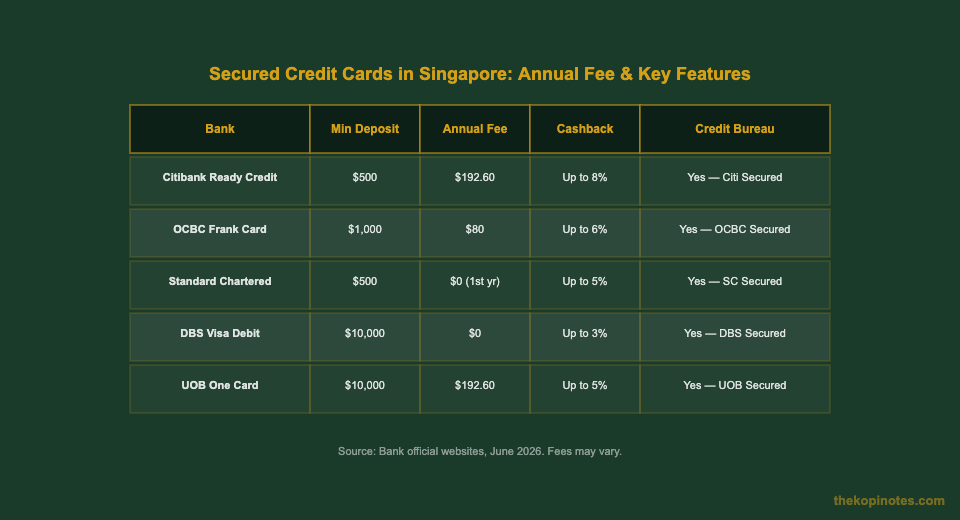
Here is a side-by-side comparison of secured credit cards in Singapore, showing minimum deposit, annual fee, and key features:
| Bank / Card | Min Deposit | Annual Fee | Cashback | CBS Reporting |
|---|---|---|---|---|
| Citibank Ready Credit | SGD 500 | SGD 192.60 | Up to 8% | ✓ Yes |
| OCBC Frank Card | SGD 1,000 | SGD 80 | Up to 6% | ✓ Yes |
| Standard Chartered | SGD 500 | SGD 0 (1st yr) | Up to 5% | ✓ Yes |
| DBS/POSB | SGD 10,000 | SGD 0 | Up to 3% | ✓ Yes |
| UOB One Card | SGD 10,000 | SGD 192.60 | Up to 5% | ✓ Yes |
Source: Bank official websites, June 2026. Fees and terms subject to change — verify directly with the bank before applying.
Who Should Apply for a Secured Credit Card in Singapore?
Secured cards are not for everyone — but they are the right tool for specific situations. You should consider a secured credit card if you are:
- A new permanent resident or Employment Pass holder — Banks require at least 12 months of credit history for unsecured cards. A secured card lets you start building that history immediately.
- A student aged 18–21 — MAS regulations require proof of income for unsecured credit cards. Students with no income can use a secured card backed by savings or parental support.
- Someone with a low or damaged credit score — If you’ve had late payments, defaults, or a thin credit file, a secured card lets you rebuild responsibly.
- A foreigner on a short-term visa — Some banks approve secured cards for foreigners on visit passes or short-term employment passes who are unable to qualify for regular cards.
- A retiree or self-employed individual — Those without formal payslips sometimes struggle to prove income. A secured card removes that requirement entirely.
You should not choose a secured card if you qualify for a standard unsecured credit card — because tying up SGD 500–SGD 10,000 in a fixed deposit at low interest rates is a real opportunity cost. If you’re eligible, an unsecured card with no deposit is almost always better financially.
For context: Singapore investors looking to maximise returns on idle cash might consider options like Singapore Savings Bonds or Singapore T-bills instead of locking funds in a low-yield fixed deposit for a secured card — unless credit building is the primary goal.
How to Apply for a Secured Credit Card in Singapore
The application process varies slightly between banks, but the general steps are:
- Choose your bank: Select based on minimum deposit you can afford, annual fee, and rewards structure. For most people starting out, Citibank (SGD 500 minimum) or Standard Chartered (SGD 500, no first-year fee) are easiest entry points.
- Prepare documents: You will need your NRIC or passport, proof of address (utility bill, bank statement), and a minimum fixed deposit ready. Foreigners may need a copy of their work pass or employment letter.
- Open a fixed deposit account: Visit the bank branch or apply online. Transfer the required minimum amount into the fixed deposit. Note: this deposit is locked until you close the card.
- Submit the secured card application: Some banks process this simultaneously with the fixed deposit opening. Others require a separate application form. Processing takes 3–7 working days.
- Receive and activate your card: Your physical card arrives by post within 5–10 working days. Activate it via the bank’s mobile app or hotline.
- Set up GIRO for minimum payment: To avoid accidentally missing payments (which would damage your credit score), set up GIRO for at least the minimum monthly payment immediately.
Pro tip: Use the card for small, regular purchases like transport or groceries — then pay the full balance every month. This demonstrates responsible usage without incurring any interest charges.
Required Documents Summary
| Applicant Type | Required Documents |
|---|---|
| Singapore Citizen / PR | NRIC (front & back), proof of address, fixed deposit funds |
| Employment Pass Holder | Passport, EP card, proof of Singapore address, employment letter |
| S Pass / Work Permit | Passport, pass card, employer letter, proof of address |
| Student | NRIC or passport, student matriculation card, proof of address |
Source: Bank official websites, June 2026. Requirements may vary — confirm with the bank directly.
How to Graduate from a Secured to an Unsecured Credit Card
The secured card is a stepping stone, not a permanent destination. Here’s how to make the most of it and graduate as quickly as possible:
Build Your Credit Score: The 12-Month Plan
- Months 1–3: Use the card for small, predictable purchases (e.g. transport top-up, one streaming subscription). Pay the full balance by the due date every month without exception.
- Months 4–6: Increase spending slightly across 2–3 categories. Maintain 100% on-time payment record. Avoid applying for other credit products during this period.
- Months 7–9: Check your CBS credit score (costs SGD 6.42 online via creditbureau.com.sg). Aim for a score of BB or higher (scale goes from HH to AA).
- Months 10–12: Once your score reaches at least BB, contact your bank to request an upgrade to an unsecured card. Some banks offer this proactively.
Tips to Accelerate Credit Building
- Keep your credit utilisation below 30% — if your limit is SGD 500, don’t carry more than SGD 150 on the card at any time.
- Never miss a payment. A single late payment can set your credit building back significantly.
- Don’t apply for multiple credit products simultaneously — each hard inquiry lowers your score temporarily.
- Consider joining MariBank with referral code 2DCT80WQ for a high-yield savings account running alongside your credit-building journey — earn up to 2.88% p.a. on your savings while your deposit is locked in the secured card.
Once you’ve upgraded, your fixed deposit is released — typically within 30–45 calendar days. You can redirect those funds into a higher-yielding product. Singapore investors have good options: Endowus for CPF and cash investing, or Syfe for automated portfolio management. Use our Singapore retirement calculator to see how redirecting that capital affects your long-term goals.
Alternatives to Secured Credit Cards in Singapore
If a secured card doesn’t fit your situation, here are the main alternatives for building credit or managing spending in Singapore:
Digital Bank Debit Cards
Singapore’s digital banks — GXS Bank, MariBank, and Trust Bank — offer debit cards that are easy to open with no income requirement. However, debit cards do not build your credit score because they are not reported to CBS. They are useful for day-to-day spending management but not for credit building.
- GXS Bank — open with referral code YONG477 for a bonus. Integrated with Grab ecosystem.
- MariBank — open with referral code 2DCT80WQ. Integrated with Shopee/Sea ecosystem, competitive savings rate.
- Trust Bank — open with referral code HTWYQP95. Integrated with FairPrice and NTUC ecosystem. Good for everyday grocery spending.
Supplementary Card on a Family Member’s Account
If you have a family member (parent, spouse) with an existing unsecured credit card, you can be added as a supplementary cardholder. The primary cardholder’s card activity may partially reflect on your CBS report, though the extent depends on the bank’s reporting practices. This is not a guaranteed path to a high credit score but provides some benefit.
BNPL Services (Atome, Grab PayLater)
Buy-now-pay-later services are popular in Singapore but generally do not report to CBS. They are useful for managing cash flow on specific purchases but do not contribute to your credit history.
Which Should You Choose?
For pure credit building, a secured credit card is the most direct and reliable path in Singapore. If you want to avoid tying up capital, a supplementary card is the next best option. Digital bank accounts and BNPL services serve different purposes and should not be considered credit-building tools.
Once you have a credit score, consider diversifying your financial tools. Our guide to passive income in Singapore covers how to make your money work harder once your financial foundation is in place.
Frequently Asked Questions
What is the minimum deposit for a secured credit card in Singapore?
Does a secured credit card in Singapore build credit?
Can foreigners get a secured credit card in Singapore?
How long does it take to graduate from a secured to unsecured card?
What happens to my fixed deposit when I close the secured card?
Is a secured credit card better than a debit card for credit building?
Which secured credit card has the lowest annual fee in Singapore?
Disclaimer: This article is for educational purposes only and does not constitute financial advice. Credit card terms, fees, and deposit requirements change frequently — always verify the latest information directly with the bank before applying. The Kopi Notes may earn referral fees when readers sign up using our codes, at no extra cost to you.
This article was researched with the help of AI. While we strive to keep all information accurate and up to date, there may be errors. If you notice any discrepancies, please contact us.