
Singapore Insurance Gap Report 2026: Millennials Face a $500K+ Protection Shortfall
A data-driven analysis of Singapore’s insurance protection gap, backed by LIA Singapore, Swiss Re, MOM, MOH, and CPF Board data.
Singapore’s insurance protection gap is still alarmingly wide in 2026. You might think spending over US$6,000 a year on life insurance is enough. But the LIA Protection Gap Study 2022 says otherwise. It reveals a S$373 billion mortality gap and a S$579 billion critical illness gap among working residents. For a typical 35-year-old earning the median income of S$5,775 per month, the combined shortfall can exceed S$723,000. That’s a gap that could leave your family severely exposed.
TL;DR — Key Takeaways
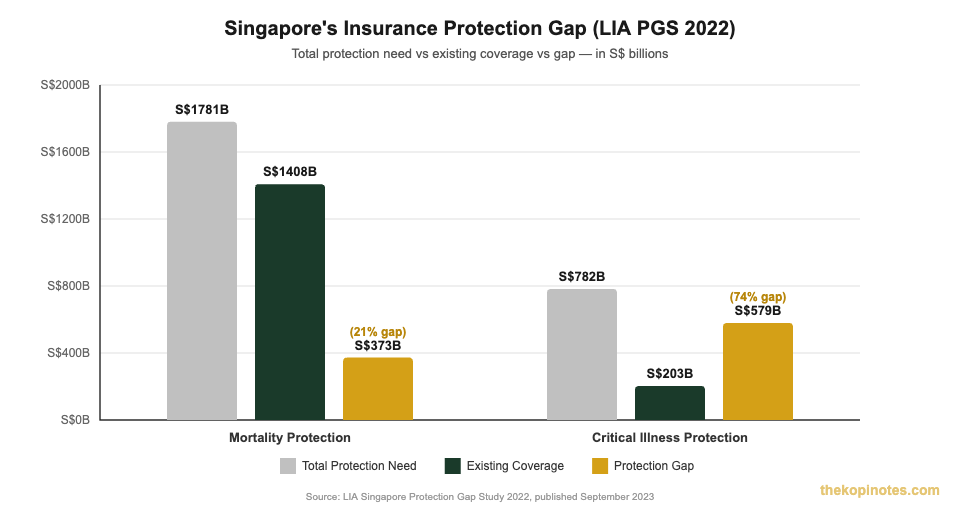
• S$373 billion — that’s how much life insurance coverage is missing across all working Singaporeans. The critical illness gap is even worse at S$579 billion (74% unmet).
• A typical millennial household is ~S$930,000 short per Swiss Re estimates — enough to cover mortgage, kids’ education, and living expenses.
• The April 2026 ISP rider reforms mean you now face up to S$9,500/year in out-of-pocket hospital costs — triple what it used to be.
This report is for general information and educational purposes only. It does not constitute financial or insurance advice. All figures are sourced from public data as at June 2026 unless noted. This report has not been reviewed by the Monetary Authority of Singapore (MAS). The Kopi Notes is not a licensed financial adviser or insurance intermediary under the Financial Advisers Act or Insurance Act of Singapore.
Table of Contents
Executive Summary
Singapore ranks among the most insurance-penetrated markets in the world. Per-capita life insurance spending exceeds US$6,000 a year. Yet most working Singaporeans are still significantly underinsured.
This report looks at the gap between what you have in coverage — and what your dependents would actually need if you died, got critically ill, or became disabled.
The findings matter especially in 2026. The Ministry of Health’s Integrated Shield Plan (ISP) rider reforms kicked in on 1 April 2026. They bring higher out-of-pocket costs that widen the protection shortfall for many policyholders. If you’re not familiar with how ISPs work, our Integrated Shield Plan Singapore guide breaks it all down.
Key Numbers at a Glance
S$373B total mortality gap • S$579B total CI gap (74% unmet) • ~S$930K gap per household • 86% of workers underestimate their needs • ~S$723K combined gap for a typical millennial
| Key Metric | Figure | Source |
|---|---|---|
| Total mortality protection gap | S$373 billion | LIA PGS 2022 |
| Total CI protection gap | S$579 billion | LIA PGS 2022 |
| CI needs unmet | 74% | LIA PGS 2022 |
| Mortality gap per household | ~S$930,000 | Swiss Re 2022 equiv. |
| Underestimate their needs | 86% of workers | LIA PGS 2022 survey |
| Modelled millennial gap (mortality + CI) | ~S$723,000 | TKN calculator model |
Source: LIA Singapore Protection Gap Study 2022 (published September 2023), Swiss Re Institute 2024, MOM 2025
The Protection Gap Explained
So what exactly is a protection gap? In simple terms, it’s the difference between what your family would need to get by without you — and what they’d actually receive from your insurance, savings, and government schemes.
Here’s a concrete example. Say you earn S$5,775 a month (the 2025 median gross monthly income per MOM data) and have two dependents. Over a 20-year period, your family’s total financial need could easily top S$1 million. Your existing life insurance, CPF, and savings may cover only a fraction of that. Our Singapore retirement calculator can help you model what your household actually needs.
According to the LIA Singapore Protection Gap Study 2022, the total mortality protection need for all economically active residents stood at S$1,781 billion. After accounting for existing coverage and savings, the gap was S$373 billion — a 21% shortfall.
However, a 21% gap at the national level hides a much uglier picture for individuals. The LIA’s consumer survey of 775 respondents found that 86% of working Singaporeans set target coverage levels below what’s actually needed. In other words, most people don’t even know how big their gap is.
Key Findings
Finding 1: The Mortality Protection Gap for 30–40 Year Olds
The LIA recommends you carry life insurance worth about 10 times your annual income. For a 35-year-old earning the 2025 median of S$5,775 a month, that works out to roughly S$693,000 in coverage.
But here’s the reality. The LIA PGS 2022 found that the average policyholder carries only about S$331,200 in mortality coverage — roughly 3.6 times their annual income. That’s a massive gap.
~S$930,000 per household
That’s the estimated mortality gap per Singapore household according to Swiss Re — factoring in mortgage, kids’ education, and living expenses.
Swiss Re’s analysis paints an even starker picture. They estimate the mortality protection gap at approximately US$645,000 per household (around S$930,000 in 2022 equivalent). This factors in mortgage obligations, children’s education costs, and dependents’ living expenses.
Using our Insurance Gap Calculator, a modelled scenario for a 35-year-old with one child, one dependent parent, and typical existing coverage of S$300,000 in life insurance plus CPF savings would face an estimated mortality shortfall of approximately S$500,000–$700,000. The exact figure depends on your remaining mortgage and desired coverage duration.
Finding 2: Critical Illness Coverage Shortfall
The critical illness gap is even worse. The LIA PGS 2022 found that Singapore’s total CI protection gap was S$579 billion. That means 74% of total CI protection needs remain unmet.
74% of CI needs unmet
Nearly three-quarters of critical illness protection needs in Singapore are not covered. Most people rely on employer group insurance that pays only 1–2x salary — and stops when you leave.
The LIA recommends CI coverage of about 3.5 to 4 times your annual income. For a median-income earner (S$5,775/month gross), that’s S$242,550 to S$277,200 in recommended coverage.
In practice, most people carry far less. Many rely only on employer group insurance. That typically provides CI coverage of just 1–2 times your salary — and it disappears when you leave the company.
For example, a 30-year-old single adult with two dependent parents could face a CI gap of approximately S$1.2 million using the LIA’s own calculator. Even after accounting for existing coverage, most millennials in their 30s are short S$150,000–$250,000 for CI alone.
Finding 3: MOH ISP Rider Reforms Widen the Health Protection Gap
From 1 April 2026, MOH introduced new rules for Integrated Shield Plan (ISP) riders. These changes significantly increase your out-of-pocket healthcare costs. For a deeper look at MediShield Life premiums and how they interact with ISP riders, see our full breakdown.
| Change | Before April 2026 | From April 2026 |
|---|---|---|
| Deductible coverage by riders | Riders could cover the full deductible (S$1,500–$3,500) | Riders cannot cover the minimum IP deductible |
| Annual co-payment cap | Minimum S$3,000/year | Minimum S$6,000/year |
| Co-payment rate | Minimum 5% | No change — minimum 5% |
| Estimated rider premium impact | — | ~30% lower for new riders |
Source: Ministry of Health ISP Rider Framework, November 2025
The bottom line? If you have a private hospital plan, you now face potential out-of-pocket costs of up to S$9,500 per policy year (S$3,500 deductible + S$6,000 co-payment cap). Previously, that figure could be as low as S$3,000.
MediShield Life provides a safety net with an annual claim limit of S$200,000 and no lifetime cap. However, it was designed for subsidised ward treatment. If you use a private hospital, you’ll face pro-rated coverage and much higher out-of-pocket costs.
For families without adequate emergency savings, these changes create a real new gap in health protection. This is especially true for major hospitalisations where bills routinely exceed S$50,000.
Finding 4: Disability Income — The Forgotten Gap
Mortality and critical illness get most of the attention. But disability income protection is arguably the most overlooked area of insurance in Singapore.
CareShield Life (compulsory for Singaporeans born in 1980 or later) provides a basic payout starting at S$600/month for severe disability. It goes up by 2% a year until your first claim. However, CareShield Life is designed for long-term care needs — not to replace your income.
Here’s why that matters. If you earn S$5,775/month and a disability stops you from working, you’d face an immediate income shortfall. Private disability income insurance can replace 50–75% of your pre-disability income, but very few Singaporeans have it. Building passive income streams can also help fill this gap.
The gap is particularly acute for self-employed individuals, gig workers, and platform workers. The LIA PGS 2022 identified this group as having a mortality protection gap of S$32 billion (59% of their protection needs).
Modelled Scenario: A Typical Singapore Millennial
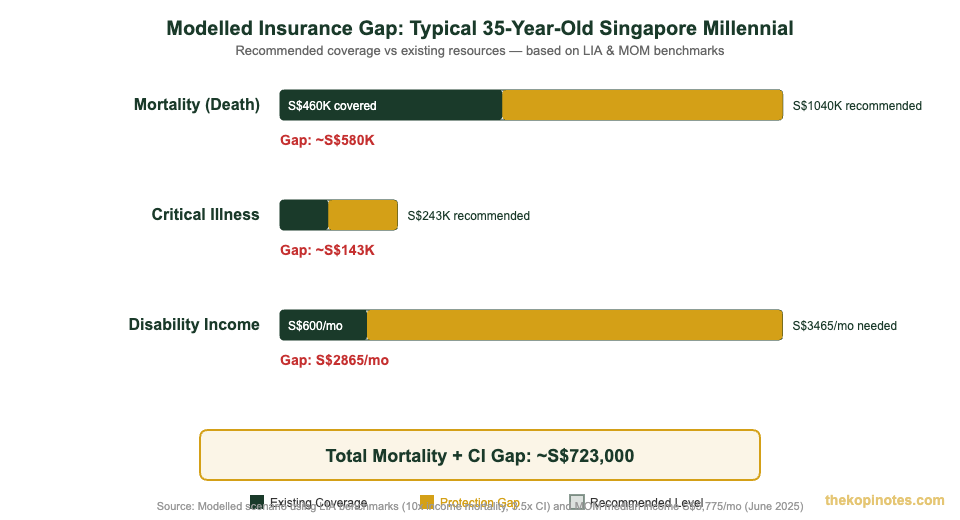
Numbers at the national level are hard to feel. So let’s make it personal. We modelled a scenario using our Insurance Gap Calculator methodology. This is not survey data — it’s a calculated example based on public benchmarks.
| Profile | Details |
|---|---|
| Age | 35 years old |
| Monthly gross income | S$5,775 (2025 median, MOM data) |
| Dependents | 1 child (age 3), 1 elderly parent |
| Outstanding HDB mortgage | S$350,000 |
| Existing life insurance | S$300,000 (group + personal) |
| Existing CI coverage | S$100,000 |
| CPF savings (OA + SA) | S$120,000 |
| Cash savings | S$40,000 |
Source: Profile based on MOM median income (June 2025), CPF Board contribution data, and HDB average resale data
Calculated Protection Gaps
| Coverage Type | Recommended | Existing Resources | Estimated Gap |
|---|---|---|---|
| Mortality (death benefit) | ~S$1,040,000 (10× annual income + mortgage + child education) |
~S$460,000 (Insurance + CPF + cash) |
~S$580,000 |
| Critical illness | ~S$243,000 (3.5× annual income) |
S$100,000 | ~S$143,000 |
| Disability income (monthly) | ~S$3,465/month (60% of income) |
~S$600/month (CareShield Life only) |
~S$2,865/month |
| Health (annual OOP risk) | Adequate ISP coverage | ISP with new-format rider | Up to S$9,500/year OOP |
Source: Modelled scenario using LIA benchmarks (10× income for mortality, 3.5× for CI), MOM median income S$5,775/mo (June 2025), MOH ISP framework (April 2026)
Total estimated gap: ~S$723,000
That’s the combined mortality + CI protection shortfall for this modelled millennial profile. Your actual gap could be higher or lower depending on your specific situation.
Note: This is a modelled scenario based on LIA, MOM, and CPF benchmarks. Your circumstances will differ. Use our free Insurance Gap Calculator to check your own gap — it takes 2 minutes with no sign-up required.
What You Can Do
Knowing you have a gap is the first step. Here are three things you can do today.
1. Check where you stand. Use our free Insurance Gap Calculator to get a personalised estimate of your mortality, CI, and disability income gaps. It uses the same LIA benchmarks from this report. No data is stored and no sign-up is needed.
2. Review your ISP rider. The April 2026 ISP rider reforms are now in effect. Check whether your current rider covers the new minimum deductible and co-payment requirements. If you’re on an older rider, your insurer should have notified you of changes — review them carefully. For context, see our Integrated Shield Plan guide.
3. Talk to a qualified financial adviser. This report shows gaps at the population level. Your individual needs depend on your dependents, debts, and risk tolerance. A licensed adviser can help you build a tailored protection plan. Meanwhile, building savings through instruments like Singapore Savings Bonds can complement your insurance coverage.
Methodology & Data Sources
This report pulls together publicly available data from official Singapore government sources and industry research. We don’t claim any proprietary consumer data or original survey results.
Data Sources
LIA Singapore Protection Gap Study 2022 — Published September 2023 by the Life Insurance Association of Singapore. Conducted independently by Ernst & Young Advisory Pte Ltd. It covers mortality and critical illness protection gaps for economically active Singaporeans and PRs aged 20–69 with at least one dependent. Includes a supplementary consumer survey of 775 respondents.
Swiss Re Institute — Closing Asia’s Mortality Protection Gap (2020, updated 2024) — Estimates mortality protection gaps across Asian markets using household-level modelling. Singapore-specific estimate: US$600 billion (2019 data). Asia-wide MPG: estimated at US$132 billion in premium equivalent terms (2024).
Ministry of Manpower (MOM) — Gross Monthly Income Tables 2025 — Median gross monthly income from employment for full-time employed residents: S$5,775 (June 2025).
Department of Statistics Singapore — Key Household Income Trends 2025 — Median monthly household market income: S$12,446 (2025). Median monthly household income per member: S$4,160 (2025).
Ministry of Health (MOH) — ISP Rider Framework (November 2025) — New requirements for ISP riders effective 1 April 2026. Minimum deductibles can no longer be covered by riders. Co-payment cap raised to S$6,000/year.
CPF Board — MediShield Life coverage (2025) — Annual claim limit of S$200,000 with no lifetime limit. Deductible of S$2,000 per policy year. Co-insurance of 3–10%.
LIA Singapore recommended coverage benchmarks — 10× annual income for mortality protection. 3.5–4× annual income for critical illness protection.
Calculator Methodology
The modelled scenario uses our Insurance Gap Calculator’s methodology. It calculates protection needs based on income replacement (adjusted for inflation and investment returns over the dependency period), outstanding liabilities, children’s education funding, and dependents’ living expenses. It then subtracts existing insurance coverage, CPF savings, and liquid assets. The calculator does not collect or store personal data.
Important Disclaimer
This report is published by The Kopi Notes (thekopinotes.com) for general information and educational purposes only. It does not constitute financial advice, insurance advice, or a recommendation to purchase any financial product.
The information here is based on publicly available data from the sources listed above. While we’ve done our best to ensure accuracy, The Kopi Notes does not warrant the completeness or timeliness of the information. Data from third parties (LIA Singapore, Swiss Re, MOM, MOH, CPF Board, Department of Statistics Singapore) is reproduced in good faith. We encourage you to verify figures against the original publications.
The modelled scenario is an illustrative calculation based on stated assumptions and published benchmarks. It does not represent any actual individual’s financial situation. Your insurance needs depend on your personal circumstances, financial obligations, risk tolerance, and other factors. Please consult a qualified financial adviser before making any insurance or financial planning decisions.
The Kopi Notes is not a licensed financial adviser, insurance broker, or intermediary under the Financial Advisers Act (Cap. 110) or the Insurance Act (Cap. 142) of Singapore. This report has not been reviewed by the Monetary Authority of Singapore (MAS).
© 2026 The Kopi Notes. All rights reserved.
Frequently Asked Questions
What is the insurance protection gap in Singapore?
It’s the difference between the total coverage you need to protect your dependents — and the coverage you actually have through insurance, CPF, and savings. According to the LIA Protection Gap Study 2022, the total mortality gap is S$373 billion and the critical illness gap is S$579 billion for all working residents.
How much life insurance does a typical Singaporean need?
The LIA recommends about 10 times your annual income. For example, if you earn the 2025 median of S$5,775 a month, that’s roughly S$693,000 in life insurance. However, the average policyholder currently has only about S$331,200 — around 3.6 times their annual income. That leaves a big gap for most people.
What changed with ISP riders in April 2026?
From 1 April 2026, ISP riders can no longer cover the minimum IP deductible (S$1,500–S$3,500). The minimum annual co-payment cap also went up from S$3,000 to S$6,000 per year. So if you have a private hospital plan, your potential out-of-pocket costs can now reach S$9,500 per year — up from as little as S$3,000 before.
Why is the critical illness gap worse than the mortality gap?
Because 74% of total CI needs remain unmet, compared to 21% for mortality. The main reason? Most people rely on employer group CI coverage, which usually pays only 1–2 times your salary. That’s far below the LIA’s recommended 3.5–4 times. And here’s the catch — employer coverage disappears when you leave your job.
How can I check my own insurance gap?
Use our free Insurance Gap Calculator at thekopinotes.com/tools/insurance-gap-calculator-singapore/. It gives you a personalised estimate of your mortality, CI, and disability income gaps based on LIA benchmarks. It takes about 2 minutes, requires no sign-up, and doesn’t store any personal data.
Does CareShield Life cover my disability income needs?
Not really. CareShield Life pays S$600/month for severe disability. But it’s designed for long-term care, not income replacement. If you earn S$5,775/month (the median), CareShield Life covers only about 10% of the income you’d lose. Private disability income insurance can replace 50–75% of your pre-disability income — but few people in Singapore have it.
Is the S$723,000 gap figure based on actual survey data?
No. It’s a modelled scenario, not survey data. We calculated it using a hypothetical 35-year-old earning S$5,775/month with one child and one elderly parent. The calculation uses LIA benchmarks (10× income for mortality, 3.5× for CI) and subtracts typical existing coverage. Your actual gap will depend on your personal circumstances.
Check Your Own Insurance Gap
Our free Insurance Gap Calculator takes 2 minutes. No sign-up required. No data stored. Just an honest look at where you stand.