Best Critical Illness Insurance Singapore 2026: Top Plans Compared
The best critical illness insurance in Singapore for most people in 2026 is FWD Big 3 CI for budget-conscious buyers (from ~S$198/yr at 35), Manulife ManuProtect CI for comprehensive multi-pay coverage, and AIA Power Critical Care for early-stage illness protection. The right plan depends on your age, income, existing coverage, and whether you want a single-pay or multi-pay CI policy. This guide compares 6 top plans across premiums, conditions covered, and key features so you can choose confidently.
Not financial advice. All figures are for educational reference only. Data as at June 2026 unless noted.
What Is Critical Illness Insurance?
Critical illness (CI) insurance pays out a lump sum when you are diagnosed with one of the covered conditions — typically cancer, heart attack, and stroke, which together account for over 90% of CI claims in Singapore. Unlike hospitalisation insurance (MediShield Life), CI insurance is not tied to your medical bills. You receive the full sum assured regardless of actual treatment costs, giving you cash to cover lost income, rehabilitation, alternative treatments, or home modifications.
In Singapore, the Life Insurance Association (LIA) standardises 37 critical illness definitions so that all compliant insurers use the same diagnostic criteria. This means a “heart attack” claim means exactly the same thing at FWD, AIA, or Prudential — no hidden definitional loopholes.
CI insurance complements your hospitalisation plan (Integrated Shield Plan) and your disability income insurance. Together, these three form the core protection layer every Singapore working adult should have.
Best Critical Illness Insurance Plans in Singapore 2026
After reviewing six leading CI plans on premiums, conditions covered, multi-pay options, and insurer financial strength, here are our picks for 2026:
| Plan | Insurer | Best For | Conditions Covered | Multi-Pay? |
|---|---|---|---|---|
| FWD Big 3 CI | FWD Singapore | Budget-conscious, basic cover | 3 (Cancer/Heart/Stroke) | No (single pay) |
| Singlife CI Elite | Singlife | Affordable 37-condition cover | 37 LIA conditions | No |
| HSBC Life CI | HSBC Life | Competitive mid-range premiums | 37 LIA + 5 juvenile | No |
| Manulife ManuProtect CI | Manulife | Multi-pay, recurring CI claims | 37 LIA conditions | Yes (up to 5×) |
| AIA Power Critical Care | AIA | Early CI + comprehensive stages | 100+ conditions incl. early stage | Yes (multi-stage) |
| Prudential PRUActive Crisis Cover | Prudential | Whole life CI with savings element | 37 LIA + 9 special | Optional rider |
Source: Insurer product brochures, MoneySmart, June 2026. Premiums vary by age, gender, smoking status and sum assured.
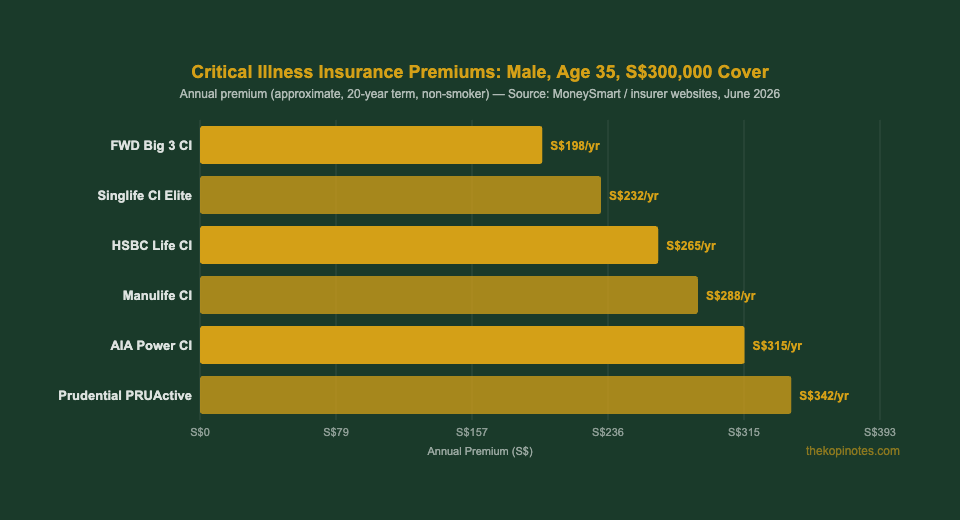
Critical Illness Insurance Premium Comparison Table 2026
Premiums below are approximate annual figures for a non-smoking male at three key ages, with S$300,000 sum assured and a 20-year term policy. Female premiums are typically 10–20% lower for CI plans.
| Plan | Age 30 | Age 35 | Age 40 | Age 45 |
|---|---|---|---|---|
| FWD Big 3 CI | S$148 | S$198 | S$285 | S$430 |
| Singlife CI Elite | S$175 | S$232 | S$340 | S$510 |
| HSBC Life CI | S$198 | S$265 | S$385 | S$570 |
| Manulife ManuProtect CI | S$215 | S$288 | S$420 | S$640 |
| AIA Power Critical Care | S$235 | S$315 | S$460 | S$695 |
| Prudential PRUActive Crisis Cover | S$255 | S$342 | S$498 | S$755 |
Source: MoneySmart CI comparison tool, insurer websites, June 2026. Non-smoking male, S$300,000 sum assured, 20-year term. Indicative only — get a formal quote for your exact situation.
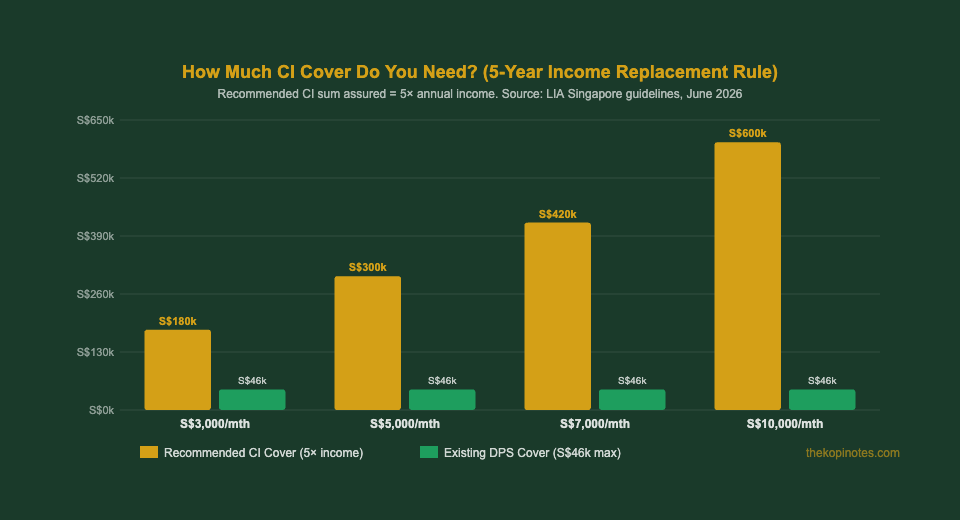
For context: a 35-year-old earning S$5,000/month should ideally hold S$300,000 in CI cover (equivalent to 5 years’ income). The cheapest option — FWD Big 3 CI — costs less than a weekly hawker meal at S$3.81 per week.
How Much Critical Illness Cover Do You Need?
The LIA Singapore recommends holding critical illness coverage equal to 3.9× your annual income, though many financial advisers use the more conservative 5× rule to account for full income replacement during a 2–3 year recovery period plus ancillary costs. Here is a practical framework:
| Monthly Income | LIA Recommended (3.9×) | Conservative (5×) | DPS Gap (DPS = S$46k) |
|---|---|---|---|
| S$3,000/mth | S$140,400 | S$180,000 | S$134,000 |
| S$5,000/mth | S$234,000 | S$300,000 | S$254,000 |
| S$7,000/mth | S$327,600 | S$420,000 | S$374,000 |
| S$10,000/mth | S$468,000 | S$600,000 | S$554,000 |
Source: LIA Singapore Protection Gap Study 2022; DPS coverage S$46,000 max. Figures rounded.
The “DPS Gap” column shows how much additional CI coverage you need beyond the Dependants’ Protection Scheme — which only covers death and TPD, not critical illness. Most Singaporeans are significantly underinsured on CI. Use our Insurance Gap Calculator to find your personal coverage gap.
CI vs Early CI (ECI) Insurance: What’s the Difference?
Standard CI insurance only pays out at the severe or end-stage of a condition. Early CI (ECI) insurance also pays on early and intermediate stages — for example, early-stage prostate cancer (Stage 1–2) or a minor heart attack that does not meet the full LIA “heart attack of specified severity” definition.
| Feature | Standard CI | Early CI (ECI) |
|---|---|---|
| Conditions Covered | 37 (late stage) | 100+ (early, intermediate, late) |
| Payout Trigger | Severe/end-stage diagnosis | Early, intermediate, or severe stage |
| Typical Payout (% of SA) | 100% | 25–100% depending on stage |
| Premium vs Standard CI | Baseline | ~20–40% higher |
| Best For | Budget-focused; core protection | Comprehensive protection; family history of cancer |
Source: LIA Singapore, insurer product documentation, June 2026.
If you have a family history of cancer or heart disease — and medical advances mean early detection is increasingly common — ECI insurance is worth the premium uplift. The complete CI insurance guide walks through exactly how ECI payouts work at each disease stage.
Who Should Buy Critical Illness Insurance?
CI insurance makes sense for virtually every working Singapore adult — but certain profiles need it most urgently:
- Primary breadwinners — a CI diagnosis means months or years off work. Your household’s financial survival should not hinge on whether you can physically work.
- Self-employed / freelancers — no employer sick leave. CI insurance replaces the income safety net you do not have.
- People with family history of cancer, heart disease, or stroke — your risk profile is elevated. Start young before premiums rise or exclusions are added.
- Those relying on CPF for retirement — a CI event often forces early CPF drawdowns, derailing retirement plans. A lump-sum CI payout protects your CPF nest egg.
- Young adults aged 25–35 — premiums are at their lowest. A 30-year-old pays roughly 55% less than a 45-year-old for the same coverage.
CI insurance is less suitable for those with very significant liquid assets (net worth above S$5M), who can self-insure through savings, or retirees with no income to replace.
To plan your overall insurance and retirement strategy, try our retirement planning calculator or explore the CPF investment strategy guide to see how CI cover fits into your broader financial plan.
How to Buy Critical Illness Insurance in Singapore: 6 Steps
Follow this step-by-step process to buy the right CI plan without overpaying or getting the wrong coverage:
- Calculate your coverage gap — use the 5× income rule and subtract any existing CI coverage from employer group insurance or riders. Our Insurance Gap Calculator does this instantly.
- Decide: standard CI or early CI? — if budget is tight, start with a standard 37-condition plan and add an ECI rider later. If you have family history of early-onset cancer, go ECI from day one.
- Choose: term or whole life? — term CI is cheaper and covers your working years (to age 65–70); whole life CI provides lifelong coverage with cash value accumulation but costs 4–6× more annually.
- Compare quotes — use MoneySmart or CompareFirst (a MAS-authorised portal) to compare premiums across all licensed insurers side-by-side.
- Check for Medisave usage — some CI plans (particularly those attached to whole life policies) allow Medisave withdrawals of up to S$600/year under the Medisave-approved Integrated Shield Plan framework. Confirm with your insurer.
- Apply and disclose health history accurately — non-disclosure is the single biggest cause of CI claim rejections in Singapore. Disclose all pre-existing conditions upfront, even if you think they are minor.
If you want a robo-advisor to invest alongside your insurance, consider using Endowus (referral code 2V343) for CPF and cash portfolios, or Syfe (referral code SRPRFFFCD) for flexible goal-based investing alongside your CI cover.
Start Building Your Protection Today
CI insurance protects your income. Combine it with smart investing to build wealth — even while paying premiums.
Frequently Asked Questions
What is the best critical illness insurance in Singapore 2026?
How many critical illnesses does Singapore insurance cover?
Can I use Medisave for critical illness insurance in Singapore?
How much does critical illness insurance cost in Singapore?
What is the difference between CI and early CI insurance?
Does CI insurance pay out for all 37 LIA conditions?
How much CI insurance cover do I need?
Is critical illness insurance tax deductible in Singapore?
Can I buy CI insurance if I have a pre-existing condition?
Should I buy CI insurance or invest the money instead?
Get Free Insurance Advice
Speak with a licensed insurance advisor. No obligation, no cost.
By submitting this form, you agree to our Privacy Policy.
This article was researched with the help of AI. While we strive to keep all information accurate and up to date, there may be errors. If you notice any discrepancies, please contact us.